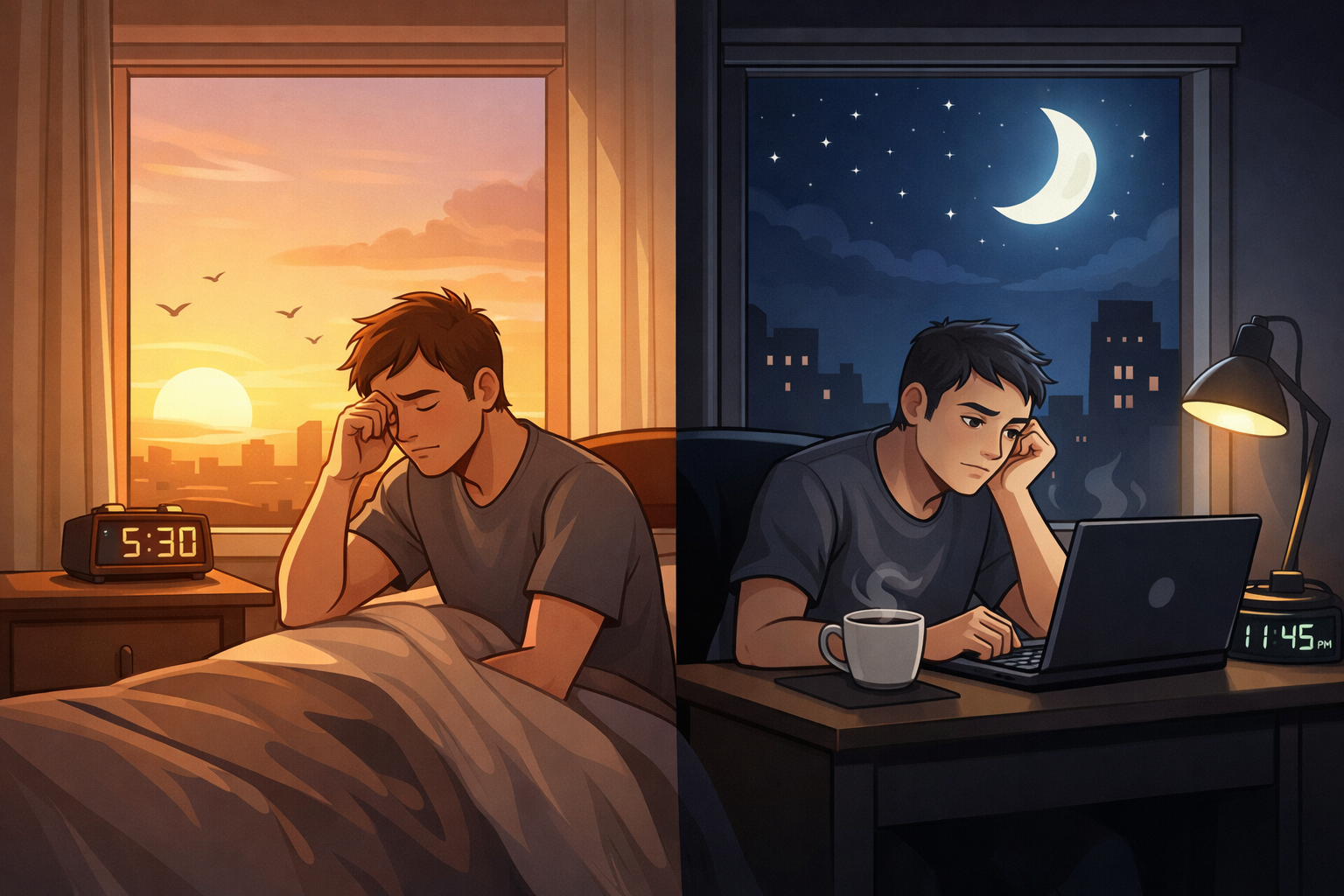
Why your natural sleep timing may be working against your daily energy and mental clarity
Most people struggle with low energy, poor focus, and inconsistent sleep without realizing that the problem is not discipline or lifestyle. Waking up early may feel unnaturally difficult, while mental clarity appears later in the day—often when obligations are already ending.
When this happens consistently, the instinct is to push harder, drink more coffee, or force earlier bedtimes. Yet for many people, these strategies fail because they are fighting their chronotype rather than working with it.
Understanding chronotype helps explain why effort alone does not always lead to better energy, focus, or sleep quality.
What a Chronotype Really Is
A chronotype describes your body’s natural timing for sleep, wakefulness, and peak cognitive performance. It reflects when your brain is biologically prepared to be alert, focused, and mentally efficient, and when it naturally shifts toward rest.
Chronotype is closely linked to the circadian rhythm, the internal timing system that regulates alertness, hormone release, sleep pressure, and brain performance across the day. While the circadian rhythm defines the overall 24-hour structure, chronotype determines how your body fits within that structure.
Importantly, chronotype is not a habit you chose or a routine you developed. It is largely biological, shaped by genetics and internal brain timing mechanisms rather than motivation or lifestyle.
Chronotype Is Not a Preference
A common misconception is that chronotype is simply a preference that can be trained away. In reality, chronotype tends to remain relatively stable across adulthood, even when schedules change.
You can force yourself to wake early for years and still feel misaligned. You can adopt late-night habits and still struggle with evening focus. Preferences may adapt, but biological timing resists rapid change.
This is why some people feel persistently tired or unfocused despite maintaining consistent sleep schedules and “doing everything right.”
The Biology Behind Different Chronotypes
Chronotype differences arise from how the brain’s internal clock responds to light and darkness.
Later chronotypes experience delayed melatonin release, meaning alertness remains elevated later into the evening and rises more slowly in the morning. Earlier chronotypes show the opposite pattern, with earlier sleep pressure and faster morning activation.
Neither pattern is abnormal. Human populations naturally include a range of chronotypes, each representing a valid expression of circadian biology.
What Happens When You Fight Your Chronotype
When daily schedules consistently oppose biological timing, the brain operates under chronic strain.
Sleep often becomes less restorative, even if duration appears sufficient. Morning grogginess intensifies, focus requires more effort, and emotional regulation becomes more difficult. Over time, this misalignment can lead to persistent fatigue, brain fog, and reduced cognitive performance.
Crucially, these effects can occur even in people who believe they are sleeping enough. The issue is not always how long you sleep, but when your brain is being asked to perform.
Why Willpower Doesn’t Fix Chronotype Mismatch
Many people respond to chronotype conflict with discipline: stricter alarms, more caffeine, tighter routines.
While these approaches can temporarily override biological signals, they come at a cost. The brain must expend additional cognitive resources to function outside its optimal timing window, reducing efficiency and increasing perceived fatigue.
Biological timing systems do not respond to motivation alone. They adapt slowly to consistent timing cues, not determination. This is why forcing productivity against chronotype often feels exhausting rather than empowering.
Can You Change Your Chronotype?
Chronotype is not entirely fixed, but it is not easily rewritten.
Research suggests a strong genetic component, meaning that while environmental factors such as light exposure and routines can shift timing slightly, the underlying preference usually remains stable.
Most people can adjust their chronotype within limits, but attempts to force large changes often result in ongoing misalignment rather than lasting adaptation. Understanding this limitation reframes the goal from changing yourself to working more intelligently with your biology.
Working With Your Chronotype Instead of Against It
The first step toward alignment is awareness. Observing when your energy, focus, and mental clarity naturally rise and fall provides valuable insight into your internal timing.
Rather than forcing immediate change, recognizing these patterns allows for gradual adjustments that reduce friction instead of increasing pressure. Even small shifts toward biological alignment can significantly improve how effortful daily tasks feel.
Energy is not something you create through willpower. It emerges when timing and biology work together.
The Core Idea to Remember
Feeling out of sync is often interpreted as a personal failure. In reality, it is frequently a biological timing issue.
Chronotype shapes when your brain is ready to perform, recover, and rest. Fighting it repeatedly drains energy, while understanding it creates clarity.
Recognizing your chronotype does not solve every sleep or energy problem, but it provides a critical framework for understanding why effort alone is not always enough—and that understanding is a powerful starting point.