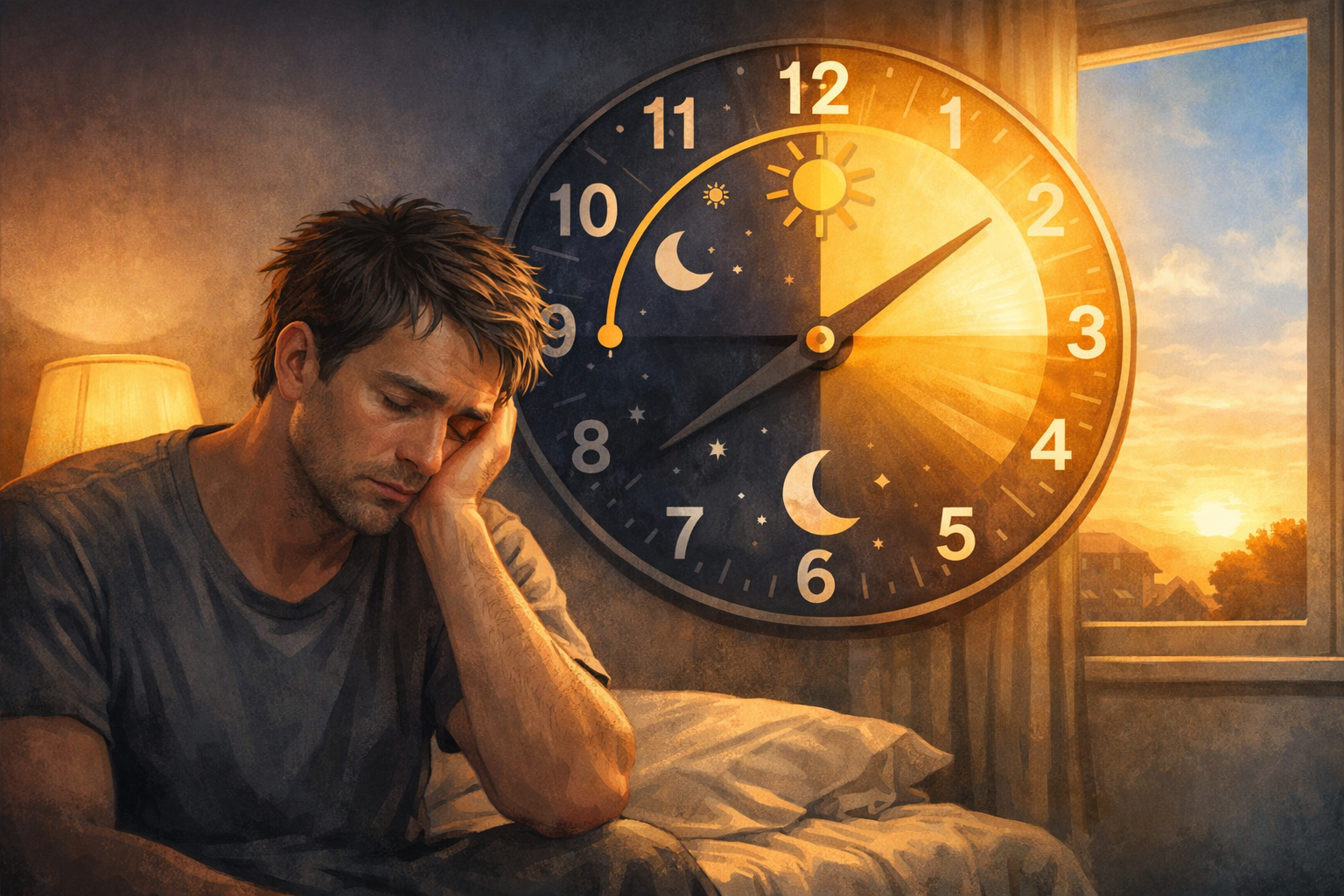
Most people assume their daily energy depends on how motivated they feel, how busy their schedule is, or how many hours they slept the night before. When energy drops, the instinctive solution is simple: sleep more, push harder, drink more coffee.
But energy is not random — and it’s not controlled by willpower.
Behind every moment of mental clarity or exhaustion, there is a biological system quietly working in the background: the circadian rhythm.
This internal clock doesn’t just decide when you feel sleepy. It regulates alertness, focus, reaction time, mood, and how efficiently your brain functions throughout the day. Understanding how it works is the first step to understanding why you feel energized at some times — and completely drained at others.
What the circadian rhythm really is
The circadian rhythm is a roughly 24-hour biological cycle that exists in every human being. It evolved to synchronize your body with the natural light–dark cycle of the planet.
At its core, it’s a timing system. It tells your body when to be alert, when to rest, when to release certain hormones, and when to conserve energy. While a central “clock” in the brain helps coordinate this rhythm, the system is much broader. Cells throughout your body follow circadian signals, meaning your entire physiology runs on time.
This is why the circadian rhythm affects far more than sleep alone. It influences digestion, body temperature, cognitive performance, and emotional regulation. Sleep is just one visible output of a deeper timing mechanism.
How your internal clock controls energy and focus
Your energy levels follow a predictable biological curve each day. You are not designed to feel equally alert at all hours.
During certain windows, your brain is biologically primed for focus, learning, and decision-making. At other times, mental fog, slower reaction time, and fatigue are normal — even if you slept “enough.”
This explains why energy crashes often happen at similar times each day, such as the early afternoon. It also explains why forcing productivity outside your natural rhythm often feels harder than it should.
When your circadian rhythm is aligned, energy feels effortless. When it’s misaligned, everything requires more effort — even simple mental tasks.
Why sleep duration alone doesn’t guarantee energy
One of the most common misconceptions about sleep is that more hours automatically mean more energy. In reality, timing matters just as much as duration.
You can sleep eight hours and still wake up exhausted if those hours occurred at the wrong biological time. Sleeping out of sync with your circadian rhythm disrupts the natural progression of sleep stages and reduces the restorative value of rest.
This is why some people feel better after six well-timed hours than after nine poorly timed ones. Energy is not just about quantity — it’s about biological alignment.
What happens when the circadian rhythm is disrupted
When your internal clock is consistently misaligned, the effects accumulate. At first, the symptoms may seem subtle: difficulty concentrating, low motivation, or feeling “off” during the day.
Over time, disruption can lead to persistent brain fog, unrefreshing sleep, emotional instability, and a sense of constant fatigue that doesn’t resolve with rest. Importantly, these effects often appear even in people who believe they are sleeping enough.
The problem isn’t always sleep itself — it’s timing.
Why modern life pushes the body out of sync
The circadian rhythm evolved under conditions very different from modern life. Natural light exposure during the day and darkness at night were once reliable signals for the brain.
Today, artificial lighting, screens, irregular schedules, and constant stimulation blur those signals. Evening light delays the internal clock, while inconsistent sleep times prevent it from stabilizing.
The result is a body that never fully knows when to be alert and when to rest. Energy becomes unpredictable, and fatigue becomes chronic.
Understanding energy through biology, not discipline
One of the most important shifts in perspective is realizing that low energy is not always a personal failure. It’s often a biological signal.
The circadian rhythm doesn’t respond to motivation or discipline. It responds to timing cues. When those cues are consistent and aligned, energy follows naturally. When they are chaotic, effort alone can’t compensate.
Understanding this changes how you interpret tiredness. Instead of asking, “Why am I so unmotivated?” the better question becomes, “What is my body being timed to do right now?”
The key idea to remember
The circadian rhythm is invisible, but it’s powerful. It shapes how your brain feels long before you consciously notice it.
Energy is not something you force — it’s something that emerges when biology and timing work together. Once you understand that your internal clock controls energy more than sleep duration or willpower, many daily struggles suddenly make sense.
Learning how this clock works is the foundation for understanding sleep quality, mental clarity, and long-term well-being.