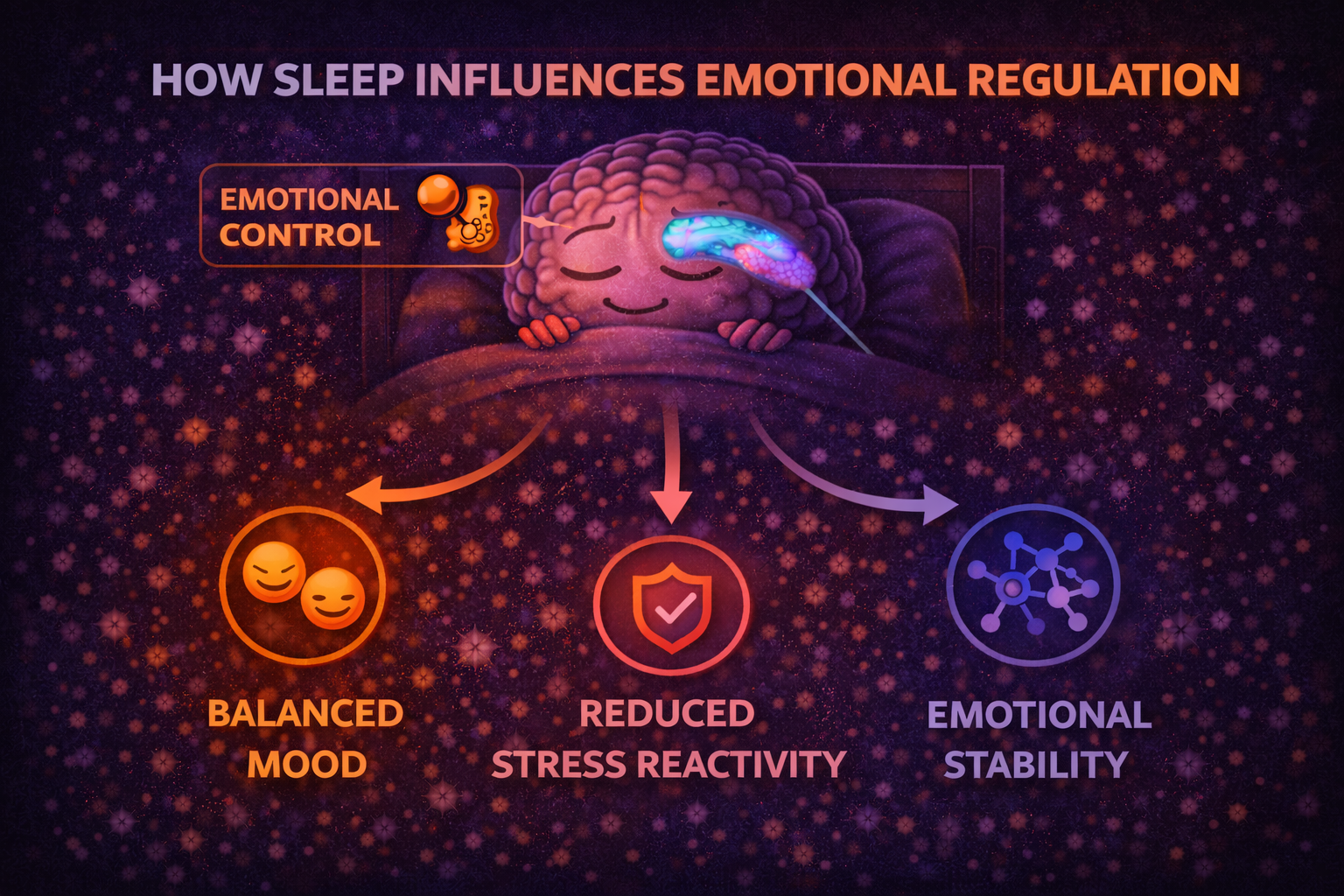
Why sleep determines how well the brain manages emotions and stress responses
Emotional regulation is often framed as a skill — something that improves with awareness, effort, or practice. When emotions feel overwhelming or difficult to control, people tend to assume they need better coping strategies.
But emotional regulation is not only psychological. It is deeply biological. The brain’s ability to manage emotions depends heavily on sleep. When sleep is disrupted, emotional regulation weakens. When sleep is consistent and restorative, emotional balance becomes far easier to maintain.
Emotional Regulation Is a Brain Function
Regulating emotions requires coordination.
Some brain systems generate emotional responses, while others evaluate context, apply restraint, and reduce intensity. Emotional regulation depends on smooth communication between these systems.
Sleep is the primary period when this coordination is restored. Without it, emotional responses become stronger and harder to modulate.
How Sleep Resets Emotional Control Systems
During sleep, emotional control systems recalibrate.
Neural sensitivity decreases, stress signaling lowers, and regulatory circuits regain efficiency. This reset allows emotions to arise without overwhelming the system.
Poor sleep leaves these control systems partially depleted, reducing emotional flexibility the next day.
The Role of Deep Sleep in Regulation Stability
Deep sleep supports baseline emotional stability.
During slow-wave sleep, the brain reduces background noise and restores core regulatory networks. This creates a stable emotional baseline during waking hours.
When deep sleep is reduced, emotional reactions become more volatile and less predictable.
REM Sleep and Emotional Processing
REM sleep plays a central role in emotional regulation.
During REM, emotional experiences are processed in a low-stress neurochemical environment. This allows emotions to be integrated without retaining excessive emotional charge.
Disrupted REM sleep leaves emotional experiences unresolved, increasing reactivity and emotional intensity.
Why Poor Sleep Increases Emotional Reactivity
Sleep deprivation amplifies emotional responses.
Negative stimuli provoke stronger reactions, while positive experiences feel less rewarding. Emotional responses feel immediate and difficult to pause.
This heightened reactivity reflects reduced regulatory capacity, not increased emotional sensitivity by choice.
Sleep Loss and Reduced Emotional Insight
Poor sleep impairs emotional awareness.
The brain becomes less accurate at identifying internal emotional states and interpreting others’ emotions. This reduces empathy and increases misunderstandings.
As a result, social interactions feel more emotionally draining.
Why Emotions Feel Harder to Control When Tired
Emotional control requires cognitive resources.
Sleep restores the neural energy needed to pause, evaluate, and respond intentionally. Without sleep, emotions bypass regulation and feel automatic.
This explains why emotional reactions are often regretted after poor sleep.
Cumulative Effects of Chronic Sleep Disruption
Emotional dysregulation compounds over time.
Repeated nights of poor sleep weaken regulation, lower stress tolerance, and increase emotional fatigue. Over time, emotional instability becomes the baseline state.
These changes are often misattributed to personality or mental health alone.
Circadian Alignment and Emotional Balance
Emotional regulation follows circadian timing.
When sleep timing aligns with biological rhythms, emotional control is more consistent. Irregular schedules disrupt this timing, increasing emotional variability.
Timing influences regulation as much as sleep duration.
Why Emotional Regulation Improves After Good Sleep
After high-quality sleep, emotional regulation feels natural.
Reactions are more proportional, recovery is faster, and emotional clarity returns. This reflects restored regulation rather than changes in circumstances.
Sleep prepares the brain to regulate emotions before the day begins.
Why Effort Alone Cannot Replace Sleep
Trying harder does not restore regulation.
Emotional regulation requires biological recovery. Without sleep, effort increases strain without improving control.
Sleep supports emotional regulation at its foundation.
The Core Idea to Remember
Sleep influences emotional regulation because it restores the brain’s ability to manage emotions.
Through deep sleep and REM sleep, emotional control systems reset, reactivity decreases, and balance returns. Without sleep, emotional regulation weakens regardless of intention.
Emotional regulation is not forced — it is supported overnight by sleep.