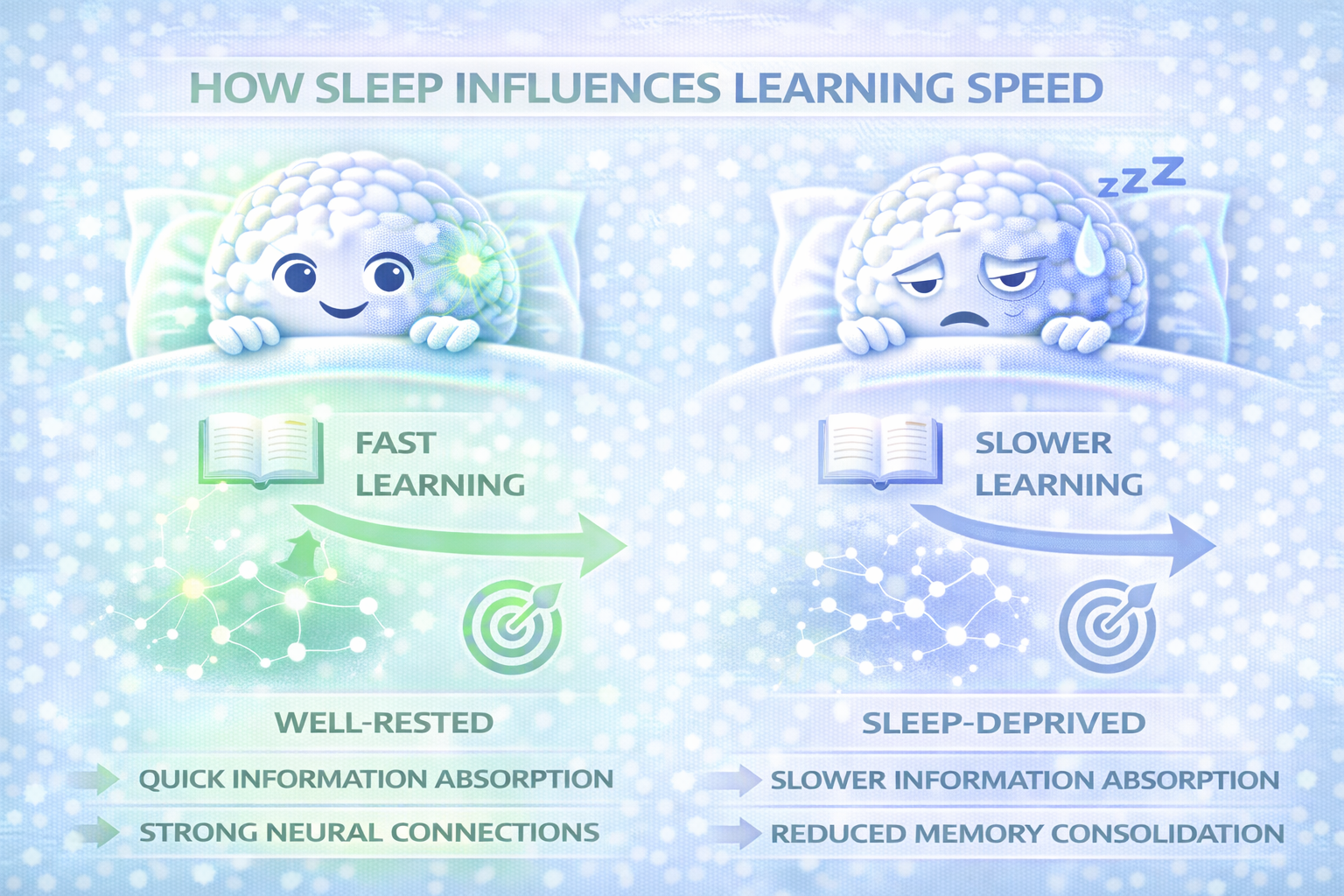
Why the brain learns faster when sleep supports memory and neural efficiency
Learning speed is often attributed to intelligence, talent, or effort. When learning feels slow, the instinct is to practice more, concentrate harder, or push through fatigue.
In reality, how quickly you learn depends heavily on sleep. Sleep determines how efficiently the brain absorbs new information, integrates it with existing knowledge, and prepares itself to learn again the next day. Without proper sleep, learning slows — not because ability disappears, but because the brain’s learning systems are impaired.
Learning Is a Two-Phase Process
Learning does not happen all at once.
The first phase occurs while awake, when information is encoded. The second phase happens during sleep, when that information is stabilized and organized. Learning speed depends on how smoothly these two phases work together.
When sleep is disrupted, the second phase weakens, slowing future learning even if practice continues.
Why Sleep Prepares the Brain to Learn
Sleep restores the brain’s learning capacity.
During sleep, neural networks reset their sensitivity, clearing space for new information. This prevents saturation of memory systems and improves signal efficiency.
After good sleep, the brain can encode new material faster and with less effort.
Deep Sleep and Foundational Learning
Deep sleep supports the consolidation of factual and conceptual knowledge.
During this stage, recently learned information is transferred from temporary storage into long-term memory networks. This process reduces interference and stabilizes learning.
When deep sleep is reduced, new information competes for limited capacity, slowing learning speed.
REM Sleep and Skill Acquisition
REM sleep plays a key role in procedural and skill-based learning.
Motor skills, pattern recognition, and complex problem-solving benefit from REM-related integration. This stage helps refine performance and improve accuracy without additional practice.
Disrupted REM sleep limits this refinement, making learning feel slower and less efficient.
Sleep Deprivation and Slower Encoding
Lack of sleep reduces the brain’s ability to encode information.
Attention becomes unstable, working memory capacity shrinks, and errors increase. Even when studying longer, the brain absorbs less per unit of effort.
This creates the illusion that learning ability has declined, when the real issue is reduced neural efficiency.
Why Sleep Timing Matters for Learning Speed
Learning speed depends on circadian alignment.
When learning occurs during periods of high biological alertness, encoding is faster and more reliable. Poorly timed sleep disrupts this rhythm, reducing learning efficiency even after adequate sleep duration.
Mistimed sleep makes learning inconsistent and unpredictable.
Fragmented Sleep and Learning Inefficiency
Learning benefits from uninterrupted sleep cycles.
Fragmented sleep interrupts the consolidation process, leaving new information partially integrated. This forces the brain to relearn or reinforce material repeatedly.
As a result, learning feels slower and requires more repetition.
Why Effort Cannot Replace Sleep for Learning
Extra effort cannot fully compensate for poor sleep.
Studying longer while sleep-deprived increases fatigue without proportionally increasing retention. The brain simply cannot process information at normal speed.
Efficient learning depends more on recovery than on time spent practicing.
Long-Term Effects on Learning Capacity
Chronic sleep disruption reduces learning adaptability.
Over time, the brain becomes less flexible, slower to integrate new information, and more prone to overload. This affects not only academic learning but also everyday skill acquisition.
Protecting sleep protects the ability to learn efficiently over the long term.
The Core Idea to Remember
Sleep is a key determinant of how fast you learn.
By restoring neural capacity, stabilizing memory, and supporting integration, sleep allows learning to happen quickly and efficiently. Poor sleep slows learning not by reducing intelligence, but by impairing the brain’s ability to process and retain information.
Learning speed improves when sleep quality is protected.