Why consistent sleep keeps emotions proportional, steady, and easier to manage
Emotional balance is often mistaken for calmness or the absence of strong feelings. In reality, it’s the ability to experience emotions without being overwhelmed by them—and to return to baseline after stress.
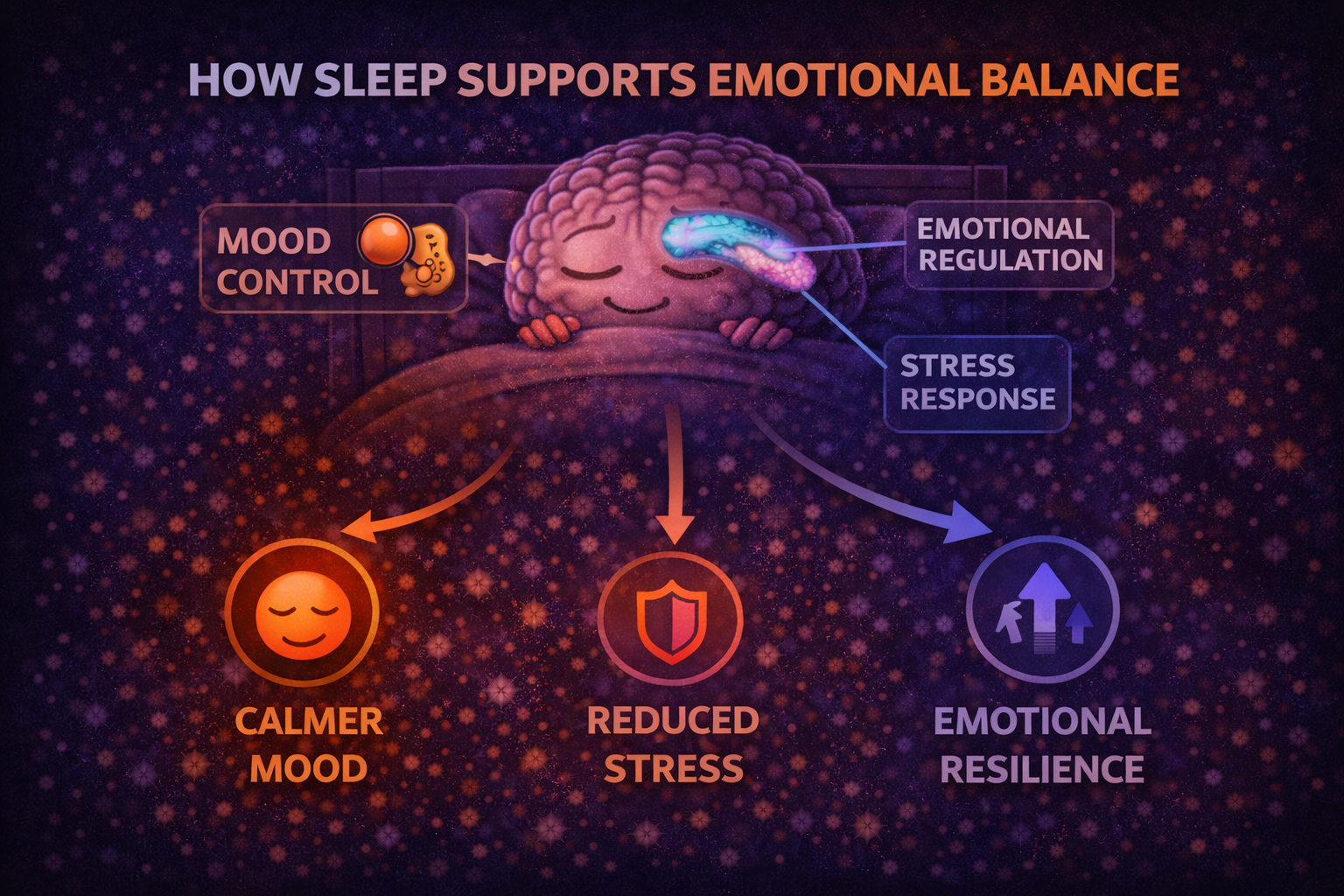
That ability depends heavily on sleep. When sleep is consistent and restorative, emotions remain proportional and recover quickly. When sleep is disrupted, emotional balance weakens, reactions intensify, and recovery slows. Sleep does not eliminate emotion—it stabilizes it.
Emotional Balance Is a Regulatory State
Emotional balance reflects how well the brain regulates emotion.
Some brain systems generate emotional responses; others modulate intensity, context, and recovery. Balance emerges when these systems communicate efficiently.
Sleep is the primary time when this communication is restored. Without sleep, regulation falters and emotions become harder to manage.
How Sleep Resets Emotional Baselines
Each day adds emotional load.
During sleep, the brain lowers emotional sensitivity and resets baseline thresholds. This recalibration allows emotions to arise without tipping into overwhelm.
Poor sleep leaves thresholds elevated, making emotions feel heavier the next day.
Deep Sleep and Emotional Stability
Deep sleep supports baseline emotional steadiness.
During slow-wave sleep, neural noise decreases and core regulatory networks recover. This creates a calmer emotional baseline during waking hours.
When deep sleep is reduced, emotional reactions become more volatile and less predictable.
REM Sleep and Emotional Integration
REM sleep is essential for emotional processing.
During REM, emotional experiences are revisited in a low-stress chemical environment. This allows emotions to be integrated without retaining high emotional charge.
Disrupted REM sleep leaves emotions unresolved, increasing reactivity and emotional spillover.
Why Poor Sleep Disrupts Emotional Proportionality
Sleep loss reduces proportionality.
Minor stressors trigger outsized reactions because regulation capacity is depleted. Emotions escalate faster and settle more slowly.
The stressor hasn’t changed—the brain’s ability to regulate it has.
Sleep and Emotional Recovery Speed
Balance depends on recovery speed.
After emotional events, a well-rested brain returns to baseline quickly. Poor sleep slows this recovery, allowing emotions to linger and accumulate.
Sleep determines how long emotions stay activated.
Circadian Timing and Emotional Balance
Emotional balance follows biological timing.
Aligned sleep schedules support predictable regulation across the day. Irregular timing disrupts this rhythm, increasing emotional variability—even with adequate sleep duration.
Timing matters as much as hours slept.
Sleep Fragmentation and Emotional Drift
Interrupted sleep undermines balance.
Frequent awakenings prevent full emotional reset, leaving partial activation overnight. Over time, this leads to persistent tension and irritability.
Fragmentation often harms balance more than short but continuous sleep.
Why Effort Alone Can’t Create Balance
Trying to “stay balanced” without sleep doesn’t work.
Emotional regulation requires neural resources replenished during sleep. Without recovery, effort increases strain without restoring stability.
Balance is biological before it is intentional.
How Emotional Balance Returns After Good Sleep
After high-quality sleep, balance often returns naturally.
Emotions feel steadier, stress feels manageable, and perspective improves—without deliberate effort. This reflects restored regulation, not changes in circumstances.
Sleep prepares the brain to regulate emotions before the day begins.
The Core Idea to Remember
Sleep supports emotional balance by restoring emotional regulation.
Through deep sleep and REM sleep, the brain resets thresholds, integrates experiences, and improves recovery speed. Without sleep, balance weakens and emotions dominate.
Emotional balance is not forced—it is rebuilt overnight by sleep.