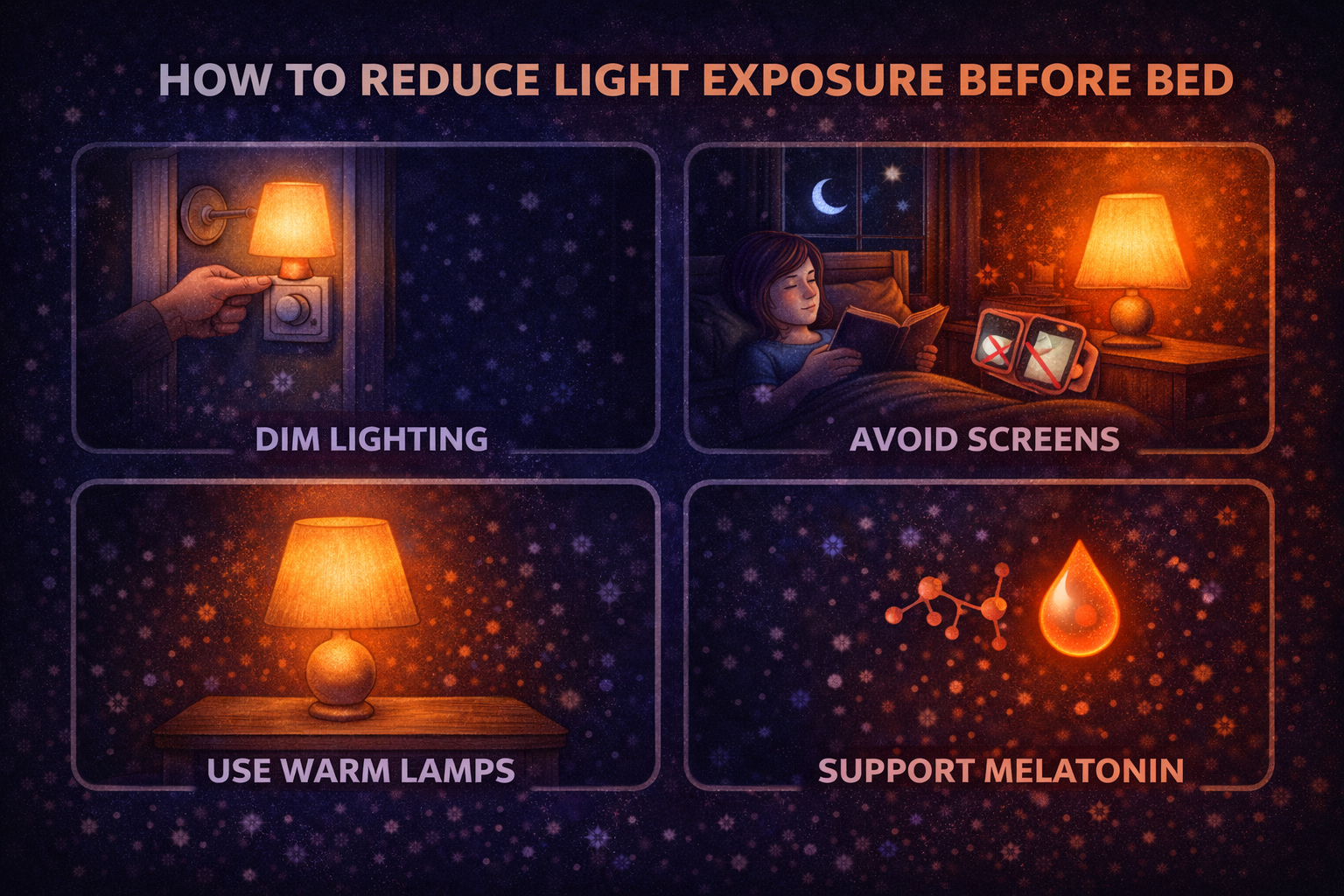
Practical ways to protect melatonin and prepare your brain for sleep
Many sleep problems don’t begin at bedtime. They begin hours earlier, when light exposure quietly tells the brain to stay alert. By the time you try to sleep, the biological signals are already misaligned.
Reducing light exposure before bed is one of the most effective, non-medical ways to improve sleep timing and quality. It doesn’t require extreme measures—only intentional changes that align evening light with biology.
Why Evening Light Matters So Much
Light is the brain’s strongest timing signal.
As evening approaches, the brain expects light levels to fall. This drop allows melatonin to rise and initiates nighttime physiology. When light remains bright, the brain delays this transition.
Reducing evening light is not about darkness all day—it’s about darkness at the right time.
Start Reducing Light Earlier Than You Think
Timing matters more than intensity alone.
Reducing light exposure only at bedtime is often too late. The circadian system responds to cumulative light signals over several hours.
Dimming lights 2–3 hours before bed is far more effective than sudden darkness right before sleep.
Dim Indoor Lighting in the Evening
Brightness signals alertness.
Lowering overall room brightness in the evening tells the brain that night is approaching. This includes overhead lights, lamps, and decorative lighting.
Using fewer light sources with softer intensity helps initiate the sleep transition.
Use Warm, Low-Intensity Light Sources
Color temperature affects melatonin.
Warm light (amber, red, or soft yellow) interferes less with melatonin than cool white or blue light. Switching to warmer bulbs in the evening reduces circadian disruption.
The goal is light that supports visibility without stimulating alertness.
Limit Screen Exposure Before Bed
Screens are concentrated light sources.
Phones, tablets, computers, and televisions deliver bright, blue-rich light directly into the eyes. Reducing screen use in the evening significantly improves sleep readiness.
When screens are unavoidable, shorter exposure and earlier cutoffs matter more than filters alone.
Lower Screen Brightness and Use Night Modes
Brightness amplifies disruption.
Reducing screen brightness and enabling night modes lowers the alerting signal sent to the brain. While not a complete solution, these steps reduce harm when screens are used.
Behavior still matters more than settings.
Avoid Overhead Lighting at Night
Overhead lights mimic daytime conditions.
Turning off ceiling lights and relying on localized, low-level lighting reduces the brain’s perception of daytime. This supports melatonin release and relaxation.
Smaller light sources create a more sleep-friendly environment.
Create a “Light Curfew” Routine
Consistency trains the brain.
Establishing a routine where lights are dimmed at the same time each evening helps stabilize circadian timing. Over time, sleepiness begins to appear more naturally.
Routine reduces the need for conscious effort.
Use Darkness as a Signal, Not an Obstacle
Darkness is biologically meaningful.
As light fades, the brain shifts into night mode. Allowing this transition supports sleep onset, depth, and emotional regulation.
Darkness is not the absence of activity—it is an active signal for sleep.
Be Careful With Late-Night Bright Environments
Light exposure outside the home counts.
Bright stores, gyms, offices, and street lighting can delay sleep when encountered late at night. Being mindful of late-evening environments helps protect sleep timing.
Even short exposures can shift circadian signals.
Why Small Changes Make a Big Difference
The circadian system is sensitive.
You don’t need perfect darkness or extreme measures. Gradual, consistent reductions in evening light exposure are enough to improve sleep over time.
Biology responds to patterns, not perfection.
The Core Idea to Remember
Reducing light exposure before bed helps the brain transition into sleep mode.
By dimming lights, limiting screens, and prioritizing darkness at the right time, melatonin rises naturally and sleep becomes easier.
Sleep improves not by forcing rest—but by removing the signals that keep the brain awake.