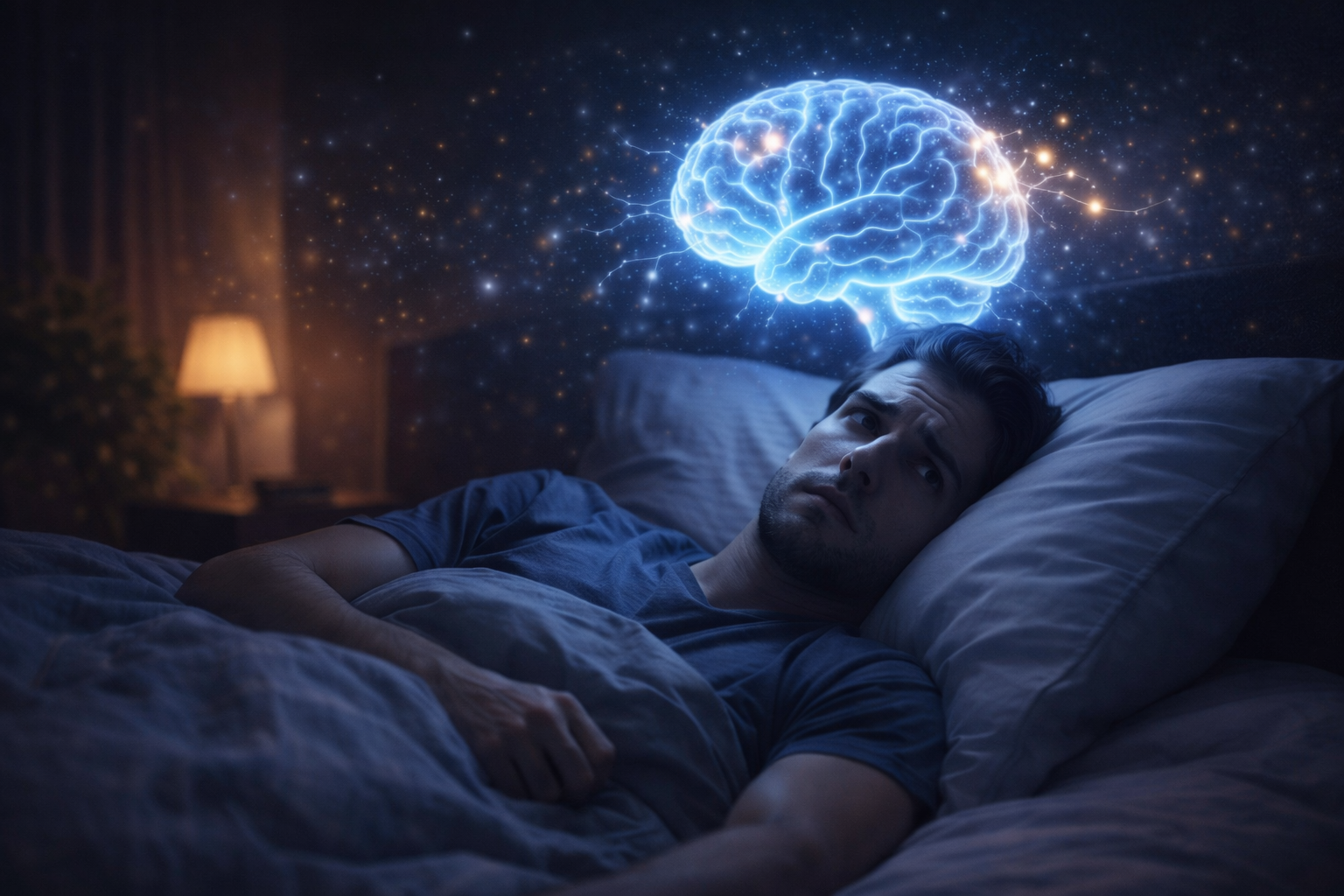
Insomnia is often described as a simple inability to fall asleep. In reality, it is far more complex. Insomnia is not just a nighttime problem — it is a condition rooted in how the brain regulates arousal, timing, and recovery.
From a scientific perspective, insomnia reflects a state in which the brain struggles to disengage from wakefulness. Understanding why this happens requires looking at the nervous system, circadian rhythm, and stress regulation together.
Insomnia is not just “lack of sleep”
Many people assume insomnia means sleeping too little. While reduced sleep time is a consequence, it is not the core issue. Insomnia is defined by difficulty falling asleep, staying asleep, or waking too early despite adequate opportunity to sleep.
What distinguishes insomnia from occasional poor sleep is persistence. The brain remains alert when it should be resting, creating a mismatch between intention and physiology.
The hyperarousal model
One of the most widely accepted scientific explanations for insomnia is the hyperarousal model. According to this model, the brain of someone with insomnia remains in a heightened state of activation, even at night.
This activation can be cognitive (racing thoughts), emotional (worry, frustration), or physiological (elevated heart rate, stress hormones). The result is a nervous system that does not fully downshift into sleep mode.
Importantly, this state can persist even when the person feels exhausted.
The role of the nervous system
Sleep requires a shift from sympathetic nervous system dominance (alertness) to parasympathetic dominance (rest). In insomnia, this shift is incomplete.
Stress, irregular schedules, and conditioned arousal can keep the nervous system primed for wakefulness. Over time, the bed itself can become associated with alertness rather than rest, reinforcing the problem.
This explains why many people with insomnia feel tired during the day but unable to sleep at night.
Circadian rhythm and insomnia
Circadian misalignment plays a significant role in many forms of insomnia. When sleep timing does not match the brain’s internal clock, sleep pressure builds inefficiently.
Late light exposure, inconsistent schedules, and irregular wake times confuse circadian signals. As a result, the brain may not produce the proper hormonal cues for sleep at the intended time.
In these cases, insomnia is not a failure to sleep but a failure of timing.
Stress hormones and sleep onset
Stress hormones such as cortisol interfere with sleep initiation. Elevated cortisol levels in the evening signal alertness rather than rest.
Chronic stress, whether psychological or physiological, can flatten normal cortisol rhythms. Instead of declining at night, cortisol remains elevated, delaying sleep onset and increasing nighttime awakenings.
This hormonal pattern is common in chronic insomnia and contributes to its persistence.
Why insomnia becomes self-reinforcing
Insomnia often develops a feedback loop. Poor sleep increases daytime fatigue and stress. Increased stress heightens nighttime arousal. Heightened arousal worsens sleep.
Over time, fear of not sleeping becomes part of the problem. The brain begins to associate nighttime with frustration rather than rest, strengthening the hyperarousal response.
This does not mean insomnia is “all in the head.” It means the brain has learned a pattern that must be gently unlearned.
Insomnia and mental health
Insomnia and mental health are closely linked. Sleep disruption increases vulnerability to anxiety, depression, and emotional instability. At the same time, these conditions can worsen insomnia.
Importantly, insomnia can exist independently of mental health disorders. Treating sleep directly often improves emotional symptoms, even without targeted psychological intervention.
This highlights sleep’s foundational role in brain regulation.
The scientific takeaway
Insomnia is not simply a lack of willpower or a bad habit. It is a biological state characterized by hyperarousal, disrupted timing, and impaired nervous system regulation.
Understanding insomnia scientifically removes blame and opens the door to more effective strategies. Restoring sleep requires addressing arousal and timing — not forcing sleep to happen.
The key takeaway
Insomnia reflects a brain that has difficulty disengaging from wakefulness. It is shaped by nervous system activation, circadian misalignment, and stress regulation.
By understanding the mechanisms behind insomnia, it becomes possible to approach sleep restoration with clarity rather than frustration.