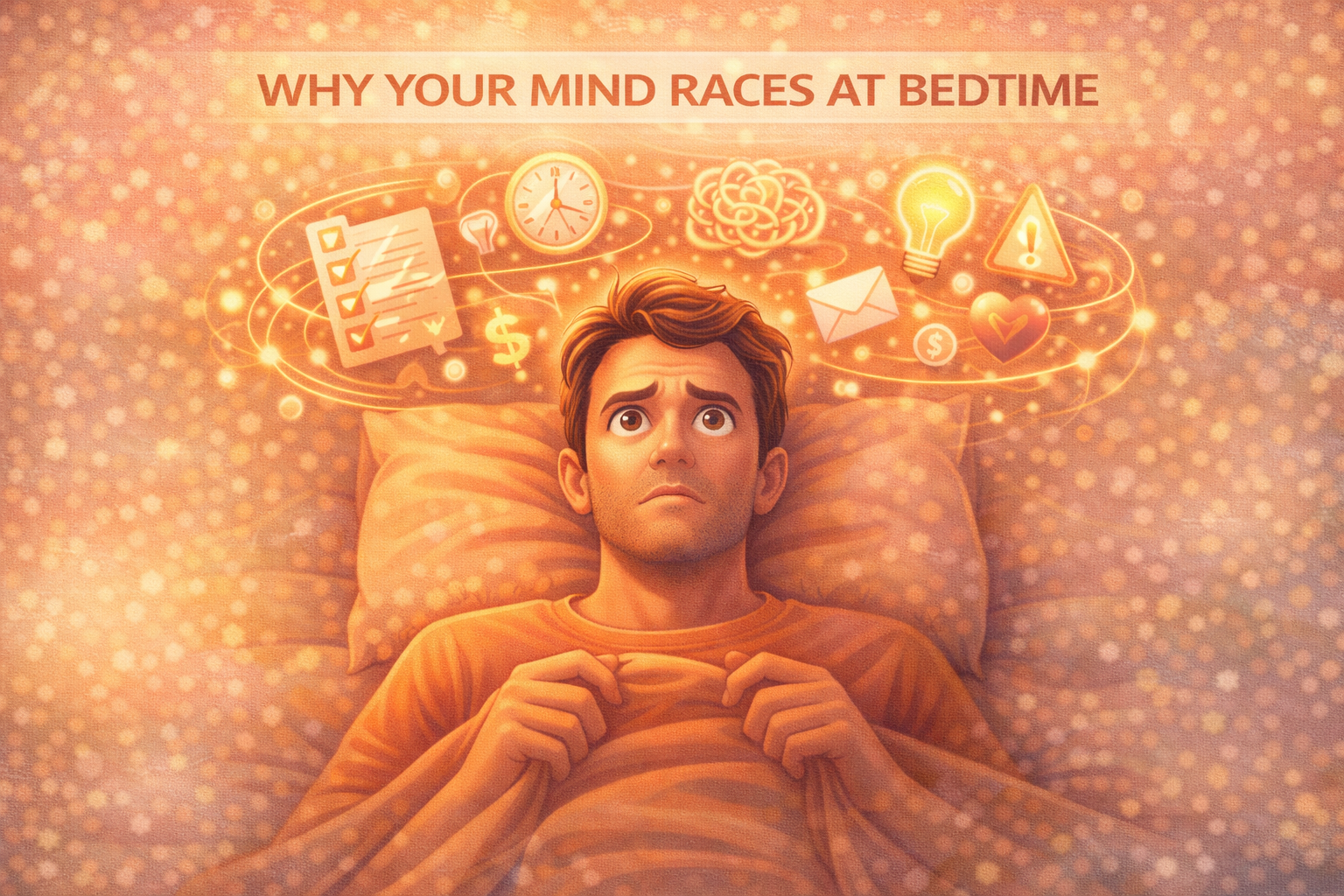
How timing, stress, and learned arousal keep the brain active when it should slow down
Lying in bed with a tired body and an overactive mind is a common experience. Thoughts jump from one topic to another, worries resurface, plans replay, and sleep feels distant despite clear exhaustion.
This racing mind is not a sign of poor discipline or a flawed personality. It reflects a state of heightened brain arousal that conflicts with sleep onset. Understanding why this happens reveals that the issue is not the presence of thoughts, but the conditions that keep the brain alert at the wrong time.
Sleep Requires the Brain to Disengage
Falling asleep is not about shutting thoughts off on command.
Sleep begins when alertness systems quiet down and the brain reduces its engagement with problem-solving and monitoring. This disengagement is gradual and depends on timing, safety signals, and reduced stimulation.
When these conditions are missing, the brain remains active even when the body is ready for rest.
Stress Keeps the Brain in Problem-Solving Mode
Stress is one of the strongest drivers of nighttime mental activity.
Even low-grade or background stress keeps the brain oriented toward anticipation and control. Cortisol and other stress-related signals promote vigilance, making the brain more likely to scan for unresolved issues.
At bedtime, when distractions disappear, this unresolved cognitive load becomes more noticeable, giving the impression that the mind suddenly “wakes up.”
Why Thoughts Appear Louder at Night
The mind does not usually become more active at night — the environment becomes quieter.
During the day, attention is occupied by tasks, noise, and interaction. At night, external input drops sharply, leaving internal thoughts more prominent.
Even small amounts of light can signal alertness to the brain.
Some people use a comfortable sleep mask to create complete darkness and reduce visual stimulation, helping the brain shift away from environmental monitoring.
This contrast makes normal cognitive activity feel intense, even though overall brain activity may not be higher than during the day.
Circadian Timing and Evening Alertness
Circadian timing influences how alert the brain feels in the evening.
For later chronotypes, alertness naturally peaks later at night. If bedtime occurs before this alertness declines, the brain remains engaged and resistant to sleep.
In these cases, racing thoughts reflect biological timing rather than anxiety or overthinking alone.
Learned Arousal and the Bed–Wake Association
Over time, the brain can learn to associate the bed with alertness.
If bedtime repeatedly involves worrying, planning, or frustration about not sleeping, the brain links the bed environment with cognitive activity. This learned association triggers alertness as soon as you lie down.
Sudden or inconsistent sounds can also reinforce this alert state.
Consistent background sound, such as white noise, can help reduce the brain’s need to monitor the environment and support disengagement.
The result is a conditioned response where the mind races automatically, even on low-stress days.
Why Trying to Control Thoughts Backfires
Efforts to suppress thoughts often increase arousal.
When the brain detects effort or frustration, it interprets this as a need for control, activating alertness systems further. This creates a feedback loop where trying harder to sleep makes sleep less likely.
Sleep emerges when effort drops, not when control increases.
Sleep Pressure Isn’t Always Enough
High sleep pressure does not guarantee mental quiet.
You can be physically exhausted while cognitive systems remain active. Alertness driven by stress or timing can override sleep pressure, delaying sleep onset.
This explains why extreme tiredness does not always lead to immediate sleep.
Why the Mind Races Most Right Before Sleep
Bedtime is a transition point.
As the brain shifts from engagement to disengagement, unresolved thoughts surface briefly before fading — unless alertness is sustained. When timing or stress interferes, this transitional phase stretches longer than it should.
The racing mind is often a sign that disengagement has stalled.
Reducing Nighttime Mental Activation
Calming the racing mind is about reducing arousal, not eliminating thoughts.
Consistent sleep timing, reduced evening stimulation, and allowing alertness to decline naturally help the brain disengage. Creating a predictable wind-down period signals that problem-solving is no longer required.
Supporting the nervous system’s transition into a calmer state can also play a role.
Some people include magnesium glycinate in their evening routine, as it is involved in regulating relaxation and neural recovery.
When the brain receives permission to disengage, thoughts slow without force.
The Core Idea to Remember
Your mind races at bedtime because the brain remains alert when it should be winding down.
Stress, circadian timing, and learned associations keep cognitive systems active despite physical fatigue. Sleep does not arrive when thoughts are fought — it arrives when alertness is allowed to fade.
Understanding this shifts the focus from controlling the mind to creating the conditions that let it rest.