Tag: cognitive flexibility

  • Can Sleep Improve Problem Solving?

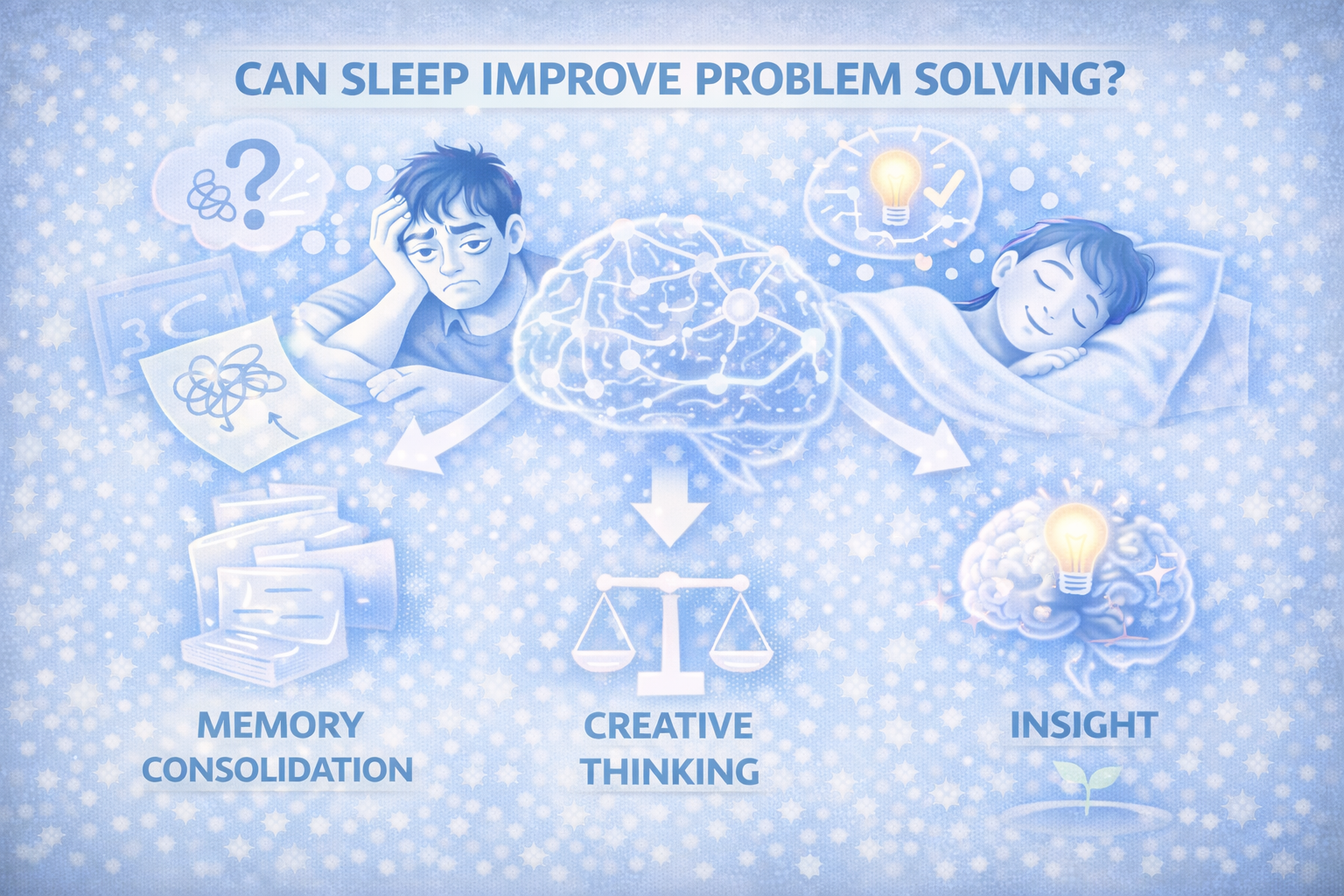
    Can Sleep Improve Problem Solving?

    How sleep helps the brain find solutions, patterns, and new perspectives

    Problem solving is often seen as a conscious effort: analyze the issue, think harder, and work through the details. When solutions don’t come easily, the instinct is to spend more time thinking.

    Yet many people experience the opposite — stepping away, sleeping on a problem, and waking up with clarity. This is not coincidence. Sleep actively improves the brain’s ability to solve problems by reorganizing information, strengthening insight, and reducing mental rigidity.


    Problem Solving Is Not Only a Waking Process

    Solving problems does not stop when you stop thinking about them.

    While awake, the brain gathers information and explores obvious solutions. During sleep, especially certain stages, the brain continues working offline — without pressure or conscious control.

    This offline processing often leads to solutions that feel sudden or intuitive the next day.


    How Sleep Reorganizes Information

    During sleep, the brain restructures knowledge.

    Information acquired during the day is replayed, reorganized, and connected across networks. This process allows the brain to see relationships that were not obvious during focused effort.

    Problem solving improves when information is integrated rather than repeatedly analyzed in the same way.


    REM Sleep and Insight-Based Solutions

    REM sleep is particularly important for insight.

    During REM, the brain links distant ideas, reduces rigid thinking, and promotes unconventional associations. This environment supports creative problem solving and “aha” moments.

    Disrupted REM sleep reduces the likelihood of these insights emerging.


    Deep Sleep and Logical Problem Solving

    Deep sleep supports structured reasoning.

    It strengthens core memory representations and stabilizes relevant information. This allows logical problems to be approached more efficiently after sleep, with fewer distractions.

    Reduced deep sleep weakens this foundation, making reasoning feel slower and more effortful.


    Why Sleep Reduces Mental Fixation

    Problem solving often fails because of fixation — getting stuck on one approach.

    Sleep helps break fixation by weakening unproductive associations and allowing alternative pathways to emerge. This reset increases cognitive flexibility.

    After sleep, the brain is less locked into previous assumptions.


    Sleep Deprivation and Narrow Thinking

    Lack of sleep narrows problem-solving ability.

    The brain defaults to familiar strategies and struggles to adapt. Novel solutions feel harder to generate, and errors increase.

    Sleep deprivation does not remove intelligence, but it limits access to flexible thinking.


    Circadian Timing and Solution Quality

    Problem-solving ability varies across the day.

    Circadian rhythm influences when the brain is most receptive to insight and reasoning. Poorly timed sleep disrupts these peaks, reducing solution quality even after sufficient sleep duration.

    Alignment improves consistency in problem-solving performance.


    Why Stepping Away Works Better Than Pushing Through

    Pushing harder often increases mental rigidity.

    Sleep allows the brain to disengage from effortful control and reorganize information naturally. This explains why solutions often feel obvious after rest.

    The brain solves better when it is allowed to reset.


    Long-Term Benefits of Sleep for Problem Solving

    Consistent good sleep compounds benefits.

    Over time, learning improves, mental flexibility increases, and complex problem solving becomes more efficient. These effects accumulate and protect cognitive performance.

    Sleep supports both immediate insight and long-term adaptability.


    When Sleep Does Not Help Immediately

    Not every problem is solved after one night.

    Some problems require sufficient information or multiple cycles of integration. However, sleep consistently improves the conditions under which solutions can emerge.

    Progress may feel gradual, but it is real.


    The Core Idea to Remember

    Sleep improves problem solving by reorganizing information, reducing fixation, and enhancing insight.

    Through deep sleep and REM sleep, the brain continues working on problems without conscious effort. Depriving sleep deprives the brain of this advantage.

    Sometimes the best way to solve a problem is not to think harder — but to sleep on it.
  • Why You Feel Less Creative When Sleep-Deprived

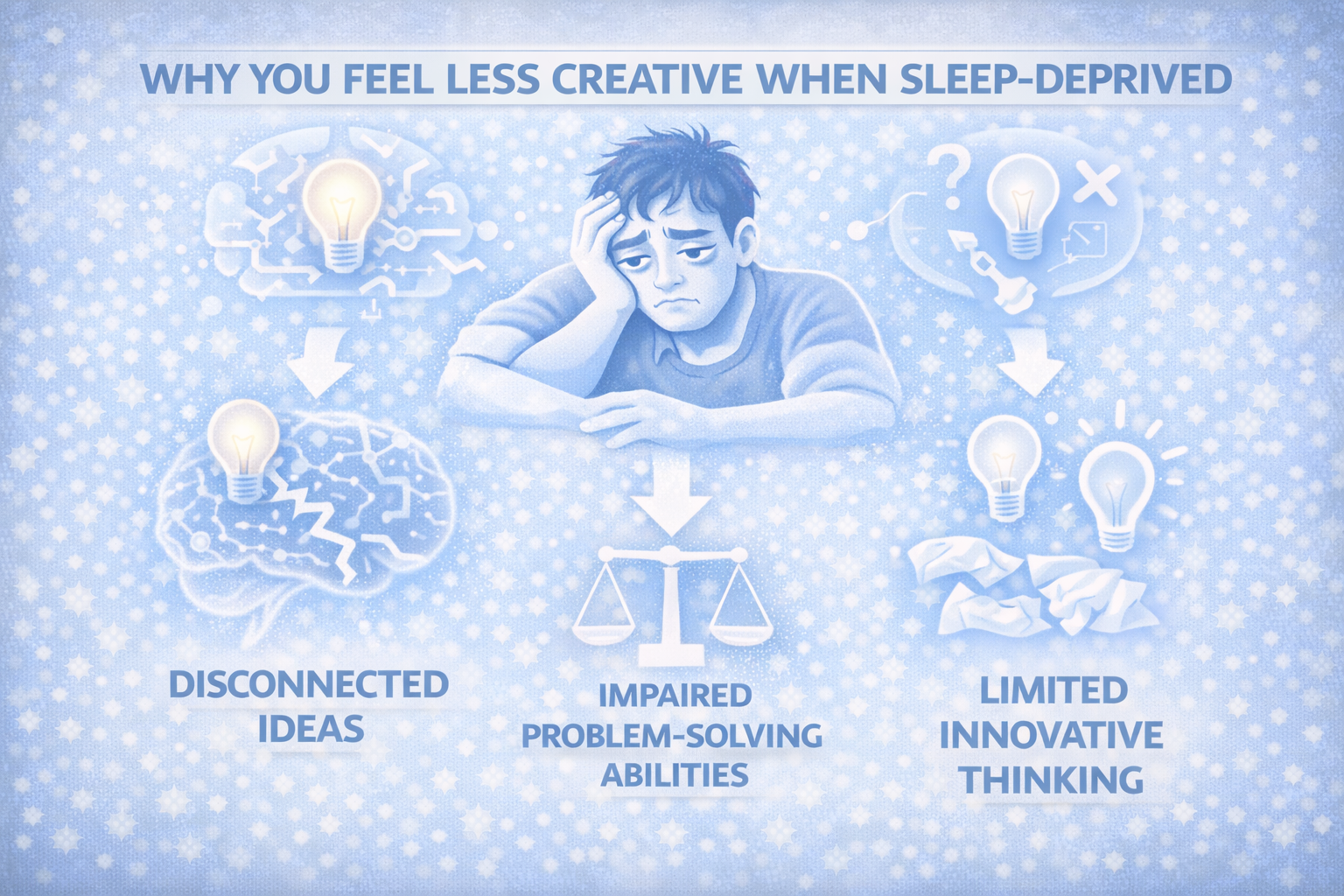
    Why You Feel Less Creative When Sleep-Deprived

    How lack of sleep disrupts idea generation, insight, and flexible thinking

    Creativity often feels spontaneous. Ideas connect unexpectedly, solutions appear without force, and thinking flows. After poor sleep, that flow disappears. Ideas feel flat, rigid, or repetitive, and creative tasks require far more effort.

    This shift is not about motivation or talent. Creativity depends on specific brain processes that are highly sensitive to sleep. When sleep is reduced or fragmented, the brain loses the conditions needed to combine ideas, explore alternatives, and generate insight.


    Creativity Depends on Flexible Brain Networks

    Creative thinking requires flexibility.

    The brain must move easily between concepts, access distant associations, and tolerate ambiguity. This flexibility relies on efficient communication between multiple brain networks.

    Sleep maintains this flexibility. Without it, thinking becomes narrower and more constrained.


    How Sleep Supports Creative Integration

    During sleep, the brain integrates information across networks.

    Ideas learned or experienced during the day are reorganized, combined, and connected in new ways. This integration allows creative insights to emerge later with little conscious effort.

    Without sleep, information remains siloed, limiting creative recombination.


    REM Sleep and Creative Insight

    REM sleep plays a central role in creativity.

    During REM, the brain connects distant concepts while emotional pressure is reduced. This state encourages unconventional associations and novel solutions.

    Disrupted REM sleep significantly reduces the brain’s ability to generate original ideas.


    Deep Sleep and Creative Stability

    Deep sleep supports the foundation of creativity.

    It stabilizes core cognitive function, reduces neural noise, and restores mental energy. This stability allows creative processes to operate smoothly the next day.

    When deep sleep is reduced, creative thinking becomes effortful and easily derailed.


    Why Sleep Deprivation Produces Rigid Thinking

    Lack of sleep increases cognitive rigidity.

    The brain defaults to familiar patterns and known solutions because flexible exploration requires more neural resources. Novel ideas feel harder to access.

    This rigidity explains why sleep-deprived thinking often feels repetitive or uninspired.


    Sleep Loss and Reduced Cognitive Exploration

    Creative thinking requires exploration.

    Sleep deprivation reduces the brain’s tolerance for uncertainty and complexity. As a result, thinking becomes more linear and less exploratory.

    The brain prioritizes efficiency over innovation when resources are limited.


    Why Forcing Creativity Doesn’t Work Without Sleep

    Creativity cannot be forced under deprivation.

    Effort increases mental strain but does not restore integrative capacity. The harder you try, the more constrained thinking becomes.

    Creative flow depends on recovery, not pressure.


    Circadian Timing and Creative Peaks

    Creativity fluctuates with circadian rhythm.

    Certain times of day naturally support creative thinking. Poorly timed sleep disrupts these peaks, flattening creative energy even after sufficient hours of sleep.

    Timing matters as much as duration for creative output.


    Fragmented Sleep and Creative Inconsistency

    Interrupted sleep reduces creative consistency.

    Ideas may appear briefly, then disappear. Creative clarity becomes unpredictable. This inconsistency reflects incomplete neural integration during sleep.

    Fragmented sleep often impairs creativity more than short but continuous sleep.


    Long-Term Effects of Poor Sleep on Creativity

    Chronic sleep disruption dulls creative capacity over time.

    Original thinking becomes harder, insight rarer, and creative confidence declines. These changes are often misattributed to burnout or loss of inspiration.

    Restoring sleep often restores creative ability people assumed was gone.


    Why Creativity Returns After Good Sleep

    After good sleep, creativity feels natural again.

    Ideas connect more easily, thinking becomes playful, and insight emerges without force. This reflects restored integration, flexibility, and mental energy.

    Sleep does not create creativity — it removes the barriers that suppress it.


    The Core Idea to Remember

    Sleep deprivation reduces creativity because it disrupts the brain’s ability to integrate, explore, and connect ideas.

    REM sleep and deep sleep restore the neural conditions required for creative thinking. Without them, creativity becomes rigid and effortful.

    Creative thinking is not summoned — it emerges when the brain has recovered.