Tag: cognitive performance

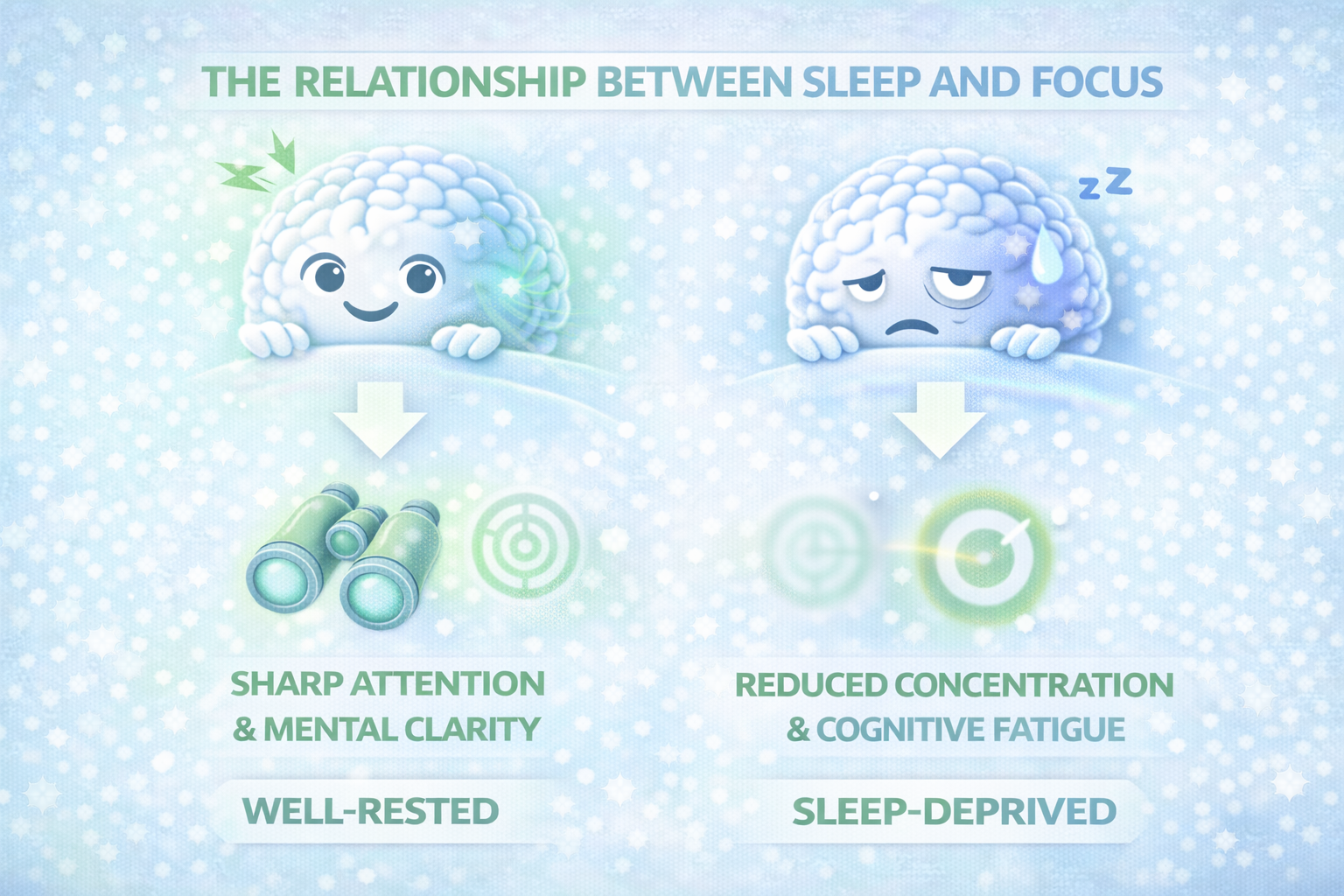
  • The Relationship Between Sleep and Focus

    The Relationship Between Sleep and Focus

    Why sustained attention depends more on sleep than on concentration techniques

    Focus is often treated as a skill you train through discipline, productivity systems, or mental effort. When concentration fades, the instinct is to remove distractions or try harder to stay engaged.

    In reality, focus is largely a biological state. The brain’s ability to sustain attention, filter irrelevant input, and remain mentally stable depends heavily on sleep quality. When sleep is disrupted, focus degrades even if motivation remains high.


    Focus Is a Function of Brain Readiness

    The brain cannot focus efficiently unless it is properly recovered.

    Attention relies on coordination between multiple neural systems responsible for alertness, control, and filtering. These systems require restoration to function smoothly.

    Sleep is the primary period when this restoration occurs. Without it, focus becomes fragile and short-lived.


    How Sleep Restores Attention Control

    During sleep, attention-control networks are recalibrated.

    Unnecessary neural activity is reduced, while key pathways responsible for sustained attention are strengthened. This improves signal clarity and reduces mental noise.

    After good sleep, the brain can maintain focus with less effort.


    Deep Sleep and Stable Focus

    Deep sleep supports attention stability.

    During slow-wave sleep, neural synchronization improves communication across brain regions involved in executive control. This synchronization allows attention to remain steady rather than fluctuating.

    Reduced deep sleep leads to distractibility and frequent attention lapses.


    REM Sleep and Flexible Attention

    REM sleep supports attentional flexibility.

    It allows the brain to shift focus smoothly between tasks and adapt to changing demands. This flexibility prevents mental rigidity and reduces cognitive fatigue.

    Disrupted REM sleep makes focus feel narrow and exhausting.


    Why Poor Sleep Shortens Focus Span

    When sleep is insufficient or fragmented, focus capacity shrinks.

    The brain reaches cognitive overload faster, leading to mental drifting, task switching, and loss of engagement. Concentration breaks occur sooner and more often.

    This is not a failure of willpower — it is a limit of recovery.


    Circadian Timing and Focus Quality

    Focus fluctuates across the day due to circadian rhythm.

    When sleep timing aligns with biological alertness peaks, focus feels natural and sustained. Misaligned sleep produces uneven alertness, causing focus to drop unpredictably.

    Even adequate sleep duration cannot fully compensate for poor timing.


    Fragmented Sleep and Attention Lapses

    Interrupted sleep increases micro-lapses in attention.

    Frequent awakenings prevent complete recovery of attention systems, leading to brief but frequent lapses that reduce overall performance.

    Fragmented sleep often impairs focus more than short but continuous sleep.


    Why Effort Can’t Replace Sleep for Focus

    Trying harder does not restore focus capacity.

    Effort can temporarily override fatigue, but neural efficiency remains reduced. The brain consumes more energy to maintain attention, accelerating exhaustion.

    Sustainable focus depends on recovery, not pressure.


    Long-Term Effects of Poor Sleep on Focus

    Chronic sleep disruption gradually erodes focus.

    Reduced attention becomes normalized, and sustained concentration feels increasingly difficult. These changes are often attributed to stress or distraction rather than sleep.

    Restoring sleep quality often restores focus people assumed was lost.


    Why Focus Feels Effortless After Good Sleep

    After good sleep, focus feels lighter and more stable.

    This reflects improved neural efficiency and reduced cognitive noise. The brain filters distractions automatically, allowing attention to stay engaged without strain.

    Effort decreases because the system is working as designed.


    The Core Idea to Remember

    Focus depends on sleep more than on discipline.

    Sleep restores the neural systems that support sustained attention, filtering, and control. Without it, focus naturally fragments.

    If concentration feels hard to maintain, the limiting factor is often not focus itself — it is recovery.
  • Why Sleep Is a Cognitive Upgrade

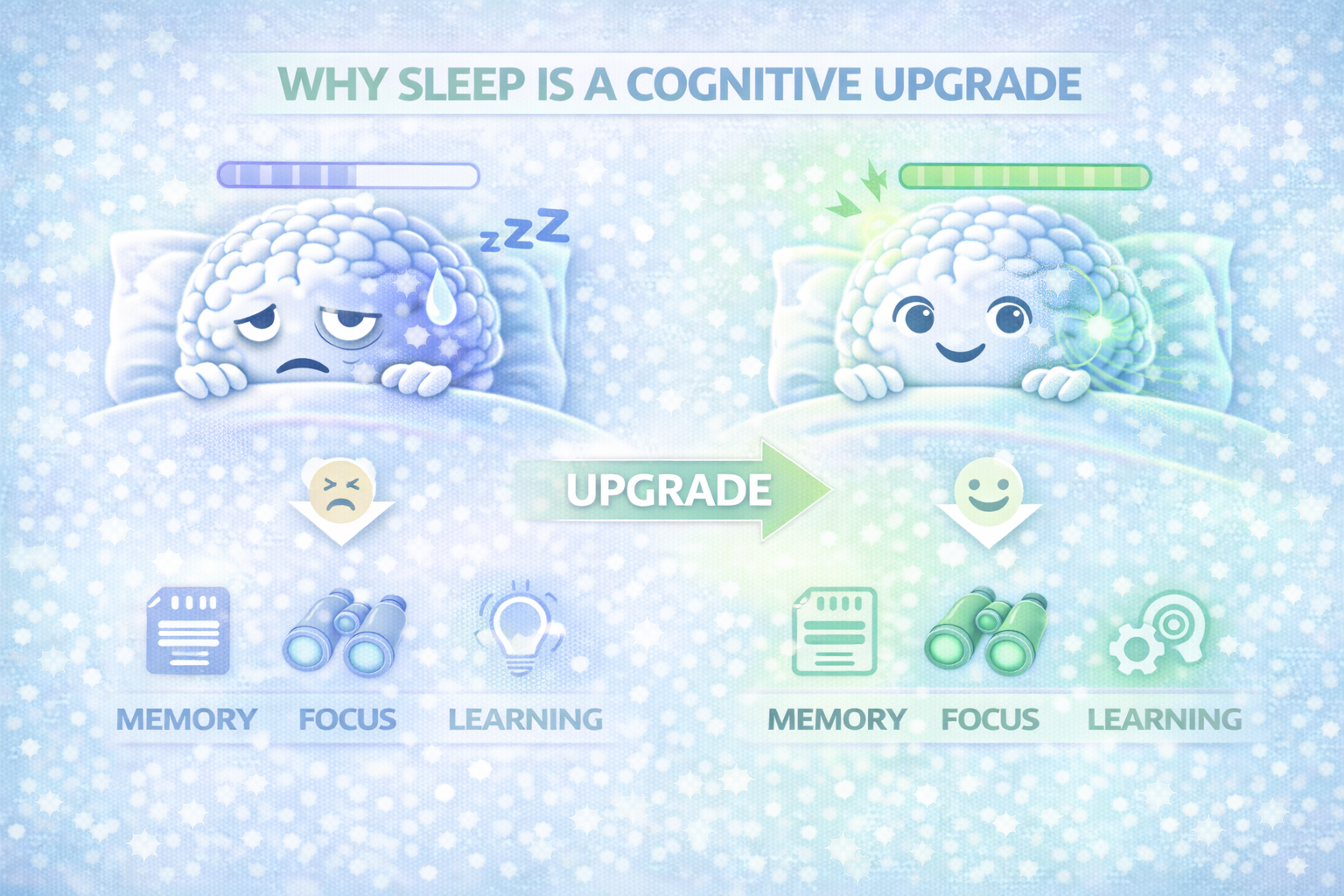
    Why Sleep Is a Cognitive Upgrade

    How sleep improves thinking capacity, efficiency, and mental performance

    Sleep is often treated as maintenance — something the brain needs to avoid malfunction. In reality, sleep does much more than preserve function. It actively upgrades how the brain operates.

    After good sleep, thinking feels clearer, learning is faster, focus lasts longer, and mental effort decreases. These improvements are not psychological or motivational. They reflect measurable changes in how efficiently the brain processes information. Sleep does not just restore baseline performance — it enhances cognitive capability.


    A Cognitive Upgrade, Not a Reset

    A reset returns a system to its original state.

    Sleep goes further. It reorganizes neural networks, improves signal efficiency, and optimizes how information flows across the brain. This is why performance after good sleep often exceeds performance before sleep.

    The brain wakes up not just repaired, but refined.


    How Sleep Improves Neural Efficiency

    During sleep, the brain reduces unnecessary neural noise.

    Connections that are weak or redundant are downregulated, while important pathways are strengthened. This increases signal-to-noise ratio, allowing thoughts to move more directly and with less effort.

    Efficient brains think faster using less energy.


    Deep Sleep and Core Cognitive Power

    Deep sleep supports foundational cognitive strength.

    During slow-wave sleep, large-scale brain synchronization improves communication between regions responsible for reasoning, working memory, and attention control. This synchronization reduces fragmentation in thinking.

    When deep sleep is reduced, cognition becomes less stable and more effortful.


    REM Sleep and Cognitive Integration

    REM sleep drives integration across brain systems.

    It allows distant concepts to connect, supporting creativity, insight, and flexible problem-solving. This integrative processing explains why solutions and ideas often emerge effortlessly after sleep.

    REM sleep upgrades how knowledge is used, not just stored.


    Why Sleep Makes Thinking Feel Easier

    After good sleep, cognitive tasks feel lighter.

    This is not because tasks are simpler, but because the brain processes them more efficiently. Less mental effort is required to maintain focus, reason through complexity, or make decisions.

    Ease is a sign of efficiency, not laziness.


    Sleep and Working Memory Capacity

    Working memory is a bottleneck for thinking.

    Sleep restores working memory capacity, allowing more information to be held and manipulated at once. This improves comprehension, multitasking, and problem-solving speed.

    Poor sleep narrows this capacity, slowing cognition across the board.


    Circadian Alignment and Cognitive Stability

    Sleep timing affects cognitive upgrades.

    When sleep aligns with circadian rhythm, alertness and performance remain stable throughout the day. Mistimed sleep produces uneven upgrades — moments of clarity followed by fog.

    Biological timing determines how fully the upgrade applies.


    Why Sleep Outperforms Effort

    Effort cannot substitute for neural efficiency.

    Trying harder while sleep-deprived increases cognitive strain without restoring capacity. The brain continues operating below optimal efficiency.

    Sleep upgrades the system so effort becomes effective again.


    Long-Term Cognitive Benefits of Sleep

    Over time, consistent good sleep compounds benefits.

    Learning accelerates, mental endurance increases, and cognitive resilience improves. These effects are cumulative and protective against long-term decline.

    Sleep upgrades are not one-time events — they build.


    Why Poor Sleep Feels Like a Downgrade

    When sleep is disrupted, the opposite occurs.

    Neural noise increases, integration weakens, and efficiency drops. Thinking becomes slower, narrower, and more exhausting.

    This is not loss of ability — it is loss of optimization.


    The Core Idea to Remember

    Sleep is a cognitive upgrade because it improves how the brain operates.

    By increasing efficiency, integration, and capacity, sleep enhances thinking beyond baseline function. It does not add intelligence — it removes friction.

    When sleep is protected, the brain doesn’t just recover.
    It levels up.

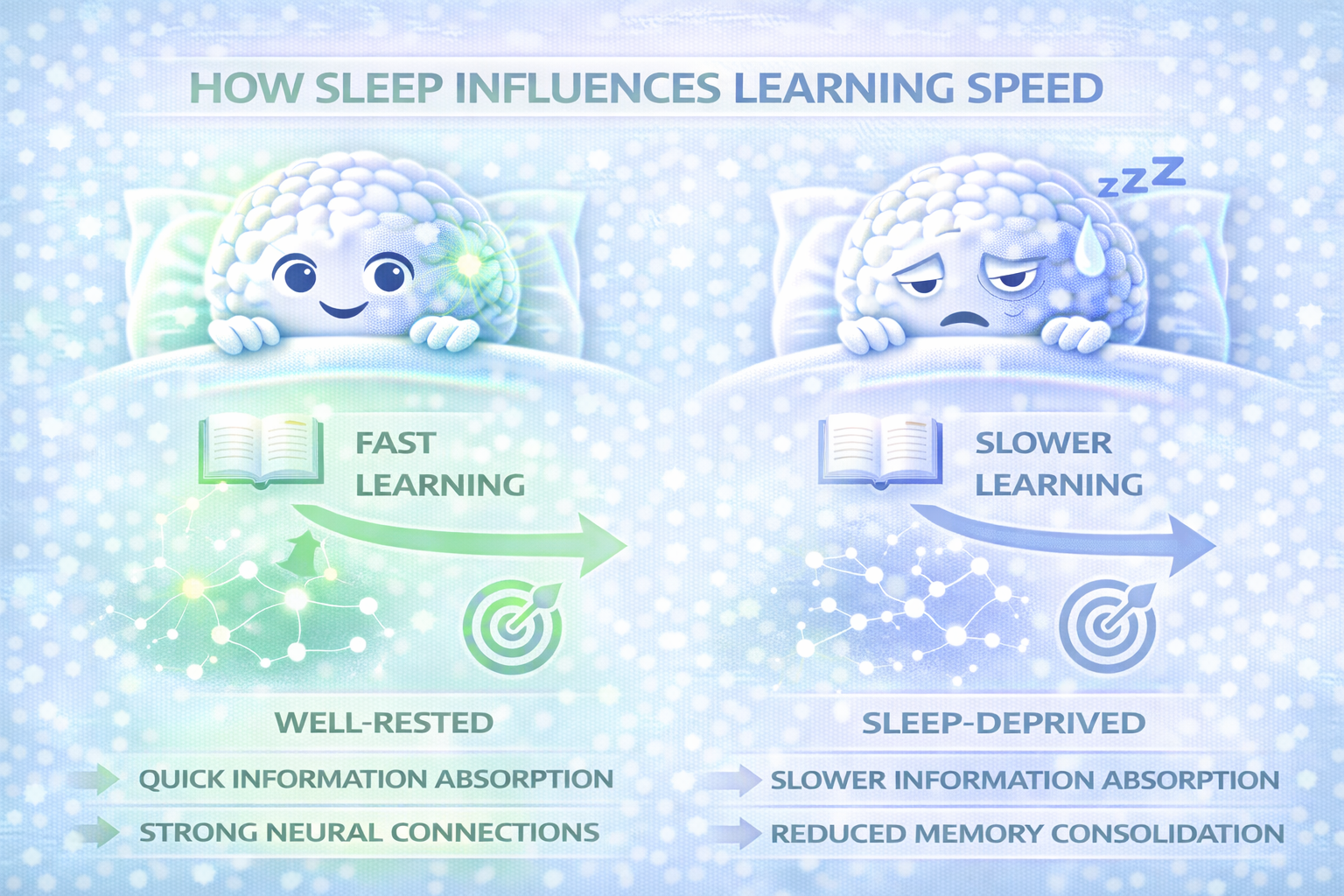
  • How Sleep Influences Learning Speed

    How Sleep Influences Learning Speed

    Why the brain learns faster when sleep supports memory and neural efficiency

    Learning speed is often attributed to intelligence, talent, or effort. When learning feels slow, the instinct is to practice more, concentrate harder, or push through fatigue.

    In reality, how quickly you learn depends heavily on sleep. Sleep determines how efficiently the brain absorbs new information, integrates it with existing knowledge, and prepares itself to learn again the next day. Without proper sleep, learning slows — not because ability disappears, but because the brain’s learning systems are impaired.


    Learning Is a Two-Phase Process

    Learning does not happen all at once.

    The first phase occurs while awake, when information is encoded. The second phase happens during sleep, when that information is stabilized and organized. Learning speed depends on how smoothly these two phases work together.

    When sleep is disrupted, the second phase weakens, slowing future learning even if practice continues.


    Why Sleep Prepares the Brain to Learn

    Sleep restores the brain’s learning capacity.

    During sleep, neural networks reset their sensitivity, clearing space for new information. This prevents saturation of memory systems and improves signal efficiency.

    After good sleep, the brain can encode new material faster and with less effort.


    Deep Sleep and Foundational Learning

    Deep sleep supports the consolidation of factual and conceptual knowledge.

    During this stage, recently learned information is transferred from temporary storage into long-term memory networks. This process reduces interference and stabilizes learning.

    When deep sleep is reduced, new information competes for limited capacity, slowing learning speed.


    REM Sleep and Skill Acquisition

    REM sleep plays a key role in procedural and skill-based learning.

    Motor skills, pattern recognition, and complex problem-solving benefit from REM-related integration. This stage helps refine performance and improve accuracy without additional practice.

    Disrupted REM sleep limits this refinement, making learning feel slower and less efficient.


    Sleep Deprivation and Slower Encoding

    Lack of sleep reduces the brain’s ability to encode information.

    Attention becomes unstable, working memory capacity shrinks, and errors increase. Even when studying longer, the brain absorbs less per unit of effort.

    This creates the illusion that learning ability has declined, when the real issue is reduced neural efficiency.


    Why Sleep Timing Matters for Learning Speed

    Learning speed depends on circadian alignment.

    When learning occurs during periods of high biological alertness, encoding is faster and more reliable. Poorly timed sleep disrupts this rhythm, reducing learning efficiency even after adequate sleep duration.

    Mistimed sleep makes learning inconsistent and unpredictable.


    Fragmented Sleep and Learning Inefficiency

    Learning benefits from uninterrupted sleep cycles.

    Fragmented sleep interrupts the consolidation process, leaving new information partially integrated. This forces the brain to relearn or reinforce material repeatedly.

    As a result, learning feels slower and requires more repetition.


    Why Effort Cannot Replace Sleep for Learning

    Extra effort cannot fully compensate for poor sleep.

    Studying longer while sleep-deprived increases fatigue without proportionally increasing retention. The brain simply cannot process information at normal speed.

    Efficient learning depends more on recovery than on time spent practicing.


    Long-Term Effects on Learning Capacity

    Chronic sleep disruption reduces learning adaptability.

    Over time, the brain becomes less flexible, slower to integrate new information, and more prone to overload. This affects not only academic learning but also everyday skill acquisition.

    Protecting sleep protects the ability to learn efficiently over the long term.


    The Core Idea to Remember

    Sleep is a key determinant of how fast you learn.

    By restoring neural capacity, stabilizing memory, and supporting integration, sleep allows learning to happen quickly and efficiently. Poor sleep slows learning not by reducing intelligence, but by impairing the brain’s ability to process and retain information.

    Learning speed improves when sleep quality is protected.

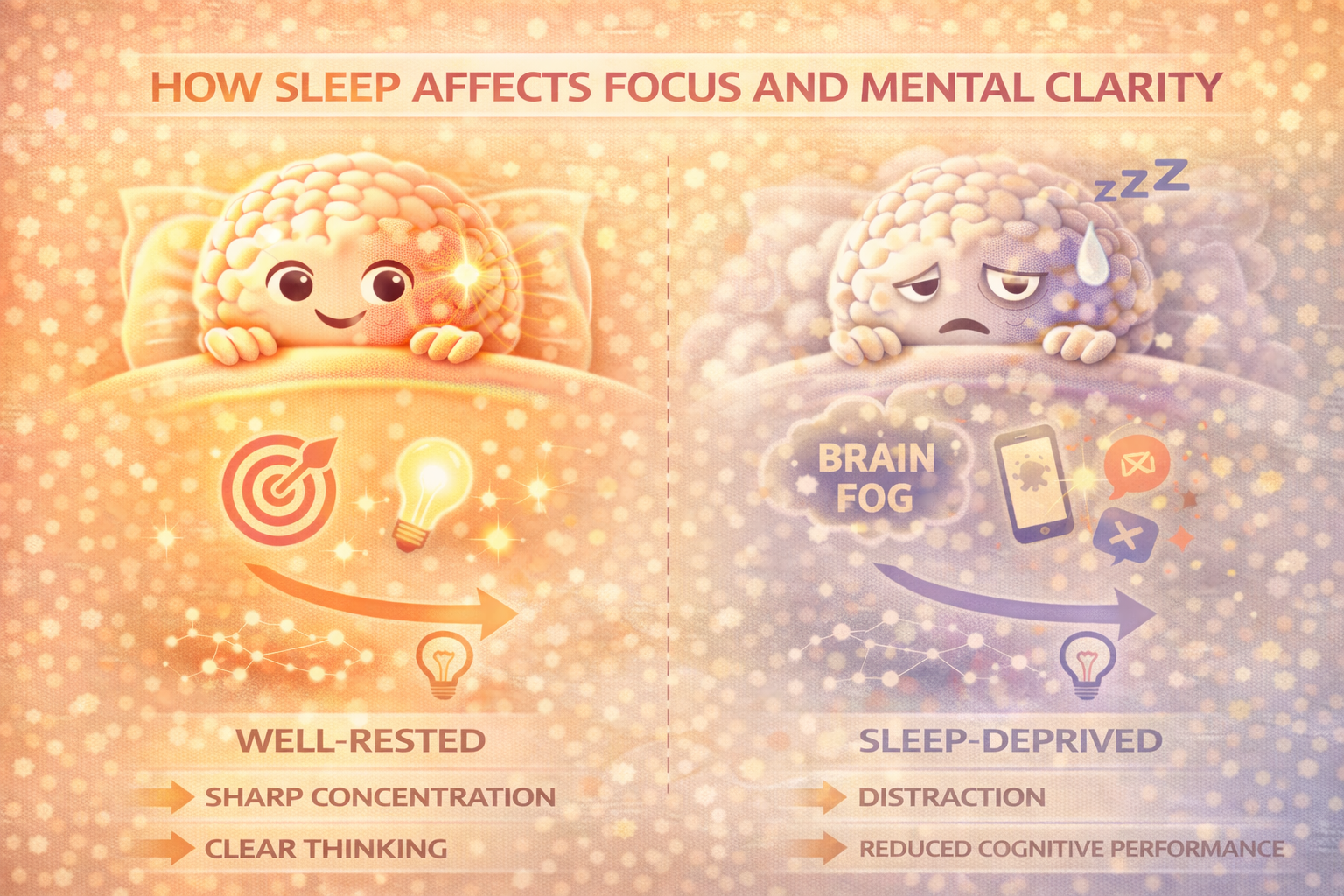
  • How Sleep Affects Focus and Mental Clarity

    How Sleep Affects Focus and Mental Clarity

    Why a well-rested brain processes information faster and with less effort

    Focus and mental clarity are often treated as skills you train through discipline, motivation, or productivity techniques. When concentration fades, people tend to push harder, rely on caffeine, or blame distraction.

    In reality, focus is primarily a biological state. The brain’s ability to sustain attention, filter irrelevant information, and think clearly depends heavily on sleep quality. When sleep is insufficient, fragmented, or mistimed, mental clarity declines even if motivation remains high.


    Focus Is a Brain State, Not a Personality Trait

    The ability to focus depends on how efficiently the brain regulates attention.

    Sleep supports the balance between neural systems responsible for alertness and those responsible for filtering distractions. When this balance is intact, attention feels natural and effortless.

    When sleep is disrupted, the brain struggles to maintain this balance, making focus feel forced and mentally exhausting.


    How Sleep Restores Attention Networks

    During sleep, the brain recalibrates attention networks.

    Neural connections involved in sustained focus are strengthened, while unnecessary or noisy connections are pruned. This optimization reduces cognitive load and improves signal clarity the next day.

    Without sufficient sleep, attention networks remain inefficient, requiring more effort to achieve the same level of focus.


    Sleep Deprivation and Mental Fog

    Mental fog is one of the earliest signs of poor sleep.

    Sleep loss slows neural communication, reduces processing speed, and weakens coordination between brain regions. Thoughts feel less precise, reactions are delayed, and information feels harder to organize.

    This fog is not subjective—it reflects real changes in brain function.


    The Role of Deep Sleep in Cognitive Clarity

    Deep sleep plays a critical role in restoring mental clarity.

    During slow-wave sleep, metabolic waste is cleared and neural activity becomes synchronized. This process improves signal-to-noise ratio in the brain, making thoughts feel sharper and more coherent.

    Reduced deep sleep leaves the brain cluttered, increasing distraction and mental fatigue.


    REM Sleep and Cognitive Flexibility

    REM sleep supports cognitive flexibility and creative thinking.

    During this stage, the brain integrates information across networks, allowing for insight, pattern recognition, and flexible problem-solving. This integration supports clarity when switching tasks or adapting to new information.

    Disrupted REM sleep reduces this flexibility, making thinking feel rigid or stuck.


    Why Sleep Timing Matters for Focus

    Focus depends not only on sleep duration, but on timing.

    When sleep aligns with the circadian rhythm, alertness rises smoothly during the day. Mistimed sleep produces uneven alertness, leading to periods of fog even after adequate hours in bed.

    Circadian misalignment makes focus unreliable and inconsistent.


    Fragmented Sleep and Attention Lapses

    Interrupted sleep weakens sustained attention.

    Frequent awakenings prevent the brain from completing restorative cycles, leading to micro-lapses in focus the next day. These lapses increase errors and reduce productivity, even when they go unnoticed.

    This is why fragmented sleep often feels worse than short but uninterrupted sleep.


    Why Effort Can’t Replace Sleep for Focus

    Many people try to compensate for poor sleep with effort.

    While motivation can temporarily override fatigue, it cannot restore neural efficiency. The brain continues to operate with reduced capacity, making focus increasingly costly.

    Sustained clarity requires recovery, not willpower.


    Sleep Quality and Decision Fatigue

    Poor sleep accelerates decision fatigue.

    As focus declines, the brain uses more energy to maintain attention. This depletes cognitive resources faster, making decisions feel harder and reducing mental endurance throughout the day.

    Good sleep preserves focus by reducing the cost of thinking.


    Long-Term Effects on Mental Clarity

    Chronic sleep disruption leads to persistent clarity loss.

    Over time, reduced focus becomes normalized. Mental fog, distractibility, and slower thinking are often attributed to stress or aging rather than sleep.

    Restoring sleep quality often restores clarity that people forgot was possible.


    The Core Idea to Remember

    Sleep is one of the strongest determinants of focus and mental clarity.

    A well-rested brain filters distractions, processes information efficiently, and sustains attention with less effort. Poor sleep makes thinking heavier, slower, and less precise.

    Mental clarity is not forced—it is restored overnight, when the brain is allowed to recover.

  • What Happens to Your Brain When You Don’t Sleep Enough

    What Happens to Your Brain When You Don’t Sleep Enough

    How insufficient sleep alters brain function, perception, and emotional control

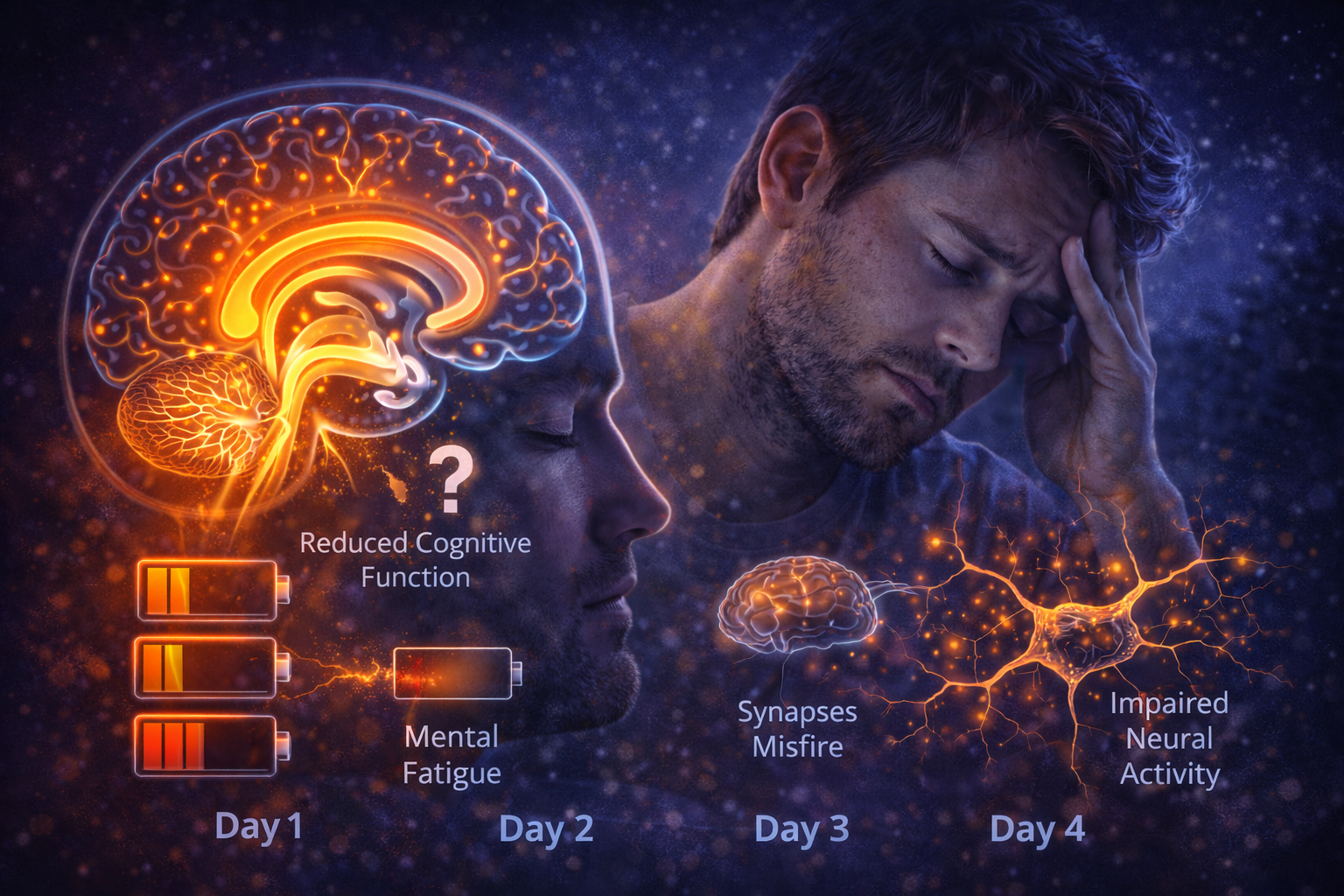
    Lack of sleep is often described as feeling tired or unfocused, but the real effects go much deeper. When you don’t sleep enough, the brain does not simply run on less energy — it begins to operate differently.

    Even short periods of insufficient sleep change how the brain processes information, regulates emotions, and evaluates risk. These changes are biological, predictable, and cumulative, affecting performance long before severe exhaustion is obvious.


    Sleep Is Active Brain Maintenance

    Sleep is not a shutdown state for the brain.

    During sleep, neural networks reorganize, synaptic connections are recalibrated, metabolic waste is cleared, and memory is consolidated. These processes are essential for maintaining efficient brain function.

    When sleep is shortened or disrupted, this maintenance is incomplete. The brain remains functional, but with reduced efficiency and increased strain.


    Attention and Focus Decline First

    One of the earliest effects of insufficient sleep is impaired attention.

    The brain struggles to sustain focus, especially on tasks that require continuous concentration. Reaction times slow, and brief lapses of attention become more frequent.

    These micro-failures often go unnoticed, but they significantly increase error rates and reduce overall cognitive reliability.


    Memory Formation Becomes Less Efficient

    Sleep plays a crucial role in memory consolidation.

    Without enough sleep, the brain struggles to stabilize new information. Learning becomes slower, recall less reliable, and mental clarity reduced.

    This effect is not limited to complex tasks — even simple information processing suffers when sleep is insufficient.


    Decision-Making and Judgment Are Altered

    Sleep deprivation changes how the brain evaluates choices.

    Risk assessment becomes distorted, impulse control weakens, and long-term consequences carry less weight. The brain favors immediate rewards over thoughtful decisions.

    This shift explains why people make poorer choices when sleep-deprived, even while believing they are thinking clearly.


    Emotional Regulation Breaks Down

    The emotional centers of the brain are highly sensitive to sleep loss.

    When sleep is insufficient, emotional responses become stronger and less regulated. Irritability increases, stress tolerance decreases, and negative emotions are amplified.

    At the same time, the brain’s ability to moderate these reactions weakens, creating emotional volatility.


    The Brain’s Error Detection System Weakens

    Sleep-deprived brains are less aware of their own mistakes.

    As performance declines, the brain’s ability to monitor errors also deteriorates. This creates a dangerous gap between perceived and actual functioning.

    People often feel “functional” while objectively performing far below baseline.


    Neural Communication Becomes Less Efficient

    Insufficient sleep disrupts communication between brain regions.

    Signals travel more slowly, coordination weakens, and cognitive processes require more effort. Tasks that once felt automatic become mentally taxing.

    This inefficiency contributes to the heavy, foggy feeling commonly associated with sleep loss.


    Why the Brain Feels Foggy

    Brain fog is not a vague sensation — it reflects real neural changes.

    Reduced sleep impairs waste clearance, disrupts synaptic balance, and weakens network coordination. The result is slowed thinking, reduced clarity, and mental heaviness.

    This fog often persists even after brief recovery sleep.


    Cumulative Effects Over Time

    One night of poor sleep is manageable. Repeated nights are not.

    As insufficient sleep accumulates, deficits compound. Cognitive performance declines progressively, emotional regulation worsens, and resilience erodes.

    The brain does not fully reset between nights unless sleep becomes consistent and sufficient.


    Why Willpower Can’t Override These Changes

    Motivation does not restore neural function.

    While effort can temporarily mask symptoms, it cannot replace the biological processes that occur during sleep. The brain requires sleep to maintain itself, regardless of discipline or intention.

    Ignoring this requirement leads to predictable degradation.


    The Core Idea to Remember

    When you don’t sleep enough, your brain does not simply feel tired — it changes how it operates.

    Attention, memory, decision-making, emotional control, and self-awareness all decline. These effects accumulate quietly, often before you realize how impaired you are.

    Sleep is not optional for the brain. It is the process that keeps thinking clear, emotions stable, and perception accurate.

  • Why Sleep Loss Feels Cumulative

    Why Sleep Loss Feels Cumulative

    How missed sleep builds up in the brain and quietly erodes performance over time

    Missing one night of good sleep feels bad. Missing several nights in a row feels much worse — even if the losses seem small. A few late nights, slightly shorter sleep, or fragmented rest can gradually turn into persistent fatigue, brain fog, and emotional instability.

    This is because sleep loss is not experienced as isolated events. The brain tracks sleep over time. When sleep is repeatedly reduced or disrupted, the effects accumulate, creating a growing deficit that cannot be erased by a single good night.


    Sleep Debt Is a Real Biological Phenomenon

    Sleep loss creates what is commonly referred to as sleep debt.

    Each night of insufficient or poor-quality sleep adds to this debt. The brain remembers missed recovery and adjusts its functioning accordingly. Alertness decreases, reaction time slows, and cognitive effort increases.

    Unlike tiredness from one bad night, accumulated sleep debt changes baseline brain performance.


    Why the Brain Can’t Fully Reset Overnight

    One good night of sleep helps, but it rarely restores full function after repeated loss.

    Many sleep-dependent processes require multiple cycles of high-quality sleep to normalize. Memory consolidation, emotional regulation, and metabolic recovery unfold over time, not instantly.

    This is why people often feel “better but not normal” after a single recovery night.


    The Role of Slow-Wave Sleep in Recovery

    Deep sleep plays a critical role in reversing sleep debt.

    During slow-wave sleep, the brain restores synaptic balance, clears metabolic waste, and supports neural recovery. When deep sleep is repeatedly reduced or fragmented, these processes remain incomplete.

    Catching up on sleep does not always restore lost deep sleep proportionally, limiting recovery efficiency.


    Circadian Misalignment Makes Accumulation Worse

    Sleep loss accumulates faster when sleep timing is misaligned.

    Sleeping at inconsistent or biologically inappropriate times reduces sleep quality, even if duration appears sufficient. The brain receives partial recovery while still carrying unresolved deficits forward.

    This combination of sleep loss and mistiming accelerates cumulative fatigue.


    Cognitive Effects of Accumulated Sleep Loss

    As sleep debt builds, cognitive performance declines progressively.

    Common effects include:

    • slower thinking and reduced focus

    • impaired memory and learning

    • increased errors and lapses of attention

    • reduced mental flexibility

    These changes often occur gradually, making them easy to overlook until performance is significantly impaired.


    Emotional Amplification Over Time

    Sleep loss also accumulates emotionally.

    Repeated insufficient sleep increases emotional reactivity and reduces stress tolerance. Small challenges feel heavier, patience declines, and emotional recovery slows.

    These effects are frequently misattributed to personality or circumstances rather than cumulative biological fatigue.


    Why You Stop Noticing How Impaired You Are

    One of the most dangerous aspects of cumulative sleep loss is reduced self-awareness.

    As the brain becomes impaired, its ability to accurately assess its own performance also declines. People often feel “used to” being tired and underestimate how far from baseline they have drifted.

    This creates the illusion of adaptation while deficits continue to grow.


    Why Sleeping In Doesn’t Erase the Debt

    Occasional long sleep can reduce acute sleep pressure but does not fully eliminate accumulated debt.

    Extended sleep may help temporarily, but if it disrupts circadian timing, recovery becomes less efficient. True reversal of sleep debt requires consistent, high-quality sleep over multiple nights.

    Recovery is a process, not a single event.


    How Long It Takes to Recover From Accumulated Loss

    The time required to recover depends on the depth and duration of sleep loss.

    Mild debt may resolve within several nights. Chronic sleep loss often requires weeks of consistent, well-timed sleep to restore full function.

    The brain repairs itself gradually once regular recovery opportunities return.


    The Core Idea to Remember

    Sleep loss feels cumulative because it is.

    Each night of reduced or disrupted sleep adds to an ongoing biological deficit. Performance, mood, and resilience decline progressively, even when changes seem subtle at first.

    Sleep cannot be fully “caught up” in one night. Recovery unfolds over time, through consistent, well-timed, high-quality sleep.

  • Sleep Debt: What It Is and How It Affects Your Body

    Sleep Debt: What It Is and How It Affects Your Body

    Most people think of sleep as something you can “catch up on.” A late night here, a short night there—no big deal, right? In reality, the body keeps score. When you consistently get less sleep than you need, you accumulate what scientists call sleep debt. And unlike a bad night’s rest, sleep debt doesn’t disappear after one long weekend of sleep.

    Sleep debt quietly alters how your brain, hormones, metabolism, and immune system function. Over time, it affects how you feel, how you perform, and how resilient your body actually is.


    The Science Behind Sleep Debt

    Sleep debt occurs when your sleep duration or quality falls below your biological requirement. For most adults, that requirement sits between 7 and 9 hours per night, but individual needs vary based on genetics, age, and circadian timing.

    From a physiological standpoint, sleep is not passive rest. During sleep—especially deep non-REM sleep—the brain clears metabolic waste through the glymphatic system, restores synaptic balance, and recalibrates neural circuits involved in attention and emotional regulation.

    When sleep is shortened, these processes are incompletely executed. The result is a cumulative deficit that alters brain signaling, stress hormones like cortisol, insulin sensitivity, and inflammatory markers. Importantly, the brain adapts subjectively—you may feel functional—while objective performance continues to decline.


    Main Causes of Sleep Debt

    Sleep debt rarely comes from a single bad night. It is usually the result of chronic patterns:

    • Consistently short sleep due to work schedules, late bedtimes, or early alarms

    • Irregular sleep timing, such as weekday restriction and weekend oversleeping

    • Fragmented sleep, often caused by stress, light exposure, alcohol, or sleep disorders

    • Circadian misalignment, including night shifts or late-night screen exposure

    Even losing 60–90 minutes per night can generate measurable sleep debt within a week.


    How Sleep Debt Affects the Body

    Brain and Cognitive Function
    Sleep debt reduces attention, working memory, decision-making speed, and emotional regulation. Reaction time slows, error rates increase, and mental flexibility declines. Over time, this resembles mild cognitive impairment—even in young adults.

    Hormones and Metabolism
    Insufficient sleep disrupts leptin and ghrelin, hormones that regulate hunger and satiety. This increases appetite, especially for high-calorie foods. Insulin sensitivity decreases, raising the risk of metabolic dysfunction and weight gain.

    Immune Function
    Sleep debt weakens immune response by reducing natural killer cell activity and increasing inflammatory signaling. This makes infections more likely and recovery slower.

    Cardiovascular Stress
    Chronic sleep restriction is associated with elevated blood pressure, impaired vascular function, and increased sympathetic nervous system activity—placing long-term strain on the heart.


    Practical Implications

    The most dangerous aspect of sleep debt is that you don’t feel how impaired you are. Subjective alertness plateaus, while objective performance continues to decline.

    Short-term “recovery sleep” helps, but research shows that repaying sleep debt often requires multiple consecutive nights of adequate sleep—not just one long night.

    The most effective strategy is prevention:

    • Maintain consistent sleep and wake times

    • Protect the last 90 minutes before bed from bright light and stimulation

    • Prioritize sleep duration before optimizing supplements or routines

    Sleep debt is not a productivity problem—it is a biological one.


    Conclusion (Takeaway)

    Sleep debt is not abstract, and it is not optional. It accumulates silently, reshaping how your brain and body function long before obvious symptoms appear. While you can partially recover, the real advantage comes from consistency—not compensation.

    If you want clarity, resilience, and long-term health, sleep cannot remain negotiable.