Tag: cortisol

  • Why Deep Sleep Declines With Stress

    Why Deep Sleep Declines With Stress

    How chronic stress interferes with the brain’s ability to enter restorative sleep

    Many people under stress notice the same pattern: sleep becomes lighter, more fragmented, and less refreshing. Even when they spend enough hours in bed, they wake up feeling unrested, tense, or mentally drained.

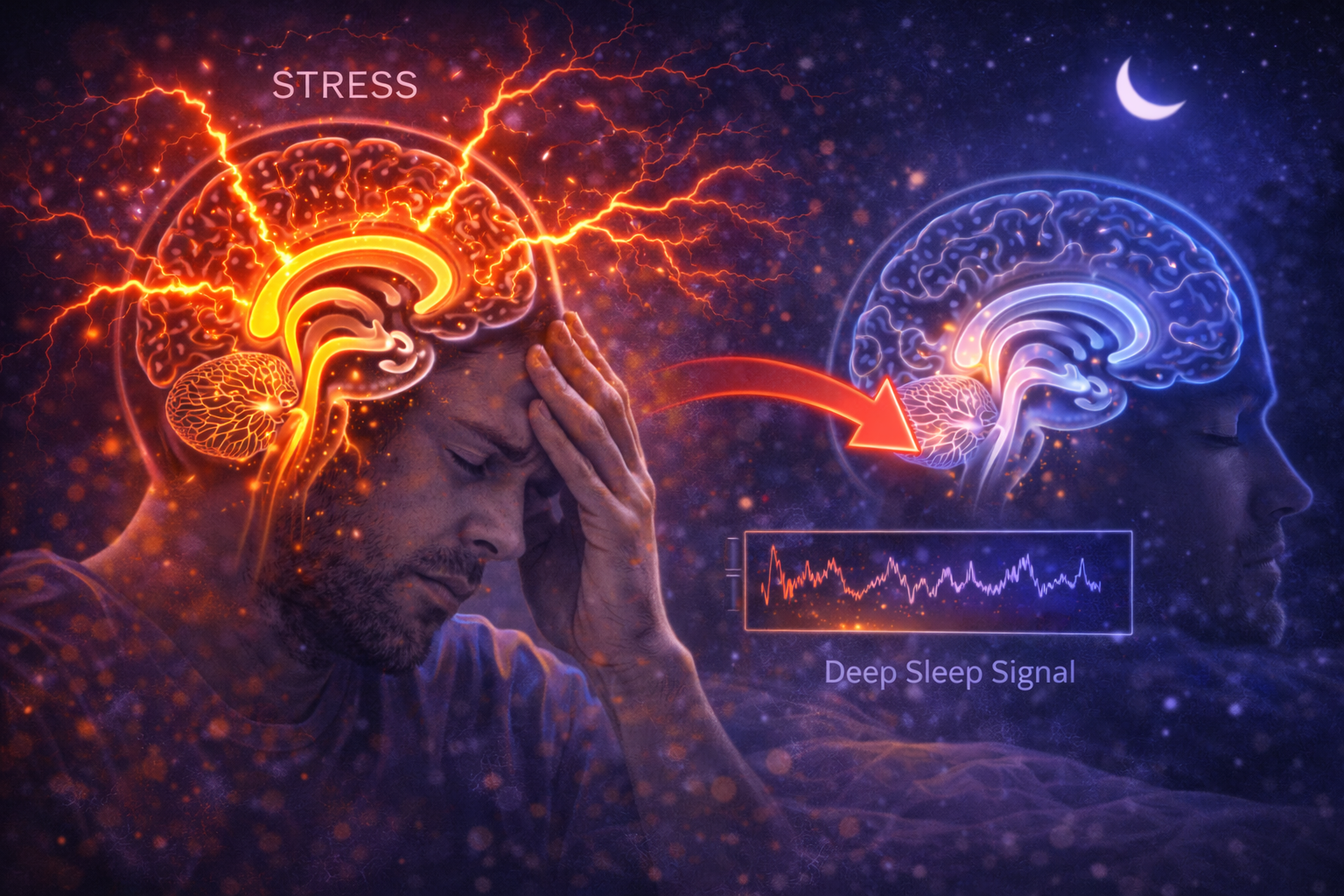
    This is not a coincidence. Stress directly interferes with the brain processes that generate deep sleep. The problem is not simply worry or racing thoughts — it is a biological shift that changes how the brain regulates sleep depth and recovery.


    What Deep Sleep Actually Does

    Deep sleep, also known as slow-wave sleep, is the most restorative stage of sleep.

    During deep sleep, brain activity slows, metabolic waste is cleared more efficiently, and neural repair processes are prioritized. This stage supports physical recovery, cognitive resilience, and emotional stability.

    When deep sleep is reduced, sleep may still occur, but recovery is incomplete.


    How Stress Changes Brain Chemistry

    Stress activates systems designed for short-term survival.

    Hormones such as cortisol and adrenaline increase alertness and prepare the body for action. While useful in acute situations, chronic activation keeps the brain in a state of readiness that conflicts with the conditions required for deep sleep.

    When stress signals remain elevated into the night, the brain struggles to downshift into slow-wave activity.


    Why Stress Prevents the Brain From Slowing Down

    Deep sleep requires a reduction in neural firing and mental activity.

    Stress increases cortical activation, emotional processing, and threat monitoring. Even when the body is physically tired, the brain remains partially alert.

    This heightened arousal makes it difficult to enter and sustain deep sleep, leading to lighter sleep stages and more frequent awakenings.


    The Role of the Autonomic Nervous System

    Stress shifts the balance of the autonomic nervous system.

    The sympathetic branch, associated with alertness and action, becomes dominant. Deep sleep depends on parasympathetic activity, which supports relaxation and recovery.

    When sympathetic activation persists, the physiological environment needed for deep sleep is weakened.


    Why Sleep Duration Doesn’t Compensate for Lost Depth

    Many stressed individuals try to sleep longer to compensate.

    However, extended sleep does not necessarily restore deep sleep if stress remains high. The brain may cycle through lighter stages repeatedly without spending sufficient time in slow-wave sleep.

    As a result, long nights can still feel unrefreshing.


    Stress, Fragmentation, and Micro-Awakenings

    Stress increases sleep fragmentation.

    Micro-awakenings become more frequent, even if they are not consciously remembered. Each interruption disrupts the continuity required for deep sleep to stabilize.

    Over time, this fragmentation significantly reduces total deep sleep across the night.


    The Feedback Loop Between Stress and Poor Sleep

    Reduced deep sleep increases vulnerability to stress.

    Without sufficient deep sleep, emotional regulation weakens, stress tolerance declines, and cognitive resilience drops. This makes daily stressors feel more intense, which further disrupts sleep depth.

    The result is a self-reinforcing cycle of stress and poor recovery.


    Why the Brain Prioritizes Vigilance Over Recovery

    From an evolutionary perspective, stress signals danger.

    When the brain perceives threat — even psychological threat — it prioritizes vigilance over recovery. Deep sleep becomes biologically risky when danger is perceived.

    Modern stress triggers this ancient response, even when no physical danger exists.


    Restoring Conditions for Deep Sleep

    Improving deep sleep under stress is not about forcing relaxation.

    It involves reducing physiological arousal over time and restoring predictability to daily rhythms. Consistent sleep timing, reduced evening stimulation, and gradual stress regulation help the brain relearn when it is safe to enter deep sleep.

    Recovery emerges when the brain no longer expects constant threat.


    The Core Idea to Remember

    Deep sleep declines with stress because stress keeps the brain in a state of alertness.

    When survival systems dominate, recovery systems are suppressed. Sleep still occurs, but its most restorative stage is reduced.

    Protecting deep sleep means reducing chronic stress signals — not just trying harder to sleep. When the brain feels safe enough to slow down, deep sleep returns naturally.

  • How the Circadian Rhythm Controls Hormones

    How the Circadian Rhythm Controls Hormones

    Hormones are often described as chemical messengers that influence how we feel, think, and function. What is less commonly understood is that hormones do not operate randomly. Their release follows a precise biological schedule governed by time, light exposure, and internal signals. At the center of this schedule is the circadian rhythm.

    The circadian rhythm acts as a master timing system, coordinating when hormones rise and fall across the day and night. This timing plays a critical role in energy levels, stress response, sleep quality, and emotional balance. When hormonal timing is aligned, the body functions smoothly. When it is disrupted, even normal hormone levels can feel ineffective.

    The circadian rhythm as a timing system

    The circadian rhythm is a roughly 24-hour internal clock that synchronizes the body with the external light–dark cycle. Rather than directly producing hormones, it tells the body when specific hormones should be released and when they should decline.

    Hormones depend on timing to be effective. A hormone released at the wrong time can create imbalance, even if the total amount is normal. This is why circadian regulation is so important: it ensures coordination across multiple systems rather than isolated chemical signals acting independently.

    Cortisol and the biology of wakefulness

    Cortisol is often labeled a “stress hormone,” but this description is incomplete. Cortisol also plays a vital role in healthy wakefulness and daily energy.

    Under normal circadian conditions, cortisol rises sharply in the early morning. This increase helps mobilize energy, sharpen attention, and prepare the brain and body for the demands of the day. This process is known as the cortisol awakening response.

    When circadian timing is disrupted, cortisol patterns become irregular. Cortisol may remain elevated late at night or fail to rise properly in the morning. The result is often grogginess, low energy, and difficulty feeling alert, even after adequate sleep.

    Melatonin and the signal for sleep

    Melatonin works in opposition to cortisol. Rather than promoting alertness, melatonin signals the body that it is time to rest.

    As evening light decreases, melatonin production increases. This hormonal shift lowers alertness, reduces body temperature, and prepares the nervous system for sleep. Melatonin is not a sleeping drug; it is a biological timing signal. Its effectiveness depends on proper circadian alignment.

    Exposure to artificial light at night suppresses melatonin release. When this signal is delayed or weakened, sleep onset becomes harder and sleep quality declines. Over time, this disruption affects not only sleep but also overall hormonal balance.

    Metabolic hormones and circadian timing

    Circadian rhythm also regulates metabolic hormones such as insulin. The body processes glucose more efficiently at certain times of day, typically earlier rather than late at night.

    Eating late or at irregular times creates a mismatch between metabolic hormone signaling and circadian timing. This mismatch can contribute to energy instability and metabolic stress, even without changes in diet quality.

    Hormonal health is therefore influenced not only by what we eat, but by when the body expects to metabolize nutrients.

    Stress hormones and circadian disruption

    Chronic circadian misalignment places continuous strain on stress-regulating hormones. Irregular sleep schedules, late-night stimulation, and inconsistent light exposure keep the nervous system in a state of partial activation.

    When this happens, stress hormones remain elevated when the body should be recovering. This prevents full physiological downregulation and makes true rest difficult. Over time, this state contributes to emotional volatility, reduced resilience, and mental fatigue.

    Why consistency matters more than precision

    Hormones respond best to predictable patterns. Regular sleep and wake times reinforce circadian signals and allow hormonal cycles to stabilize.

    Inconsistent routines confuse the timing system. Hormones are released unpredictably, reducing their effectiveness and increasing physiological noise. This is why people with irregular schedules often feel “off” even when they believe they are sleeping enough.

    Consistency does not require perfection. It requires giving the circadian system reliable cues day after day.

    Hormonal balance and long-term health

    Because hormones influence nearly every system in the body, circadian disruption has long-term consequences. Energy instability, mood changes, and cognitive fatigue often appear before more serious symptoms emerge.

    Understanding circadian hormone regulation reframes many common complaints. Fatigue, irritability, and poor focus are often timing problems rather than true hormonal deficiencies.

    Supporting circadian alignment is therefore one of the most effective ways to support hormonal health naturally.

    The key takeaway

    Hormones do not function in isolation. They operate on a schedule governed by the circadian rhythm.

    When this timing system is aligned, hormones work together to support energy, clarity, and emotional balance. When it is disrupted, imbalance emerges — even if hormone levels appear normal on paper.

    Understanding how the circadian rhythm controls hormones provides a powerful framework for interpreting sleep, energy, and long-term well-being.