Tag: deep sleep

  • How Sleep Influences Learning Speed

    How Sleep Influences Learning Speed

    Why the brain learns faster when sleep supports memory and neural efficiency

    Learning speed is often attributed to intelligence, talent, or effort. When learning feels slow, the instinct is to practice more, concentrate harder, or push through fatigue.

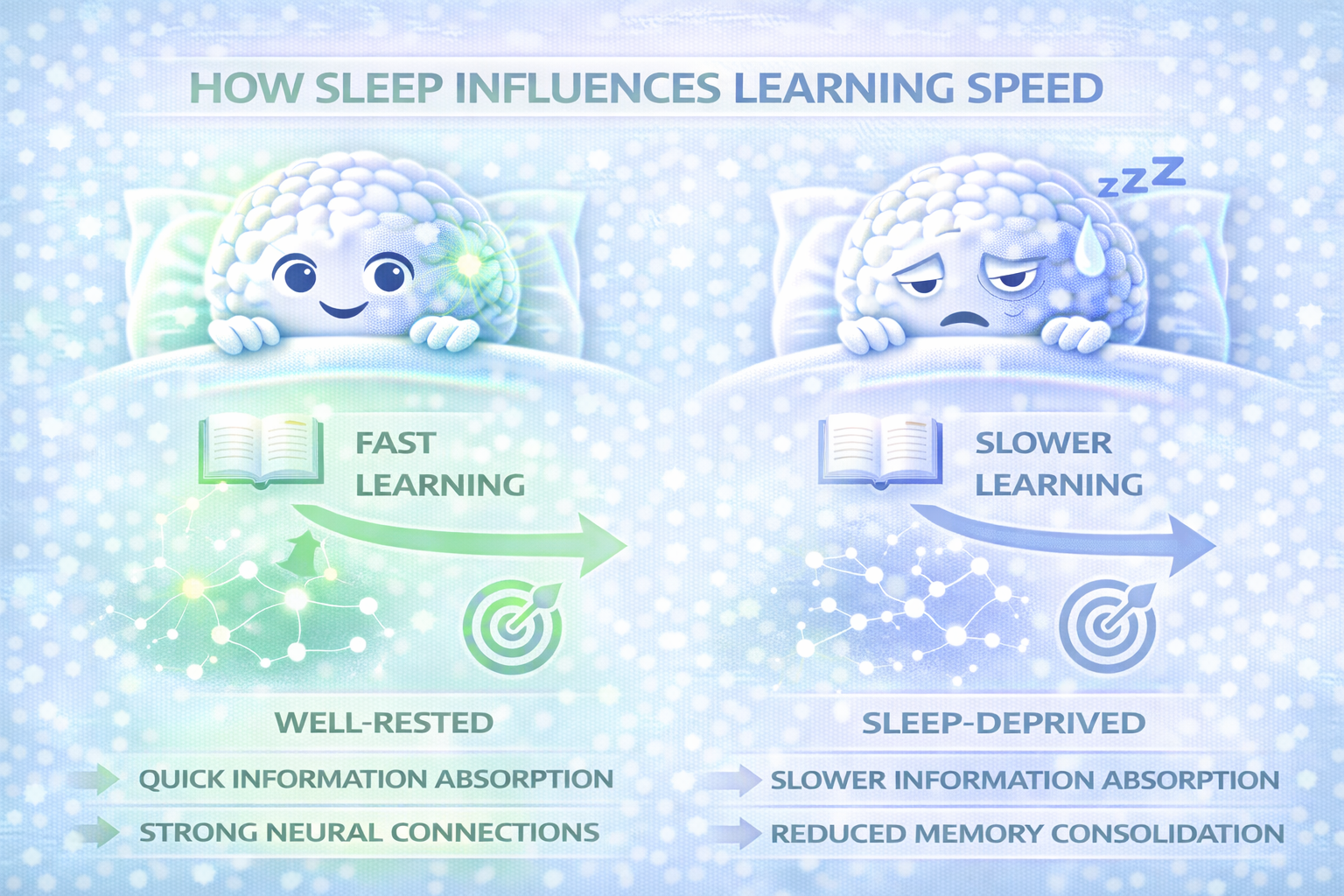
    In reality, how quickly you learn depends heavily on sleep. Sleep determines how efficiently the brain absorbs new information, integrates it with existing knowledge, and prepares itself to learn again the next day. Without proper sleep, learning slows — not because ability disappears, but because the brain’s learning systems are impaired.


    Learning Is a Two-Phase Process

    Learning does not happen all at once.

    The first phase occurs while awake, when information is encoded. The second phase happens during sleep, when that information is stabilized and organized. Learning speed depends on how smoothly these two phases work together.

    When sleep is disrupted, the second phase weakens, slowing future learning even if practice continues.


    Why Sleep Prepares the Brain to Learn

    Sleep restores the brain’s learning capacity.

    During sleep, neural networks reset their sensitivity, clearing space for new information. This prevents saturation of memory systems and improves signal efficiency.

    After good sleep, the brain can encode new material faster and with less effort.


    Deep Sleep and Foundational Learning

    Deep sleep supports the consolidation of factual and conceptual knowledge.

    During this stage, recently learned information is transferred from temporary storage into long-term memory networks. This process reduces interference and stabilizes learning.

    When deep sleep is reduced, new information competes for limited capacity, slowing learning speed.


    REM Sleep and Skill Acquisition

    REM sleep plays a key role in procedural and skill-based learning.

    Motor skills, pattern recognition, and complex problem-solving benefit from REM-related integration. This stage helps refine performance and improve accuracy without additional practice.

    Disrupted REM sleep limits this refinement, making learning feel slower and less efficient.


    Sleep Deprivation and Slower Encoding

    Lack of sleep reduces the brain’s ability to encode information.

    Attention becomes unstable, working memory capacity shrinks, and errors increase. Even when studying longer, the brain absorbs less per unit of effort.

    This creates the illusion that learning ability has declined, when the real issue is reduced neural efficiency.


    Why Sleep Timing Matters for Learning Speed

    Learning speed depends on circadian alignment.

    When learning occurs during periods of high biological alertness, encoding is faster and more reliable. Poorly timed sleep disrupts this rhythm, reducing learning efficiency even after adequate sleep duration.

    Mistimed sleep makes learning inconsistent and unpredictable.


    Fragmented Sleep and Learning Inefficiency

    Learning benefits from uninterrupted sleep cycles.

    Fragmented sleep interrupts the consolidation process, leaving new information partially integrated. This forces the brain to relearn or reinforce material repeatedly.

    As a result, learning feels slower and requires more repetition.


    Why Effort Cannot Replace Sleep for Learning

    Extra effort cannot fully compensate for poor sleep.

    Studying longer while sleep-deprived increases fatigue without proportionally increasing retention. The brain simply cannot process information at normal speed.

    Efficient learning depends more on recovery than on time spent practicing.


    Long-Term Effects on Learning Capacity

    Chronic sleep disruption reduces learning adaptability.

    Over time, the brain becomes less flexible, slower to integrate new information, and more prone to overload. This affects not only academic learning but also everyday skill acquisition.

    Protecting sleep protects the ability to learn efficiently over the long term.


    The Core Idea to Remember

    Sleep is a key determinant of how fast you learn.

    By restoring neural capacity, stabilizing memory, and supporting integration, sleep allows learning to happen quickly and efficiently. Poor sleep slows learning not by reducing intelligence, but by impairing the brain’s ability to process and retain information.

    Learning speed improves when sleep quality is protected.
  • How Sleep Affects Focus and Mental Clarity

    How Sleep Affects Focus and Mental Clarity

    Why a well-rested brain processes information faster and with less effort

    Focus and mental clarity are often treated as skills you train through discipline, motivation, or productivity techniques. When concentration fades, people tend to push harder, rely on caffeine, or blame distraction.

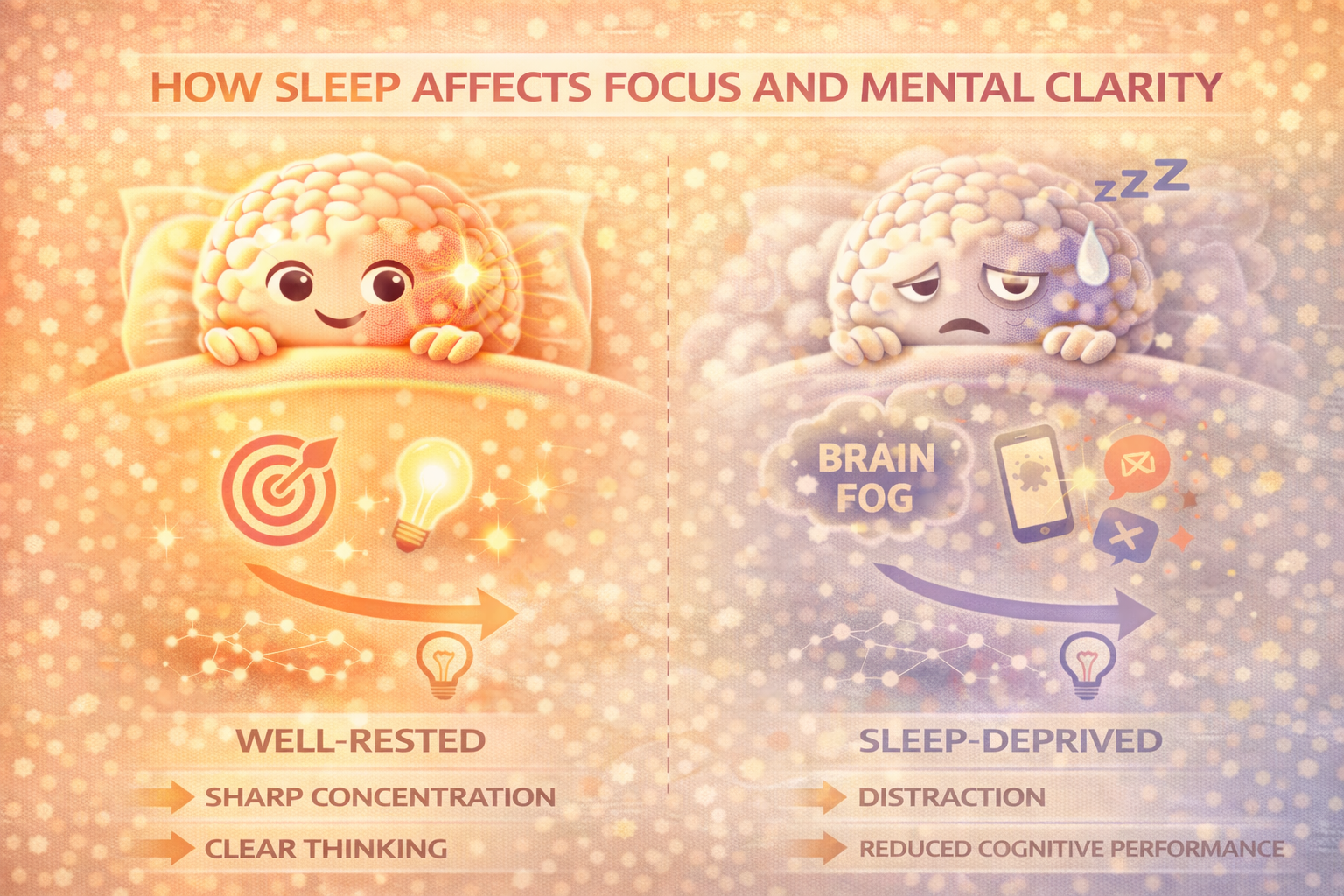
    In reality, focus is primarily a biological state. The brain’s ability to sustain attention, filter irrelevant information, and think clearly depends heavily on sleep quality. When sleep is insufficient, fragmented, or mistimed, mental clarity declines even if motivation remains high.


    Focus Is a Brain State, Not a Personality Trait

    The ability to focus depends on how efficiently the brain regulates attention.

    Sleep supports the balance between neural systems responsible for alertness and those responsible for filtering distractions. When this balance is intact, attention feels natural and effortless.

    When sleep is disrupted, the brain struggles to maintain this balance, making focus feel forced and mentally exhausting.


    How Sleep Restores Attention Networks

    During sleep, the brain recalibrates attention networks.

    Neural connections involved in sustained focus are strengthened, while unnecessary or noisy connections are pruned. This optimization reduces cognitive load and improves signal clarity the next day.

    Without sufficient sleep, attention networks remain inefficient, requiring more effort to achieve the same level of focus.


    Sleep Deprivation and Mental Fog

    Mental fog is one of the earliest signs of poor sleep.

    Sleep loss slows neural communication, reduces processing speed, and weakens coordination between brain regions. Thoughts feel less precise, reactions are delayed, and information feels harder to organize.

    This fog is not subjective—it reflects real changes in brain function.


    The Role of Deep Sleep in Cognitive Clarity

    Deep sleep plays a critical role in restoring mental clarity.

    During slow-wave sleep, metabolic waste is cleared and neural activity becomes synchronized. This process improves signal-to-noise ratio in the brain, making thoughts feel sharper and more coherent.

    Reduced deep sleep leaves the brain cluttered, increasing distraction and mental fatigue.


    REM Sleep and Cognitive Flexibility

    REM sleep supports cognitive flexibility and creative thinking.

    During this stage, the brain integrates information across networks, allowing for insight, pattern recognition, and flexible problem-solving. This integration supports clarity when switching tasks or adapting to new information.

    Disrupted REM sleep reduces this flexibility, making thinking feel rigid or stuck.


    Why Sleep Timing Matters for Focus

    Focus depends not only on sleep duration, but on timing.

    When sleep aligns with the circadian rhythm, alertness rises smoothly during the day. Mistimed sleep produces uneven alertness, leading to periods of fog even after adequate hours in bed.

    Circadian misalignment makes focus unreliable and inconsistent.


    Fragmented Sleep and Attention Lapses

    Interrupted sleep weakens sustained attention.

    Frequent awakenings prevent the brain from completing restorative cycles, leading to micro-lapses in focus the next day. These lapses increase errors and reduce productivity, even when they go unnoticed.

    This is why fragmented sleep often feels worse than short but uninterrupted sleep.


    Why Effort Can’t Replace Sleep for Focus

    Many people try to compensate for poor sleep with effort.

    While motivation can temporarily override fatigue, it cannot restore neural efficiency. The brain continues to operate with reduced capacity, making focus increasingly costly.

    Sustained clarity requires recovery, not willpower.


    Sleep Quality and Decision Fatigue

    Poor sleep accelerates decision fatigue.

    As focus declines, the brain uses more energy to maintain attention. This depletes cognitive resources faster, making decisions feel harder and reducing mental endurance throughout the day.

    Good sleep preserves focus by reducing the cost of thinking.


    Long-Term Effects on Mental Clarity

    Chronic sleep disruption leads to persistent clarity loss.

    Over time, reduced focus becomes normalized. Mental fog, distractibility, and slower thinking are often attributed to stress or aging rather than sleep.

    Restoring sleep quality often restores clarity that people forgot was possible.


    The Core Idea to Remember

    Sleep is one of the strongest determinants of focus and mental clarity.

    A well-rested brain filters distractions, processes information efficiently, and sustains attention with less effort. Poor sleep makes thinking heavier, slower, and less precise.

    Mental clarity is not forced—it is restored overnight, when the brain is allowed to recover.

  • The Relationship Between Sleep and Memory

    The Relationship Between Sleep and Memory

    How sleep stabilizes learning, strengthens recall, and protects cognitive function

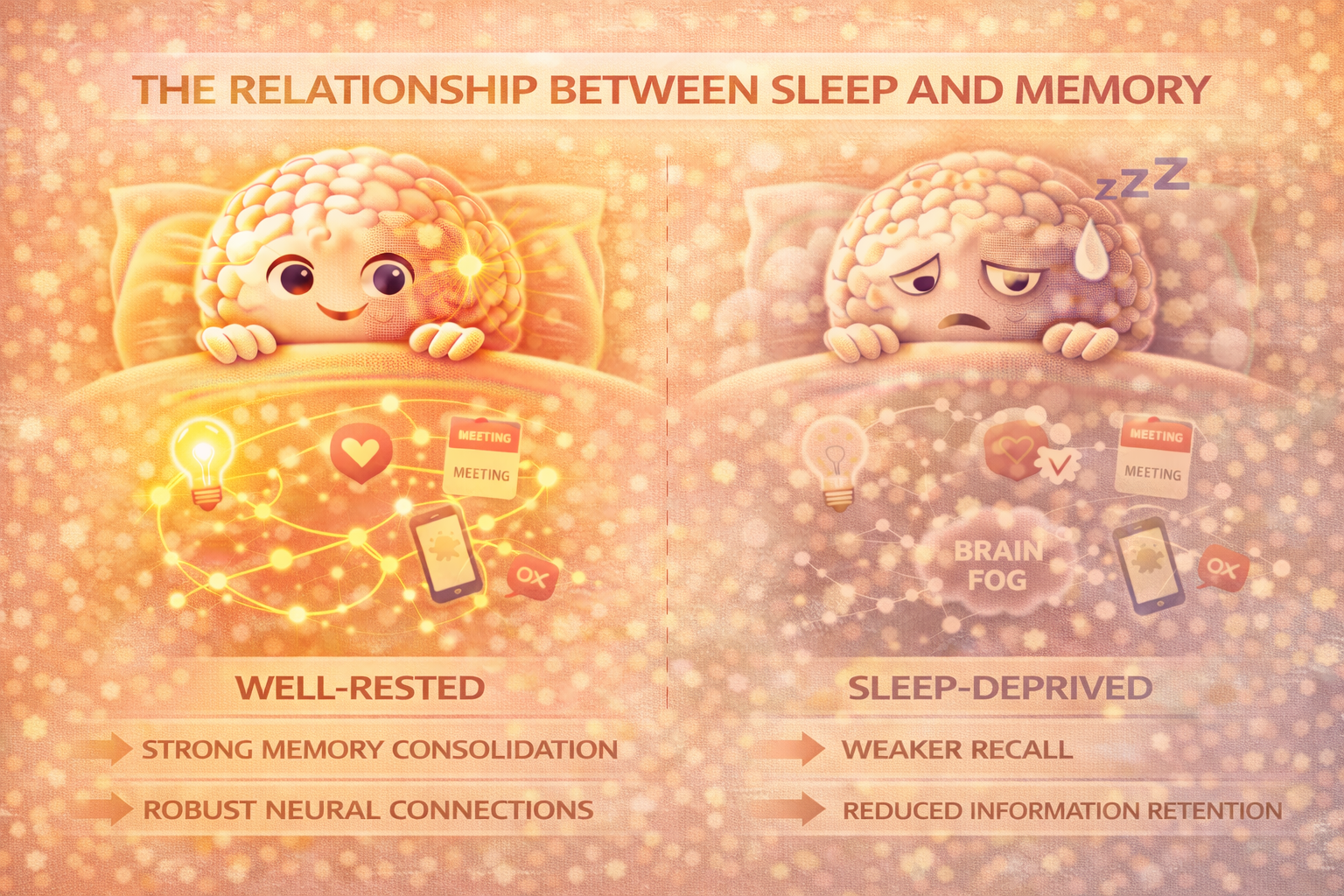
    Memory is often thought of as something that happens while we are awake — during studying, working, or experiencing events. Sleep is usually seen as a passive pause between periods of learning.

    In reality, sleep plays an active and essential role in memory. What you remember, how well you recall it, and how durable those memories become all depend heavily on what happens in the brain during sleep. Without sufficient, well-timed sleep, memory formation remains incomplete and fragile.


    Memory Is Not Finished When Learning Ends

    Learning does not end when you stop paying attention.

    During wakefulness, the brain encodes information, but those memory traces are unstable. They require further processing to become durable and accessible. Sleep provides the conditions needed for this stabilization.

    Without sleep, newly learned information remains vulnerable to interference and loss.


    How Sleep Consolidates Memory

    Memory consolidation is the process by which temporary memories become long-term.

    During sleep, especially during deep sleep and REM sleep, the brain replays and reorganizes neural patterns formed during the day. This replay strengthens important connections and weakens irrelevant ones.

    Through this process, memories become more stable, integrated, and easier to retrieve later.


    The Role of Deep Sleep in Memory Storage

    Deep sleep plays a critical role in consolidating declarative memories — facts, concepts, and experiences.

    During this stage, slow, synchronized brain activity allows information stored temporarily in the hippocampus to be transferred to long-term storage in the cortex. This transfer reduces overload and frees capacity for new learning the next day.

    When deep sleep is reduced, this transfer process becomes less efficient.


    REM Sleep and Emotional Memory

    REM sleep contributes strongly to emotional and procedural memory.

    During REM sleep, emotional experiences are processed and integrated with existing knowledge. This helps regulate emotional responses and reduces the intensity of emotional memories while preserving their content.

    Disrupted REM sleep can leave emotional memories poorly integrated, increasing emotional reactivity and reducing learning efficiency.


    Why Sleep Deprivation Impairs Learning

    Lack of sleep affects memory in two ways.

    First, it weakens the brain’s ability to consolidate memories formed the previous day. Second, it reduces the brain’s ability to encode new information the next day.

    This double impact explains why sleep-deprived individuals struggle both to remember what they learned and to learn anything new.


    Sleep Timing Matters for Memory

    Memory consolidation is sensitive to timing.

    Sleep that occurs at biologically appropriate times supports optimal coordination between sleep stages. Mistimed sleep disrupts this coordination, reducing the effectiveness of memory processing.

    Even long sleep durations may fail to support memory if circadian alignment is poor.


    Fragmented Sleep and Memory Breakdown

    Memory consolidation requires uninterrupted sleep.

    Fragmented sleep interrupts the cycles needed for replay and integration. Frequent awakenings prevent sustained deep and REM sleep, weakening memory stabilization.

    As a result, sleep fragmentation often leads to forgetfulness, reduced recall accuracy, and mental fog.


    Why You Remember Better After Good Sleep

    After high-quality sleep, memories feel clearer and more accessible.

    This is not because you tried harder to remember, but because the brain completed its overnight processing. Neural connections are stronger, interference is reduced, and retrieval becomes easier.

    Sleep improves memory efficiency, not just storage.


    Long-Term Effects of Poor Sleep on Memory

    Chronic sleep disruption affects memory over time.

    Repeated impairment of consolidation weakens learning capacity, slows cognitive processing, and reduces mental flexibility. These effects are often gradual and mistaken for aging or stress.

    Protecting sleep protects long-term cognitive health.


    Why Sleep Is Not Optional for Memory

    Memory depends on sleep as much as it depends on attention.

    Without regular, well-timed sleep, learning remains incomplete. The brain cannot compensate for missing sleep through effort or repetition alone.

    Sleep is the phase where memory becomes durable.


    The Core Idea to Remember

    Sleep is a central part of how memory works.

    During sleep, the brain stabilizes, organizes, and integrates what you learn. Without it, memories remain fragile and learning capacity declines.

    Good memory is not just about what you do while awake — it is about what your brain is allowed to do while you sleep.

  • Sleep Fragmentation: Why Interrupted Sleep Feels So Bad

    Sleep Fragmentation: Why Interrupted Sleep Feels So Bad

    How repeated awakenings disrupt recovery even when total sleep time looks normal

    Many people sleep for what appears to be a full night yet wake up feeling exhausted, foggy, or irritable. They may not remember waking up often, but the sleep still feels shallow and unrefreshing.

    This experience is usually caused by sleep fragmentation. Interrupted sleep prevents the brain from completing the continuous processes required for restoration. The problem is not always how long you sleep, but how often that sleep is broken.


    What Sleep Fragmentation Really Is

    Sleep fragmentation occurs when sleep is repeatedly interrupted throughout the night.

    These interruptions can be brief awakenings, shifts to lighter sleep stages, or micro-arousals that are not consciously remembered. Even short disruptions can break the continuity the brain needs to maintain restorative sleep.

    From a biological perspective, fragmented sleep is very different from uninterrupted sleep, even if total hours are identical.


    Why Continuous Sleep Matters

    Sleep is designed to unfold in cycles.

    Each cycle builds on the previous one, allowing deeper stages of sleep and REM sleep to stabilize. When sleep is interrupted, these cycles are cut short or restarted.

    As a result, the brain spends more time transitioning between stages and less time in the stages responsible for recovery, memory processing, and emotional regulation.


    Deep Sleep and Fragmentation

    Deep sleep is particularly vulnerable to fragmentation.

    This stage requires sustained stability in brain activity. Frequent interruptions prevent deep sleep from consolidating, reducing its total duration and effectiveness.

    Even small disturbances can significantly reduce the amount of deep sleep across the night, weakening physical and cognitive recovery.


    REM Sleep Disruption and Emotional Effects

    Fragmentation also affects REM sleep.

    REM sleep plays a key role in emotional processing and memory integration. When REM periods are repeatedly interrupted, emotional regulation suffers.

    This contributes to irritability, heightened stress sensitivity, and emotional volatility the following day.


    Why Fragmented Sleep Feels Worse Than Short Sleep

    Many people report feeling worse after fragmented sleep than after intentionally short but uninterrupted sleep.

    This is because the brain never fully settles into restorative states. Constant disruption keeps neural systems partially alert, increasing biological effort and reducing efficiency.

    Sleep becomes work instead of recovery.


    Common Causes of Sleep Fragmentation

    Sleep fragmentation can arise from many sources, including:

    • stress and hyperarousal

    • noise or light exposure

    • irregular sleep schedules

    • sleep-disordered breathing

    • physical discomfort or pain

    Often, multiple factors interact to create repeated disruption.


    Fragmentation and the Stress Response

    Interrupted sleep activates stress systems.

    Each awakening triggers a brief stress response, increasing heart rate and alertness. When this happens repeatedly, the body remains in a semi-alert state throughout the night.

    This prevents full downregulation of stress hormones and contributes to morning fatigue.


    Why Fragmentation Accumulates Over Time

    One night of fragmented sleep is manageable.

    Repeated nights create cumulative effects. As restorative processes remain incomplete, sleep debt builds and resilience declines.

    Over time, fragmented sleep can lead to persistent fatigue, reduced concentration, and emotional instability.


    Why Sleeping Longer Doesn’t Fix Fragmentation

    Sleeping longer does not necessarily solve fragmented sleep.

    If interruptions continue, additional time in bed simply adds more broken sleep cycles. Recovery remains inefficient, and fatigue persists.

    Improving sleep continuity is more effective than increasing sleep duration.


    Supporting Sleep Continuity

    Improving sleep continuity involves reducing disruptions rather than forcing sleep.

    Stable sleep timing, reduced nighttime stimulation, and minimizing environmental disturbances help the brain maintain uninterrupted sleep cycles.

    When continuity improves, sleep often feels deeper and more refreshing without increasing total hours.


    The Core Idea to Remember

    Interrupted sleep feels bad because it breaks the brain’s recovery process.

    Sleep fragmentation prevents deep and REM sleep from stabilizing, increases nighttime stress responses, and reduces overall sleep efficiency.

    Sleep quality depends heavily on continuity. When sleep remains uninterrupted, the brain can recover as designed

  • How Sleep Quality Declines With Age

    How Sleep Quality Declines With Age

    Why the brain’s ability to generate restorative sleep changes over time

    As people get older, sleep often becomes lighter and less predictable. Nights that once felt deep and uninterrupted are replaced by longer time spent falling asleep, frequent awakenings, and mornings that feel less refreshing.

    These changes are commonly blamed on habits, lifestyle, or simply “getting older.” In reality, sleep quality declines with age because the biological systems that regulate sleep gradually change. The brain still needs sleep, but it becomes less efficient at producing the kind of sleep that feels truly restorative.


    Aging Does Not Eliminate the Need for Sleep

    One widespread belief is that older adults simply require less sleep.

    Biologically, this is not accurate. The brain’s need for recovery, memory processing, and metabolic regulation remains largely intact across adulthood. What changes is the brain’s capacity to generate consolidated, high-quality sleep.

    This is why many older individuals spend enough time in bed yet still feel unrefreshed the next day.


    How Sleep Architecture Shifts With Age

    Sleep is organized into stages that follow a repeating pattern throughout the night.

    With age, this structure becomes less stable. Deep sleep tends to decrease, light sleep occupies a larger portion of the night, and transitions between stages become more frequent.

    These shifts reduce sleep continuity. Even when total sleep time remains similar, the restorative value of sleep declines because the most recovery-focused stages occur less consistently.


    Why Deep Sleep Becomes More Fragile

    Deep sleep depends on synchronized, slow brain activity.

    As the brain ages, neural networks become less tightly coordinated. The brain also becomes more reactive to internal signals and external disturbances. This makes it harder to maintain the slow, stable activity patterns required for deep sleep.

    As a result, deep sleep becomes shorter, lighter, and more easily disrupted.


    Circadian Rhythm Changes Across the Lifespan

    The circadian rhythm also evolves with age.

    Many people experience an advance in circadian timing, meaning they feel sleepy earlier in the evening and wake earlier in the morning. While this shift is biological, it can conflict with modern schedules and social routines.

    When circadian timing and lifestyle are misaligned, sleep efficiency declines and nighttime awakenings become more frequent.


    Increased Sensitivity to Sleep Disruption

    With age, the brain becomes more sensitive to disturbance.

    Light, noise, temperature changes, physical discomfort, and stress that once had little impact can now interrupt sleep. These interruptions may be brief and unnoticed, but they fragment sleep and reduce overall quality.

    Sleep becomes more dependent on a stable, supportive environment.


    Hormonal Regulation and Sleep Stability

    Sleep quality is influenced by hormonal signaling.

    Age-related changes in melatonin release, stress hormone regulation, and body temperature rhythms alter how smoothly the brain transitions into sleep and maintains it through the night.

    These changes do not prevent sleep, but they reduce its stability and depth, making sleep more vulnerable to disruption.


    Why Fragmentation Matters More Than Hours Slept

    Fragmented sleep is one of the most important contributors to declining sleep quality.

    Frequent micro-awakenings interrupt restorative processes, even if total sleep duration appears sufficient. The brain exits deeper sleep stages repeatedly, limiting recovery.

    This is why people can sleep for many hours yet still feel mentally and physically tired.


    Cognitive and Emotional Consequences

    As sleep quality declines, daytime effects become more noticeable.

    Common experiences include slower thinking, reduced concentration, increased emotional reactivity, and lower stress tolerance. These effects are often attributed to aging itself, when disrupted sleep plays a significant role.

    Sleep quality strongly influences how aging is experienced cognitively and emotionally.


    Why Declining Sleep Quality Is Not Inevitable

    Although sleep changes with age, poor sleep is not unavoidable.

    The aging brain responds strongly to consistency. Stable sleep timing, protected circadian rhythms, and reduced nighttime disruption can significantly improve sleep quality at any age.

    While sleep may differ from earlier life, it can remain restorative when biological needs are respected.


    The Core Idea to Remember

    Sleep quality declines with age because the brain becomes less efficient at producing deep, stable sleep — not because sleep is no longer needed.

    Changes in sleep architecture, circadian timing, and sensitivity to disruption all contribute to lighter, more fragmented nights.

    Understanding these biological shifts allows sleep to be supported intelligently, improving quality of life rather than accepting poor sleep as inevitable.

  • Why Deep Sleep Declines With Stress

    Why Deep Sleep Declines With Stress

    How chronic stress interferes with the brain’s ability to enter restorative sleep

    Many people under stress notice the same pattern: sleep becomes lighter, more fragmented, and less refreshing. Even when they spend enough hours in bed, they wake up feeling unrested, tense, or mentally drained.

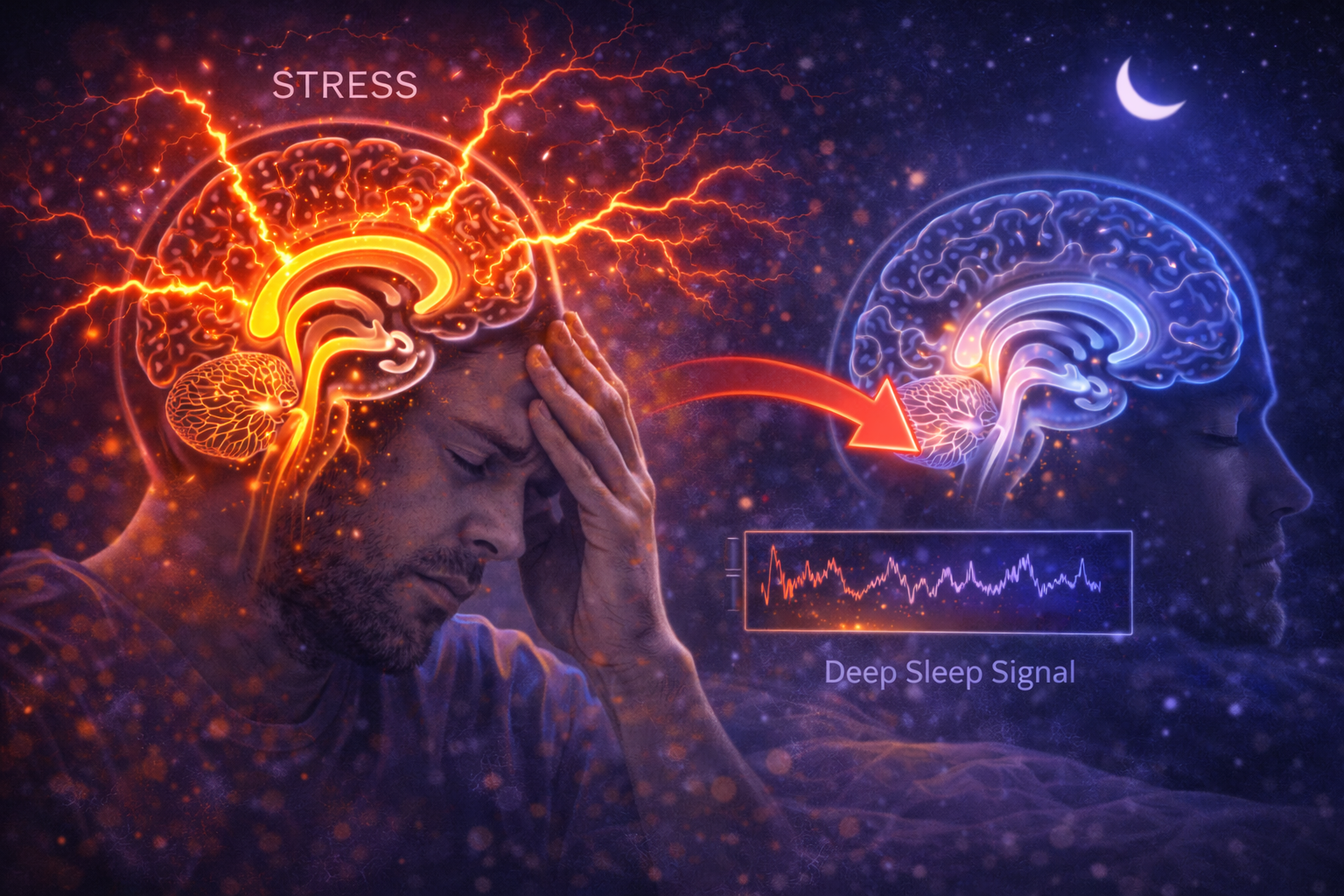
    This is not a coincidence. Stress directly interferes with the brain processes that generate deep sleep. The problem is not simply worry or racing thoughts — it is a biological shift that changes how the brain regulates sleep depth and recovery.


    What Deep Sleep Actually Does

    Deep sleep, also known as slow-wave sleep, is the most restorative stage of sleep.

    During deep sleep, brain activity slows, metabolic waste is cleared more efficiently, and neural repair processes are prioritized. This stage supports physical recovery, cognitive resilience, and emotional stability.

    When deep sleep is reduced, sleep may still occur, but recovery is incomplete.


    How Stress Changes Brain Chemistry

    Stress activates systems designed for short-term survival.

    Hormones such as cortisol and adrenaline increase alertness and prepare the body for action. While useful in acute situations, chronic activation keeps the brain in a state of readiness that conflicts with the conditions required for deep sleep.

    When stress signals remain elevated into the night, the brain struggles to downshift into slow-wave activity.


    Why Stress Prevents the Brain From Slowing Down

    Deep sleep requires a reduction in neural firing and mental activity.

    Stress increases cortical activation, emotional processing, and threat monitoring. Even when the body is physically tired, the brain remains partially alert.

    This heightened arousal makes it difficult to enter and sustain deep sleep, leading to lighter sleep stages and more frequent awakenings.


    The Role of the Autonomic Nervous System

    Stress shifts the balance of the autonomic nervous system.

    The sympathetic branch, associated with alertness and action, becomes dominant. Deep sleep depends on parasympathetic activity, which supports relaxation and recovery.

    When sympathetic activation persists, the physiological environment needed for deep sleep is weakened.


    Why Sleep Duration Doesn’t Compensate for Lost Depth

    Many stressed individuals try to sleep longer to compensate.

    However, extended sleep does not necessarily restore deep sleep if stress remains high. The brain may cycle through lighter stages repeatedly without spending sufficient time in slow-wave sleep.

    As a result, long nights can still feel unrefreshing.


    Stress, Fragmentation, and Micro-Awakenings

    Stress increases sleep fragmentation.

    Micro-awakenings become more frequent, even if they are not consciously remembered. Each interruption disrupts the continuity required for deep sleep to stabilize.

    Over time, this fragmentation significantly reduces total deep sleep across the night.


    The Feedback Loop Between Stress and Poor Sleep

    Reduced deep sleep increases vulnerability to stress.

    Without sufficient deep sleep, emotional regulation weakens, stress tolerance declines, and cognitive resilience drops. This makes daily stressors feel more intense, which further disrupts sleep depth.

    The result is a self-reinforcing cycle of stress and poor recovery.


    Why the Brain Prioritizes Vigilance Over Recovery

    From an evolutionary perspective, stress signals danger.

    When the brain perceives threat — even psychological threat — it prioritizes vigilance over recovery. Deep sleep becomes biologically risky when danger is perceived.

    Modern stress triggers this ancient response, even when no physical danger exists.


    Restoring Conditions for Deep Sleep

    Improving deep sleep under stress is not about forcing relaxation.

    It involves reducing physiological arousal over time and restoring predictability to daily rhythms. Consistent sleep timing, reduced evening stimulation, and gradual stress regulation help the brain relearn when it is safe to enter deep sleep.

    Recovery emerges when the brain no longer expects constant threat.


    The Core Idea to Remember

    Deep sleep declines with stress because stress keeps the brain in a state of alertness.

    When survival systems dominate, recovery systems are suppressed. Sleep still occurs, but its most restorative stage is reduced.

    Protecting deep sleep means reducing chronic stress signals — not just trying harder to sleep. When the brain feels safe enough to slow down, deep sleep returns naturally.

  • How Sleep Affects Brain Detoxification

    How Sleep Affects Brain Detoxification

    Why deep, well-timed sleep is essential for clearing metabolic waste from the brain

    Sleep is often described as a period of rest, but one of its most critical roles is far more active. During sleep, the brain engages in a vital maintenance process: clearing metabolic waste that accumulates during waking hours.

    When sleep is insufficient or poorly timed, this detoxification process becomes less efficient. Over time, waste products build up, contributing to mental fog, reduced cognitive performance, and long-term neurological strain. Understanding how sleep supports brain detoxification reveals why sleep quality matters as much as sleep duration.


    Why the Brain Needs Detoxification

    The brain is metabolically active.

    Every thought, movement, and decision produces waste products as a byproduct of neural activity. Unlike other organs, the brain lacks a traditional lymphatic system to clear this waste during waking hours.

    Instead, the brain relies on specialized processes that become active primarily during sleep. Without regular and efficient clearance, these byproducts accumulate and interfere with normal brain function.


    The Glymphatic System and Sleep

    Brain detoxification is carried out by a network known as the glymphatic system.

    This system allows cerebrospinal fluid to flow through brain tissue, flushing out metabolic waste and transporting it away for removal. During sleep, especially deep sleep, the space between brain cells expands, allowing this fluid movement to increase dramatically.

    When awake, glymphatic activity is significantly reduced. Sleep creates the conditions required for this system to operate effectively.


    Why Deep Sleep Matters Most

    Not all sleep stages contribute equally to detoxification.

    Deep sleep, also known as slow-wave sleep, is particularly important for glymphatic clearance. During this stage, neural activity slows, brain cells shrink slightly, and fluid flow increases.

    If deep sleep is shortened or fragmented, detoxification efficiency declines. Even long sleep durations may not compensate for a lack of sufficient deep sleep.


    Timing and Brain Cleaning Efficiency

    Detoxification is not only dependent on sleep stages but also on timing.

    The circadian rhythm influences when the brain is most prepared to enter deep sleep and initiate clearance processes. Sleeping during biological night supports deeper, more stable sleep architecture.

    Mistimed sleep — such as sleeping too late, too early, or during the day — can reduce the amount and quality of deep sleep, weakening detoxification even if total sleep time seems adequate.


    What Happens When Detoxification Is Disrupted

    When brain detoxification is impaired, the effects are often subtle at first.

    Common signs include:

    • mental fog

    • reduced concentration

    • slower thinking

    • headaches or pressure-like sensations

    Over time, chronic disruption may contribute to cognitive decline, emotional instability, and reduced resilience to stress.

    These symptoms are often mistaken for general fatigue or aging rather than impaired brain maintenance.


    Why Sleep Deprivation Amplifies Brain Waste

    Sleep deprivation dramatically reduces glymphatic activity.

    Without adequate sleep, waste products accumulate faster than they can be cleared. This buildup increases sleep pressure and contributes to the heavy, foggy feeling associated with prolonged wakefulness.

    The brain’s urgent need for sleep is, in part, a signal that detoxification has been delayed.


    Fragmented Sleep and Incomplete Cleaning

    Sleep fragmentation also interferes with brain detoxification.

    Frequent awakenings prevent sustained deep sleep, interrupting fluid flow through brain tissue. Even if total sleep time is sufficient, repeated interruptions reduce the effectiveness of clearance.

    This explains why fragmented sleep often feels unrefreshing and mentally draining.


    The Long-Term Importance of Regular Detoxification

    Brain detoxification is not a one-time process.

    It occurs nightly and supports long-term cognitive health. Consistently disrupted sleep may impair the brain’s ability to maintain a clean internal environment, increasing vulnerability to neurological stress over time.

    While research continues to explore long-term implications, the importance of sleep for brain maintenance is already clear.


    Supporting Brain Detoxification Through Sleep

    Supporting brain detoxification does not require extreme interventions.

    Consistent sleep timing, sufficient deep sleep, and alignment with the circadian rhythm all promote effective clearance. Reducing sleep disruption and protecting biological night allow the brain’s maintenance systems to function as intended.

    Sleep quality, not just quantity, is the foundation of this process.


    The Core Idea to Remember

    Sleep is essential for brain detoxification.

    During deep, well-timed sleep, the brain clears metabolic waste that cannot be removed efficiently while awake. When sleep is disrupted, mistimed, or fragmented, this cleaning process suffers — and cognitive clarity declines as a result.

    Protecting sleep means protecting the brain’s ability to maintain itself, night after night.

  • How Sleep Shapes Brain Plasticity

    How Sleep Shapes Brain Plasticity

    Sleep Is Not Passive: It Actively Rewires the Brain

    For decades, sleep was seen as a passive state—a period where the brain simply “shut down” to recover energy. Modern neuroscience has completely overturned this idea.

    Sleep is one of the most active and critical periods for brain plasticity, the brain’s ability to change, adapt, and reorganize itself. Without sleep, learning stalls, memory fragments, and neural networks lose efficiency.

    In short:
    Sleep is not rest for the brain. It is construction time.


    What Brain Plasticity Really Means

    Brain plasticity (or neuroplasticity) refers to the brain’s capacity to:

    • Strengthen or weaken synaptic connections

    • Create new neural pathways

    • Prune unnecessary or inefficient connections

    • Adapt to new experiences, skills, and environments

    Plasticity is what allows you to learn a language, improve a skill, recover after injury, and integrate emotional experiences.

    Crucially, plasticity does not happen evenly across the day.
    It is strongly dependent on sleep.


    Why Sleep Is the Brain’s Main Remodeling Phase

    During wakefulness, the brain is busy processing incoming information. Neurons fire constantly, synapses strengthen rapidly, and networks become saturated.

    Sleep provides the conditions needed to rebalance and refine this activity.

    Research shows that during sleep:

    • Irrelevant synapses are weakened

    • Important connections are stabilized

    • Neural noise is reduced

    • Signal efficiency improves

    This process is often described as synaptic homeostasis: the brain resets itself to remain flexible rather than overloaded.

    Without this reset, learning becomes inefficient and unstable.


    Deep Sleep and Structural Plasticity

    Deep sleep (also called slow-wave sleep) plays a key role in structural plasticity.

    During this phase:

    • Brain waves slow dramatically

    • Growth-related processes increase

    • Metabolic waste is cleared more efficiently

    Studies indicate that deep sleep supports:

    • Synaptic downscaling (removing excess connections)

    • Long-term network stability

    • Brain tissue maintenance

    This explains why chronic sleep deprivation is linked to reduced cognitive flexibility, slower learning, and impaired problem-solving.

    Deep sleep does not make you smarter—it prevents the brain from becoming rigid.


    REM Sleep, Learning, and Emotional Plasticity

    REM sleep (Rapid Eye Movement sleep) is strongly associated with:

    • Memory integration

    • Emotional processing

    • Creative recombination of information

    During REM sleep, the brain shows activity patterns similar to wakefulness, but without external input. This allows memories to be replayed, reinterpreted, and emotionally reweighted.

    REM sleep is especially important for:

    • Skill learning

    • Language acquisition

    • Emotional regulation

    • Trauma processing

    When REM sleep is disrupted, people often experience:

    • Emotional instability

    • Poor memory consolidation

    • Reduced creativity

    This is why sleep problems frequently coexist with anxiety, depression, and burnout.


    Sleep Loss and Reduced Plasticity

    When sleep is insufficient or fragmented, brain plasticity suffers.

    Research consistently shows that sleep deprivation leads to:

    • Reduced synaptic strength

    • Impaired memory consolidation

    • Slower learning rates

    • Decreased adaptability to new tasks

    Even a single night of poor sleep can reduce the brain’s ability to modify synaptic connections the next day.

    Over time, chronic sleep loss pushes the brain toward rigidity rather than flexibility—a state linked to cognitive decline and emotional dysregulation.


    Why Plasticity Needs Both Sleep and Wake

    Plasticity is a two-phase process:

    • Wake: information is encoded

    • Sleep: information is refined and integrated

    Without wakefulness, there is nothing to consolidate.
    Without sleep, consolidation fails.

    This explains why simply “studying more” without sleeping does not improve performance—and often worsens it.

    Sleep does not add new information.
    It organizes what you already experienced.


    Aging, Sleep, and Brain Adaptability

    As people age, sleep architecture changes:

    • Less deep sleep

    • More fragmented nights

    • Altered REM patterns

    These changes are strongly associated with reduced plasticity and slower learning.

    However, studies also show that improving sleep quality can partially restore plasticity, even later in life. Sleep remains one of the most accessible levers to protect cognitive function over time.


    The Key Takeaway

    Brain plasticity does not happen by chance.
    It is scheduled, and sleep is the schedule.

    Sleep is when the brain:

    • Decides what matters

    • Removes what doesn’t

    • Strengthens what should last

    If learning, memory, or mental flexibility feel impaired, the problem is often not intelligence or effort—but sleep quality.

    Sleep shapes the brain because it is when the brain shapes itself.

  • REM Sleep vs Deep Sleep: What Actually Restores the Brain

    REM Sleep vs Deep Sleep: What Actually Restores the Brain

    When people talk about “good sleep,” they often imagine a single, uniform state of rest. In reality, sleep is made up of multiple stages, each serving a different biological purpose. Among these stages, two stand out for their role in recovery: deep sleep and REM sleep.

    Both are essential, but they restore the brain in very different ways. Understanding the difference between them helps explain why some nights feel deeply restorative while others leave you mentally drained, even after a full night in bed.


    The structure of sleep cycles

    Sleep is not static. Throughout the night, the brain moves through repeating cycles that include lighter stages of sleep, deep sleep, and REM sleep. Each cycle lasts roughly 90 minutes, and the proportion of stages shifts as the night progresses.

    Early in the night, deep sleep dominates. As morning approaches, REM sleep becomes longer and more frequent. This timing is not accidental. It reflects the different recovery needs of the brain and body at different points in the night.

    Good sleep depends on allowing these cycles to unfold naturally, without excessive disruption.

    These cycles are regulated by the circadian rhythm, the internal biological clock that determines when the brain moves through different stages of sleep.


    What deep sleep actually does

    Deep sleep is the most physically restorative stage of sleep. During this phase, brain activity slows significantly, external awareness is reduced, and the nervous system enters a state of profound recovery.

    One of the key functions of deep sleep is physical and neurological maintenance. Metabolic waste products that accumulate during waking hours are cleared more efficiently, and energy reserves are restored. The brain becomes less responsive to external stimuli, allowing internal repair processes to take priority.

    Deep sleep also plays a role in stabilizing the nervous system. It supports immune function, stress recovery, and overall physiological balance. Without enough deep sleep, the body feels worn down, even if total sleep time appears adequate.


    The unique role of REM sleep

    REM sleep serves a different purpose. During this stage, brain activity becomes more complex and resembles waking patterns. Dreaming is most vivid, and emotional processing intensifies.

    REM sleep is essential for cognitive and emotional restoration. It helps integrate memories, regulate mood, and maintain mental flexibility. Experiences from the day are reorganized, and emotional reactions are softened.

    This stage supports learning, creativity, and emotional resilience. When REM sleep is shortened or fragmented, people often experience irritability, poor emotional regulation, and reduced mental clarity — even if they don’t feel physically tired.


    Why one cannot replace the other

    A common misconception is that one type of sleep can compensate for the other. In reality, deep sleep and REM sleep are not interchangeable.

    Deep sleep restores the brain’s physical foundation. REM sleep fine-tunes emotional and cognitive functioning. Losing either one creates a specific form of imbalance.

    A night with adequate deep sleep but poor REM sleep may leave you emotionally reactive and mentally unfocused. A night rich in REM sleep but lacking deep sleep may result in physical fatigue and reduced stress tolerance.

    True recovery requires both.

    Understanding the balance between deep sleep and REM sleep is essential for defining good sleep quality from a scientific perspective.


    How disruption affects sleep stages

    Sleep stages are sensitive to disruption. Stress, irregular schedules, light exposure at night, and frequent awakenings can all interfere with the normal progression of deep and REM sleep.

    Deep sleep is particularly vulnerable to stress and late-night stimulation, while REM sleep is often shortened by early alarms or irregular wake times. Over time, this imbalance accumulates, even if total sleep duration remains stable.

    This explains why many people feel chronically under-recovered without being clinically sleep-deprived.


    Why you may sleep “enough” but still feel off

    Because deep sleep and REM sleep serve different functions, problems in either stage can produce specific symptoms. Physical heaviness, low resilience, and frequent illness often point to insufficient deep sleep. Emotional volatility, brain fog, and reduced creativity often reflect disrupted REM sleep.

    Importantly, these symptoms do not always appear immediately. The brain can compensate temporarily, masking the effects until the imbalance becomes chronic.


    The role of timing and consistency

    Both deep sleep and REM sleep depend on circadian alignment. When sleep occurs at biologically appropriate times, these stages unfold more efficiently.

    Consistency reinforces this process. Regular sleep schedules help the brain anticipate when to enter each stage, improving both depth and continuity. Irregular timing confuses the system, reducing the quality of both deep and REM sleep.

    Proper timing also supports hormonal regulation, which is controlled by the circadian rhythm’s influence on hormones


    What truly restores the brain

    Brain restoration is not about maximizing a single sleep stage. It is about balance, timing, and stability.

    Deep sleep repairs the brain’s infrastructure. REM sleep restores its flexibility and emotional balance. Together, they create a system that supports clarity, resilience, and long-term cognitive health.

    When either stage is compromised, recovery feels incomplete — no matter how many hours you spend in bed.


    The key takeaway

    Deep sleep and REM sleep are not competing priorities. They are complementary processes that restore different aspects of brain function.

    Understanding their roles shifts the focus away from sleep quantity and toward sleep quality. True restoration happens when the brain is allowed to move naturally through both stages, night after night.

    This distinction is fundamental to understanding why sleep works — and why it sometimes doesn’t.

  • What “Good Sleep” Actually Means Scientifically

    What “Good Sleep” Actually Means Scientifically

    Most people believe they know what good sleep looks like. If you sleep for seven or eight hours, don’t wake up too often, and feel reasonably rested in the morning, you assume your sleep is “good enough.”
    But from a scientific perspective, good sleep is not defined by hours alone — and it’s not always obvious from how you feel when you wake up.

    Sleep quality is a biological process, not a subjective impression. To understand what good sleep actually means, it’s necessary to look beyond duration and examine how the brain and body recover during the night.


    Why sleep duration is an incomplete measure

    Sleep duration is the most commonly used metric when people talk about sleep health. While total sleep time does matter, it tells only part of the story.

    Two people can sleep the same number of hours and experience vastly different levels of recovery. One may wake up mentally clear and energized, while the other feels foggy, heavy, and unfocused. The difference lies not in how long they slept, but in how that sleep unfolded biologically.

    Good sleep depends on structure, timing, and continuity — not just on how many hours pass between bedtime and wake-up.


    The architecture of good sleep

    Scientifically, sleep is divided into multiple stages that repeat in cycles throughout the night. These stages are not interchangeable. Each one plays a distinct role in restoration.

    Deep sleep is critical for physical recovery and brain maintenance. During this stage, the brain reduces external responsiveness, metabolic waste is cleared more efficiently, and the nervous system downshifts into a state of repair.

    REM sleep, on the other hand, supports emotional regulation, memory integration, and cognitive flexibility. It helps the brain process experiences and maintain mental balance.

    Good sleep is not about maximizing one stage at the expense of the other. It’s about allowing these stages to occur in the right proportions and at the right times.


    Why timing matters as much as structure

    Even perfectly structured sleep can lose its restorative value if it occurs at the wrong biological time. Sleep is regulated by the circadian rhythm, an internal clock that determines when the brain is most prepared for rest.

    Sleeping out of sync with this rhythm disrupts the natural progression of sleep stages. Deep sleep may become fragmented, REM sleep may be shortened, and transitions between stages may be less efficient.

    This is why sleeping during irregular hours often feels less refreshing, even if the total duration appears adequate. Good sleep is aligned sleep.


    Continuity: the hidden factor in sleep quality

    Another defining feature of good sleep is continuity. Frequent awakenings — even brief ones that you don’t remember — interrupt the natural cycling of sleep stages.

    Each disruption forces the brain to reinitiate parts of the sleep process, reducing the depth and effectiveness of recovery. Over time, fragmented sleep can produce the same cognitive and emotional effects as insufficient sleep.

    Good sleep is not perfectly uninterrupted, but it is relatively stable. The fewer unnecessary awakenings occur, the more restorative the night becomes.


    Why “feeling rested” is not a reliable indicator

    It’s tempting to judge sleep quality based solely on how you feel in the morning. While subjective perception matters, it is not always accurate.

    Stress, adrenaline, and habitual sleep deprivation can mask fatigue temporarily. Some people feel alert despite being biologically under-recovered, while others feel groggy even after adequate rest due to circadian timing or sleep inertia.

    Scientific sleep quality is defined by what happens during the night, not just by morning sensations.


    What good sleep does for the brain

    When sleep is truly good, the effects extend far beyond feeling less tired. Cognitive performance improves, emotional regulation becomes more stable, and mental resilience increases.

    Good sleep supports attention, memory consolidation, problem-solving ability, and emotional balance. It also reduces the brain’s sensitivity to stress and enhances recovery from daily cognitive demands.

    These benefits are cumulative. Consistently good sleep builds long-term cognitive health, while poor sleep slowly erodes it — often without immediate warning signs.


    Why modern habits often degrade sleep quality

    Modern life frequently undermines the conditions required for good sleep. Artificial light exposure at night delays circadian signals, irregular schedules confuse the brain’s timing system, and constant stimulation prevents proper physiological wind-down.

    As a result, many people sleep regularly without ever achieving truly high-quality rest. They are not insomniac, but they are not fully restored either.

    Understanding this distinction is crucial. Poor sleep quality is often normalized because it feels common, not because it is healthy.


    The scientific definition of good sleep

    From a scientific standpoint, good sleep is characterized by:

    • sufficient duration for the individual

    • proper alignment with the circadian rhythm

    • stable sleep architecture with adequate deep and REM sleep

    • minimal unnecessary fragmentation

    When these conditions are met, recovery happens naturally. Energy, focus, and emotional balance emerge as byproducts of biological alignment — not effort.


    The key takeaway

    Good sleep is not something you guess or hope for. It is a measurable biological process shaped by timing, structure, and consistency.

    Understanding what good sleep actually means scientifically changes how you approach rest. Instead of chasing hours or quick fixes, the focus shifts toward alignment and quality.

    This perspective lays the foundation for improving sleep in a way that supports long-term mental clarity, resilience, and well-being.