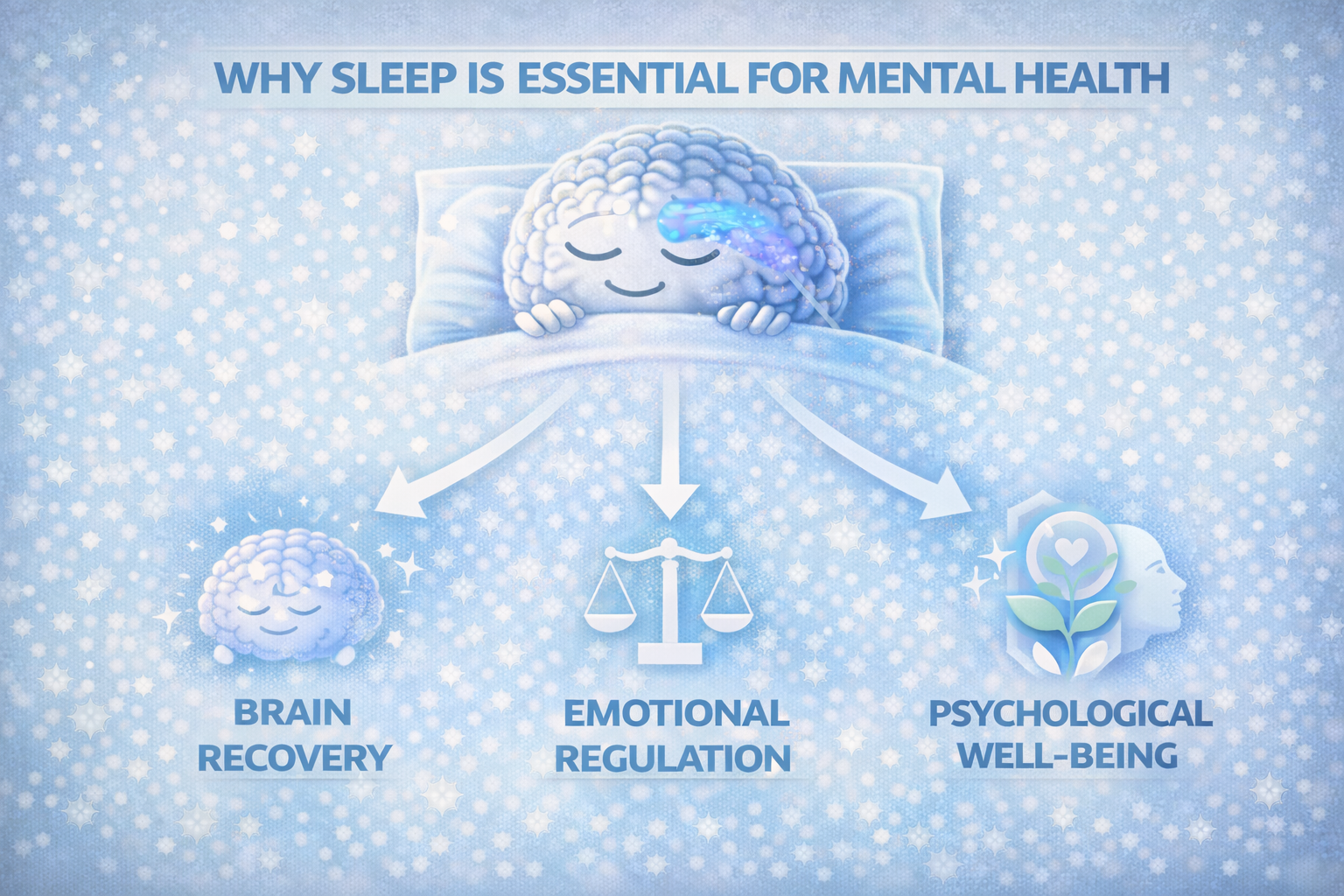
How sleep regulates emotional balance, stress resilience, and psychological stability
Mental health is often discussed in terms of thoughts, emotions, habits, and coping strategies. Sleep is frequently treated as a secondary factor — something helpful, but not central.
In reality, sleep is one of the most powerful regulators of mental health. It shapes how emotions are processed, how stress is tolerated, and how the brain maintains psychological balance. When sleep is disrupted, mental health becomes fragile. When sleep is protected, emotional stability becomes possible.
Mental Health Is a Biological State First
Mental health does not begin with mindset.
It begins with brain regulation. Emotional balance, mood stability, and stress tolerance all depend on how effectively the brain can regulate itself. Sleep is the primary period during which this regulation occurs.
Without sufficient, well-timed sleep, the brain loses its ability to maintain emotional equilibrium, regardless of insight or effort.
How Sleep Regulates Emotional Processing
Every day produces emotional input.
During sleep, the brain processes these experiences offline. Emotional reactions are reviewed, integrated, and moderated. This allows emotions to be remembered without remaining overwhelming.
When sleep is disrupted, emotional processing remains incomplete. Emotions carry over with greater intensity, making everyday stressors feel heavier and harder to manage.
The Role of Sleep in Stress Resilience
Stress is unavoidable. Recovery is not.
Sleep restores the systems that regulate the stress response. During sleep, stress hormones decline, neural reactivity decreases, and emotional thresholds reset.
Without sleep, stress responses remain elevated. Small challenges trigger outsized reactions, and recovery from stress takes longer.
Why Poor Sleep Amplifies Anxiety
Anxiety is strongly linked to sleep quality.
When sleep is insufficient or fragmented, the brain’s threat-detection systems become more sensitive. At the same time, the systems responsible for calming and rational evaluation weaken.
This imbalance makes worry feel automatic, persistent, and difficult to control — even when external circumstances are stable.
Sleep and Mood Stability
Mood regulation depends on sleep continuity.
Sleep supports stable communication between emotional and cognitive brain regions. This balance allows emotions to rise and fall without becoming extreme.
Poor sleep disrupts this coordination, increasing irritability, mood swings, and emotional volatility.
Why Depression and Sleep Are Closely Connected
Sleep and depression influence each other bidirectionally.
Chronic sleep disruption increases vulnerability to depressive symptoms by weakening emotional regulation and motivation. At the same time, depression often disrupts sleep timing and quality.
This creates a reinforcing loop where poor sleep and low mood sustain each other unless sleep is addressed directly.
REM Sleep and Emotional Integration
REM sleep plays a critical role in mental health.
During REM sleep, emotional experiences are processed in a low-stress neurochemical environment. This allows emotional memories to be integrated without triggering intense emotional responses.
Disrupted REM sleep leaves emotional experiences unprocessed, increasing emotional reactivity and mental fatigue.
Deep Sleep and Psychological Stability
Deep sleep supports overall mental stability.
It restores core brain networks, reduces neural noise, and improves emotional baseline regulation. This stability provides the foundation upon which emotional resilience is built.
When deep sleep is reduced, mental health becomes more vulnerable to daily fluctuations.
Why Mental Health Interventions Often Fail Without Sleep
Many mental health strategies assume a functional brain.
Therapy, reflection, coping techniques, and behavioral changes all rely on neural stability. When sleep is compromised, the brain lacks the capacity to apply these tools effectively.
Improving sleep often enhances the effectiveness of all other mental health interventions.
Sleep as Prevention, Not Just Treatment
Sleep is not only corrective — it is protective.
Consistent, high-quality sleep reduces the risk of anxiety, burnout, emotional exhaustion, and long-term mental health decline. It increases resilience before problems escalate.
Mental health is easier to maintain than to repair.
Why Modern Life Undermines Mental Health Through Sleep
Modern environments disrupt sleep in subtle ways.
Irregular schedules, artificial light, constant stimulation, and chronic stress interfere with sleep timing and depth. Over time, these disruptions erode mental stability even in otherwise healthy individuals.
Mental health challenges often emerge gradually as sleep debt accumulates.
The Core Idea to Remember
Sleep is the foundation of mental health because it regulates how the brain processes emotion, stress, and psychological balance.
Without sleep, mental health becomes fragile. With sleep, emotional resilience becomes possible.
Sleep does not replace therapy, insight, or support — but without it, none of them work as they should.