Tag: learning

  • The Relationship Between Sleep and Memory

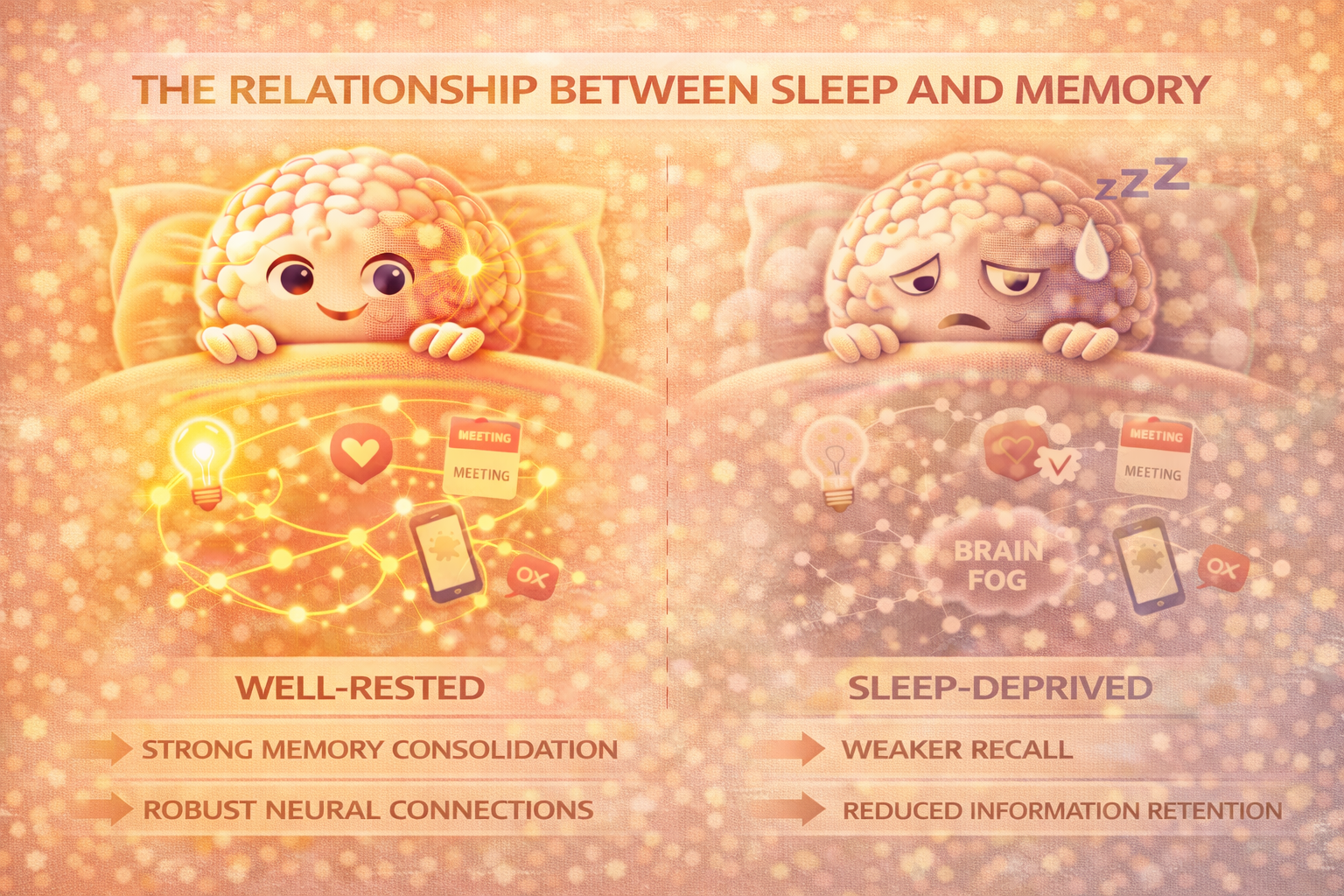
    The Relationship Between Sleep and Memory

    How sleep stabilizes learning, strengthens recall, and protects cognitive function

    Memory is often thought of as something that happens while we are awake — during studying, working, or experiencing events. Sleep is usually seen as a passive pause between periods of learning.

    In reality, sleep plays an active and essential role in memory. What you remember, how well you recall it, and how durable those memories become all depend heavily on what happens in the brain during sleep. Without sufficient, well-timed sleep, memory formation remains incomplete and fragile.


    Memory Is Not Finished When Learning Ends

    Learning does not end when you stop paying attention.

    During wakefulness, the brain encodes information, but those memory traces are unstable. They require further processing to become durable and accessible. Sleep provides the conditions needed for this stabilization.

    Without sleep, newly learned information remains vulnerable to interference and loss.


    How Sleep Consolidates Memory

    Memory consolidation is the process by which temporary memories become long-term.

    During sleep, especially during deep sleep and REM sleep, the brain replays and reorganizes neural patterns formed during the day. This replay strengthens important connections and weakens irrelevant ones.

    Through this process, memories become more stable, integrated, and easier to retrieve later.


    The Role of Deep Sleep in Memory Storage

    Deep sleep plays a critical role in consolidating declarative memories — facts, concepts, and experiences.

    During this stage, slow, synchronized brain activity allows information stored temporarily in the hippocampus to be transferred to long-term storage in the cortex. This transfer reduces overload and frees capacity for new learning the next day.

    When deep sleep is reduced, this transfer process becomes less efficient.


    REM Sleep and Emotional Memory

    REM sleep contributes strongly to emotional and procedural memory.

    During REM sleep, emotional experiences are processed and integrated with existing knowledge. This helps regulate emotional responses and reduces the intensity of emotional memories while preserving their content.

    Disrupted REM sleep can leave emotional memories poorly integrated, increasing emotional reactivity and reducing learning efficiency.


    Why Sleep Deprivation Impairs Learning

    Lack of sleep affects memory in two ways.

    First, it weakens the brain’s ability to consolidate memories formed the previous day. Second, it reduces the brain’s ability to encode new information the next day.

    This double impact explains why sleep-deprived individuals struggle both to remember what they learned and to learn anything new.


    Sleep Timing Matters for Memory

    Memory consolidation is sensitive to timing.

    Sleep that occurs at biologically appropriate times supports optimal coordination between sleep stages. Mistimed sleep disrupts this coordination, reducing the effectiveness of memory processing.

    Even long sleep durations may fail to support memory if circadian alignment is poor.


    Fragmented Sleep and Memory Breakdown

    Memory consolidation requires uninterrupted sleep.

    Fragmented sleep interrupts the cycles needed for replay and integration. Frequent awakenings prevent sustained deep and REM sleep, weakening memory stabilization.

    As a result, sleep fragmentation often leads to forgetfulness, reduced recall accuracy, and mental fog.


    Why You Remember Better After Good Sleep

    After high-quality sleep, memories feel clearer and more accessible.

    This is not because you tried harder to remember, but because the brain completed its overnight processing. Neural connections are stronger, interference is reduced, and retrieval becomes easier.

    Sleep improves memory efficiency, not just storage.


    Long-Term Effects of Poor Sleep on Memory

    Chronic sleep disruption affects memory over time.

    Repeated impairment of consolidation weakens learning capacity, slows cognitive processing, and reduces mental flexibility. These effects are often gradual and mistaken for aging or stress.

    Protecting sleep protects long-term cognitive health.


    Why Sleep Is Not Optional for Memory

    Memory depends on sleep as much as it depends on attention.

    Without regular, well-timed sleep, learning remains incomplete. The brain cannot compensate for missing sleep through effort or repetition alone.

    Sleep is the phase where memory becomes durable.


    The Core Idea to Remember

    Sleep is a central part of how memory works.

    During sleep, the brain stabilizes, organizes, and integrates what you learn. Without it, memories remain fragile and learning capacity declines.

    Good memory is not just about what you do while awake — it is about what your brain is allowed to do while you sleep.

  • How Sleep Shapes Brain Plasticity

    How Sleep Shapes Brain Plasticity

    Sleep Is Not Passive: It Actively Rewires the Brain

    For decades, sleep was seen as a passive state—a period where the brain simply “shut down” to recover energy. Modern neuroscience has completely overturned this idea.

    Sleep is one of the most active and critical periods for brain plasticity, the brain’s ability to change, adapt, and reorganize itself. Without sleep, learning stalls, memory fragments, and neural networks lose efficiency.

    In short:
    Sleep is not rest for the brain. It is construction time.


    What Brain Plasticity Really Means

    Brain plasticity (or neuroplasticity) refers to the brain’s capacity to:

    • Strengthen or weaken synaptic connections

    • Create new neural pathways

    • Prune unnecessary or inefficient connections

    • Adapt to new experiences, skills, and environments

    Plasticity is what allows you to learn a language, improve a skill, recover after injury, and integrate emotional experiences.

    Crucially, plasticity does not happen evenly across the day.
    It is strongly dependent on sleep.


    Why Sleep Is the Brain’s Main Remodeling Phase

    During wakefulness, the brain is busy processing incoming information. Neurons fire constantly, synapses strengthen rapidly, and networks become saturated.

    Sleep provides the conditions needed to rebalance and refine this activity.

    Research shows that during sleep:

    • Irrelevant synapses are weakened

    • Important connections are stabilized

    • Neural noise is reduced

    • Signal efficiency improves

    This process is often described as synaptic homeostasis: the brain resets itself to remain flexible rather than overloaded.

    Without this reset, learning becomes inefficient and unstable.


    Deep Sleep and Structural Plasticity

    Deep sleep (also called slow-wave sleep) plays a key role in structural plasticity.

    During this phase:

    • Brain waves slow dramatically

    • Growth-related processes increase

    • Metabolic waste is cleared more efficiently

    Studies indicate that deep sleep supports:

    • Synaptic downscaling (removing excess connections)

    • Long-term network stability

    • Brain tissue maintenance

    This explains why chronic sleep deprivation is linked to reduced cognitive flexibility, slower learning, and impaired problem-solving.

    Deep sleep does not make you smarter—it prevents the brain from becoming rigid.


    REM Sleep, Learning, and Emotional Plasticity

    REM sleep (Rapid Eye Movement sleep) is strongly associated with:

    • Memory integration

    • Emotional processing

    • Creative recombination of information

    During REM sleep, the brain shows activity patterns similar to wakefulness, but without external input. This allows memories to be replayed, reinterpreted, and emotionally reweighted.

    REM sleep is especially important for:

    • Skill learning

    • Language acquisition

    • Emotional regulation

    • Trauma processing

    When REM sleep is disrupted, people often experience:

    • Emotional instability

    • Poor memory consolidation

    • Reduced creativity

    This is why sleep problems frequently coexist with anxiety, depression, and burnout.


    Sleep Loss and Reduced Plasticity

    When sleep is insufficient or fragmented, brain plasticity suffers.

    Research consistently shows that sleep deprivation leads to:

    • Reduced synaptic strength

    • Impaired memory consolidation

    • Slower learning rates

    • Decreased adaptability to new tasks

    Even a single night of poor sleep can reduce the brain’s ability to modify synaptic connections the next day.

    Over time, chronic sleep loss pushes the brain toward rigidity rather than flexibility—a state linked to cognitive decline and emotional dysregulation.


    Why Plasticity Needs Both Sleep and Wake

    Plasticity is a two-phase process:

    • Wake: information is encoded

    • Sleep: information is refined and integrated

    Without wakefulness, there is nothing to consolidate.
    Without sleep, consolidation fails.

    This explains why simply “studying more” without sleeping does not improve performance—and often worsens it.

    Sleep does not add new information.
    It organizes what you already experienced.


    Aging, Sleep, and Brain Adaptability

    As people age, sleep architecture changes:

    • Less deep sleep

    • More fragmented nights

    • Altered REM patterns

    These changes are strongly associated with reduced plasticity and slower learning.

    However, studies also show that improving sleep quality can partially restore plasticity, even later in life. Sleep remains one of the most accessible levers to protect cognitive function over time.


    The Key Takeaway

    Brain plasticity does not happen by chance.
    It is scheduled, and sleep is the schedule.

    Sleep is when the brain:

    • Decides what matters

    • Removes what doesn’t

    • Strengthens what should last

    If learning, memory, or mental flexibility feel impaired, the problem is often not intelligence or effort—but sleep quality.

    Sleep shapes the brain because it is when the brain shapes itself.