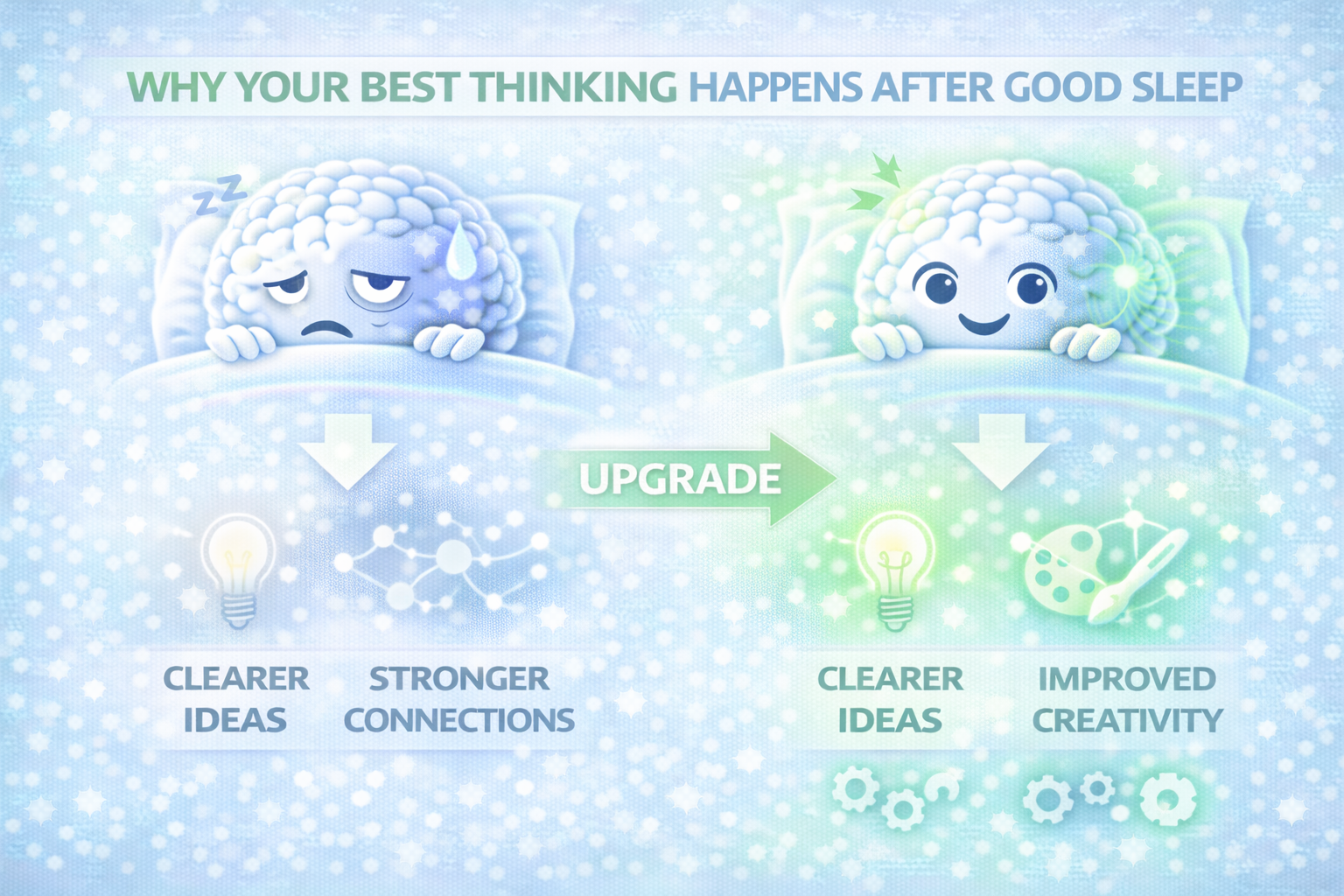
How sleep restores the brain’s ability to reason, connect ideas, and think clearly
Moments of clear thinking often arrive after a good night of sleep. Problems feel easier to solve, ideas connect more naturally, and decisions require less effort. This contrast becomes especially noticeable after nights of poor or fragmented sleep, when thinking feels slow and mentally heavy.
This difference is not psychological. It reflects real changes in how the brain functions. Good sleep restores the neural conditions required for high-quality thinking, while poor sleep degrades them — regardless of intelligence or motivation.
Thinking Quality Depends on Brain Efficiency
Clear thinking depends on efficient neural communication.
When the brain is well-rested, signals move smoothly across networks. Relevant information stands out, distractions are filtered out, and mental effort stays low.
After poor sleep, communication becomes noisier. The brain must work harder to achieve the same results, making thinking feel strained and inefficient.
How Sleep Restores Cognitive Processing
During sleep, the brain undergoes widespread recalibration.
Neural connections are strengthened or weakened based on relevance, metabolic waste is cleared, and signaling systems are reset. This overnight maintenance improves processing speed and accuracy the next day.
Good sleep prepares the brain to operate with precision rather than brute effort.
Deep Sleep and Logical Reasoning
Deep sleep supports core reasoning abilities.
During this stage, neural synchronization increases, improving signal clarity across brain regions involved in analysis and problem-solving. This synchronization reduces cognitive noise and enhances logical flow.
When deep sleep is reduced, reasoning becomes slower and more error-prone.
REM Sleep and Insightful Thinking
REM sleep supports insight and creative integration.
During REM, the brain connects information across distant networks, allowing new perspectives and associations to emerge. This integration explains why solutions or insights often appear effortlessly after sleep.
Disrupted REM sleep limits this integrative thinking, making ideas feel stuck or repetitive.
Why Thinking Feels Harder After Poor Sleep
Poor sleep increases cognitive load.
The brain compensates for reduced efficiency by using more effort to maintain performance. This effort is perceived as mental fatigue, slower thinking, and reduced clarity.
Tasks that normally feel simple begin to feel demanding.
Sleep Timing and Mental Sharpness
Thinking quality depends on circadian alignment.
When sleep occurs at biologically appropriate times, alertness rises smoothly and remains stable. Mistimed sleep creates uneven alertness, producing periods of mental fog even after adequate sleep duration.
Good timing supports consistent thinking quality throughout the day.
Fragmented Sleep and Mental Inconsistency
Interrupted sleep disrupts cognitive consistency.
Fragmentation prevents the brain from completing restorative cycles, leading to fluctuations in thinking quality. Mental clarity may come and go unpredictably.
This inconsistency is often more frustrating than uniformly low performance.
Why Effort Can’t Replace Sleep for Thinking
Trying harder cannot fully compensate for poor sleep.
Effort temporarily masks impairment but increases mental strain. Over time, this leads to faster fatigue and reduced cognitive endurance.
The brain thinks best when recovery precedes effort.
Long-Term Effects on Thinking Quality
Chronic poor sleep degrades thinking over time.
Slower processing, reduced flexibility, and diminished insight become normalized. These changes are often attributed to stress or aging rather than sleep.
Restoring sleep quality often restores thinking clarity people assumed was lost.
Why Good Sleep Makes Thinking Feel Effortless
After good sleep, thinking feels lighter.
This is because the brain operates closer to optimal efficiency. Less effort is required to maintain clarity, allowing higher-level thinking to emerge naturally.
Good sleep does not add intelligence — it removes interference.
The Core Idea to Remember
Your best thinking happens after good sleep because the brain has been restored.
Sleep recalibrates neural efficiency, supports reasoning and insight, and reduces cognitive noise. Without it, thinking becomes effortful and less precise.
Clear thinking is not forced — it emerges when the brain has recovered overnight.