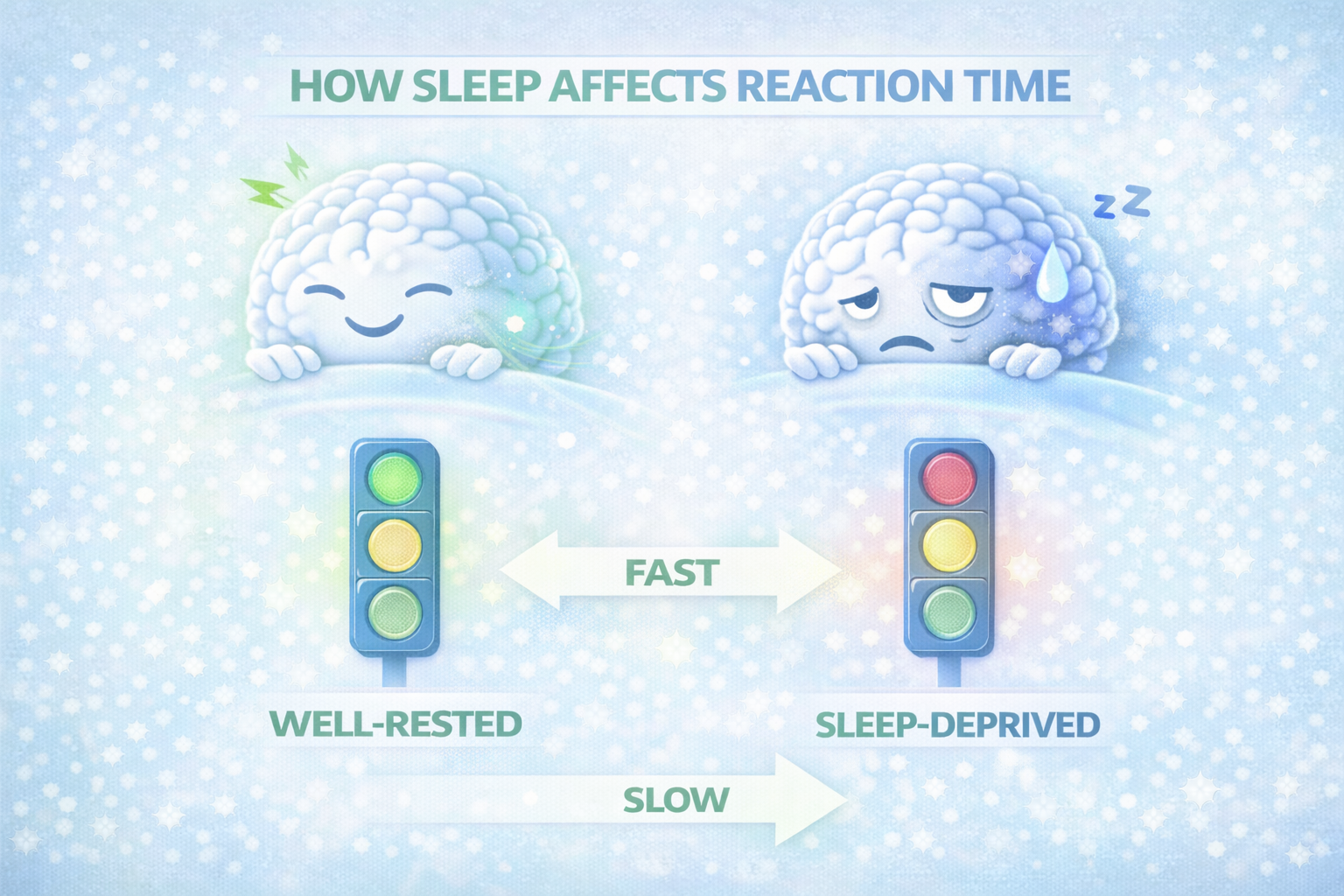
Why sleep determines how fast the brain detects, processes, and responds
Reaction time is often associated with reflexes, athleticism, or quick thinking. When reactions slow, people tend to blame distraction, age, or lack of focus.
In reality, reaction time is strongly shaped by sleep. The speed at which the brain detects information, processes it, and produces a response depends on how well neural systems have recovered overnight. Poor sleep slows reaction time even when motivation and effort are high.
Reaction Time Is a Neural Process
Reaction time is not a simple reflex.
It involves multiple steps: sensory detection, signal transmission, decision processing, and motor response. Each step depends on efficient neural communication.
Sleep supports the integrity of this entire chain. When sleep is disrupted, delays accumulate across each stage.
How Sleep Restores Neural Transmission Speed
During sleep, the brain restores communication efficiency.
Neural signaling pathways are recalibrated, metabolic waste is cleared, and electrical signaling becomes more synchronized. This reduces transmission delays between brain regions.
After good sleep, signals travel faster and with less interference.
Deep Sleep and Signal Precision
Deep sleep improves signal precision.
During slow-wave sleep, large-scale synchronization strengthens core communication pathways involved in perception and response. This synchronization reduces variability in reaction timing.
When deep sleep is reduced, responses become slower and less consistent.
REM Sleep and Decision Speed
REM sleep supports rapid decision-making.
It helps integrate sensory input with learned responses, allowing faster interpretation and action. This is especially important for complex or unpredictable situations.
Disrupted REM sleep slows this integration, increasing hesitation and response latency.
Sleep Deprivation and Slower Reactions
Lack of sleep reliably slows reaction time.
Processing speed drops, attention becomes unstable, and errors increase. Even small sleep losses can produce reaction delays comparable to alcohol impairment.
Importantly, individuals often underestimate how impaired their reactions are when sleep-deprived.
Circadian Timing and Reaction Speed
Reaction time fluctuates across the day.
Circadian rhythm determines when neural alertness peaks. When sleep timing aligns with this rhythm, reaction speed remains stable.
Mistimed sleep creates periods of slowed reactions, even after sufficient sleep duration.
Fragmented Sleep and Inconsistent Responses
Interrupted sleep leads to variable reaction time.
Micro-awakenings prevent full neural recovery, causing responses to fluctuate unpredictably. Some reactions feel normal, others feel delayed.
This inconsistency increases error risk in tasks requiring rapid response.
Why Effort Can’t Fix Slowed Reactions
Trying to react faster cannot override neural delay.
Effort increases mental strain but does not restore transmission speed. The brain continues operating below optimal efficiency.
True reaction speed returns only after recovery.
Real-World Consequences of Slowed Reaction Time
Reduced reaction time affects daily life.
Driving, decision-making, workplace performance, and physical coordination all rely on fast responses. Sleep-related slowing increases accident risk and reduces performance quality.
These effects accumulate with repeated sleep disruption.
Long-Term Effects on Neural Speed
Chronic poor sleep reduces baseline reaction speed.
Over time, slower reactions become normalized. This decline is often attributed to aging or stress rather than sleep.
Improving sleep quality often restores reaction speed people assumed was permanently lost.
The Core Idea to Remember
Reaction time depends heavily on sleep.
Sleep restores neural transmission speed, decision efficiency, and response consistency. Without it, reactions slow regardless of effort or motivation.
Fast reactions are not trained — they are recovered overnight.