Tag: REM sleep

  • Why Quiet Isn’t Enough for Good Sleep

    Why Quiet Isn’t Enough for Good Sleep

    Why silence alone doesn’t guarantee deep, restorative sleep

    Many people assume that a quiet bedroom is all they need for good sleep. When sleep feels poor, the first instinct is often to eliminate noise and aim for total silence.

    While reducing noise is important, quiet alone is not enough. Sleep quality depends on a combination of environmental signals that tell the brain it is safe to fully shut down. Without the right balance of light, temperature, stability, and predictability, even a silent room can produce shallow, unrefreshing sleep.


    Sleep Requires More Than the Absence of Noise

    The brain looks for safety, not silence.

    During sleep, the brain continuously evaluates the environment. Silence removes one potential threat, but it does not automatically signal safety or readiness for deep sleep.

    Other factors can keep alert systems partially active even in total quiet.


    Why Silence Can Increase Sensitivity

    Absolute silence can backfire.

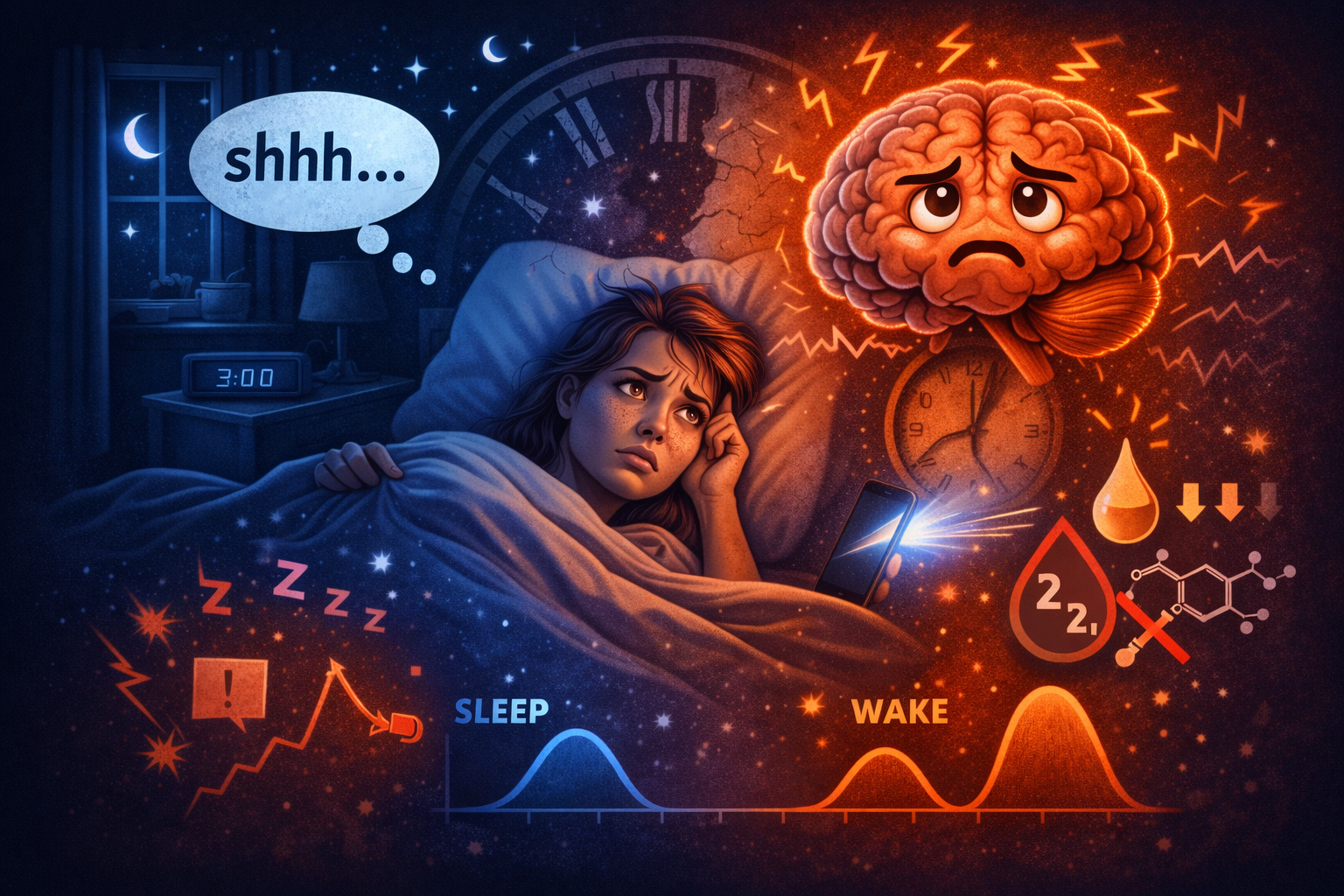
    In very quiet environments, the brain becomes more sensitive to small disturbances. Minor sounds that would otherwise go unnoticed can trigger micro-arousals because they contrast sharply with silence.

    This heightened sensitivity can fragment sleep rather than protect it.


    The Role of Predictability in Sleep Quality

    The brain prefers predictable environments.

    Sleep deepens when conditions remain stable and expected. Silence that is inconsistent—interrupted by occasional sounds—creates uncertainty rather than calm.

    Predictability matters more than complete quiet.


    Light Can Disrupt Sleep Even in Silence

    A quiet room can still be biologically loud.

    Light exposure at night suppresses melatonin, increases alertness, and delays circadian timing. Even dim light can weaken sleep depth.

    Silence cannot compensate for poor light conditions.


    Temperature and Physical Arousal

    Thermal discomfort disrupts sleep.

    If the room is too warm or fluctuates in temperature, the body struggles to cool down. This increases awakenings and prevents sustained deep sleep.

    A quiet but warm room still degrades sleep quality.


    Why the Brain Needs Environmental Stability

    Sleep is a state of vulnerability.

    The brain only allows deep sleep when it perceives stable, safe conditions. Changes in airflow, temperature, light, or subtle vibrations can keep the nervous system partially alert.

    Silence without stability is incomplete.


    The Importance of Background Consistency

    Stable background conditions support sleep.

    A consistent auditory backdrop can sometimes improve sleep more than silence by masking unpredictable noise. The brain adapts more easily to steady input than to sudden contrast.

    Consistency reduces vigilance.


    Emotional Arousal and the Quiet Bedroom

    Quiet does not calm the nervous system by itself.

    If stress levels are high or emotional arousal remains elevated, the brain stays alert even in silence. Sleep requires both environmental calm and internal downregulation.

    Silence alone does not trigger recovery.


    Why People Sleep Poorly in “Perfectly Quiet” Rooms

    Many people report poor sleep despite ideal silence.

    This often reflects missing environmental cues—darkness, coolness, or consistency—that signal nighttime safety. The brain remains in standby mode rather than full sleep mode.

    Quiet is only one piece of the system.


    Building a Truly Sleep-Supportive Environment

    Good sleep environments work as systems.

    Darkness, stable temperature, predictable sound, and sensory comfort work together to signal safety. Removing noise helps—but only when combined with these factors.

    Sleep improves when the whole environment supports recovery.


    Why Sleep Quality Improves When Conditions Align

    When the environment feels safe, sleep deepens naturally.

    The brain stops monitoring for threats and allows uninterrupted progression through sleep stages. Recovery completes without effort.

    This alignment—not silence alone—produces restorative sleep.


    The Core Idea to Remember

    Quiet isn’t enough for good sleep because sleep depends on multiple environmental signals.

    While silence reduces disruption, sleep quality requires darkness, thermal comfort, predictability, and stability. Without these, the brain remains partially alert—even in a quiet room.

    Good sleep happens when the entire environment signals safety, not just the absence of noise.
  • Can White Noise Improve Sleep Consistency?

    Can White Noise Improve Sleep Consistency?

    How steady sound can reduce sleep disruptions and stabilize nightly rest

    Sleep consistency depends on more than bedtime routines or sleep duration. Many people sleep poorly not because they can’t fall asleep, but because their sleep is repeatedly interrupted throughout the night.

    White noise is often suggested as a solution—but does it actually help? In many cases, white noise can improve sleep consistency by stabilizing the auditory environment and reducing disruptive sound contrasts. Its effectiveness depends on how and why sleep is being disrupted.


    Sleep Consistency Depends on Stability

    Consistent sleep requires predictable conditions.

    The brain sleeps best when the environment remains stable across the night. Sudden changes—especially in sound—trigger brief alert responses that fragment sleep.

    White noise works by reducing variability, not by forcing sleep.


    Why Sudden Sounds Disrupt Sleep

    The sleeping brain remains vigilant.

    Even during deep sleep, the brain monitors sounds for potential threats. Sudden or irregular noises activate alert systems, causing micro-arousals that pull the brain out of deeper sleep stages.

    These disruptions often go unnoticed but reduce sleep quality.


    How White Noise Works

    White noise creates a constant auditory backdrop.

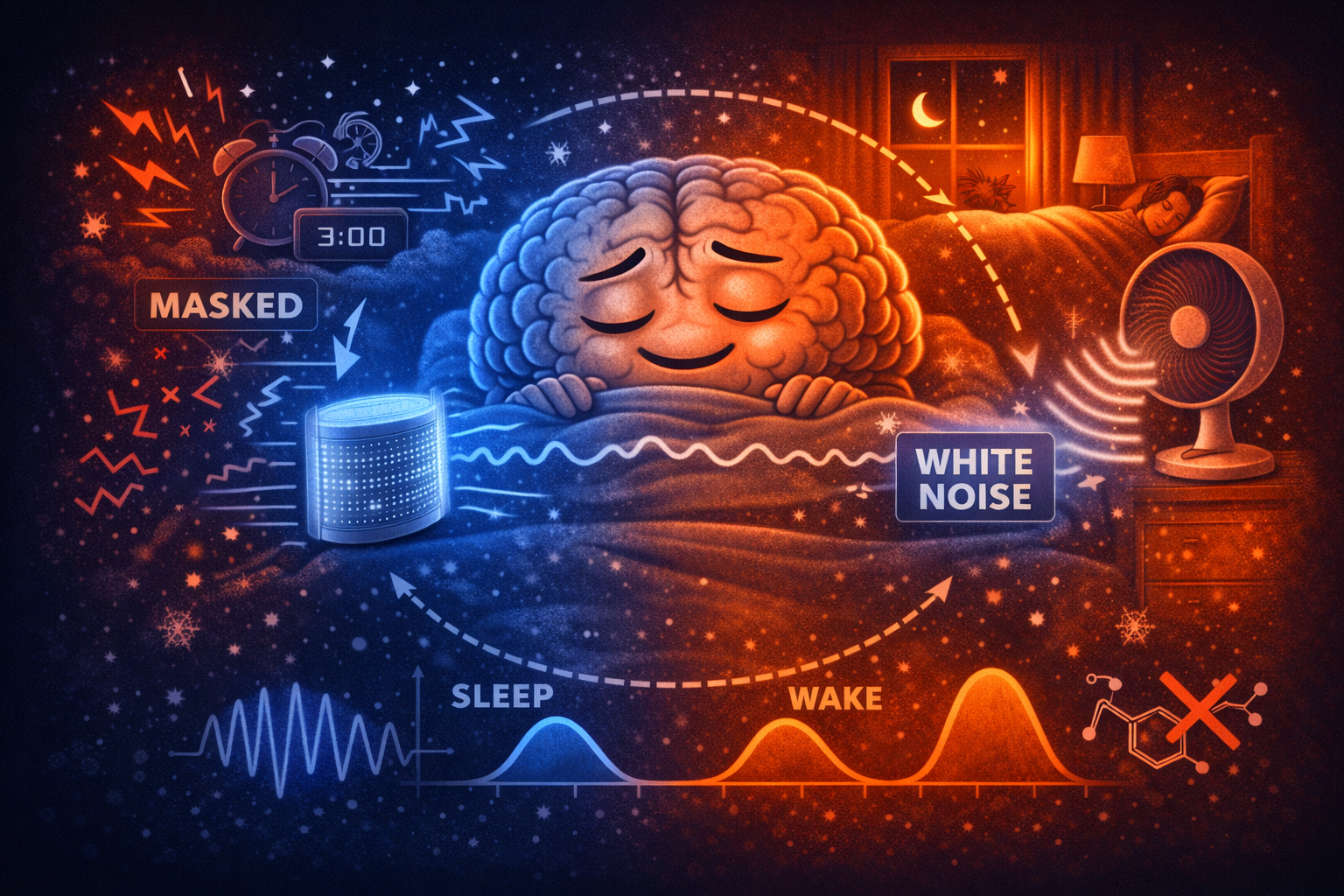
    By filling the sound spectrum evenly, white noise masks sudden changes in volume or pitch. This reduces the contrast between background silence and intrusive sounds.

    The brain responds more calmly to steady input than to unpredictability.


    White Noise and Micro-Arousals

    Reducing micro-arousals improves consistency.

    When sudden sounds are masked, the brain is less likely to shift into alert mode. Sleep stages become more stable, and transitions are smoother.

    Over time, this improves sleep continuity.


    Why White Noise Helps Some People More Than Others

    Effectiveness depends on the cause of disruption.

    White noise is most helpful when sleep is disturbed by environmental sounds such as traffic, voices, or household noise. It is less effective for sleep problems driven by stress, anxiety, or circadian misalignment.

    It supports stability—it doesn’t fix timing.


    White Noise and Deep Sleep

    Deep sleep benefits from uninterrupted conditions.

    By reducing auditory disruptions, white noise can indirectly increase time spent in deep sleep. This improves physical recovery and next-day energy.

    However, volume and consistency matter.


    REM Sleep and Sound Masking

    REM sleep is sensitive to noise.

    White noise can help protect REM cycles by preventing sudden sounds from triggering awakenings or stage shifts. More stable REM sleep supports emotional regulation and mental clarity.

    Poor masking weakens this benefit.


    Why Volume Matters

    Louder is not better.

    White noise should be set just loud enough to mask disruptive sounds. Excessive volume can itself become stimulating or stressful.

    The goal is background presence, not dominance.


    White Noise vs Total Silence

    Silence increases contrast.

    In very quiet environments, sudden sounds stand out sharply. White noise reduces this contrast, making the auditory environment more predictable.

    Sleep improves with predictability, not absolute silence.


    When White Noise Does Not Help

    White noise is limited.

    It does not correct poor sleep timing, light exposure, or emotional arousal. In some people, constant sound can feel irritating rather than soothing.

    Individual preference matters.


    Consistency Is More Important Than Sound Type

    Predictability matters more than the specific sound.

    Some people prefer white noise, others pink noise, brown noise, or steady environmental sounds. What matters is that the sound remains stable throughout the night.

    The brain adapts to consistency.


    Using White Noise to Support Long-Term Sleep Consistency

    White noise works best as part of a system.

    When combined with consistent sleep timing, proper light exposure, and a calm sleep environment, white noise can significantly improve sleep stability.

    It supports—not replaces—good sleep biology.


    The Core Idea to Remember

    White noise can improve sleep consistency by stabilizing the auditory environment.

    By masking sudden sounds and reducing micro-arousals, it helps the brain remain in deeper sleep stages. Its benefit depends on proper volume, consistency, and the source of sleep disruption.

    Sleep becomes more consistent when the night feels predictable.

  • How Noise Affects Sleep Quality

    How Noise Affects Sleep Quality

    Why sound exposure fragments sleep even when you don’t fully wake up

    Sleep quality is often judged by how long you sleep or how quickly you fall asleep. Noise is frequently overlooked—especially when it doesn’t fully wake you. Yet sound is one of the most powerful disruptors of sleep depth and continuity.

    The brain remains responsive to sound throughout the night. Even when you stay asleep, noise can trigger micro-arousals that fragment sleep, reduce deep and REM sleep, and leave you feeling unrefreshed the next day.


    The Sleeping Brain Never Fully Turns Off Hearing

    Hearing stays active during sleep.

    Unlike vision, the auditory system continues to monitor the environment for potential threats. This evolutionary feature increases safety—but it comes at a cost in modern environments.

    Noise keeps parts of the brain on alert, preventing full shutdown.


    How Noise Causes Micro-Arousals

    Most noise disruptions are invisible.

    Sounds don’t need to wake you fully to disrupt sleep. Brief increases in brain activity—called micro-arousals—pull the brain out of deeper sleep stages for seconds at a time.

    You may not remember waking up, but sleep quality still declines.


    Why Intermittent Noise Is Worse Than Constant Noise

    Irregular sounds are more disruptive.

    Sudden or unpredictable noises—traffic, voices, doors, notifications—trigger stronger brain responses than steady background noise.

    The brain cannot habituate to unpredictability, increasing fragmentation.


    Noise and Deep Sleep Reduction

    Deep sleep is highly sensitive to sound.

    Noise reduces the amount of time spent in slow-wave sleep, the stage responsible for physical recovery, immune function, and neural repair.

    Even small reductions in deep sleep impact how restored you feel.


    REM Sleep and Sound Sensitivity

    REM sleep is easily disrupted by noise.

    Because REM sleep involves higher brain activity, it is more vulnerable to auditory disturbances. Noise fragments REM cycles, reducing emotional processing and mental clarity.

    Poor REM sleep contributes to mood instability and cognitive fog.


    Why You Feel Tired After a Noisy Night

    Sleep duration can be misleading.

    You may sleep for many hours, yet feel exhausted because noise prevented sustained deep and REM sleep. Recovery processes were repeatedly interrupted.

    The problem isn’t how long you slept—it’s how continuously.


    Noise and Stress Activation

    Noise triggers stress responses.

    Sudden sounds increase heart rate, blood pressure, and stress signaling—even during sleep. Over time, this increases baseline stress and reduces resilience.

    Nighttime noise prevents full nervous system downregulation.


    Why the Brain Reacts to Familiar Sounds

    Familiar sounds still matter.

    Even noises you “get used to,” like traffic or appliances, can continue to trigger micro-arousals. The brain prioritizes safety over comfort.

    Habituation is often incomplete.


    Noise Timing Matters

    Noise early in the night affects sleep onset.

    Noise later in the night disrupts REM sleep and causes early awakenings. Both reduce sleep quality, but late-night noise often has stronger emotional effects.

    Timing influences which sleep stages are disrupted.


    Why Silence Isn’t Always the Solution

    Absolute silence can feel uncomfortable.

    In some cases, very quiet environments make the brain more sensitive to sudden sounds. This can increase reactivity rather than reduce it.

    The goal is sound stability, not total silence.


    How Consistent Background Noise Can Help

    Stable sound reduces contrast.

    Consistent background noise can mask sudden sounds, reducing micro-arousals. The brain adapts more easily to predictable auditory input.

    This explains why some people sleep better with steady background sound.


    Improving Sleep Quality by Managing Noise

    Protecting sleep from noise improves recovery.

    Reducing unpredictable sounds, improving sound insulation, and stabilizing the auditory environment help the brain remain in deeper sleep stages.

    Even small improvements increase sleep efficiency.


    The Core Idea to Remember

    Noise affects sleep quality by fragmenting sleep, not just waking you up.

    Through micro-arousals and stress activation, sound reduces deep and REM sleep even when you remain asleep. Sleep becomes lighter and less restorative.

    Better sleep quality often comes from quieter—or more stable—nights, not longer ones.

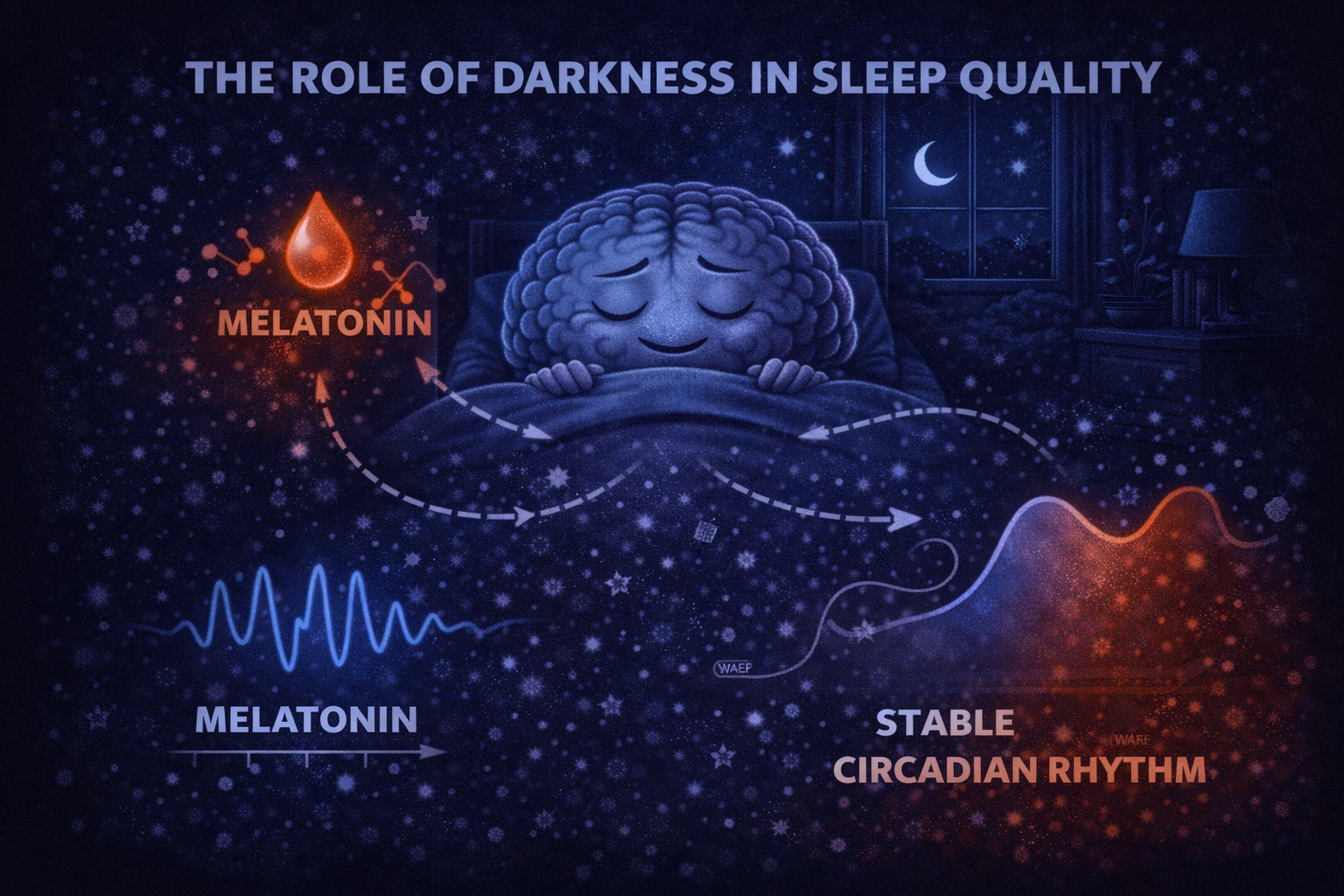
  • The Role of Darkness in Sleep Quality

    The Role of Darkness in Sleep Quality

    Why darkness determines how deeply and restoratively you sleep

    Sleep quality is often blamed on stress, noise, or sleep duration. While these factors matter, one of the most overlooked influences on sleep quality is darkness.

    Darkness does more than help you fall asleep. It determines how deeply you sleep, how stable your sleep cycles are, and how restored you feel the next day. When darkness is incomplete or inconsistent, sleep becomes lighter, more fragmented, and less restorative—even if total sleep time seems adequate.


    Sleep Quality Depends on Clear Nighttime Signals

    The brain needs certainty to sleep well.

    Sleep quality improves when the brain receives a clear, unambiguous signal that night has arrived. Darkness provides this signal by telling the brain to fully shift into recovery mode.

    When light remains present, the brain hesitates. Sleep still happens, but it is less efficient.


    How Darkness Supports Melatonin Stability

    Melatonin is central to sleep quality.

    Darkness allows melatonin levels to rise steadily and remain elevated throughout the night. This stable melatonin signal supports continuous sleep and proper cycling through sleep stages.

    When darkness is interrupted, melatonin production fluctuates, weakening sleep depth and continuity.


    Darkness and Sleep Depth

    Deep sleep depends on environmental signals.

    In darkness, the brain is more likely to enter and maintain deep sleep stages. These stages are responsible for physical recovery, immune support, and neural restoration.

    Exposure to light during the night reduces time spent in deep sleep, making rest feel shallow.


    REM Sleep and Darkness

    REM sleep is sensitive to light disruption.

    Darkness supports stable REM sleep cycles by maintaining circadian alignment and reducing nighttime alertness. When light exposure occurs at night, REM sleep becomes fragmented or shortened.

    Poor REM sleep reduces emotional processing and mental clarity.


    Why Even Low Light Can Reduce Sleep Quality

    The circadian system is highly sensitive.

    Dim light sources—night lights, hallway lighting, electronic indicators—can still interfere with nighttime signaling. The brain does not require bright light to detect disruption.

    Small amounts of light can reduce sleep efficiency over time.


    Darkness and Sleep Continuity

    Quality sleep requires continuity.

    Darkness reduces micro-awakenings and nighttime alertness. When light intrudes, the brain partially reactivates, increasing the likelihood of fragmented sleep.

    Sleep becomes lighter and more easily disturbed.


    How Darkness Reduces Nighttime Arousal

    Darkness quiets alerting systems.

    Heart rate slows, stress signaling decreases, and the nervous system shifts into recovery mode. This physiological downregulation allows sleep to deepen naturally.

    Light exposure prevents full shutdown, keeping the body partially alert.


    Modern Environments and Poor Darkness

    Modern life weakens natural darkness.

    Streetlights, indoor lighting, screens, and ambient glow keep nighttime light levels higher than biology expects. This constant exposure degrades sleep quality gradually.

    People often adapt without realizing sleep depth is declining.


    Why Darkness Matters More Than Sleep Duration

    Long sleep does not guarantee quality sleep.

    Without proper darkness, sleep can be long but inefficient. Deep and REM sleep suffer, and recovery remains incomplete.

    Darkness determines how effectively sleep performs its function.


    Improving Sleep Quality by Improving Darkness

    Enhancing darkness improves sleep quality directly.

    Reducing evening light, eliminating nighttime light sources, and creating a darker sleep environment strengthen nighttime signaling and deepen sleep.

    Consistency is more important than perfection.


    Why Darkness Improves How You Feel the Next Day

    Restorative sleep depends on depth.

    When darkness supports deep and REM sleep, the brain completes recovery processes. Energy, mood, and clarity improve without extra effort.

    Darkness allows sleep to do its work fully.


    The Core Idea to Remember

    Darkness plays a central role in sleep quality by supporting depth, continuity, and recovery.

    By stabilizing melatonin, reducing alertness, and reinforcing circadian timing, darkness allows sleep to become truly restorative. Without it, sleep becomes lighter and less effective.

    Improving sleep quality often starts by improving darkness.

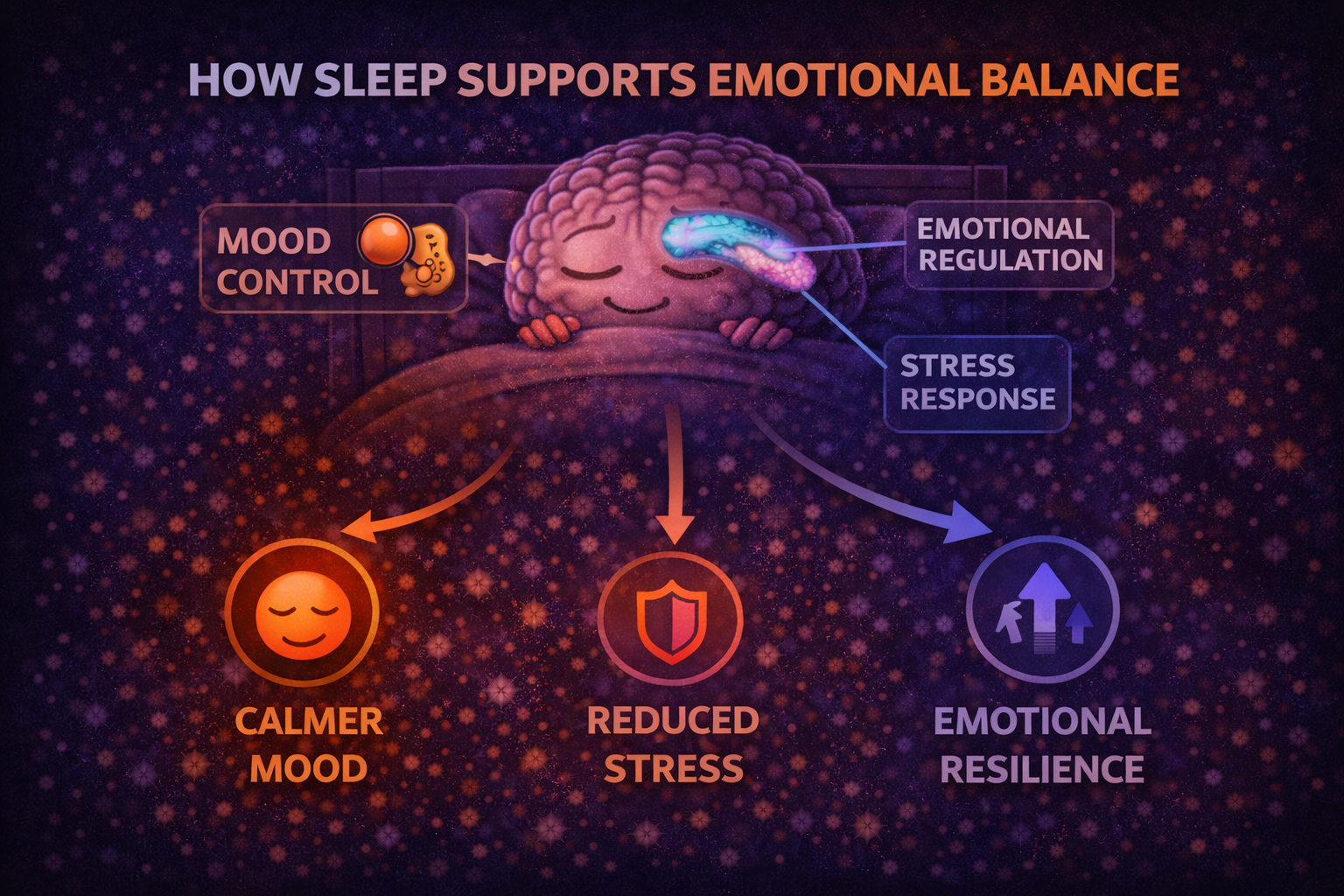
  • How Sleep Supports Emotional Balance

    How Sleep Supports Emotional Balance

    Why consistent sleep keeps emotions proportional, steady, and easier to manage

    Emotional balance is often mistaken for calmness or the absence of strong feelings. In reality, it’s the ability to experience emotions without being overwhelmed by them—and to return to baseline after stress.

    That ability depends heavily on sleep. When sleep is consistent and restorative, emotions remain proportional and recover quickly. When sleep is disrupted, emotional balance weakens, reactions intensify, and recovery slows. Sleep does not eliminate emotion—it stabilizes it.


    Emotional Balance Is a Regulatory State

    Emotional balance reflects how well the brain regulates emotion.

    Some brain systems generate emotional responses; others modulate intensity, context, and recovery. Balance emerges when these systems communicate efficiently.

    Sleep is the primary time when this communication is restored. Without sleep, regulation falters and emotions become harder to manage.


    How Sleep Resets Emotional Baselines

    Each day adds emotional load.

    During sleep, the brain lowers emotional sensitivity and resets baseline thresholds. This recalibration allows emotions to arise without tipping into overwhelm.

    Poor sleep leaves thresholds elevated, making emotions feel heavier the next day.


    Deep Sleep and Emotional Stability

    Deep sleep supports baseline emotional steadiness.

    During slow-wave sleep, neural noise decreases and core regulatory networks recover. This creates a calmer emotional baseline during waking hours.

    When deep sleep is reduced, emotional reactions become more volatile and less predictable.


    REM Sleep and Emotional Integration

    REM sleep is essential for emotional processing.

    During REM, emotional experiences are revisited in a low-stress chemical environment. This allows emotions to be integrated without retaining high emotional charge.

    Disrupted REM sleep leaves emotions unresolved, increasing reactivity and emotional spillover.


    Why Poor Sleep Disrupts Emotional Proportionality

    Sleep loss reduces proportionality.

    Minor stressors trigger outsized reactions because regulation capacity is depleted. Emotions escalate faster and settle more slowly.

    The stressor hasn’t changed—the brain’s ability to regulate it has.


    Sleep and Emotional Recovery Speed

    Balance depends on recovery speed.

    After emotional events, a well-rested brain returns to baseline quickly. Poor sleep slows this recovery, allowing emotions to linger and accumulate.

    Sleep determines how long emotions stay activated.


    Circadian Timing and Emotional Balance

    Emotional balance follows biological timing.

    Aligned sleep schedules support predictable regulation across the day. Irregular timing disrupts this rhythm, increasing emotional variability—even with adequate sleep duration.

    Timing matters as much as hours slept.


    Sleep Fragmentation and Emotional Drift

    Interrupted sleep undermines balance.

    Frequent awakenings prevent full emotional reset, leaving partial activation overnight. Over time, this leads to persistent tension and irritability.

    Fragmentation often harms balance more than short but continuous sleep.


    Why Effort Alone Can’t Create Balance

    Trying to “stay balanced” without sleep doesn’t work.

    Emotional regulation requires neural resources replenished during sleep. Without recovery, effort increases strain without restoring stability.

    Balance is biological before it is intentional.


    How Emotional Balance Returns After Good Sleep

    After high-quality sleep, balance often returns naturally.

    Emotions feel steadier, stress feels manageable, and perspective improves—without deliberate effort. This reflects restored regulation, not changes in circumstances.

    Sleep prepares the brain to regulate emotions before the day begins.


    The Core Idea to Remember

    Sleep supports emotional balance by restoring emotional regulation.

    Through deep sleep and REM sleep, the brain resets thresholds, integrates experiences, and improves recovery speed. Without sleep, balance weakens and emotions dominate.

    Emotional balance is not forced—it is rebuilt overnight by sleep.

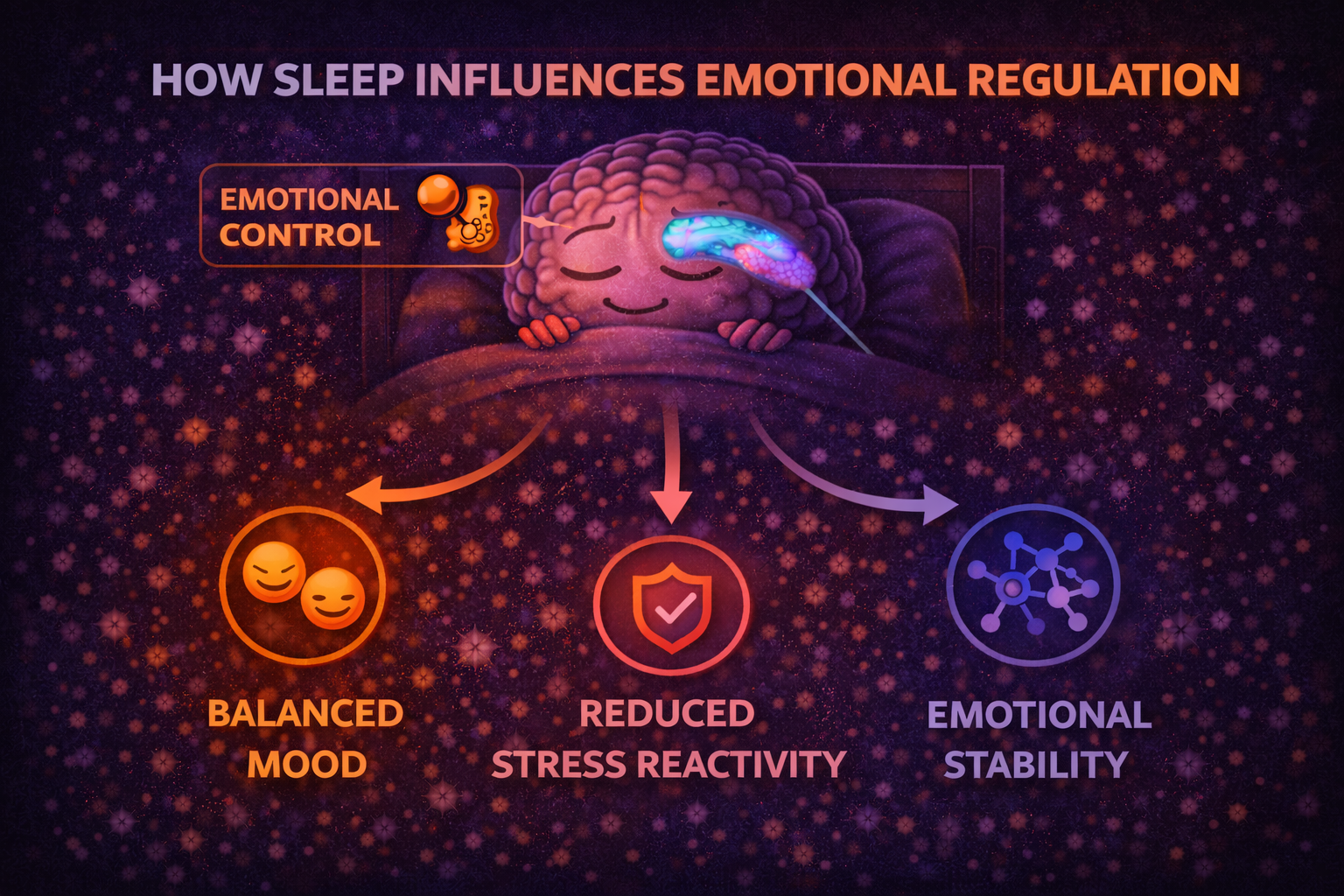
  • How Sleep Influences Emotional Regulation

    How Sleep Influences Emotional Regulation

    Why sleep determines how well the brain manages emotions and stress responses

    Emotional regulation is often framed as a skill — something that improves with awareness, effort, or practice. When emotions feel overwhelming or difficult to control, people tend to assume they need better coping strategies.

    But emotional regulation is not only psychological. It is deeply biological. The brain’s ability to manage emotions depends heavily on sleep. When sleep is disrupted, emotional regulation weakens. When sleep is consistent and restorative, emotional balance becomes far easier to maintain.


    Emotional Regulation Is a Brain Function

    Regulating emotions requires coordination.

    Some brain systems generate emotional responses, while others evaluate context, apply restraint, and reduce intensity. Emotional regulation depends on smooth communication between these systems.

    Sleep is the primary period when this coordination is restored. Without it, emotional responses become stronger and harder to modulate.


    How Sleep Resets Emotional Control Systems

    During sleep, emotional control systems recalibrate.

    Neural sensitivity decreases, stress signaling lowers, and regulatory circuits regain efficiency. This reset allows emotions to arise without overwhelming the system.

    Poor sleep leaves these control systems partially depleted, reducing emotional flexibility the next day.


    The Role of Deep Sleep in Regulation Stability

    Deep sleep supports baseline emotional stability.

    During slow-wave sleep, the brain reduces background noise and restores core regulatory networks. This creates a stable emotional baseline during waking hours.

    When deep sleep is reduced, emotional reactions become more volatile and less predictable.


    REM Sleep and Emotional Processing

    REM sleep plays a central role in emotional regulation.

    During REM, emotional experiences are processed in a low-stress neurochemical environment. This allows emotions to be integrated without retaining excessive emotional charge.

    Disrupted REM sleep leaves emotional experiences unresolved, increasing reactivity and emotional intensity.


    Why Poor Sleep Increases Emotional Reactivity

    Sleep deprivation amplifies emotional responses.

    Negative stimuli provoke stronger reactions, while positive experiences feel less rewarding. Emotional responses feel immediate and difficult to pause.

    This heightened reactivity reflects reduced regulatory capacity, not increased emotional sensitivity by choice.


    Sleep Loss and Reduced Emotional Insight

    Poor sleep impairs emotional awareness.

    The brain becomes less accurate at identifying internal emotional states and interpreting others’ emotions. This reduces empathy and increases misunderstandings.

    As a result, social interactions feel more emotionally draining.


    Why Emotions Feel Harder to Control When Tired

    Emotional control requires cognitive resources.

    Sleep restores the neural energy needed to pause, evaluate, and respond intentionally. Without sleep, emotions bypass regulation and feel automatic.

    This explains why emotional reactions are often regretted after poor sleep.


    Cumulative Effects of Chronic Sleep Disruption

    Emotional dysregulation compounds over time.

    Repeated nights of poor sleep weaken regulation, lower stress tolerance, and increase emotional fatigue. Over time, emotional instability becomes the baseline state.

    These changes are often misattributed to personality or mental health alone.


    Circadian Alignment and Emotional Balance

    Emotional regulation follows circadian timing.

    When sleep timing aligns with biological rhythms, emotional control is more consistent. Irregular schedules disrupt this timing, increasing emotional variability.

    Timing influences regulation as much as sleep duration.


    Why Emotional Regulation Improves After Good Sleep

    After high-quality sleep, emotional regulation feels natural.

    Reactions are more proportional, recovery is faster, and emotional clarity returns. This reflects restored regulation rather than changes in circumstances.

    Sleep prepares the brain to regulate emotions before the day begins.


    Why Effort Alone Cannot Replace Sleep

    Trying harder does not restore regulation.

    Emotional regulation requires biological recovery. Without sleep, effort increases strain without improving control.

    Sleep supports emotional regulation at its foundation.


    The Core Idea to Remember

    Sleep influences emotional regulation because it restores the brain’s ability to manage emotions.

    Through deep sleep and REM sleep, emotional control systems reset, reactivity decreases, and balance returns. Without sleep, emotional regulation weakens regardless of intention.

    Emotional regulation is not forced — it is supported overnight by sleep.

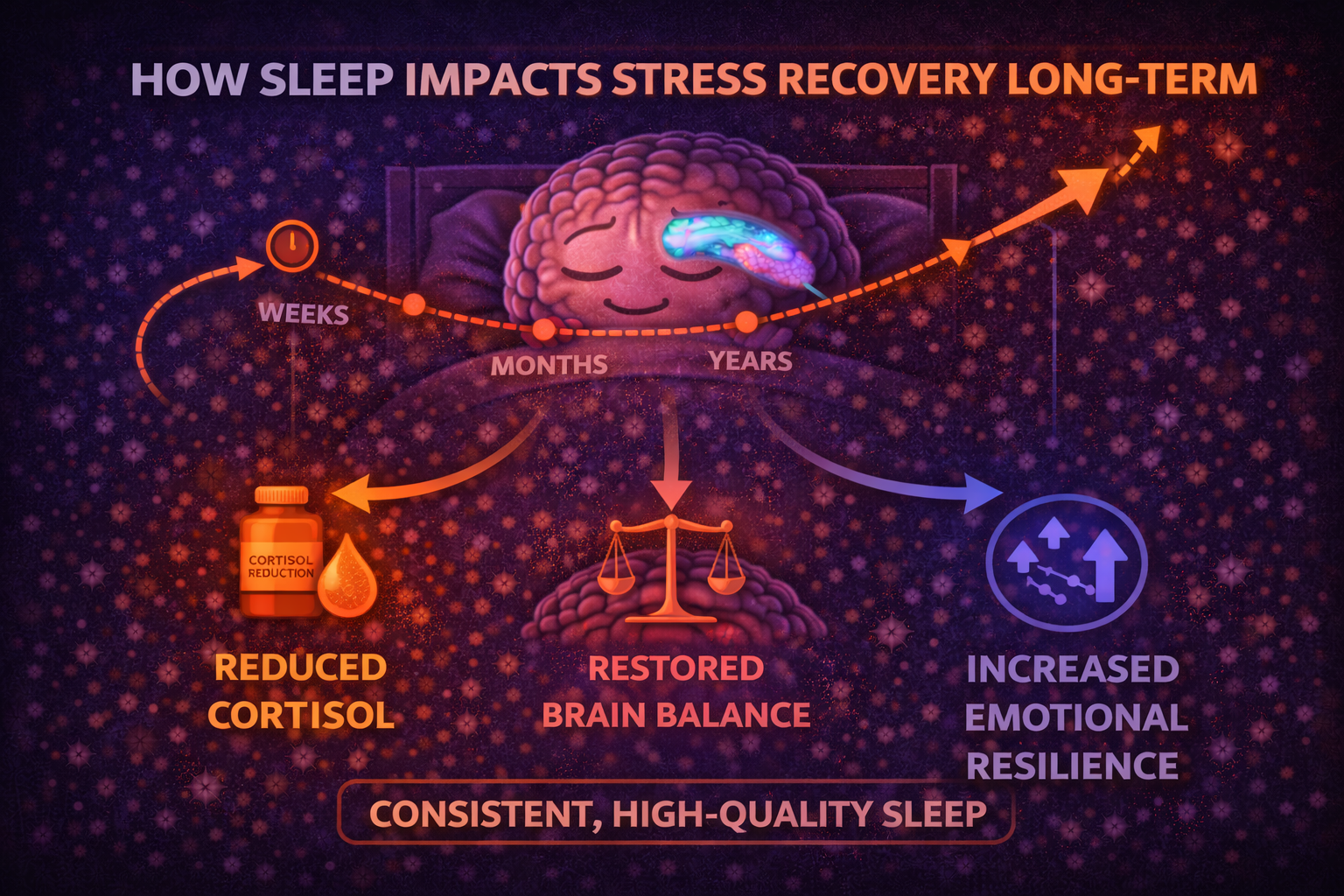
  • How Sleep Impacts Stress Recovery Long-Term

    How Sleep Impacts Stress Recovery Long-Term

    Why consistent sleep determines whether stress resolves or becomes chronic

    Stress is not inherently harmful. The body is designed to activate under pressure and then return to baseline. Problems arise when this recovery does not occur. Over time, unresolved stress accumulates and reshapes both mental and physical health.

    Long-term stress recovery depends less on occasional rest and more on what happens night after night. Sleep is the primary mechanism through which the brain and body resolve stress. When sleep is consistently disrupted, stress stops being temporary and becomes chronic.


    Stress Recovery Is a Cumulative Process

    Recovery does not reset instantly.

    Each night of sleep contributes a small but essential amount of stress resolution. When sleep is consistent and restorative, these nightly resets accumulate, maintaining balance over weeks and months.

    When sleep is poor, stress carries forward. Over time, the nervous system adapts to a state of persistent activation.


    How Sleep Repeatedly Resets the Stress System

    During healthy sleep, stress-related systems downregulate.

    Stress hormones decline, autonomic balance shifts toward recovery, and neural circuits involved in threat detection quiet down. This nightly reset prevents stress responses from becoming the baseline state.

    Without regular sleep-driven resets, stress systems remain partially activated long-term.


    Deep Sleep and Long-Term Physiological Recovery

    Deep sleep is central to sustained stress recovery.

    Across repeated nights, deep sleep supports cardiovascular regulation, metabolic repair, and immune balance. These systems are highly sensitive to chronic stress load.

    Reduced deep sleep over time leads to sustained physiological strain, even if daily stressors appear moderate.


    REM Sleep and Emotional Stress Resolution Over Time

    REM sleep plays a key role in emotional stress recovery.

    Night after night, REM sleep processes emotional experiences in a low-stress chemical environment. This repeated integration prevents emotional stress from accumulating.

    Chronic disruption of REM sleep allows emotional stress to build, increasing long-term emotional exhaustion and reactivity.


    Why Short-Term Coping Isn’t Enough

    Short-term stress relief does not equal recovery.

    Relaxation techniques, breaks, or time off may reduce stress temporarily. However, without consistent sleep, the nervous system does not fully reset.

    Long-term recovery requires repeated biological downregulation, not occasional relief.


    Sleep Loss and the Shift Toward Chronic Stress

    Chronic sleep disruption changes stress physiology.

    Over time, baseline stress hormone levels rise, stress responses become exaggerated, and recovery slows. The body begins to treat normal demands as threats.

    This shift explains why chronic stress often persists even after external stressors decrease.


    Circadian Disruption and Long-Term Stress Load

    Stress recovery is timing-dependent.

    Misaligned sleep schedules interfere with the natural nighttime decline of stress hormones. Even sufficient sleep duration may fail to produce recovery if timing is inconsistent.

    Circadian alignment improves the efficiency of long-term stress resolution.


    Why Burnout Develops When Sleep Is Inadequate

    Burnout reflects long-term recovery failure.

    When sleep does not resolve stress consistently, emotional exhaustion and disengagement accumulate. Motivation declines, resilience erodes, and stress feels constant.

    Burnout is not caused by stress alone — it is caused by stress without recovery.


    The Compounding Effect of Fragmented Sleep

    Fragmented sleep undermines long-term recovery.

    Frequent awakenings prevent full downregulation each night. Over weeks and months, this partial recovery produces chronic tension and fatigue.

    Fragmentation is often more damaging long-term than short sleep duration alone.


    Why Stress Becomes “Normal” Without Sleep

    Chronic stress can feel normal over time.

    As recovery remains incomplete, heightened arousal becomes the baseline state. People adapt to feeling tense, alert, or exhausted without recognizing the cause.

    Sleep loss gradually resets the body’s definition of normal.


    Restoring Long-Term Stress Recovery Through Sleep

    Long-term recovery begins with sleep consistency.

    Protecting sleep timing, continuity, and depth allows nightly stress resolution to accumulate. Over time, baseline arousal decreases and resilience returns.

    Recovery is not sudden — it rebuilds across many nights of sleep.


    The Core Idea to Remember

    Long-term stress recovery depends on sleep because sleep resolves stress repeatedly, not once.

    Through deep sleep and REM sleep, the brain and body downregulate stress systems night after night. Without this process, stress accumulates and becomes chronic.

    Stress is resolved over time — and sleep is the mechanism that makes long-term recovery possible.

  • Why Sleep Loss Amplifies Negative Emotions

    Why Sleep Loss Amplifies Negative Emotions

    How insufficient sleep intensifies emotional reactions and weakens regulation

    After a poor night of sleep, emotions often feel sharper and harder to manage. Minor frustrations trigger outsized reactions, stress feels heavier, and negative thoughts linger longer than they should.

    This shift is not a change in personality or attitude. It is a biological consequence of sleep loss. When sleep is insufficient, the brain’s emotional systems become more reactive while the systems that regulate and calm emotions lose efficiency. The result is an amplification of negative emotional experience.


    Emotional Regulation Depends on Brain Balance

    Emotions are controlled by a balance between reactive and regulatory brain systems.

    Some regions generate emotional responses, while others evaluate context, apply restraint, and reduce intensity. Emotional stability depends on coordination between these systems.

    Sleep is essential for maintaining this balance. When sleep is disrupted, emotional reactivity increases while control weakens.


    How Sleep Restores Emotional Control

    During sleep, the brain recalibrates emotional thresholds.

    Stress signaling decreases, neural sensitivity is reduced, and emotional circuits reset. This overnight regulation allows emotions to rise and fall without becoming overwhelming.

    Without adequate sleep, this recalibration remains incomplete.


    Sleep Loss and Heightened Emotional Reactivity

    One of the earliest effects of sleep deprivation is increased emotional reactivity.

    Negative stimuli provoke stronger responses, while positive experiences feel muted. The brain becomes more sensitive to perceived threats, criticism, or uncertainty.

    This explains why irritability, anxiety, and low mood intensify after poor sleep.


    Why Negative Emotions Dominate After Poor Sleep

    Sleep loss creates a negative emotional bias.

    The brain prioritizes negative information and memories, while positive emotional processing weakens. As a result, the world feels more stressful and less rewarding — even when circumstances have not changed.

    This bias is biological, not intentional.


    The Role of REM Sleep in Emotional Processing

    REM sleep plays a key role in emotional integration.

    During REM sleep, emotional experiences are processed in a low-stress chemical environment. This allows emotional memories to be stored without retaining high emotional charge.

    When REM sleep is reduced, emotions remain raw and reactive the next day.


    Deep Sleep and Emotional Stability

    Deep sleep supports emotional baseline stability.

    It restores core regulatory networks and reduces background neural noise. This creates a calmer emotional baseline during waking hours.

    Reduced deep sleep lowers emotional resilience and increases volatility.


    Why Small Stressors Feel Bigger When Sleep-Deprived

    Sleep deprivation lowers emotional tolerance.

    With fewer regulatory resources available, small challenges consume disproportionate emotional energy. What feels manageable when rested feels overwhelming when tired.

    The problem is not increased stress — it is reduced regulation.


    Sleep Loss and Reduced Emotional Insight

    Poor sleep impairs emotional awareness.

    The brain becomes less accurate at interpreting both internal emotional states and the emotions of others. Empathy declines, misunderstandings increase, and social interactions feel more draining.

    These effects contribute to emotional friction.


    Cumulative Effects of Repeated Sleep Loss

    Emotional amplification accumulates over time.

    Repeated nights of poor sleep reinforce negative bias and reduce recovery between stressors. Emotional fatigue builds even in the absence of major stress.

    This cumulative effect increases vulnerability to anxiety, burnout, and mood instability.


    Why Effort Alone Can’t Control Emotions Without Sleep

    Trying harder to control emotions does not restore regulation.

    Emotional control requires neural resources that are replenished during sleep. Without recovery, effort increases strain without improving stability.

    Sleep restores the capacity for emotional regulation.


    Why Emotional Balance Returns After Good Sleep

    After sufficient sleep, emotional balance often returns naturally.

    Reactions feel more proportional, stress feels manageable, and negative emotions lose intensity. This reflects restored regulation rather than changes in circumstances.

    Sleep gives the brain the stability it needs to regulate emotions.


    The Core Idea to Remember

    Sleep loss amplifies negative emotions because it disrupts emotional regulation.

    Without sleep, emotional systems become more reactive while control mechanisms weaken. Negative experiences feel stronger, more persistent, and harder to manage.

    Emotional balance is not forced — it is restored overnight when the brain is allowed to recover.

  • How Sleep Impacts Stress Recovery

    How Sleep Impacts Stress Recovery

    Why the ability to recover from stress depends on what happens during sleep

    Stress is unavoidable. What determines its impact is not how often it appears, but how effectively the brain and body recover afterward. Two people can experience similar stressors and have completely different outcomes — one rebounds quickly, the other remains tense, exhausted, and overwhelmed.

    Sleep is the dividing line. Stress recovery is not a passive process; it is an active biological reset that occurs primarily during sleep. When sleep is disrupted, stress does not resolve — it accumulates.


    Stress Is Meant to Be Temporary

    The stress response is designed to activate and then shut down.

    In a healthy system, stress hormones rise to meet a challenge and then fall once the threat passes. This return to baseline is essential for physical and mental health.

    Sleep is the primary window during which this shutdown occurs. Without it, stress systems remain partially activated.


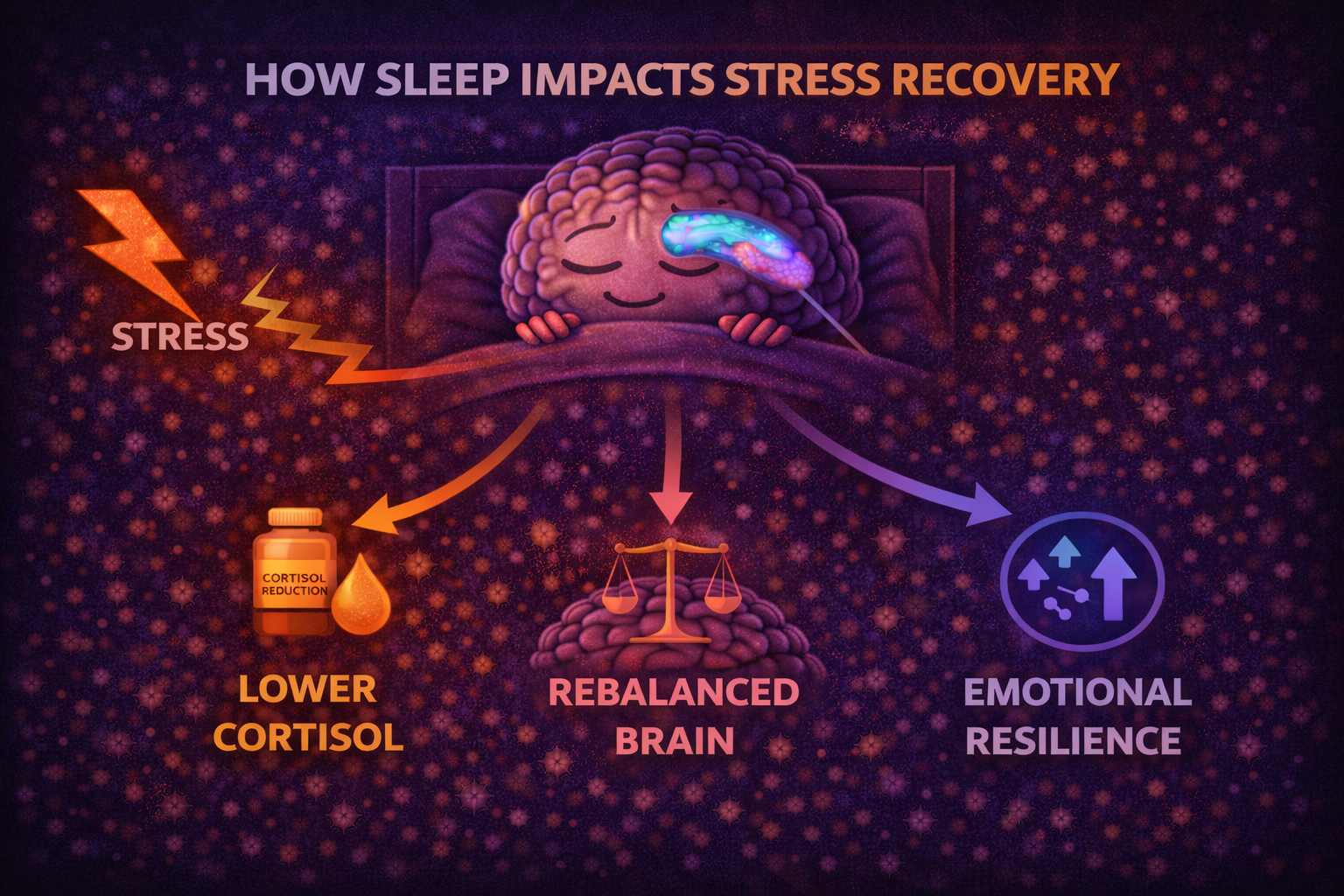
    How Sleep Turns Off the Stress Response

    During healthy sleep, stress-related activity declines.

    Stress hormones decrease, sympathetic nervous system activity lowers, and the body shifts into recovery mode. This allows tissues, neural circuits, and emotional systems to reset.

    Poor sleep leaves this process incomplete, keeping the body in a semi-alert state.


    Deep Sleep and Physiological Recovery

    Deep sleep is critical for physical stress recovery.

    During slow-wave sleep, heart rate slows, blood pressure drops, and metabolic repair accelerates. These changes signal safety to the nervous system.

    Reduced deep sleep prevents full physiological downregulation, prolonging stress effects into the next day.


    REM Sleep and Emotional Stress Processing

    REM sleep plays a key role in emotional recovery.

    During REM, emotional experiences are processed in a low-stress neurochemical environment. This allows stressful memories to be integrated without maintaining high emotional charge.

    Disrupted REM sleep leaves emotional stress unresolved, increasing emotional fatigue and reactivity.


    Why Poor Sleep Makes Stress Feel Constant

    Without sleep, stress lacks closure.

    The brain does not receive the signal that the challenge has ended. As a result, stress-related thoughts and bodily tension persist even when nothing new is happening.

    This creates the sensation of constant pressure rather than discrete stressful events.


    Sleep Loss and Reduced Stress Tolerance

    Sleep deprivation lowers the threshold for stress.

    Minor challenges trigger disproportionate reactions because regulatory systems are already strained. What would normally feel manageable becomes exhausting.

    Stress tolerance depends on prior recovery, not willpower.


    Cumulative Stress Without Recovery

    Stress accumulates when recovery is missing.

    Each night of poor sleep adds to unresolved stress load. Over time, this leads to emotional exhaustion, burnout, and chronic tension.

    The body keeps score when stress is not resolved.


    Why Time Off Doesn’t Always Reduce Stress

    Taking time off does not guarantee recovery.

    If sleep remains disrupted, stress systems stay active. The body cannot reset without consistent, high-quality sleep.

    This explains why people sometimes return from breaks still feeling stressed.


    Circadian Timing and Stress Recovery

    Stress recovery is influenced by circadian rhythm.

    Poorly timed sleep interferes with the natural decline of stress hormones at night. Even adequate sleep duration may fail to produce recovery if timing is misaligned.

    Alignment improves the efficiency of stress resolution.


    Why Relaxation Techniques Work Better After Sleep

    Relaxation requires regulation.

    Sleep restores the neural capacity needed for relaxation techniques to be effective. Without sleep, these techniques feel forced and temporary.

    Sleep provides the foundation upon which relaxation can work.


    Restoring Stress Recovery Through Sleep

    Improving stress recovery begins with improving sleep.

    Protecting sleep timing, continuity, and depth allows stress systems to downregulate naturally. Emotional and physical resilience rebuild without additional effort.

    Sleep is not an escape from stress — it is how the body recovers from it.


    The Core Idea to Remember

    Stress recovery depends on sleep because sleep turns off the stress response.

    Through deep sleep and REM sleep, the brain and body reset physiological and emotional stress systems. Without sleep, stress accumulates and becomes chronic.

    Recovering from stress is not optional — it is biological, and it happens at night.

  • The Connection Between Sleep and Anxiety

    The Connection Between Sleep and Anxiety

    How disrupted sleep increases anxious thinking, reactivity, and physiological stress

    Anxiety is often described as excessive worry, racing thoughts, or constant tension. When anxiety rises, people usually look for psychological causes — stress, personality, or life circumstances.

    But anxiety is also deeply biological. One of the strongest drivers of anxious states is poor sleep. When sleep quality declines, the brain becomes more reactive, less regulated, and more sensitive to threat. Anxiety does not appear out of nowhere — it often emerges from a sleep-deprived nervous system.


    Anxiety Begins With a Dysregulated Brain

    Anxiety reflects how the brain evaluates safety and threat.

    A regulated brain can assess risk proportionally and disengage from worry when danger is low. A dysregulated brain stays alert, scanning for potential problems even in safe conditions.

    Sleep is essential for maintaining this regulation. Without it, the brain shifts toward hypervigilance.


    How Sleep Calms the Nervous System

    Sleep reduces baseline arousal.

    During healthy sleep, stress hormones decline, neural activity stabilizes, and the nervous system resets. This downregulation allows the brain to exit survival mode.

    Poor sleep leaves the nervous system partially activated, making anxiety more likely the next day.


    Why Sleep Loss Increases Anxious Thoughts

    Sleep deprivation increases mental noise.

    The brain becomes less able to filter irrelevant thoughts and worries. Negative possibilities feel more urgent and harder to dismiss.

    This is why anxious thinking often intensifies after a bad night, even when nothing new has happened.


    REM Sleep and Anxiety Processing

    REM sleep plays a key role in reducing anxiety.

    During REM, emotional experiences are processed in a low-stress chemical environment. This allows fear-related memories to be integrated without triggering strong emotional reactions.

    When REM sleep is disrupted, anxious memories remain emotionally charged, increasing anxiety sensitivity.


    Deep Sleep and Baseline Calm

    Deep sleep supports physiological calm.

    It restores core regulatory systems, lowers background stress signaling, and increases emotional resilience. This calm baseline reduces the likelihood of anxious reactions.

    Reduced deep sleep leaves the brain more vulnerable to stress and worry.


    Why Anxiety Feels Worse at Night

    Anxiety often intensifies in the evening.

    As sleep pressure builds and cognitive control weakens, anxious thoughts become harder to regulate. Poor sleep timing amplifies this effect by disrupting circadian regulation of emotional systems.

    This creates a feedback loop where anxiety interferes with sleep, and poor sleep increases anxiety.


    Sleep Fragmentation and Anxiety Sensitivity

    Interrupted sleep increases anxiety sensitivity.

    Frequent awakenings prevent full nervous system recovery, even if total sleep time seems adequate. The brain remains partially alert overnight.

    This incomplete recovery lowers stress tolerance and increases anxious reactivity.


    Why Reassurance Doesn’t Work When Sleep-Deprived

    Anxious reassurance requires cognitive regulation.

    When sleep is poor, the brain lacks the resources to calm itself through logic or reassurance. Worry feels automatic rather than chosen.

    Sleep restores the capacity to evaluate concerns realistically.


    Cumulative Effects of Poor Sleep on Anxiety

    Anxiety builds cumulatively with sleep loss.

    Repeated nights of disrupted sleep reinforce hypervigilance, emotional sensitivity, and worry patterns. Over time, anxiety can become persistent even without clear triggers.

    Sleep problems often precede the onset of chronic anxiety.


    Improving Sleep to Reduce Anxiety

    Reducing anxiety often begins with restoring sleep.

    Improving sleep timing, continuity, and depth allows the nervous system to downregulate naturally. Emotional regulation strengthens without forcing relaxation.

    Sleep does not eliminate anxiety instantly, but it removes the biological fuel that sustains it.


    Why Anxiety Feels More Manageable After Good Sleep

    After good sleep, anxiety often softens.

    Thoughts feel less urgent, bodily tension decreases, and perspective returns. This shift reflects restored regulation rather than changes in circumstances.

    Sleep gives the brain the stability it needs to feel safe again.


    The Core Idea to Remember

    Sleep and anxiety are tightly connected because sleep regulates the nervous system.

    Without sleep, the brain becomes hyperreactive and threat-focused. With sleep, emotional regulation and calm return naturally.

    Managing anxiety is difficult without addressing sleep — but when sleep improves, anxiety often becomes easier to manage.