Tag: REM sleep

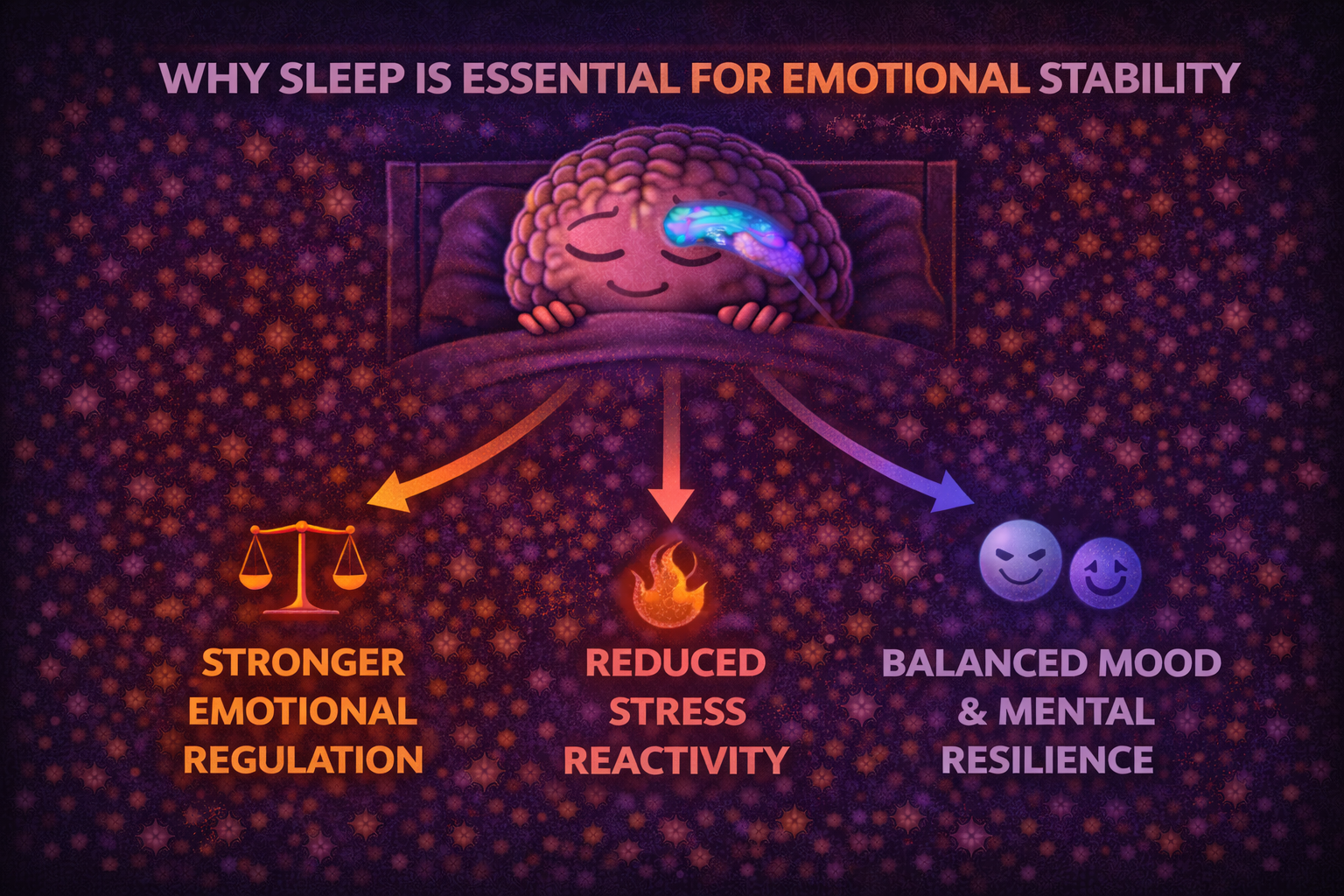
  • Why Sleep Is Essential for Emotional Stability

    Why Sleep Is Essential for Emotional Stability

    How sleep keeps emotions balanced, proportional, and easier to regulate

    Emotional stability is often described as a personality trait or a learned skill. When emotions feel intense or unpredictable, people tend to search for psychological explanations or coping techniques.

    In reality, emotional stability is strongly biological. The brain’s ability to keep emotions proportional, recover from stress, and maintain balance depends heavily on sleep quality. When sleep is disrupted, emotional regulation weakens. When sleep is protected, emotional stability becomes the default state rather than a constant effort.


    Emotional Stability Begins in the Brain

    Emotions are generated and regulated by interconnected brain systems.

    Some regions produce emotional responses, while others evaluate context, apply control, and reduce intensity. Emotional stability depends on smooth coordination between these systems.

    Sleep is the main period when this coordination is restored. Without it, emotional balance becomes fragile.


    How Sleep Resets Emotional Thresholds

    Every day raises emotional load.

    During sleep, the brain lowers emotional sensitivity and resets response thresholds. This recalibration allows emotions to rise without becoming overwhelming.

    Poor sleep leaves emotional thresholds elevated, making reactions stronger and harder to control.


    The Role of Deep Sleep in Emotional Balance

    Deep sleep supports emotional baseline stability.

    During slow-wave sleep, neural noise decreases and core regulatory networks recover. This creates a calm emotional baseline the next day.

    When deep sleep is reduced, emotional responses become more reactive and less predictable.


    REM Sleep and Emotional Integration

    REM sleep plays a critical role in processing emotional experiences.

    During REM, emotional memories are revisited in a low-stress chemical environment. This allows the brain to integrate emotions without maintaining high emotional intensity.

    Disrupted REM sleep leaves emotions unresolved, increasing emotional volatility.


    Why Poor Sleep Leads to Mood Swings

    Mood swings often reflect unstable emotional regulation.

    Without sufficient sleep, emotional responses fluctuate rapidly. Irritability, sadness, anxiety, and frustration appear with little provocation.

    These shifts are not random — they reflect reduced overnight emotional regulation.


    Sleep Loss and Reduced Emotional Control

    Sleep deprivation weakens impulse control.

    The brain becomes less able to pause, evaluate, and modulate emotional reactions. Responses feel automatic rather than chosen.

    This loss of control explains why people often regret emotional reactions after poor sleep.


    Why Small Stressors Feel Overwhelming

    Sleep loss lowers emotional tolerance.

    With reduced regulatory capacity, even minor stressors consume disproportionate emotional energy. Situations that normally feel manageable become draining.

    Emotional instability increases not because problems are bigger, but because regulation is weaker.


    Emotional Recovery Depends on Sleep

    Stability is not just about reaction — it’s about recovery.

    After emotional events, a well-rested brain returns to baseline quickly. Poor sleep slows this recovery, allowing emotions to linger and accumulate.

    Sleep determines how fast emotional balance is restored.


    Cumulative Effects of Chronic Poor Sleep

    Repeated sleep disruption compounds emotional instability.

    Over time, irritability becomes baseline, stress tolerance drops, and emotional fatigue sets in. These changes are often mistaken for personality or mental health issues.

    Restoring sleep often restores emotional balance people assumed was lost.


    Why Effort Alone Can’t Create Emotional Stability

    Trying harder to stay calm does not fix regulation.

    Emotional control requires neural resources replenished during sleep. Without recovery, effort increases strain without improving stability.

    Sleep supports emotional regulation at the biological level.


    Why Emotional Stability Returns After Good Sleep

    After high-quality sleep, emotions feel steadier.

    Reactions are more proportional, patience increases, and stress feels manageable. This shift reflects restored regulation, not changes in life circumstances.

    Sleep allows the brain to regulate emotions before the day begins.


    The Core Idea to Remember

    Sleep is essential for emotional stability because it restores emotional regulation.

    Through deep sleep and REM sleep, the brain resets emotional thresholds, integrates experiences, and reduces reactivity. Without sleep, emotional balance becomes fragile.

    Emotional stability is not forced — it is supported overnight by sleep.

  • The Link Between Sleep and Burnout

    The Link Between Sleep and Burnout

    How chronic sleep disruption fuels exhaustion, disengagement, and emotional depletion

    Burnout is often described as the result of working too much, caring too deeply, or being under constant pressure. While these factors matter, they don’t fully explain why some people collapse emotionally while others remain resilient under similar demands.

    Sleep is a critical missing piece. Burnout is not just a psychological state — it is a physiological breakdown of recovery. When sleep is compromised over time, the brain loses its ability to reset stress, restore motivation, and regulate emotion. Burnout emerges when demand continues but recovery disappears.


    Burnout Is a Failure of Recovery

    Burnout does not happen overnight.

    It develops when stress accumulates faster than the brain can recover. Sleep is the primary period when this recovery should occur. When sleep is shortened, fragmented, or mistimed, recovery remains incomplete.

    Over time, this imbalance produces emotional exhaustion, mental detachment, and a sense of being permanently drained.


    How Sleep Restores Stress Regulation

    Sleep resets the stress response.

    During healthy sleep, stress hormones decline, neural reactivity decreases, and emotional thresholds are restored. This allows the brain to respond to challenges without remaining in a constant state of alert.

    Without sufficient sleep, stress systems stay activated, turning everyday demands into chronic pressure.


    Why Poor Sleep Accelerates Emotional Exhaustion

    Emotional exhaustion is a hallmark of burnout.

    Sleep loss reduces emotional regulation capacity, making each interaction more taxing. Empathy declines, patience shortens, and emotional effort increases.

    What once felt meaningful begins to feel overwhelming when emotional recovery is missing.


    Sleep Loss and Cognitive Detachment

    Burnout often includes detachment and reduced motivation.

    Poor sleep weakens cognitive engagement systems, making tasks feel empty or pointless. This is not loss of interest — it is loss of mental energy.

    Sleep restores the cognitive resources needed for engagement and purpose.


    The Role of REM Sleep in Emotional Recovery

    REM sleep supports emotional processing.

    During REM, emotional experiences are integrated in a low-stress neurochemical environment. This processing prevents emotional overload from accumulating.

    Disrupted REM sleep leaves emotional experiences unresolved, increasing vulnerability to burnout.


    Deep Sleep and Core Resilience

    Deep sleep restores baseline resilience.

    It supports neural stability, reduces background stress signaling, and improves tolerance to challenge. This foundation allows the brain to handle prolonged demand.

    Reduced deep sleep lowers this threshold, making burnout more likely under sustained pressure.


    Why Long Hours Are Not the Only Cause

    Many people work long hours without burning out.

    The difference lies in recovery quality. Adequate sleep allows stress to resolve between days. Poor sleep allows stress to carry forward.

    Burnout is more strongly linked to insufficient recovery than to workload alone.


    Sleep Fragmentation and Burnout Risk

    Fragmented sleep increases burnout risk.

    Frequent awakenings prevent full recovery, even when total sleep time appears sufficient. The brain remains partially alert all night, increasing physiological strain.

    Over time, this strain manifests as emotional and mental exhaustion.


    Why Burnout Persists Even During Time Off

    Time off does not always fix burnout.

    If sleep remains disrupted, recovery does not occur. The brain cannot reset stress systems without consistent, high-quality sleep.

    This explains why vacations sometimes fail to relieve burnout symptoms.


    Breaking the Burnout Cycle Through Sleep

    Reducing burnout requires restoring recovery.

    Improving sleep timing, continuity, and depth allows stress systems to downregulate and emotional capacity to rebuild. Without sleep restoration, other interventions have limited impact.

    Sleep is not a luxury during burnout — it is the intervention.


    The Core Idea to Remember

    Burnout is tightly linked to sleep because sleep is how the brain recovers from stress.

    Chronic sleep disruption prevents emotional, cognitive, and physiological restoration, allowing exhaustion to accumulate. Burnout emerges when recovery is missing, not simply when work is demanding.

    Protecting sleep protects resilience — and is one of the most effective ways to prevent and reverse burnout.

  • Why Your Mood Depends on Sleep Quality

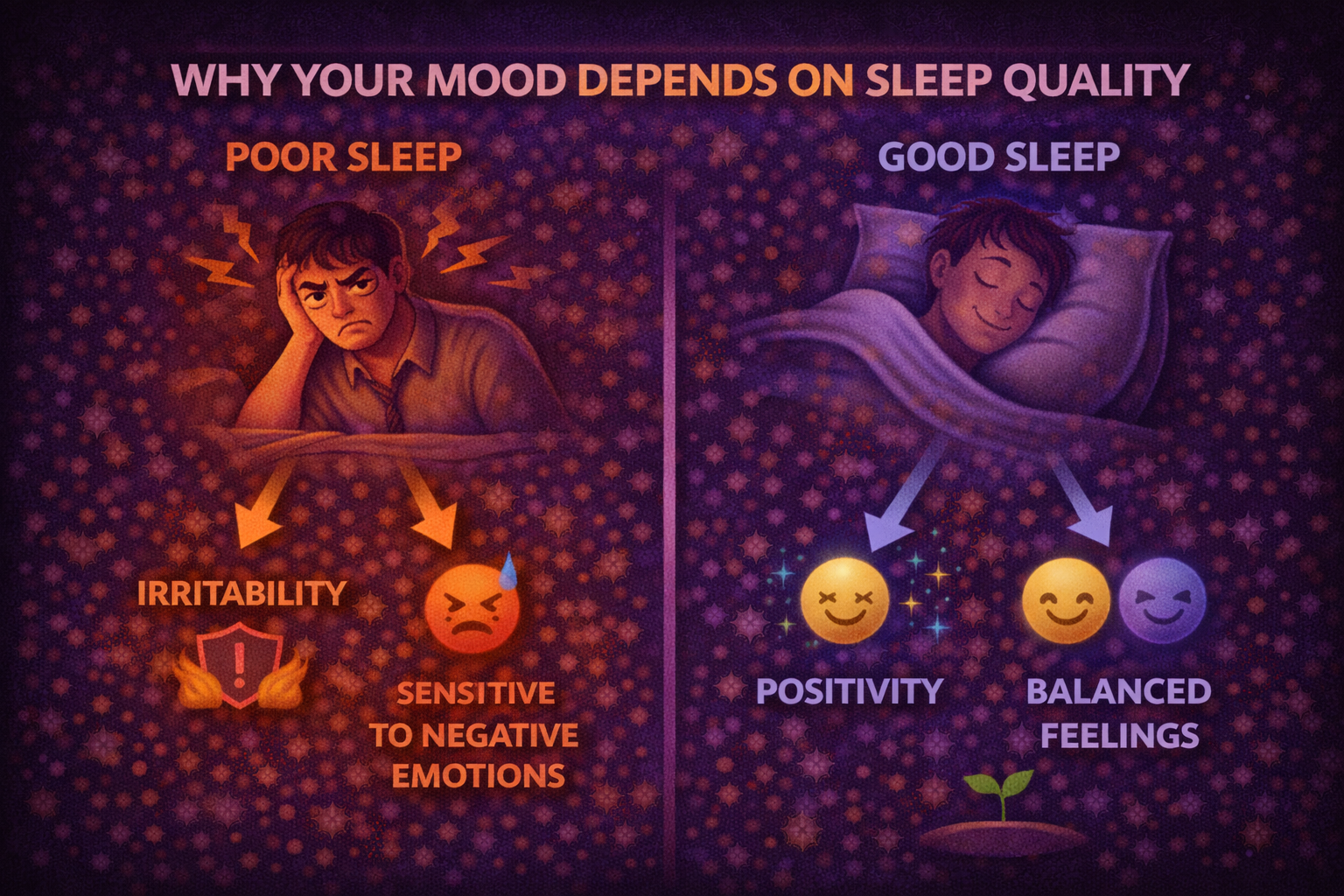
    Why Your Mood Depends on Sleep Quality

    How sleep quality shapes emotional stability, resilience, and daily mood

    Mood often feels like a reaction to circumstances. A good day lifts it, a stressful event lowers it. When mood worsens, people usually search for psychological or situational explanations.

    But mood is not only shaped by what happens during the day. It is strongly influenced by how the brain recovers at night. Sleep quality — not just sleep duration — plays a central role in determining emotional tone, stress tolerance, and mood stability from one day to the next.


    Mood Is Regulated by Brain State

    Mood reflects how the brain processes emotional input.

    A well-regulated brain evaluates situations proportionally, recovers quickly from stress, and maintains emotional balance. A poorly regulated brain reacts more strongly and recovers more slowly.

    Sleep quality is one of the main factors determining which of these states dominates.


    Why Sleep Quality Matters More Than Hours Slept

    Sleeping longer does not guarantee emotional stability.

    If sleep is fragmented, mistimed, or lacking restorative stages, the brain does not fully reset emotional systems. Mood may decline even after a long night in bed.

    High-quality sleep allows emotional regulation to complete its overnight cycle.


    How Sleep Recalibrates Emotional Thresholds

    During sleep, emotional sensitivity is recalibrated.

    Stress-related signaling decreases, emotional thresholds reset, and the brain restores balance between emotional reactivity and control. This allows emotions to arise without becoming overwhelming.

    Poor sleep leaves this recalibration incomplete, increasing emotional volatility.


    The Role of Deep Sleep in Mood Stability

    Deep sleep supports baseline emotional stability.

    It restores core neural networks involved in emotional regulation and reduces background neural noise. This creates a stable emotional baseline the next day.

    When deep sleep is reduced, mood becomes more fragile and reactive.


    REM Sleep and Emotional Processing

    REM sleep plays a critical role in emotional integration.

    During REM, emotional experiences are processed in a low-stress chemical environment. This allows emotional memories to be integrated without maintaining high emotional charge.

    Disrupted REM sleep leaves emotional experiences unprocessed, increasing emotional sensitivity and mood instability.


    Why Poor Sleep Increases Irritability

    Irritability is one of the most common signs of poor sleep.

    Sleep loss lowers tolerance for frustration and reduces impulse control. Minor inconveniences trigger disproportionate emotional reactions.

    This irritability is not a character flaw — it reflects reduced emotional regulation capacity.


    Sleep Quality and Emotional Recovery Speed

    Mood depends not only on reaction, but on recovery.

    After stress or negative emotion, a well-rested brain returns to baseline quickly. Poor sleep slows this recovery, allowing negative mood to persist longer.

    Sleep quality determines how fast emotional balance is restored.


    Negative Mood Bias After Poor Sleep

    Poor sleep creates a negative mood bias.

    The brain prioritizes negative information, memories, and interpretations. Positive experiences feel muted, while negative ones dominate attention.

    This bias shapes overall mood even when external circumstances are neutral.


    Cumulative Effects on Mood Over Time

    Repeated nights of poor sleep compound mood instability.

    Emotional regulation weakens, stress tolerance declines, and low mood becomes more persistent. Over time, this pattern increases vulnerability to anxiety and depressive symptoms.

    Mood changes often precede conscious awareness of sleep problems.


    Why Effort Can’t Stabilize Mood Without Sleep

    Trying to “stay positive” does not restore mood regulation.

    Effort requires neural resources that are replenished during sleep. Without recovery, emotional control remains impaired regardless of intention.

    Sleep supports mood regulation at a biological level.


    Why Mood Improves After High-Quality Sleep

    After good sleep, mood often improves without explanation.

    Emotions feel lighter, stress feels manageable, and perspective returns. This reflects restored regulation rather than changes in life circumstances.

    Sleep allows the brain to process emotions before the day begins.


    The Core Idea to Remember

    Mood depends on sleep quality because sleep regulates emotional balance.

    Through deep sleep and REM sleep, the brain restores emotional thresholds, processes experiences, and reduces negative bias. Poor sleep disrupts this process, amplifying mood instability.

    Stable mood is not forced — it is supported overnight by high-quality sleep.

  • Why Sleep Loss Amplifies Negative Emotions

    Why Sleep Loss Amplifies Negative Emotions

    How insufficient sleep intensifies emotional reactions and reduces regulation

    After a poor night of sleep, emotions often feel sharper and harder to control. Minor frustrations trigger strong reactions, stress feels heavier, and negative thoughts linger longer than usual. Situations that would normally feel manageable suddenly feel overwhelming.

    This emotional shift is not a personality change. It is a biological response to sleep loss. When sleep is insufficient, the brain’s emotional systems become more reactive while regulatory systems weaken, creating a bias toward negative emotional experience.


    Emotion Regulation Depends on Brain Balance

    Emotions are regulated through coordination between multiple brain regions.

    Some systems generate emotional responses, while others evaluate context, apply control, and reduce intensity. Healthy emotional regulation depends on balance between these systems.

    Sleep is essential for maintaining this balance. When sleep is disrupted, emotional responses gain strength while control mechanisms lose efficiency.


    How Sleep Supports Emotional Control

    During sleep, the brain recalibrates emotional thresholds.

    Stress signals decrease, neural sensitivity is reduced, and emotional processing systems reset. This overnight regulation allows emotions to rise and fall without becoming extreme.

    Without adequate sleep, this recalibration remains incomplete.


    Sleep Loss and Heightened Emotional Reactivity

    One of the earliest effects of sleep loss is increased emotional reactivity.

    Negative stimuli trigger stronger responses, while positive experiences feel muted. The brain becomes more sensitive to perceived threats, criticism, or uncertainty.

    This explains why irritability, anxiety, and low mood increase after even modest sleep deprivation.


    Why Negative Emotions Dominate After Poor Sleep

    Sleep loss creates a negative emotional bias.

    The brain prioritizes negative information and memories while positive emotional processing weakens. This bias shapes perception, making the world feel more stressful and less rewarding.

    Importantly, this shift occurs even when external circumstances have not changed.


    The Role of REM Sleep in Emotional Processing

    REM sleep plays a critical role in emotional integration.

    During REM, emotional experiences are processed in a low-stress chemical environment. This allows the brain to separate emotional intensity from factual memory.

    When REM sleep is reduced, emotional experiences remain raw and reactive, increasing emotional intensity the next day.


    Deep Sleep and Emotional Stability

    Deep sleep supports emotional baseline stability.

    It restores core neural networks and reduces background emotional noise. This stability allows emotional responses to remain proportional to situations.

    Reduced deep sleep lowers emotional resilience, making reactions more extreme and less predictable.


    Sleep Loss and Reduced Emotional Insight

    Poor sleep impairs emotional awareness.

    The brain becomes less accurate at interpreting its own emotional state and the emotions of others. This reduces empathy and increases misunderstandings.

    As a result, social interactions feel more strained after sleep loss.


    Why Small Stressors Feel Bigger

    Sleep deprivation lowers emotional tolerance.

    With reduced regulatory capacity, small challenges consume disproportionate emotional energy. What feels trivial on a well-rested day feels significant after poor sleep.

    This amplification contributes to the sense that “everything feels harder” when tired.


    Cumulative Effects of Repeated Sleep Loss

    Emotional amplification accumulates over time.

    Repeated nights of insufficient sleep reinforce negative emotional bias and reduce recovery between stressors. Emotional exhaustion builds, even without major life events.

    Over time, this pattern increases vulnerability to anxiety, burnout, and mood instability.


    Why Effort Can’t Control Emotions Without Sleep

    Trying to control emotions while sleep-deprived is inefficient.

    Effort increases cognitive strain without restoring regulation capacity. Emotional control requires neural resources that are replenished during sleep.

    Without recovery, emotions overpower intention.


    Why Emotional Balance Returns After Good Sleep

    After sufficient sleep, emotional balance improves naturally.

    Reactions feel more proportional, stress feels manageable, and negative emotions lose intensity. This reflects restored regulation, not changes in circumstances.

    Sleep does not remove emotions — it restores perspective.


    The Core Idea to Remember

    Sleep loss amplifies negative emotions because it disrupts emotional regulation.

    Without sleep, emotional systems become more reactive while control mechanisms weaken. Negative experiences feel stronger, more persistent, and harder to manage.

    Emotional balance is not forced — it is restored overnight when the brain is allowed to recover.

  • Why Sleep Is Essential for Mental Health

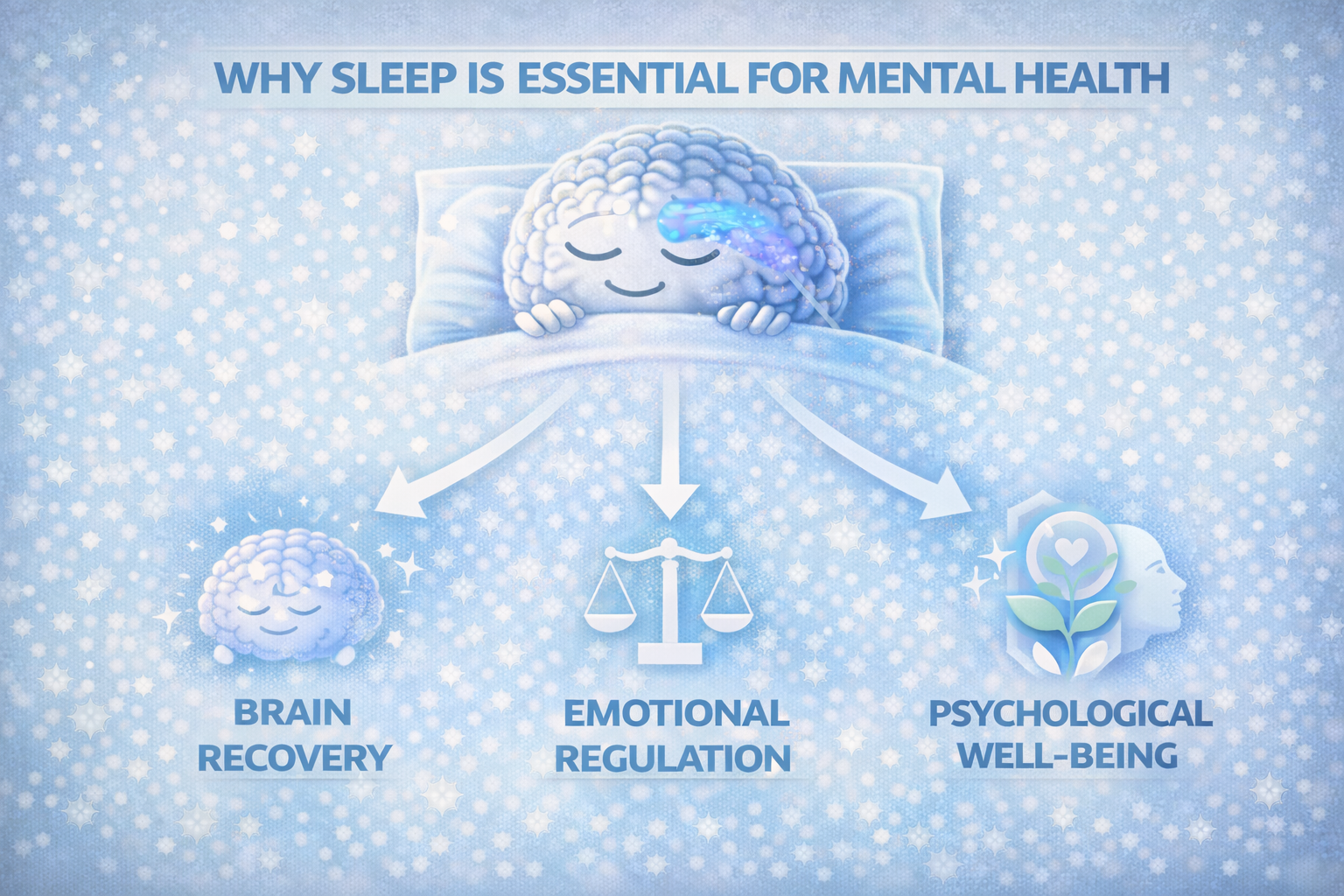
    Why Sleep Is Essential for Mental Health

    How sleep regulates emotional balance, stress resilience, and psychological stability

    Mental health is often discussed in terms of thoughts, emotions, habits, and coping strategies. Sleep is frequently treated as a secondary factor — something helpful, but not central.

    In reality, sleep is one of the most powerful regulators of mental health. It shapes how emotions are processed, how stress is tolerated, and how the brain maintains psychological balance. When sleep is disrupted, mental health becomes fragile. When sleep is protected, emotional stability becomes possible.


    Mental Health Is a Biological State First

    Mental health does not begin with mindset.

    It begins with brain regulation. Emotional balance, mood stability, and stress tolerance all depend on how effectively the brain can regulate itself. Sleep is the primary period during which this regulation occurs.

    Without sufficient, well-timed sleep, the brain loses its ability to maintain emotional equilibrium, regardless of insight or effort.


    How Sleep Regulates Emotional Processing

    Every day produces emotional input.

    During sleep, the brain processes these experiences offline. Emotional reactions are reviewed, integrated, and moderated. This allows emotions to be remembered without remaining overwhelming.

    When sleep is disrupted, emotional processing remains incomplete. Emotions carry over with greater intensity, making everyday stressors feel heavier and harder to manage.


    The Role of Sleep in Stress Resilience

    Stress is unavoidable. Recovery is not.

    Sleep restores the systems that regulate the stress response. During sleep, stress hormones decline, neural reactivity decreases, and emotional thresholds reset.

    Without sleep, stress responses remain elevated. Small challenges trigger outsized reactions, and recovery from stress takes longer.


    Why Poor Sleep Amplifies Anxiety

    Anxiety is strongly linked to sleep quality.

    When sleep is insufficient or fragmented, the brain’s threat-detection systems become more sensitive. At the same time, the systems responsible for calming and rational evaluation weaken.

    This imbalance makes worry feel automatic, persistent, and difficult to control — even when external circumstances are stable.


    Sleep and Mood Stability

    Mood regulation depends on sleep continuity.

    Sleep supports stable communication between emotional and cognitive brain regions. This balance allows emotions to rise and fall without becoming extreme.

    Poor sleep disrupts this coordination, increasing irritability, mood swings, and emotional volatility.


    Why Depression and Sleep Are Closely Connected

    Sleep and depression influence each other bidirectionally.

    Chronic sleep disruption increases vulnerability to depressive symptoms by weakening emotional regulation and motivation. At the same time, depression often disrupts sleep timing and quality.

    This creates a reinforcing loop where poor sleep and low mood sustain each other unless sleep is addressed directly.


    REM Sleep and Emotional Integration

    REM sleep plays a critical role in mental health.

    During REM sleep, emotional experiences are processed in a low-stress neurochemical environment. This allows emotional memories to be integrated without triggering intense emotional responses.

    Disrupted REM sleep leaves emotional experiences unprocessed, increasing emotional reactivity and mental fatigue.


    Deep Sleep and Psychological Stability

    Deep sleep supports overall mental stability.

    It restores core brain networks, reduces neural noise, and improves emotional baseline regulation. This stability provides the foundation upon which emotional resilience is built.

    When deep sleep is reduced, mental health becomes more vulnerable to daily fluctuations.


    Why Mental Health Interventions Often Fail Without Sleep

    Many mental health strategies assume a functional brain.

    Therapy, reflection, coping techniques, and behavioral changes all rely on neural stability. When sleep is compromised, the brain lacks the capacity to apply these tools effectively.

    Improving sleep often enhances the effectiveness of all other mental health interventions.


    Sleep as Prevention, Not Just Treatment

    Sleep is not only corrective — it is protective.

    Consistent, high-quality sleep reduces the risk of anxiety, burnout, emotional exhaustion, and long-term mental health decline. It increases resilience before problems escalate.

    Mental health is easier to maintain than to repair.


    Why Modern Life Undermines Mental Health Through Sleep

    Modern environments disrupt sleep in subtle ways.

    Irregular schedules, artificial light, constant stimulation, and chronic stress interfere with sleep timing and depth. Over time, these disruptions erode mental stability even in otherwise healthy individuals.

    Mental health challenges often emerge gradually as sleep debt accumulates.


    The Core Idea to Remember

    Sleep is the foundation of mental health because it regulates how the brain processes emotion, stress, and psychological balance.

    Without sleep, mental health becomes fragile. With sleep, emotional resilience becomes possible.

    Sleep does not replace therapy, insight, or support — but without it, none of them work as they should.

  • Can Sleep Improve Problem Solving?

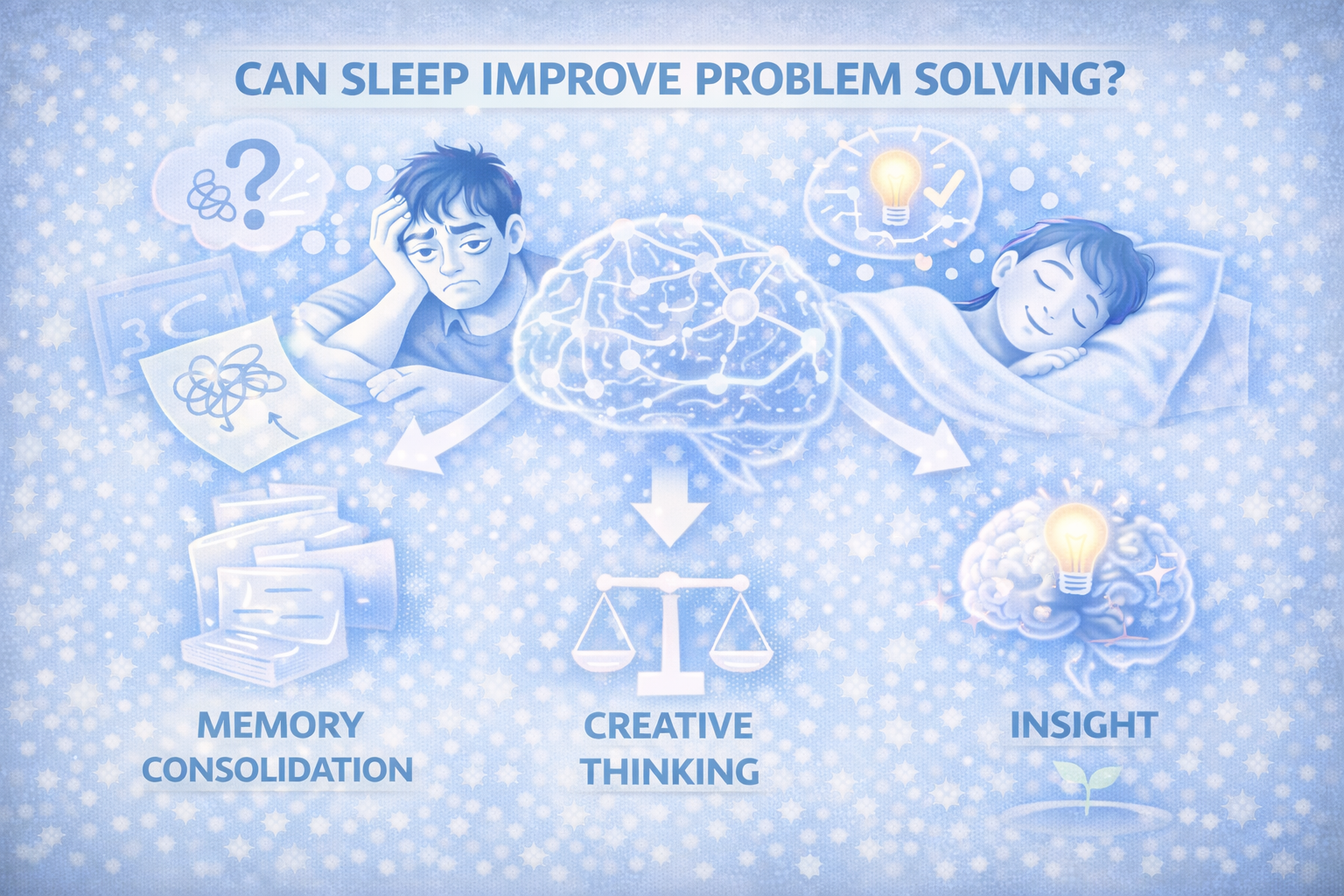
    Can Sleep Improve Problem Solving?

    How sleep helps the brain find solutions, patterns, and new perspectives

    Problem solving is often seen as a conscious effort: analyze the issue, think harder, and work through the details. When solutions don’t come easily, the instinct is to spend more time thinking.

    Yet many people experience the opposite — stepping away, sleeping on a problem, and waking up with clarity. This is not coincidence. Sleep actively improves the brain’s ability to solve problems by reorganizing information, strengthening insight, and reducing mental rigidity.


    Problem Solving Is Not Only a Waking Process

    Solving problems does not stop when you stop thinking about them.

    While awake, the brain gathers information and explores obvious solutions. During sleep, especially certain stages, the brain continues working offline — without pressure or conscious control.

    This offline processing often leads to solutions that feel sudden or intuitive the next day.


    How Sleep Reorganizes Information

    During sleep, the brain restructures knowledge.

    Information acquired during the day is replayed, reorganized, and connected across networks. This process allows the brain to see relationships that were not obvious during focused effort.

    Problem solving improves when information is integrated rather than repeatedly analyzed in the same way.


    REM Sleep and Insight-Based Solutions

    REM sleep is particularly important for insight.

    During REM, the brain links distant ideas, reduces rigid thinking, and promotes unconventional associations. This environment supports creative problem solving and “aha” moments.

    Disrupted REM sleep reduces the likelihood of these insights emerging.


    Deep Sleep and Logical Problem Solving

    Deep sleep supports structured reasoning.

    It strengthens core memory representations and stabilizes relevant information. This allows logical problems to be approached more efficiently after sleep, with fewer distractions.

    Reduced deep sleep weakens this foundation, making reasoning feel slower and more effortful.


    Why Sleep Reduces Mental Fixation

    Problem solving often fails because of fixation — getting stuck on one approach.

    Sleep helps break fixation by weakening unproductive associations and allowing alternative pathways to emerge. This reset increases cognitive flexibility.

    After sleep, the brain is less locked into previous assumptions.


    Sleep Deprivation and Narrow Thinking

    Lack of sleep narrows problem-solving ability.

    The brain defaults to familiar strategies and struggles to adapt. Novel solutions feel harder to generate, and errors increase.

    Sleep deprivation does not remove intelligence, but it limits access to flexible thinking.


    Circadian Timing and Solution Quality

    Problem-solving ability varies across the day.

    Circadian rhythm influences when the brain is most receptive to insight and reasoning. Poorly timed sleep disrupts these peaks, reducing solution quality even after sufficient sleep duration.

    Alignment improves consistency in problem-solving performance.


    Why Stepping Away Works Better Than Pushing Through

    Pushing harder often increases mental rigidity.

    Sleep allows the brain to disengage from effortful control and reorganize information naturally. This explains why solutions often feel obvious after rest.

    The brain solves better when it is allowed to reset.


    Long-Term Benefits of Sleep for Problem Solving

    Consistent good sleep compounds benefits.

    Over time, learning improves, mental flexibility increases, and complex problem solving becomes more efficient. These effects accumulate and protect cognitive performance.

    Sleep supports both immediate insight and long-term adaptability.


    When Sleep Does Not Help Immediately

    Not every problem is solved after one night.

    Some problems require sufficient information or multiple cycles of integration. However, sleep consistently improves the conditions under which solutions can emerge.

    Progress may feel gradual, but it is real.


    The Core Idea to Remember

    Sleep improves problem solving by reorganizing information, reducing fixation, and enhancing insight.

    Through deep sleep and REM sleep, the brain continues working on problems without conscious effort. Depriving sleep deprives the brain of this advantage.

    Sometimes the best way to solve a problem is not to think harder — but to sleep on it.

  • Why You Feel Less Creative When Sleep-Deprived

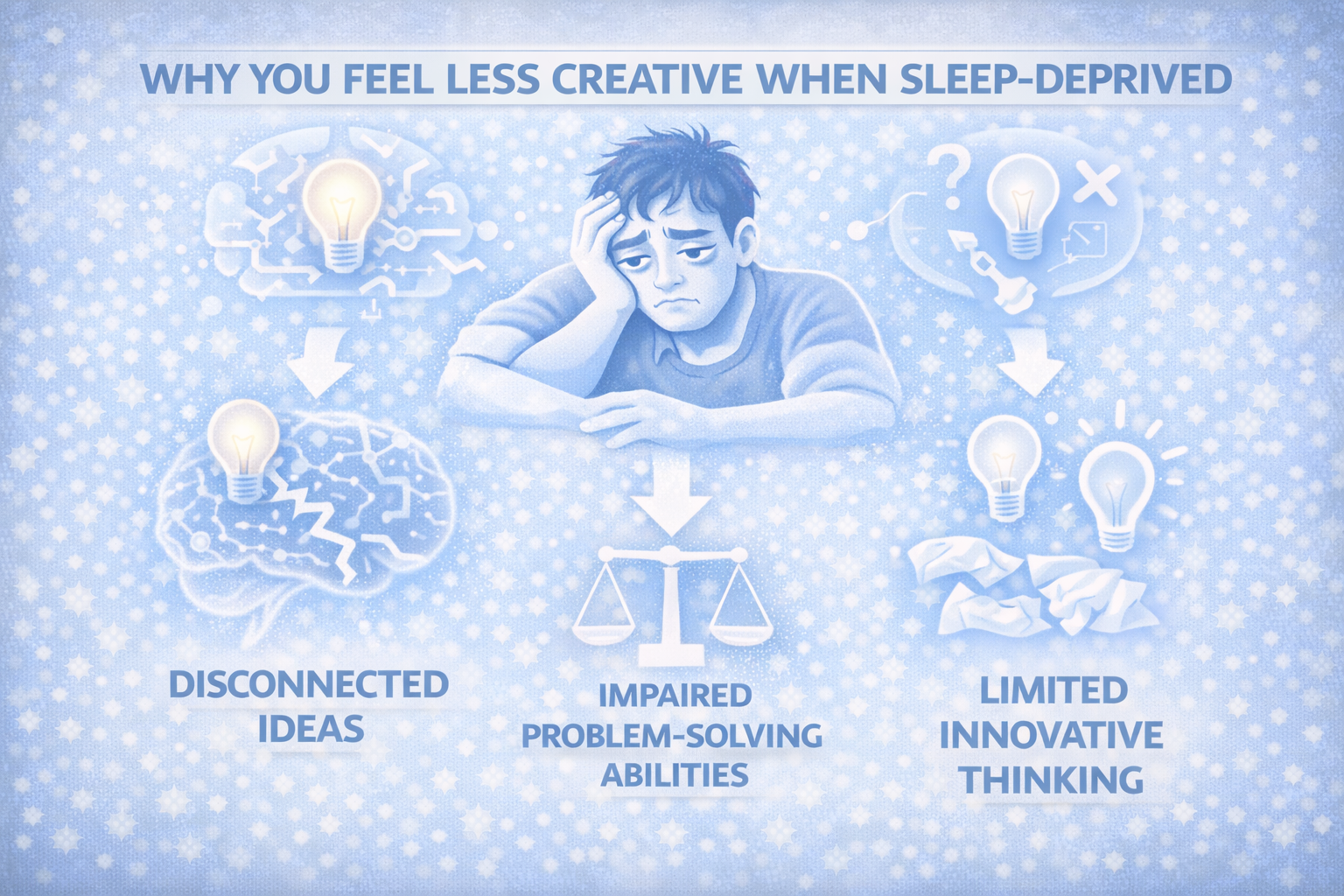
    Why You Feel Less Creative When Sleep-Deprived

    How lack of sleep disrupts idea generation, insight, and flexible thinking

    Creativity often feels spontaneous. Ideas connect unexpectedly, solutions appear without force, and thinking flows. After poor sleep, that flow disappears. Ideas feel flat, rigid, or repetitive, and creative tasks require far more effort.

    This shift is not about motivation or talent. Creativity depends on specific brain processes that are highly sensitive to sleep. When sleep is reduced or fragmented, the brain loses the conditions needed to combine ideas, explore alternatives, and generate insight.


    Creativity Depends on Flexible Brain Networks

    Creative thinking requires flexibility.

    The brain must move easily between concepts, access distant associations, and tolerate ambiguity. This flexibility relies on efficient communication between multiple brain networks.

    Sleep maintains this flexibility. Without it, thinking becomes narrower and more constrained.


    How Sleep Supports Creative Integration

    During sleep, the brain integrates information across networks.

    Ideas learned or experienced during the day are reorganized, combined, and connected in new ways. This integration allows creative insights to emerge later with little conscious effort.

    Without sleep, information remains siloed, limiting creative recombination.


    REM Sleep and Creative Insight

    REM sleep plays a central role in creativity.

    During REM, the brain connects distant concepts while emotional pressure is reduced. This state encourages unconventional associations and novel solutions.

    Disrupted REM sleep significantly reduces the brain’s ability to generate original ideas.


    Deep Sleep and Creative Stability

    Deep sleep supports the foundation of creativity.

    It stabilizes core cognitive function, reduces neural noise, and restores mental energy. This stability allows creative processes to operate smoothly the next day.

    When deep sleep is reduced, creative thinking becomes effortful and easily derailed.


    Why Sleep Deprivation Produces Rigid Thinking

    Lack of sleep increases cognitive rigidity.

    The brain defaults to familiar patterns and known solutions because flexible exploration requires more neural resources. Novel ideas feel harder to access.

    This rigidity explains why sleep-deprived thinking often feels repetitive or uninspired.


    Sleep Loss and Reduced Cognitive Exploration

    Creative thinking requires exploration.

    Sleep deprivation reduces the brain’s tolerance for uncertainty and complexity. As a result, thinking becomes more linear and less exploratory.

    The brain prioritizes efficiency over innovation when resources are limited.


    Why Forcing Creativity Doesn’t Work Without Sleep

    Creativity cannot be forced under deprivation.

    Effort increases mental strain but does not restore integrative capacity. The harder you try, the more constrained thinking becomes.

    Creative flow depends on recovery, not pressure.


    Circadian Timing and Creative Peaks

    Creativity fluctuates with circadian rhythm.

    Certain times of day naturally support creative thinking. Poorly timed sleep disrupts these peaks, flattening creative energy even after sufficient hours of sleep.

    Timing matters as much as duration for creative output.


    Fragmented Sleep and Creative Inconsistency

    Interrupted sleep reduces creative consistency.

    Ideas may appear briefly, then disappear. Creative clarity becomes unpredictable. This inconsistency reflects incomplete neural integration during sleep.

    Fragmented sleep often impairs creativity more than short but continuous sleep.


    Long-Term Effects of Poor Sleep on Creativity

    Chronic sleep disruption dulls creative capacity over time.

    Original thinking becomes harder, insight rarer, and creative confidence declines. These changes are often misattributed to burnout or loss of inspiration.

    Restoring sleep often restores creative ability people assumed was gone.


    Why Creativity Returns After Good Sleep

    After good sleep, creativity feels natural again.

    Ideas connect more easily, thinking becomes playful, and insight emerges without force. This reflects restored integration, flexibility, and mental energy.

    Sleep does not create creativity — it removes the barriers that suppress it.


    The Core Idea to Remember

    Sleep deprivation reduces creativity because it disrupts the brain’s ability to integrate, explore, and connect ideas.

    REM sleep and deep sleep restore the neural conditions required for creative thinking. Without them, creativity becomes rigid and effortful.

    Creative thinking is not summoned — it emerges when the brain has recovered.

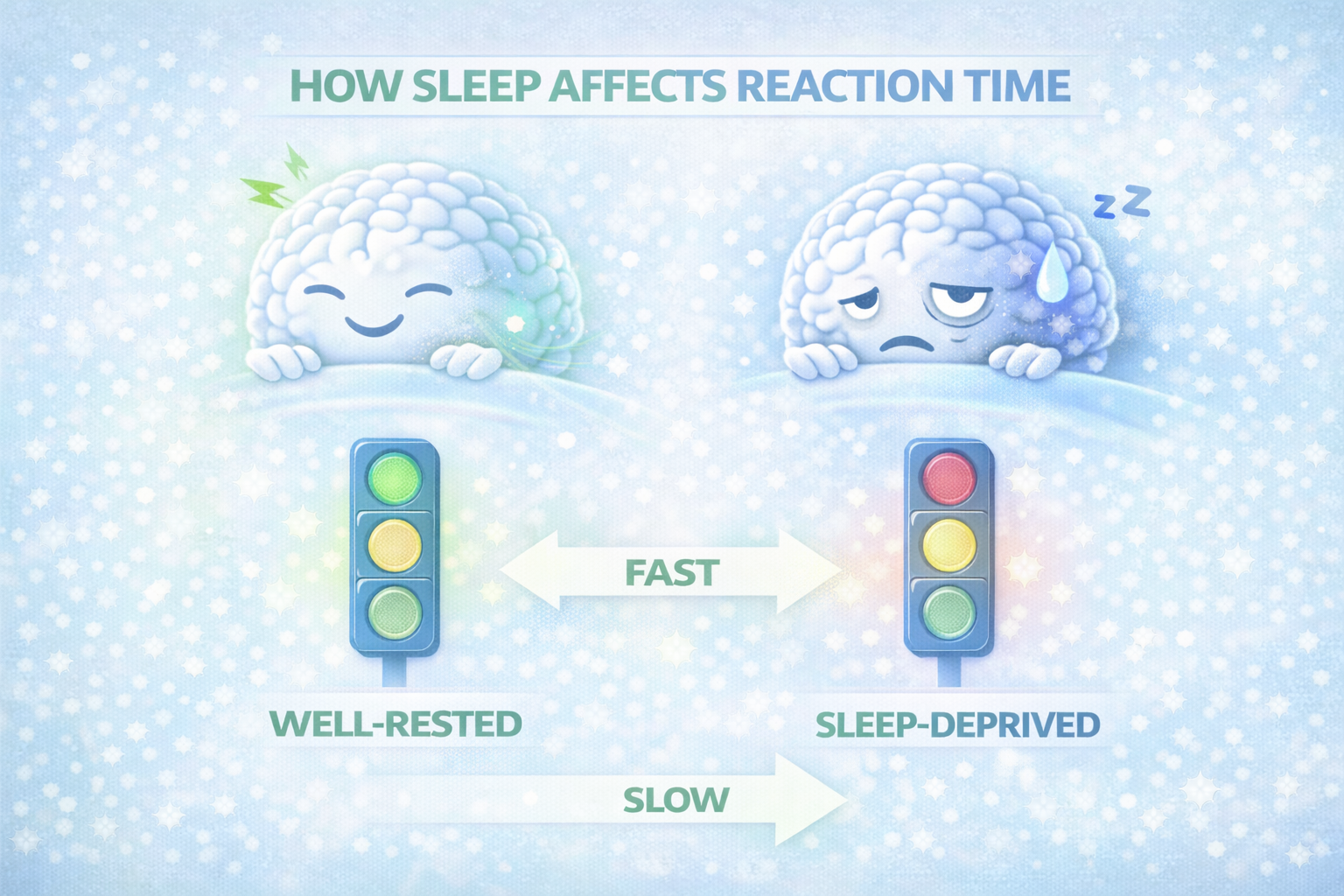
  • How Sleep Affects Reaction Time

    How Sleep Affects Reaction Time

    Why sleep determines how fast the brain detects, processes, and responds

    Reaction time is often associated with reflexes, athleticism, or quick thinking. When reactions slow, people tend to blame distraction, age, or lack of focus.

    In reality, reaction time is strongly shaped by sleep. The speed at which the brain detects information, processes it, and produces a response depends on how well neural systems have recovered overnight. Poor sleep slows reaction time even when motivation and effort are high.


    Reaction Time Is a Neural Process

    Reaction time is not a simple reflex.

    It involves multiple steps: sensory detection, signal transmission, decision processing, and motor response. Each step depends on efficient neural communication.

    Sleep supports the integrity of this entire chain. When sleep is disrupted, delays accumulate across each stage.


    How Sleep Restores Neural Transmission Speed

    During sleep, the brain restores communication efficiency.

    Neural signaling pathways are recalibrated, metabolic waste is cleared, and electrical signaling becomes more synchronized. This reduces transmission delays between brain regions.

    After good sleep, signals travel faster and with less interference.


    Deep Sleep and Signal Precision

    Deep sleep improves signal precision.

    During slow-wave sleep, large-scale synchronization strengthens core communication pathways involved in perception and response. This synchronization reduces variability in reaction timing.

    When deep sleep is reduced, responses become slower and less consistent.


    REM Sleep and Decision Speed

    REM sleep supports rapid decision-making.

    It helps integrate sensory input with learned responses, allowing faster interpretation and action. This is especially important for complex or unpredictable situations.

    Disrupted REM sleep slows this integration, increasing hesitation and response latency.


    Sleep Deprivation and Slower Reactions

    Lack of sleep reliably slows reaction time.

    Processing speed drops, attention becomes unstable, and errors increase. Even small sleep losses can produce reaction delays comparable to alcohol impairment.

    Importantly, individuals often underestimate how impaired their reactions are when sleep-deprived.


    Circadian Timing and Reaction Speed

    Reaction time fluctuates across the day.

    Circadian rhythm determines when neural alertness peaks. When sleep timing aligns with this rhythm, reaction speed remains stable.

    Mistimed sleep creates periods of slowed reactions, even after sufficient sleep duration.


    Fragmented Sleep and Inconsistent Responses

    Interrupted sleep leads to variable reaction time.

    Micro-awakenings prevent full neural recovery, causing responses to fluctuate unpredictably. Some reactions feel normal, others feel delayed.

    This inconsistency increases error risk in tasks requiring rapid response.


    Why Effort Can’t Fix Slowed Reactions

    Trying to react faster cannot override neural delay.

    Effort increases mental strain but does not restore transmission speed. The brain continues operating below optimal efficiency.

    True reaction speed returns only after recovery.


    Real-World Consequences of Slowed Reaction Time

    Reduced reaction time affects daily life.

    Driving, decision-making, workplace performance, and physical coordination all rely on fast responses. Sleep-related slowing increases accident risk and reduces performance quality.

    These effects accumulate with repeated sleep disruption.


    Long-Term Effects on Neural Speed

    Chronic poor sleep reduces baseline reaction speed.

    Over time, slower reactions become normalized. This decline is often attributed to aging or stress rather than sleep.

    Improving sleep quality often restores reaction speed people assumed was permanently lost.


    The Core Idea to Remember

    Reaction time depends heavily on sleep.

    Sleep restores neural transmission speed, decision efficiency, and response consistency. Without it, reactions slow regardless of effort or motivation.

    Fast reactions are not trained — they are recovered overnight.

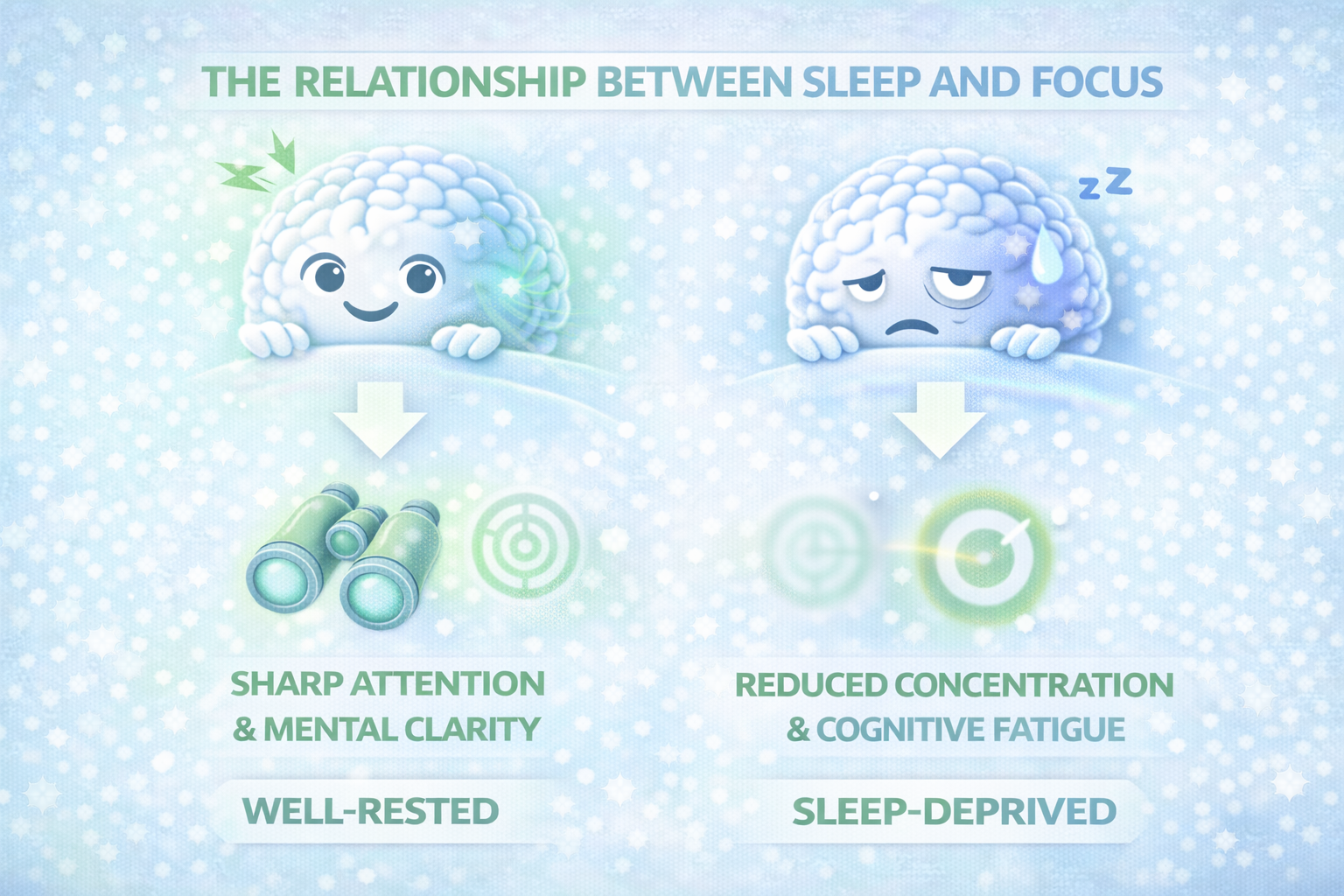
  • The Relationship Between Sleep and Focus

    The Relationship Between Sleep and Focus

    Why sustained attention depends more on sleep than on concentration techniques

    Focus is often treated as a skill you train through discipline, productivity systems, or mental effort. When concentration fades, the instinct is to remove distractions or try harder to stay engaged.

    In reality, focus is largely a biological state. The brain’s ability to sustain attention, filter irrelevant input, and remain mentally stable depends heavily on sleep quality. When sleep is disrupted, focus degrades even if motivation remains high.


    Focus Is a Function of Brain Readiness

    The brain cannot focus efficiently unless it is properly recovered.

    Attention relies on coordination between multiple neural systems responsible for alertness, control, and filtering. These systems require restoration to function smoothly.

    Sleep is the primary period when this restoration occurs. Without it, focus becomes fragile and short-lived.


    How Sleep Restores Attention Control

    During sleep, attention-control networks are recalibrated.

    Unnecessary neural activity is reduced, while key pathways responsible for sustained attention are strengthened. This improves signal clarity and reduces mental noise.

    After good sleep, the brain can maintain focus with less effort.


    Deep Sleep and Stable Focus

    Deep sleep supports attention stability.

    During slow-wave sleep, neural synchronization improves communication across brain regions involved in executive control. This synchronization allows attention to remain steady rather than fluctuating.

    Reduced deep sleep leads to distractibility and frequent attention lapses.


    REM Sleep and Flexible Attention

    REM sleep supports attentional flexibility.

    It allows the brain to shift focus smoothly between tasks and adapt to changing demands. This flexibility prevents mental rigidity and reduces cognitive fatigue.

    Disrupted REM sleep makes focus feel narrow and exhausting.


    Why Poor Sleep Shortens Focus Span

    When sleep is insufficient or fragmented, focus capacity shrinks.

    The brain reaches cognitive overload faster, leading to mental drifting, task switching, and loss of engagement. Concentration breaks occur sooner and more often.

    This is not a failure of willpower — it is a limit of recovery.


    Circadian Timing and Focus Quality

    Focus fluctuates across the day due to circadian rhythm.

    When sleep timing aligns with biological alertness peaks, focus feels natural and sustained. Misaligned sleep produces uneven alertness, causing focus to drop unpredictably.

    Even adequate sleep duration cannot fully compensate for poor timing.


    Fragmented Sleep and Attention Lapses

    Interrupted sleep increases micro-lapses in attention.

    Frequent awakenings prevent complete recovery of attention systems, leading to brief but frequent lapses that reduce overall performance.

    Fragmented sleep often impairs focus more than short but continuous sleep.


    Why Effort Can’t Replace Sleep for Focus

    Trying harder does not restore focus capacity.

    Effort can temporarily override fatigue, but neural efficiency remains reduced. The brain consumes more energy to maintain attention, accelerating exhaustion.

    Sustainable focus depends on recovery, not pressure.


    Long-Term Effects of Poor Sleep on Focus

    Chronic sleep disruption gradually erodes focus.

    Reduced attention becomes normalized, and sustained concentration feels increasingly difficult. These changes are often attributed to stress or distraction rather than sleep.

    Restoring sleep quality often restores focus people assumed was lost.


    Why Focus Feels Effortless After Good Sleep

    After good sleep, focus feels lighter and more stable.

    This reflects improved neural efficiency and reduced cognitive noise. The brain filters distractions automatically, allowing attention to stay engaged without strain.

    Effort decreases because the system is working as designed.


    The Core Idea to Remember

    Focus depends on sleep more than on discipline.

    Sleep restores the neural systems that support sustained attention, filtering, and control. Without it, focus naturally fragments.

    If concentration feels hard to maintain, the limiting factor is often not focus itself — it is recovery.

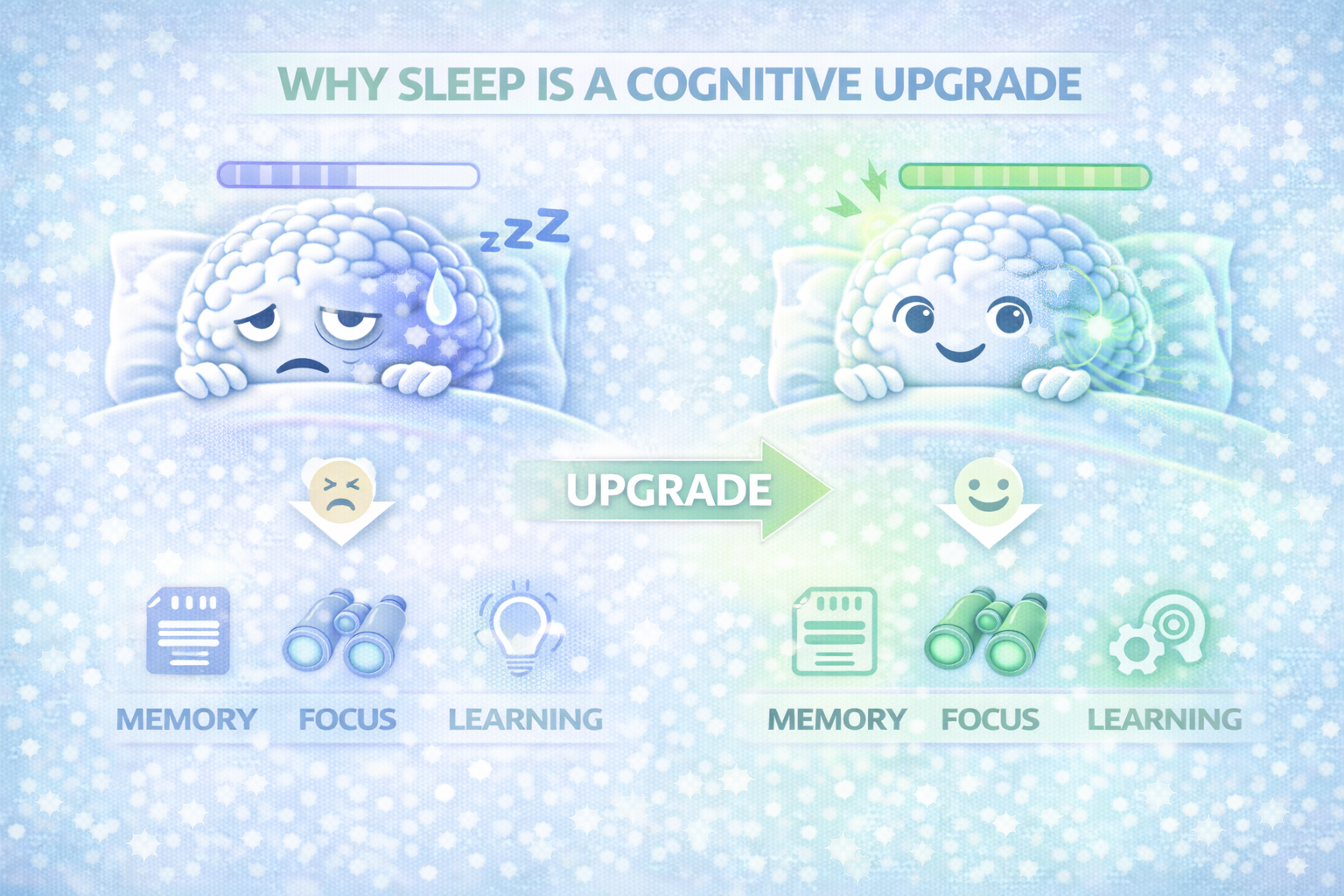
  • Why Sleep Is a Cognitive Upgrade

    Why Sleep Is a Cognitive Upgrade

    How sleep improves thinking capacity, efficiency, and mental performance

    Sleep is often treated as maintenance — something the brain needs to avoid malfunction. In reality, sleep does much more than preserve function. It actively upgrades how the brain operates.

    After good sleep, thinking feels clearer, learning is faster, focus lasts longer, and mental effort decreases. These improvements are not psychological or motivational. They reflect measurable changes in how efficiently the brain processes information. Sleep does not just restore baseline performance — it enhances cognitive capability.


    A Cognitive Upgrade, Not a Reset

    A reset returns a system to its original state.

    Sleep goes further. It reorganizes neural networks, improves signal efficiency, and optimizes how information flows across the brain. This is why performance after good sleep often exceeds performance before sleep.

    The brain wakes up not just repaired, but refined.


    How Sleep Improves Neural Efficiency

    During sleep, the brain reduces unnecessary neural noise.

    Connections that are weak or redundant are downregulated, while important pathways are strengthened. This increases signal-to-noise ratio, allowing thoughts to move more directly and with less effort.

    Efficient brains think faster using less energy.


    Deep Sleep and Core Cognitive Power

    Deep sleep supports foundational cognitive strength.

    During slow-wave sleep, large-scale brain synchronization improves communication between regions responsible for reasoning, working memory, and attention control. This synchronization reduces fragmentation in thinking.

    When deep sleep is reduced, cognition becomes less stable and more effortful.


    REM Sleep and Cognitive Integration

    REM sleep drives integration across brain systems.

    It allows distant concepts to connect, supporting creativity, insight, and flexible problem-solving. This integrative processing explains why solutions and ideas often emerge effortlessly after sleep.

    REM sleep upgrades how knowledge is used, not just stored.


    Why Sleep Makes Thinking Feel Easier

    After good sleep, cognitive tasks feel lighter.

    This is not because tasks are simpler, but because the brain processes them more efficiently. Less mental effort is required to maintain focus, reason through complexity, or make decisions.

    Ease is a sign of efficiency, not laziness.


    Sleep and Working Memory Capacity

    Working memory is a bottleneck for thinking.

    Sleep restores working memory capacity, allowing more information to be held and manipulated at once. This improves comprehension, multitasking, and problem-solving speed.

    Poor sleep narrows this capacity, slowing cognition across the board.


    Circadian Alignment and Cognitive Stability

    Sleep timing affects cognitive upgrades.

    When sleep aligns with circadian rhythm, alertness and performance remain stable throughout the day. Mistimed sleep produces uneven upgrades — moments of clarity followed by fog.

    Biological timing determines how fully the upgrade applies.


    Why Sleep Outperforms Effort

    Effort cannot substitute for neural efficiency.

    Trying harder while sleep-deprived increases cognitive strain without restoring capacity. The brain continues operating below optimal efficiency.

    Sleep upgrades the system so effort becomes effective again.


    Long-Term Cognitive Benefits of Sleep

    Over time, consistent good sleep compounds benefits.

    Learning accelerates, mental endurance increases, and cognitive resilience improves. These effects are cumulative and protective against long-term decline.

    Sleep upgrades are not one-time events — they build.


    Why Poor Sleep Feels Like a Downgrade

    When sleep is disrupted, the opposite occurs.

    Neural noise increases, integration weakens, and efficiency drops. Thinking becomes slower, narrower, and more exhausting.

    This is not loss of ability — it is loss of optimization.


    The Core Idea to Remember

    Sleep is a cognitive upgrade because it improves how the brain operates.

    By increasing efficiency, integration, and capacity, sleep enhances thinking beyond baseline function. It does not add intelligence — it removes friction.

    When sleep is protected, the brain doesn’t just recover.
    It levels up.