Tag: sleep and emotions

  • How Sleep Supports Emotional Balance

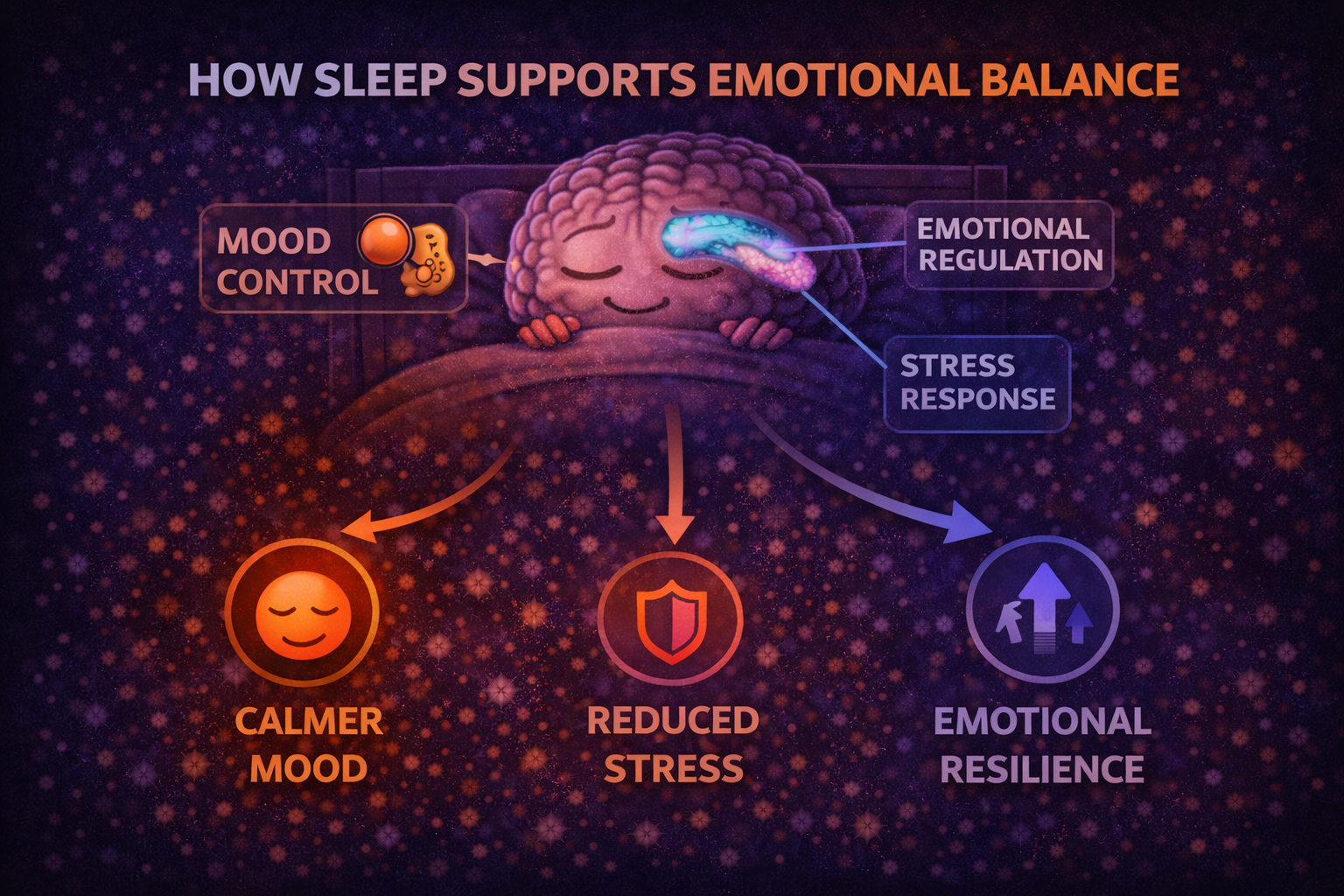
    How Sleep Supports Emotional Balance

    Why consistent sleep keeps emotions proportional, steady, and easier to manage

    Emotional balance is often mistaken for calmness or the absence of strong feelings. In reality, it’s the ability to experience emotions without being overwhelmed by them—and to return to baseline after stress.

    That ability depends heavily on sleep. When sleep is consistent and restorative, emotions remain proportional and recover quickly. When sleep is disrupted, emotional balance weakens, reactions intensify, and recovery slows. Sleep does not eliminate emotion—it stabilizes it.


    Emotional Balance Is a Regulatory State

    Emotional balance reflects how well the brain regulates emotion.

    Some brain systems generate emotional responses; others modulate intensity, context, and recovery. Balance emerges when these systems communicate efficiently.

    Sleep is the primary time when this communication is restored. Without sleep, regulation falters and emotions become harder to manage.


    How Sleep Resets Emotional Baselines

    Each day adds emotional load.

    During sleep, the brain lowers emotional sensitivity and resets baseline thresholds. This recalibration allows emotions to arise without tipping into overwhelm.

    Poor sleep leaves thresholds elevated, making emotions feel heavier the next day.


    Deep Sleep and Emotional Stability

    Deep sleep supports baseline emotional steadiness.

    During slow-wave sleep, neural noise decreases and core regulatory networks recover. This creates a calmer emotional baseline during waking hours.

    When deep sleep is reduced, emotional reactions become more volatile and less predictable.


    REM Sleep and Emotional Integration

    REM sleep is essential for emotional processing.

    During REM, emotional experiences are revisited in a low-stress chemical environment. This allows emotions to be integrated without retaining high emotional charge.

    Disrupted REM sleep leaves emotions unresolved, increasing reactivity and emotional spillover.


    Why Poor Sleep Disrupts Emotional Proportionality

    Sleep loss reduces proportionality.

    Minor stressors trigger outsized reactions because regulation capacity is depleted. Emotions escalate faster and settle more slowly.

    The stressor hasn’t changed—the brain’s ability to regulate it has.


    Sleep and Emotional Recovery Speed

    Balance depends on recovery speed.

    After emotional events, a well-rested brain returns to baseline quickly. Poor sleep slows this recovery, allowing emotions to linger and accumulate.

    Sleep determines how long emotions stay activated.


    Circadian Timing and Emotional Balance

    Emotional balance follows biological timing.

    Aligned sleep schedules support predictable regulation across the day. Irregular timing disrupts this rhythm, increasing emotional variability—even with adequate sleep duration.

    Timing matters as much as hours slept.


    Sleep Fragmentation and Emotional Drift

    Interrupted sleep undermines balance.

    Frequent awakenings prevent full emotional reset, leaving partial activation overnight. Over time, this leads to persistent tension and irritability.

    Fragmentation often harms balance more than short but continuous sleep.


    Why Effort Alone Can’t Create Balance

    Trying to “stay balanced” without sleep doesn’t work.

    Emotional regulation requires neural resources replenished during sleep. Without recovery, effort increases strain without restoring stability.

    Balance is biological before it is intentional.


    How Emotional Balance Returns After Good Sleep

    After high-quality sleep, balance often returns naturally.

    Emotions feel steadier, stress feels manageable, and perspective improves—without deliberate effort. This reflects restored regulation, not changes in circumstances.

    Sleep prepares the brain to regulate emotions before the day begins.


    The Core Idea to Remember

    Sleep supports emotional balance by restoring emotional regulation.

    Through deep sleep and REM sleep, the brain resets thresholds, integrates experiences, and improves recovery speed. Without sleep, balance weakens and emotions dominate.

    Emotional balance is not forced—it is rebuilt overnight by sleep.
  • How Sleep Influences Emotional Regulation

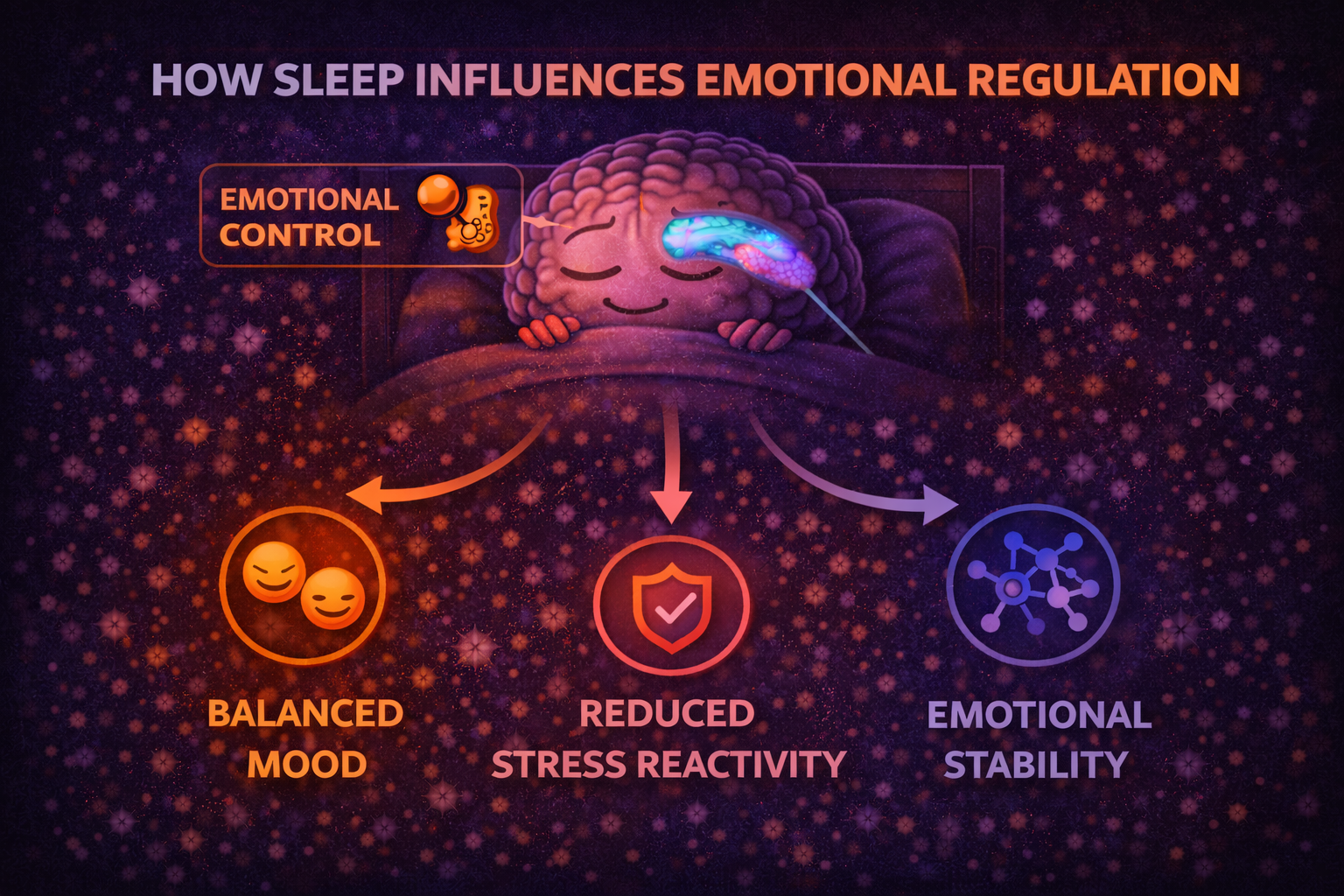
    How Sleep Influences Emotional Regulation

    Why sleep determines how well the brain manages emotions and stress responses

    Emotional regulation is often framed as a skill — something that improves with awareness, effort, or practice. When emotions feel overwhelming or difficult to control, people tend to assume they need better coping strategies.

    But emotional regulation is not only psychological. It is deeply biological. The brain’s ability to manage emotions depends heavily on sleep. When sleep is disrupted, emotional regulation weakens. When sleep is consistent and restorative, emotional balance becomes far easier to maintain.


    Emotional Regulation Is a Brain Function

    Regulating emotions requires coordination.

    Some brain systems generate emotional responses, while others evaluate context, apply restraint, and reduce intensity. Emotional regulation depends on smooth communication between these systems.

    Sleep is the primary period when this coordination is restored. Without it, emotional responses become stronger and harder to modulate.


    How Sleep Resets Emotional Control Systems

    During sleep, emotional control systems recalibrate.

    Neural sensitivity decreases, stress signaling lowers, and regulatory circuits regain efficiency. This reset allows emotions to arise without overwhelming the system.

    Poor sleep leaves these control systems partially depleted, reducing emotional flexibility the next day.


    The Role of Deep Sleep in Regulation Stability

    Deep sleep supports baseline emotional stability.

    During slow-wave sleep, the brain reduces background noise and restores core regulatory networks. This creates a stable emotional baseline during waking hours.

    When deep sleep is reduced, emotional reactions become more volatile and less predictable.


    REM Sleep and Emotional Processing

    REM sleep plays a central role in emotional regulation.

    During REM, emotional experiences are processed in a low-stress neurochemical environment. This allows emotions to be integrated without retaining excessive emotional charge.

    Disrupted REM sleep leaves emotional experiences unresolved, increasing reactivity and emotional intensity.


    Why Poor Sleep Increases Emotional Reactivity

    Sleep deprivation amplifies emotional responses.

    Negative stimuli provoke stronger reactions, while positive experiences feel less rewarding. Emotional responses feel immediate and difficult to pause.

    This heightened reactivity reflects reduced regulatory capacity, not increased emotional sensitivity by choice.


    Sleep Loss and Reduced Emotional Insight

    Poor sleep impairs emotional awareness.

    The brain becomes less accurate at identifying internal emotional states and interpreting others’ emotions. This reduces empathy and increases misunderstandings.

    As a result, social interactions feel more emotionally draining.


    Why Emotions Feel Harder to Control When Tired

    Emotional control requires cognitive resources.

    Sleep restores the neural energy needed to pause, evaluate, and respond intentionally. Without sleep, emotions bypass regulation and feel automatic.

    This explains why emotional reactions are often regretted after poor sleep.


    Cumulative Effects of Chronic Sleep Disruption

    Emotional dysregulation compounds over time.

    Repeated nights of poor sleep weaken regulation, lower stress tolerance, and increase emotional fatigue. Over time, emotional instability becomes the baseline state.

    These changes are often misattributed to personality or mental health alone.


    Circadian Alignment and Emotional Balance

    Emotional regulation follows circadian timing.

    When sleep timing aligns with biological rhythms, emotional control is more consistent. Irregular schedules disrupt this timing, increasing emotional variability.

    Timing influences regulation as much as sleep duration.


    Why Emotional Regulation Improves After Good Sleep

    After high-quality sleep, emotional regulation feels natural.

    Reactions are more proportional, recovery is faster, and emotional clarity returns. This reflects restored regulation rather than changes in circumstances.

    Sleep prepares the brain to regulate emotions before the day begins.


    Why Effort Alone Cannot Replace Sleep

    Trying harder does not restore regulation.

    Emotional regulation requires biological recovery. Without sleep, effort increases strain without improving control.

    Sleep supports emotional regulation at its foundation.


    The Core Idea to Remember

    Sleep influences emotional regulation because it restores the brain’s ability to manage emotions.

    Through deep sleep and REM sleep, emotional control systems reset, reactivity decreases, and balance returns. Without sleep, emotional regulation weakens regardless of intention.

    Emotional regulation is not forced — it is supported overnight by sleep.

  • Why Sleep Is Essential for Emotional Stability

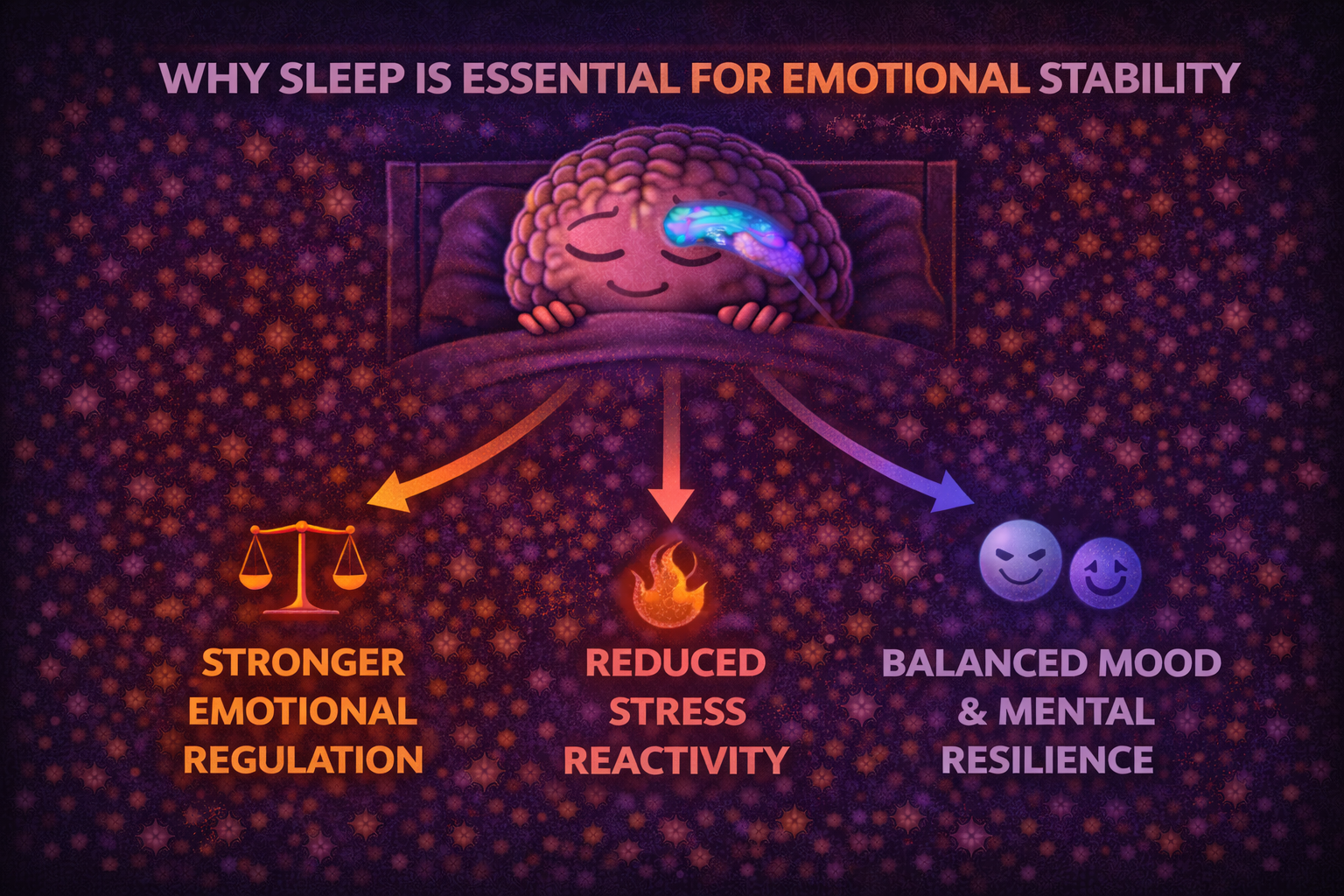
    Why Sleep Is Essential for Emotional Stability

    How sleep keeps emotions balanced, proportional, and easier to regulate

    Emotional stability is often described as a personality trait or a learned skill. When emotions feel intense or unpredictable, people tend to search for psychological explanations or coping techniques.

    In reality, emotional stability is strongly biological. The brain’s ability to keep emotions proportional, recover from stress, and maintain balance depends heavily on sleep quality. When sleep is disrupted, emotional regulation weakens. When sleep is protected, emotional stability becomes the default state rather than a constant effort.


    Emotional Stability Begins in the Brain

    Emotions are generated and regulated by interconnected brain systems.

    Some regions produce emotional responses, while others evaluate context, apply control, and reduce intensity. Emotional stability depends on smooth coordination between these systems.

    Sleep is the main period when this coordination is restored. Without it, emotional balance becomes fragile.


    How Sleep Resets Emotional Thresholds

    Every day raises emotional load.

    During sleep, the brain lowers emotional sensitivity and resets response thresholds. This recalibration allows emotions to rise without becoming overwhelming.

    Poor sleep leaves emotional thresholds elevated, making reactions stronger and harder to control.


    The Role of Deep Sleep in Emotional Balance

    Deep sleep supports emotional baseline stability.

    During slow-wave sleep, neural noise decreases and core regulatory networks recover. This creates a calm emotional baseline the next day.

    When deep sleep is reduced, emotional responses become more reactive and less predictable.


    REM Sleep and Emotional Integration

    REM sleep plays a critical role in processing emotional experiences.

    During REM, emotional memories are revisited in a low-stress chemical environment. This allows the brain to integrate emotions without maintaining high emotional intensity.

    Disrupted REM sleep leaves emotions unresolved, increasing emotional volatility.


    Why Poor Sleep Leads to Mood Swings

    Mood swings often reflect unstable emotional regulation.

    Without sufficient sleep, emotional responses fluctuate rapidly. Irritability, sadness, anxiety, and frustration appear with little provocation.

    These shifts are not random — they reflect reduced overnight emotional regulation.


    Sleep Loss and Reduced Emotional Control

    Sleep deprivation weakens impulse control.

    The brain becomes less able to pause, evaluate, and modulate emotional reactions. Responses feel automatic rather than chosen.

    This loss of control explains why people often regret emotional reactions after poor sleep.


    Why Small Stressors Feel Overwhelming

    Sleep loss lowers emotional tolerance.

    With reduced regulatory capacity, even minor stressors consume disproportionate emotional energy. Situations that normally feel manageable become draining.

    Emotional instability increases not because problems are bigger, but because regulation is weaker.


    Emotional Recovery Depends on Sleep

    Stability is not just about reaction — it’s about recovery.

    After emotional events, a well-rested brain returns to baseline quickly. Poor sleep slows this recovery, allowing emotions to linger and accumulate.

    Sleep determines how fast emotional balance is restored.


    Cumulative Effects of Chronic Poor Sleep

    Repeated sleep disruption compounds emotional instability.

    Over time, irritability becomes baseline, stress tolerance drops, and emotional fatigue sets in. These changes are often mistaken for personality or mental health issues.

    Restoring sleep often restores emotional balance people assumed was lost.


    Why Effort Alone Can’t Create Emotional Stability

    Trying harder to stay calm does not fix regulation.

    Emotional control requires neural resources replenished during sleep. Without recovery, effort increases strain without improving stability.

    Sleep supports emotional regulation at the biological level.


    Why Emotional Stability Returns After Good Sleep

    After high-quality sleep, emotions feel steadier.

    Reactions are more proportional, patience increases, and stress feels manageable. This shift reflects restored regulation, not changes in life circumstances.

    Sleep allows the brain to regulate emotions before the day begins.


    The Core Idea to Remember

    Sleep is essential for emotional stability because it restores emotional regulation.

    Through deep sleep and REM sleep, the brain resets emotional thresholds, integrates experiences, and reduces reactivity. Without sleep, emotional balance becomes fragile.

    Emotional stability is not forced — it is supported overnight by sleep.

  • Why Sleep Is Essential for Mental Health

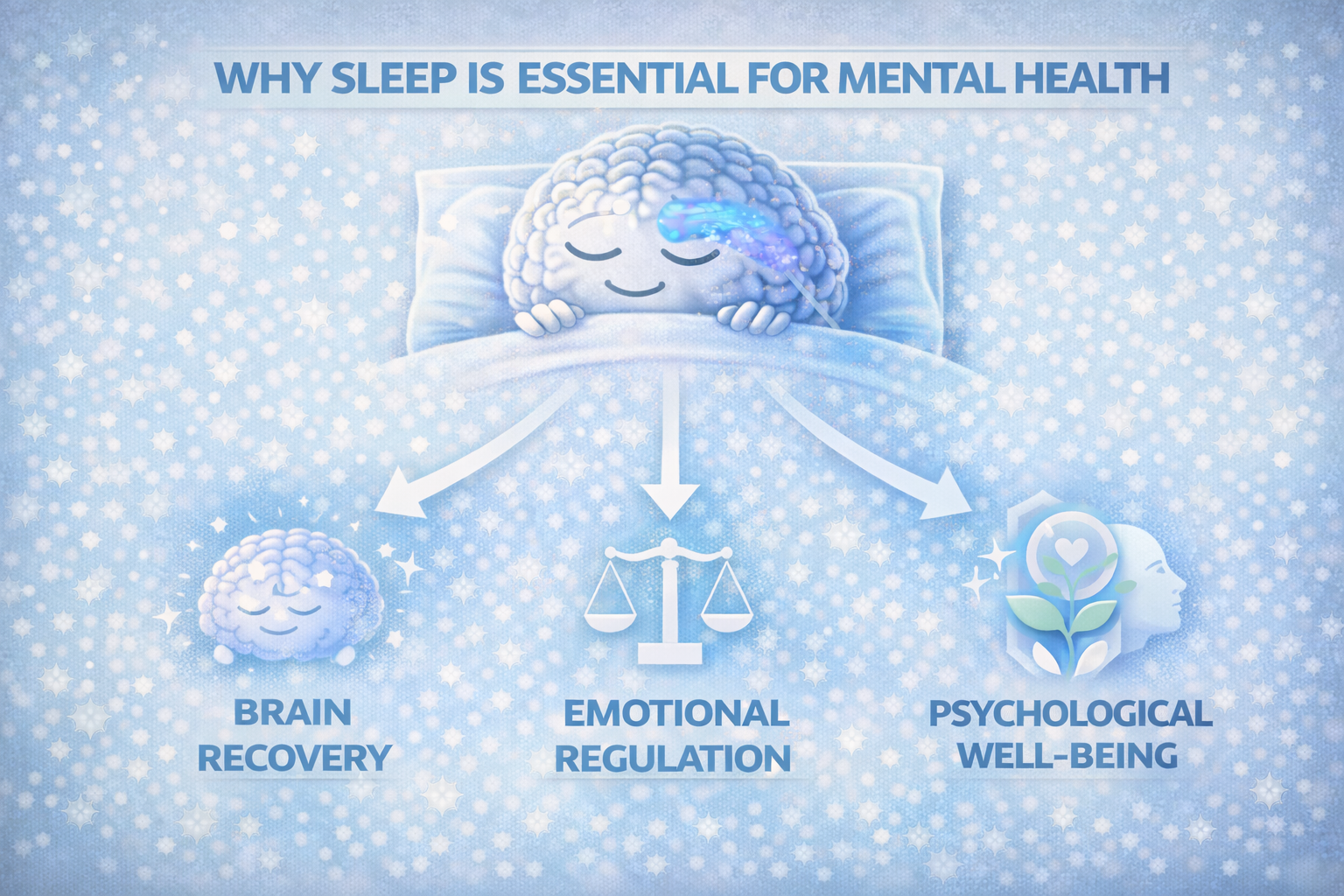
    Why Sleep Is Essential for Mental Health

    How sleep regulates emotional balance, stress resilience, and psychological stability

    Mental health is often discussed in terms of thoughts, emotions, habits, and coping strategies. Sleep is frequently treated as a secondary factor — something helpful, but not central.

    In reality, sleep is one of the most powerful regulators of mental health. It shapes how emotions are processed, how stress is tolerated, and how the brain maintains psychological balance. When sleep is disrupted, mental health becomes fragile. When sleep is protected, emotional stability becomes possible.


    Mental Health Is a Biological State First

    Mental health does not begin with mindset.

    It begins with brain regulation. Emotional balance, mood stability, and stress tolerance all depend on how effectively the brain can regulate itself. Sleep is the primary period during which this regulation occurs.

    Without sufficient, well-timed sleep, the brain loses its ability to maintain emotional equilibrium, regardless of insight or effort.


    How Sleep Regulates Emotional Processing

    Every day produces emotional input.

    During sleep, the brain processes these experiences offline. Emotional reactions are reviewed, integrated, and moderated. This allows emotions to be remembered without remaining overwhelming.

    When sleep is disrupted, emotional processing remains incomplete. Emotions carry over with greater intensity, making everyday stressors feel heavier and harder to manage.


    The Role of Sleep in Stress Resilience

    Stress is unavoidable. Recovery is not.

    Sleep restores the systems that regulate the stress response. During sleep, stress hormones decline, neural reactivity decreases, and emotional thresholds reset.

    Without sleep, stress responses remain elevated. Small challenges trigger outsized reactions, and recovery from stress takes longer.


    Why Poor Sleep Amplifies Anxiety

    Anxiety is strongly linked to sleep quality.

    When sleep is insufficient or fragmented, the brain’s threat-detection systems become more sensitive. At the same time, the systems responsible for calming and rational evaluation weaken.

    This imbalance makes worry feel automatic, persistent, and difficult to control — even when external circumstances are stable.


    Sleep and Mood Stability

    Mood regulation depends on sleep continuity.

    Sleep supports stable communication between emotional and cognitive brain regions. This balance allows emotions to rise and fall without becoming extreme.

    Poor sleep disrupts this coordination, increasing irritability, mood swings, and emotional volatility.


    Why Depression and Sleep Are Closely Connected

    Sleep and depression influence each other bidirectionally.

    Chronic sleep disruption increases vulnerability to depressive symptoms by weakening emotional regulation and motivation. At the same time, depression often disrupts sleep timing and quality.

    This creates a reinforcing loop where poor sleep and low mood sustain each other unless sleep is addressed directly.


    REM Sleep and Emotional Integration

    REM sleep plays a critical role in mental health.

    During REM sleep, emotional experiences are processed in a low-stress neurochemical environment. This allows emotional memories to be integrated without triggering intense emotional responses.

    Disrupted REM sleep leaves emotional experiences unprocessed, increasing emotional reactivity and mental fatigue.


    Deep Sleep and Psychological Stability

    Deep sleep supports overall mental stability.

    It restores core brain networks, reduces neural noise, and improves emotional baseline regulation. This stability provides the foundation upon which emotional resilience is built.

    When deep sleep is reduced, mental health becomes more vulnerable to daily fluctuations.


    Why Mental Health Interventions Often Fail Without Sleep

    Many mental health strategies assume a functional brain.

    Therapy, reflection, coping techniques, and behavioral changes all rely on neural stability. When sleep is compromised, the brain lacks the capacity to apply these tools effectively.

    Improving sleep often enhances the effectiveness of all other mental health interventions.


    Sleep as Prevention, Not Just Treatment

    Sleep is not only corrective — it is protective.

    Consistent, high-quality sleep reduces the risk of anxiety, burnout, emotional exhaustion, and long-term mental health decline. It increases resilience before problems escalate.

    Mental health is easier to maintain than to repair.


    Why Modern Life Undermines Mental Health Through Sleep

    Modern environments disrupt sleep in subtle ways.

    Irregular schedules, artificial light, constant stimulation, and chronic stress interfere with sleep timing and depth. Over time, these disruptions erode mental stability even in otherwise healthy individuals.

    Mental health challenges often emerge gradually as sleep debt accumulates.


    The Core Idea to Remember

    Sleep is the foundation of mental health because it regulates how the brain processes emotion, stress, and psychological balance.

    Without sleep, mental health becomes fragile. With sleep, emotional resilience becomes possible.

    Sleep does not replace therapy, insight, or support — but without it, none of them work as they should.

  • How Sleep Influences Emotional Memory

    How Sleep Influences Emotional Memory

    Why sleep shapes how emotional experiences are stored and recalled

    Emotional memories tend to stand out. They feel stronger, more vivid, and often harder to forget than neutral experiences. While emotion is part of this process, sleep plays a critical role in determining how these memories are processed, stored, and later recalled.

    Sleep does not simply preserve emotional memories. It actively reshapes them — stabilizing what matters while reducing emotional intensity. When sleep is disrupted, this process becomes unbalanced, affecting both memory accuracy and emotional regulation.


    What Emotional Memory Really Is

    Emotional memory refers to how the brain encodes and recalls experiences with emotional significance.

    These memories involve close interaction between memory systems and emotional processing regions. Because of this interaction, emotional memories are more sensitive to how sleep unfolds.

    Sleep determines whether emotional experiences are integrated calmly or remain emotionally charged.


    Why Sleep Is Essential for Emotional Processing

    During sleep, the brain processes emotional experiences without external demands.

    This offline state allows emotional memories to be re-evaluated, reorganized, and linked with existing knowledge. The brain can separate emotional intensity from factual content, preserving meaning while reducing reactivity.

    Without sufficient sleep, this regulation remains incomplete.


    The Role of REM Sleep in Emotional Memory

    REM sleep plays a central role in emotional memory processing.

    During REM, emotional experiences are reactivated in a low-stress chemical environment. This allows the brain to integrate emotional memories without triggering full emotional responses.

    Disrupted REM sleep leaves emotional memories poorly processed, increasing emotional sensitivity and reactivity the next day.


    Deep Sleep and Emotional Stability

    Deep sleep supports emotional stability.

    While REM sleep processes emotional content, deep sleep helps stabilize overall neural function. It reduces background emotional noise and supports balanced emotional responses.

    When deep sleep is reduced, emotional regulation weakens, amplifying emotional memory intensity.


    Why Poor Sleep Makes Emotional Memories Feel Stronger

    When sleep is fragmented or shortened, emotional memories remain highly reactive.

    The brain retains the emotional charge without fully integrating the experience. As a result, emotional memories may feel intrusive, exaggerated, or easily triggered.

    This is why poor sleep often intensifies emotional recall.


    Sleep Deprivation and Negative Emotional Bias

    Sleep loss increases negative emotional bias.

    The brain becomes more sensitive to negative stimuli and less effective at dampening emotional responses. Emotional memories skew toward negativity, while positive emotional processing weakens.

    This imbalance affects mood and perception.


    Why Emotional Memories Change After Good Sleep

    After high-quality sleep, emotional memories feel different.

    They are still accessible, but less emotionally overwhelming. The emotional tone softens, allowing clearer reflection without intense reaction.

    This shift reflects successful overnight emotional processing.


    Fragmented Sleep and Emotional Memory Disruption

    Interrupted sleep disrupts emotional memory consolidation.

    Frequent awakenings prevent sustained REM sleep, limiting emotional integration. Emotional memories remain fragmented and unstable.

    This contributes to mood instability and emotional fatigue.


    Long-Term Effects of Disrupted Emotional Processing

    Chronic sleep disruption affects emotional memory over time.

    Emotional experiences accumulate without proper integration, increasing emotional sensitivity and stress reactivity. This can contribute to anxiety and emotional exhaustion.

    Protecting sleep protects emotional resilience.


    Why Sleep Is Critical for Emotional Balance

    Sleep is not optional for emotional health.

    It allows the brain to process emotional experiences safely and efficiently. Without it, emotional memory becomes dysregulated.

    Sleep supports both memory accuracy and emotional balance.


    The Core Idea to Remember

    Sleep shapes how emotional memories are stored and recalled.

    Through deep sleep and REM sleep, the brain integrates emotional experiences while reducing emotional intensity. Poor sleep leaves emotional memories raw and reactive.

    Emotional resilience depends on what the brain is allowed to do while you sleep.