Tag: sleep and focus

  • The Relationship Between Sleep and Focus

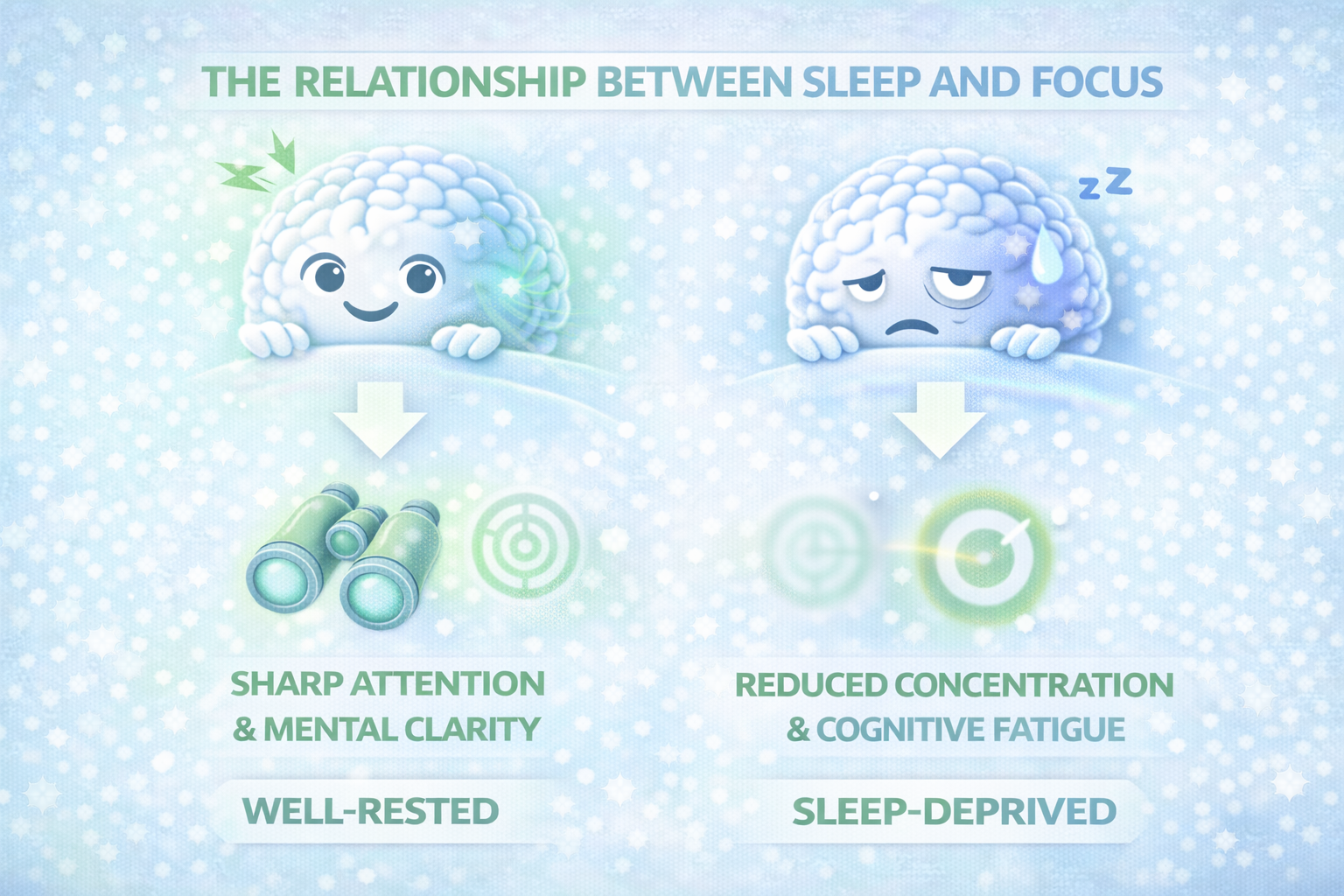
    The Relationship Between Sleep and Focus

    Why sustained attention depends more on sleep than on concentration techniques

    Focus is often treated as a skill you train through discipline, productivity systems, or mental effort. When concentration fades, the instinct is to remove distractions or try harder to stay engaged.

    In reality, focus is largely a biological state. The brain’s ability to sustain attention, filter irrelevant input, and remain mentally stable depends heavily on sleep quality. When sleep is disrupted, focus degrades even if motivation remains high.


    Focus Is a Function of Brain Readiness

    The brain cannot focus efficiently unless it is properly recovered.

    Attention relies on coordination between multiple neural systems responsible for alertness, control, and filtering. These systems require restoration to function smoothly.

    Sleep is the primary period when this restoration occurs. Without it, focus becomes fragile and short-lived.


    How Sleep Restores Attention Control

    During sleep, attention-control networks are recalibrated.

    Unnecessary neural activity is reduced, while key pathways responsible for sustained attention are strengthened. This improves signal clarity and reduces mental noise.

    After good sleep, the brain can maintain focus with less effort.


    Deep Sleep and Stable Focus

    Deep sleep supports attention stability.

    During slow-wave sleep, neural synchronization improves communication across brain regions involved in executive control. This synchronization allows attention to remain steady rather than fluctuating.

    Reduced deep sleep leads to distractibility and frequent attention lapses.


    REM Sleep and Flexible Attention

    REM sleep supports attentional flexibility.

    It allows the brain to shift focus smoothly between tasks and adapt to changing demands. This flexibility prevents mental rigidity and reduces cognitive fatigue.

    Disrupted REM sleep makes focus feel narrow and exhausting.


    Why Poor Sleep Shortens Focus Span

    When sleep is insufficient or fragmented, focus capacity shrinks.

    The brain reaches cognitive overload faster, leading to mental drifting, task switching, and loss of engagement. Concentration breaks occur sooner and more often.

    This is not a failure of willpower — it is a limit of recovery.


    Circadian Timing and Focus Quality

    Focus fluctuates across the day due to circadian rhythm.

    When sleep timing aligns with biological alertness peaks, focus feels natural and sustained. Misaligned sleep produces uneven alertness, causing focus to drop unpredictably.

    Even adequate sleep duration cannot fully compensate for poor timing.


    Fragmented Sleep and Attention Lapses

    Interrupted sleep increases micro-lapses in attention.

    Frequent awakenings prevent complete recovery of attention systems, leading to brief but frequent lapses that reduce overall performance.

    Fragmented sleep often impairs focus more than short but continuous sleep.


    Why Effort Can’t Replace Sleep for Focus

    Trying harder does not restore focus capacity.

    Effort can temporarily override fatigue, but neural efficiency remains reduced. The brain consumes more energy to maintain attention, accelerating exhaustion.

    Sustainable focus depends on recovery, not pressure.


    Long-Term Effects of Poor Sleep on Focus

    Chronic sleep disruption gradually erodes focus.

    Reduced attention becomes normalized, and sustained concentration feels increasingly difficult. These changes are often attributed to stress or distraction rather than sleep.

    Restoring sleep quality often restores focus people assumed was lost.


    Why Focus Feels Effortless After Good Sleep

    After good sleep, focus feels lighter and more stable.

    This reflects improved neural efficiency and reduced cognitive noise. The brain filters distractions automatically, allowing attention to stay engaged without strain.

    Effort decreases because the system is working as designed.


    The Core Idea to Remember

    Focus depends on sleep more than on discipline.

    Sleep restores the neural systems that support sustained attention, filtering, and control. Without it, focus naturally fragments.

    If concentration feels hard to maintain, the limiting factor is often not focus itself — it is recovery.
  • How Sleep Affects Focus and Mental Clarity

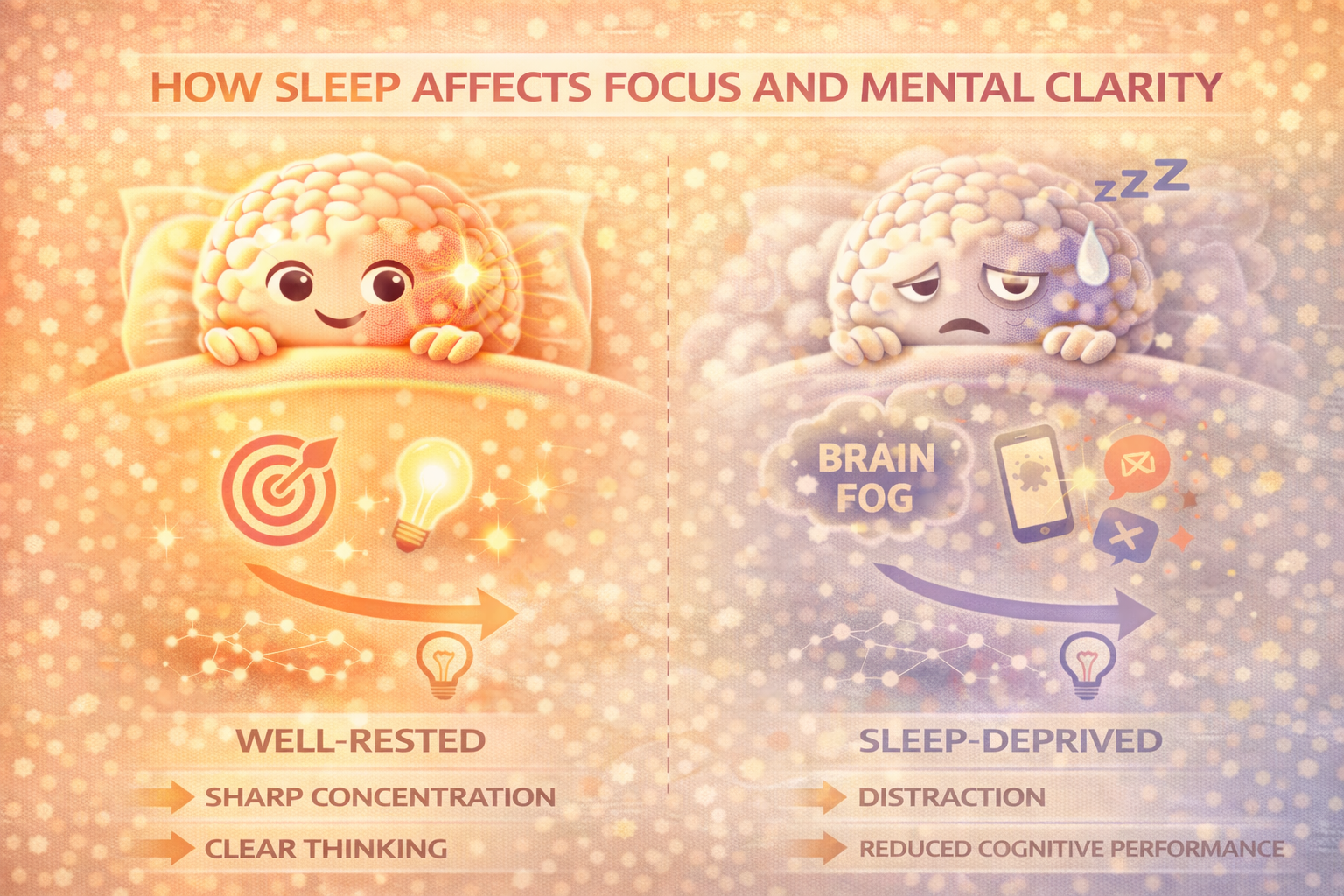
    How Sleep Affects Focus and Mental Clarity

    Why a well-rested brain processes information faster and with less effort

    Focus and mental clarity are often treated as skills you train through discipline, motivation, or productivity techniques. When concentration fades, people tend to push harder, rely on caffeine, or blame distraction.

    In reality, focus is primarily a biological state. The brain’s ability to sustain attention, filter irrelevant information, and think clearly depends heavily on sleep quality. When sleep is insufficient, fragmented, or mistimed, mental clarity declines even if motivation remains high.


    Focus Is a Brain State, Not a Personality Trait

    The ability to focus depends on how efficiently the brain regulates attention.

    Sleep supports the balance between neural systems responsible for alertness and those responsible for filtering distractions. When this balance is intact, attention feels natural and effortless.

    When sleep is disrupted, the brain struggles to maintain this balance, making focus feel forced and mentally exhausting.


    How Sleep Restores Attention Networks

    During sleep, the brain recalibrates attention networks.

    Neural connections involved in sustained focus are strengthened, while unnecessary or noisy connections are pruned. This optimization reduces cognitive load and improves signal clarity the next day.

    Without sufficient sleep, attention networks remain inefficient, requiring more effort to achieve the same level of focus.


    Sleep Deprivation and Mental Fog

    Mental fog is one of the earliest signs of poor sleep.

    Sleep loss slows neural communication, reduces processing speed, and weakens coordination between brain regions. Thoughts feel less precise, reactions are delayed, and information feels harder to organize.

    This fog is not subjective—it reflects real changes in brain function.


    The Role of Deep Sleep in Cognitive Clarity

    Deep sleep plays a critical role in restoring mental clarity.

    During slow-wave sleep, metabolic waste is cleared and neural activity becomes synchronized. This process improves signal-to-noise ratio in the brain, making thoughts feel sharper and more coherent.

    Reduced deep sleep leaves the brain cluttered, increasing distraction and mental fatigue.


    REM Sleep and Cognitive Flexibility

    REM sleep supports cognitive flexibility and creative thinking.

    During this stage, the brain integrates information across networks, allowing for insight, pattern recognition, and flexible problem-solving. This integration supports clarity when switching tasks or adapting to new information.

    Disrupted REM sleep reduces this flexibility, making thinking feel rigid or stuck.


    Why Sleep Timing Matters for Focus

    Focus depends not only on sleep duration, but on timing.

    When sleep aligns with the circadian rhythm, alertness rises smoothly during the day. Mistimed sleep produces uneven alertness, leading to periods of fog even after adequate hours in bed.

    Circadian misalignment makes focus unreliable and inconsistent.


    Fragmented Sleep and Attention Lapses

    Interrupted sleep weakens sustained attention.

    Frequent awakenings prevent the brain from completing restorative cycles, leading to micro-lapses in focus the next day. These lapses increase errors and reduce productivity, even when they go unnoticed.

    This is why fragmented sleep often feels worse than short but uninterrupted sleep.


    Why Effort Can’t Replace Sleep for Focus

    Many people try to compensate for poor sleep with effort.

    While motivation can temporarily override fatigue, it cannot restore neural efficiency. The brain continues to operate with reduced capacity, making focus increasingly costly.

    Sustained clarity requires recovery, not willpower.


    Sleep Quality and Decision Fatigue

    Poor sleep accelerates decision fatigue.

    As focus declines, the brain uses more energy to maintain attention. This depletes cognitive resources faster, making decisions feel harder and reducing mental endurance throughout the day.

    Good sleep preserves focus by reducing the cost of thinking.


    Long-Term Effects on Mental Clarity

    Chronic sleep disruption leads to persistent clarity loss.

    Over time, reduced focus becomes normalized. Mental fog, distractibility, and slower thinking are often attributed to stress or aging rather than sleep.

    Restoring sleep quality often restores clarity that people forgot was possible.


    The Core Idea to Remember

    Sleep is one of the strongest determinants of focus and mental clarity.

    A well-rested brain filters distractions, processes information efficiently, and sustains attention with less effort. Poor sleep makes thinking heavier, slower, and less precise.

    Mental clarity is not forced—it is restored overnight, when the brain is allowed to recover.