Tag: sleep inertia

  • Can Sleeping Too Much Make You Tired?

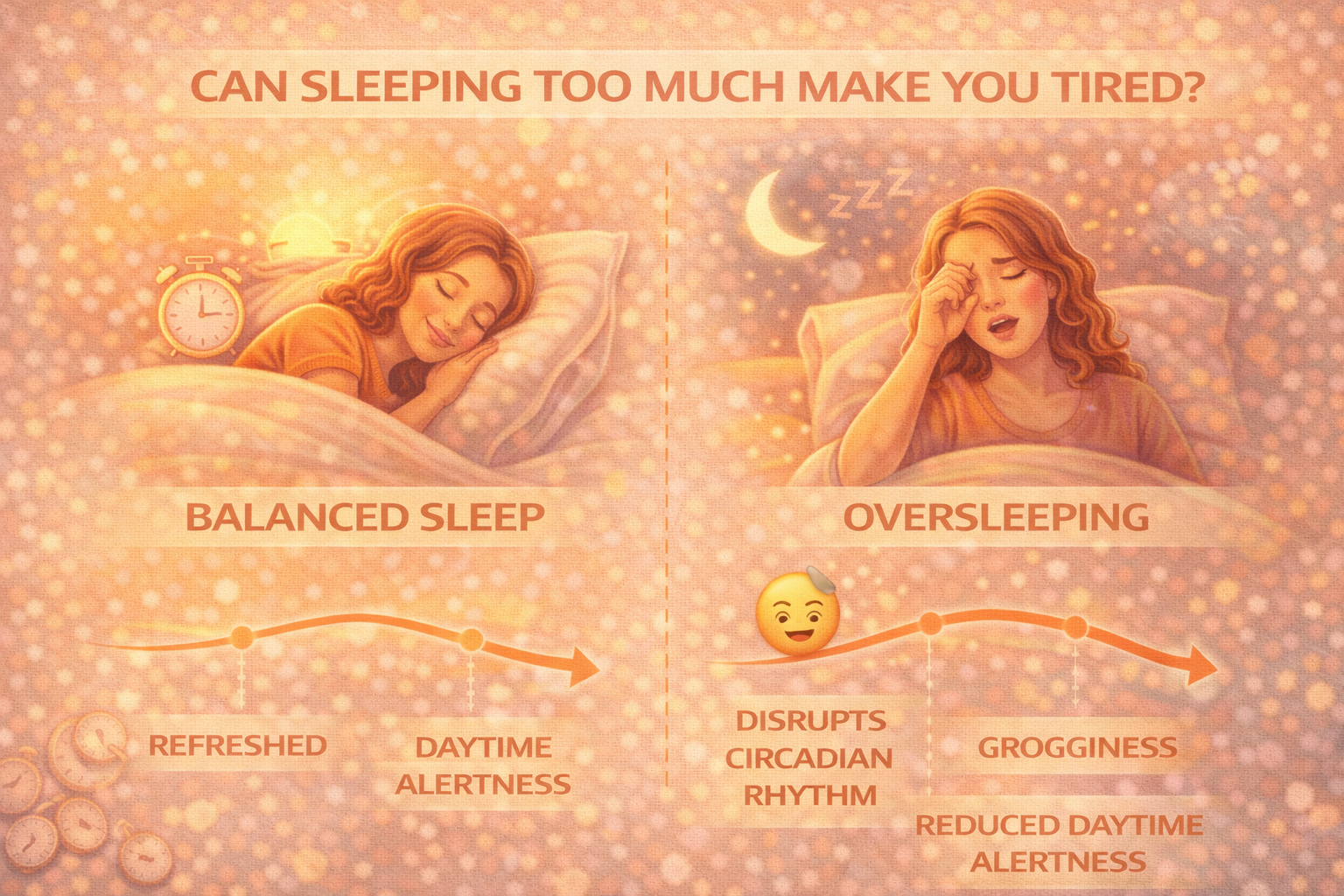
    Can Sleeping Too Much Make You Tired?

    Why excessive or poorly timed sleep can leave you feeling drained instead of restored

    Sleep is usually seen as the cure for fatigue. When energy drops, the natural response is to sleep longer, stay in bed more, or “catch up” on rest. Yet many people discover an uncomfortable paradox: after sleeping a lot, they feel heavier, foggier, and less motivated.

    This does not mean sleep is harmful. It means that more sleep is not always better sleep. When sleep duration exceeds what the brain can use efficiently — or when it occurs at the wrong time — it can actually worsen how rested you feel.


    Sleep Restores Through Quality, Not Quantity

    Sleep works through efficiency, not accumulation.

    The brain restores itself during specific sleep stages that occur at biologically appropriate times. Once those processes are completed, additional time in bed adds little benefit.

    When sleep extends beyond the optimal window, recovery does not increase proportionally. Instead, sleep quality can decline.


    Circadian Rhythm and Oversleeping

    The circadian rhythm determines when the brain is ready to wake up.

    If you continue sleeping past this natural wake window, the brain begins shifting toward alertness even while you remain asleep. This creates internal conflict between sleep and wake systems.

    As a result, waking up after oversleeping often feels sluggish and disorienting rather than refreshing.


    Why Oversleeping Increases Sleep Inertia

    Sleep inertia is the groggy, heavy feeling after waking.

    Long sleep episodes increase the likelihood of waking from deep sleep stages. When this happens, the brain requires more time to fully transition into alertness.

    Instead of easing the wake-up process, oversleeping can intensify inertia and reduce mental clarity.


    Long Sleep Often Signals Poor Sleep Quality

    Sleeping too much is frequently a response to inadequate recovery.

    Fragmented sleep, reduced deep sleep, or circadian misalignment can leave the brain under-restored. In response, sleep pressure remains high, driving longer sleep durations without improving how rested you feel.

    In these cases, long sleep is a symptom, not a solution.


    Oversleeping and Circadian Drift

    Regularly sleeping in can shift the circadian rhythm later.

    This delay makes it harder to fall asleep the following night, creating a cycle of late bedtimes and late wake-ups. Over time, this pattern increases fatigue rather than resolving it.

    What feels like recovery may quietly reinforce misalignment.


    Mental and Emotional Effects of Excessive Sleep

    Oversleeping affects more than physical energy.

    It is often associated with:

    • reduced mental sharpness

    • lower motivation

    • emotional flatness

    • difficulty initiating tasks

    These effects reflect circadian disruption and incomplete recovery rather than restfulness.


    Why More Sleep Doesn’t Fix Chronic Fatigue

    Chronic fatigue is rarely caused by insufficient sleep alone.

    When fatigue results from stress, disrupted sleep architecture, or circadian instability, extending sleep duration does not address the underlying cause. The brain remains out of sync.

    This is why some people feel better with slightly less but better-timed sleep.


    When Longer Sleep Is Actually Appropriate

    There are situations where longer sleep is necessary.

    Acute sleep deprivation, illness, intense physical exertion, or recovery periods can legitimately increase sleep needs. In these contexts, longer sleep supports healing rather than undermines energy.

    The key difference is whether longer sleep restores clarity or perpetuates fatigue.


    Finding the Right Amount of Sleep

    The optimal amount of sleep is individual and timing-dependent.

    When sleep is well-aligned, duration often stabilizes naturally. The body wakes more easily, and energy feels more consistent throughout the day.

    The goal is not maximizing hours in bed, but matching sleep duration to biological need and timing.


    The Core Idea to Remember

    Sleeping too much can make you feel tired when it disrupts circadian timing or reflects poor sleep quality.

    Energy does not come from accumulating hours in bed. It comes from sleep that is efficient, well-timed, and biologically aligned.

    When sleep timing is right, the brain takes what it needs — and more sleep stops being necessary.

  • Can Sleeping Too Much Make You Tired?

    Can Sleeping Too Much Make You Tired?

    Why excessive or mistimed sleep can reduce energy instead of restoring it

    Sleep is usually seen as the solution to fatigue. When people feel exhausted, the instinctive response is to sleep more. Yet many discover a paradox: after long nights or extended time in bed, they feel even more sluggish, foggy, or unmotivated.

    This experience is not a contradiction. Sleeping too much can make you feel tired — not because sleep is harmful, but because sleep duration alone does not guarantee biological alignment. Energy depends on how sleep fits into the brain’s timing systems.


    More Sleep Is Not Always Better Sleep

    Sleep is restorative only when it is efficient and well-timed.

    Beyond a certain point, additional sleep does not provide extra recovery. Instead, it can dilute sleep quality, fragment sleep stages, and interfere with circadian timing.

    Long sleep episodes often reflect underlying disruption rather than optimal rest.


    The Role of Circadian Rhythm in Feeling Rested

    The circadian rhythm determines when the brain is prepared for sleep and when it is prepared for wakefulness.

    When sleep extends beyond the natural wake window, the brain begins transitioning toward alertness even while the body remains in bed. This creates a mismatch between internal signals and behavior.

    As a result, waking up after excessive sleep can feel heavy and disorienting rather than refreshing.


    Sleep Inertia and Oversleeping

    One common effect of oversleeping is intensified sleep inertia.

    Sleep inertia refers to the grogginess and reduced mental clarity that occur immediately after waking. Longer sleep episodes increase the chance of waking from deeper sleep stages, which amplifies inertia.

    Instead of easing the transition to wakefulness, excessive sleep can make it harder.


    Why Long Sleep Often Signals Poor Sleep Quality

    Sleeping too much is often a response to non-restorative sleep.

    Fragmented sleep, reduced deep sleep, or circadian misalignment can leave the brain under-recovered. In response, sleep pressure remains high, driving longer sleep durations without improving quality.

    In this context, long sleep is a symptom, not a solution.


    Oversleeping and Circadian Drift

    Extended sleep times can push the circadian rhythm later.

    Sleeping in regularly delays internal timing, making it harder to fall asleep at a consistent hour the following night. This drift creates a cycle of late nights, late mornings, and persistent fatigue.

    What feels like recovery can quietly reinforce misalignment.


    Mental and Emotional Effects of Excessive Sleep

    Sleeping too much affects more than physical energy.

    Extended time in bed is associated with:

    • reduced mental sharpness

    • lower motivation

    • emotional flatness or irritability

    • difficulty initiating tasks

    These effects often overlap with symptoms of circadian disruption rather than simple rest needs.


    Why Sleeping More Doesn’t Fix Chronic Fatigue

    Chronic fatigue rarely results from sleep deprivation alone.

    When fatigue is driven by timing instability, stress, or disrupted sleep architecture, adding more sleep hours does not correct the underlying problem. The brain remains out of sync, and energy does not return.

    This explains why some people feel better with slightly less but better-timed sleep.


    When Longer Sleep Is Actually Appropriate

    There are situations where longer sleep is necessary.

    Illness, acute sleep deprivation, intense physical demands, and recovery periods may require extended rest. In these cases, increased sleep supports healing rather than undermines energy.

    The difference lies in context and consistency, not in the number of hours alone.


    Finding the Right Balance

    Restorative sleep occurs when duration, timing, and quality align.

    Consistent wake times, appropriate light exposure, and stable routines help regulate how much sleep the body truly needs. When alignment improves, sleep duration often shortens naturally without reducing energy.

    The goal is not maximizing sleep, but optimizing it.


    The Core Idea to Remember

    Sleeping too much can make you feel tired when it disrupts circadian timing or reflects poor sleep quality.

    Energy does not come from accumulating hours in bed. It comes from sleep that occurs at the right time, with sufficient depth and consistency.

    When sleep is aligned with biology, less can feel like more — and waking up no longer feels like a struggle.

  • Why Early Wake-Ups Feel So Brutal

    Why Early Wake-Ups Feel So Brutal

    How biological timing makes early mornings feel harder than they should

    For many people, early wake-ups feel disproportionately painful. The alarm goes off, the body feels heavy, the mind is foggy, and even simple tasks require effort. It often feels as if something is fundamentally wrong — especially when others seem to function just fine at the same hour.

    This experience is commonly blamed on poor sleep habits or lack of discipline. In reality, early wake-ups often feel brutal because they occur at the wrong biological moment. The problem is not weakness. It is timing.


    Waking Up Is a Biological Transition

    Waking up is not an instant switch from sleep to alertness. It is a gradual biological transition.

    During sleep, the brain moves through different stages, each with distinct patterns of neural activity and hormone regulation. When the alarm interrupts this process too early, the brain is forced into wakefulness before it has completed its natural transition.

    This incomplete transition is a major reason early wake-ups feel disorienting, slow, and uncomfortable.


    Sleep Inertia and Morning Grogginess

    One of the main contributors to brutal mornings is sleep inertia.

    Sleep inertia refers to the period of reduced alertness, impaired thinking, and sluggish reaction time that occurs immediately after waking. It is strongest when waking happens during deeper stages of sleep or at a circadian low point.

    Early wake-ups often coincide with both conditions, intensifying the sensation of mental fog and physical heaviness.


    The Role of Circadian Timing

    The circadian rhythm plays a central role in how wake-ups feel.

    For many people, especially those with later chronotypes, the early morning hours fall within a biological low point. At this time, alertness is still suppressed, body temperature is low, and cognitive readiness has not fully emerged.

    When wake-up times are imposed during this window, the brain is biologically unprepared to function efficiently, regardless of how motivated the person may be.


    Why Early Wake-Ups Feel Worse Than Late Nights

    Interestingly, many people tolerate late nights better than early mornings.

    This asymmetry occurs because staying awake later often aligns with rising alertness in later chronotypes, while waking early forces alertness before it naturally develops. The brain can resist sleep more easily than it can accelerate wakefulness.

    As a result, early wake-ups tend to feel harsher than equivalent reductions in sleep achieved by staying up late.


    Sleep Duration Isn’t the Whole Story

    It is possible to sleep enough hours and still feel terrible after waking early.

    Sleep quality depends not only on duration but on timing. When sleep occurs at biologically appropriate hours, restorative processes unfold more efficiently. When sleep is shifted earlier than the internal clock prefers, recovery is compromised.

    This explains why some people feel better after fewer hours of well-timed sleep than after longer periods of poorly timed rest.


    Why Repeated Early Wake-Ups Accumulate Fatigue

    Occasional early mornings are manageable. Chronic early wake-ups are not.

    Repeated misalignment between wake-up time and biological readiness leads to cumulative fatigue. The brain expends additional energy each morning to overcome its natural timing, leaving fewer cognitive resources available for the rest of the day.

    Over time, this accumulation contributes to persistent tiredness, reduced focus, and increased emotional strain.


    Why Willpower Doesn’t Make Mornings Easier

    Many people attempt to overcome brutal mornings through discipline, caffeine, or rigid routines.

    While these strategies may temporarily mask symptoms, they do not address the underlying timing mismatch. Biological systems respond to consistent timing cues, not pressure or motivation.

    Forcing alertness before the brain is ready increases cognitive effort rather than efficiency, making mornings feel even more draining.


    Reducing the Impact of Early Wake-Ups

    Not all early wake-ups can be avoided, but their impact can be reduced.

    Understanding that morning difficulty is biological rather than personal helps set realistic expectations. Small adjustments in timing consistency, light exposure, and task scheduling can ease the transition from sleep to wakefulness.

    The goal is not to eliminate early mornings entirely, but to reduce the friction between biological timing and external demands.


    The Core Idea to Remember

    Early wake-ups feel brutal because they often occur before the brain is biologically ready to be awake.

    This experience is not a failure of discipline or motivation. It is a consequence of circadian timing, sleep inertia, and the brain’s natural transition from rest to alertness.

    Recognizing the role of timing transforms how mornings are interpreted — and opens the door to working with biology rather than fighting it.

  • Why Your Brain Feels Foggy After Sleeping

    Why Your Brain Feels Foggy After Sleeping

    You did the “right” thing. You went to bed at a reasonable hour, got a full night of sleep, and still woke up feeling mentally slow—like your head is packed with cotton. Brain fog after sleeping is frustrating because it doesn’t feel like normal tiredness. It’s more like your thinking speed, focus, and memory are lagging behind your body.

    The good news is that post-sleep fog is usually not mysterious. In most cases, it’s a signal that something about your sleep timing, sleep continuity, breathing, or recovery isn’t lining up the way your brain needs. Sleep isn’t just about hours—it’s about architecture, oxygen, and rhythm.

    The science behind morning brain fog

    Your brain runs a nightly “maintenance cycle.” During sleep, it cycles through non-REM and REM stages in patterns that support learning, emotional regulation, immune function, and metabolic cleanup. Deep non-REM sleep (often called slow-wave sleep) is strongly linked to physical recovery and certain memory processes. REM sleep supports emotional processing and cognitive flexibility.

    A key piece most people never hear about: the brain’s waste-clearance system (often discussed in relation to the glymphatic system) appears to be more active during sleep. That doesn’t mean sleep “detoxes” you in a trendy way—but it does mean sleep is a biological reset period where fluid dynamics, neural activity, and hormonal signals shift.

    If the night is fragmented—micro-awakenings you don’t remember, breathing disruptions, or a circadian mismatch—the brain can complete the hours without completing the recovery. The result can be that foggy, low-clarity feeling even after “enough” sleep.

    Another common contributor is sleep inertia: the groggy transition period after waking. Sleep inertia is normal for a short window, but it gets worse when you wake from deep sleep at the wrong time, when your sleep is restricted, or when your circadian rhythm is out of sync.


    The main reasons you feel foggy after sleeping

    1) You’re waking up at the wrong point in your sleep cycle

    If you wake from deep non-REM sleep, your brain can feel slow and heavy. This is classic sleep inertia. It’s why two people can both sleep eight hours and feel completely different depending on when they woke within a cycle.

    What it feels like: slowed thinking, poor short-term memory, difficulty focusing, “I need an hour to become human.”

    Why it happens: your brain is transitioning out of a low-arousal state. The deeper the stage at wake-up, the stronger the inertia.

    2) Your sleep is fragmented, even if you don’t remember waking

    You can be in bed for 8 hours but only get 6.5–7 hours of actual consolidated sleep. Brief awakenings can be caused by stress, temperature shifts, light, noise, alcohol, reflux, or breathing disturbances. Many people don’t remember these awakenings, but the brain still pays the cost.

    What it does: breaks the continuity your brain needs to move smoothly through sleep stages.

    3) Breathing issues are quietly wrecking sleep quality

    Sleep-disordered breathing exists on a spectrum. You don’t need dramatic snoring to have a problem. Even mild airflow limitation can increase micro-arousals and reduce deep and REM sleep.

    Clues to watch for: waking with a dry mouth, morning headaches, unrefreshing sleep, snoring, waking up gasping, or feeling tired despite consistent sleep time.

    If this pattern is frequent, it’s worth treating as a real health signal—not a “sleep hack” problem.

    4) Circadian misalignment: your sleep timing doesn’t match your internal clock

    Your circadian rhythm is your body’s timekeeper. When your schedule (sleep/wake times, light exposure, meal timing) conflicts with your biological night, sleep can become lighter and less restorative.

    Common example: sleeping late on weekends, then forcing an early wake-up on Monday. That “social jet lag” can create brain fog and mood drag even with adequate hours.

    5) Alcohol, late caffeine, or heavy late meals

    Alcohol can make you fall asleep faster, but it tends to fragment sleep later in the night and reduce REM. Late caffeine can reduce sleep depth even when you feel like you “slept fine.” Heavy late meals or reflux can trigger micro-awakenings.

    Result: you get time in bed, but your brain doesn’t get the quality it needs.

    6) Stress and hyperarousal

    A busy nervous system can keep the brain “half online.” Even when you sleep, you may not fully downshift. People often describe this as sleeping but not recovering.

    Signs: tense jaw/shoulders in the morning, vivid stress dreams, waking too early, racing thoughts at bedtime.

    7) Dehydration or low morning blood pressure swings

    Some people wake foggy because their morning physiology is sluggish: dehydration, low blood volume, or quick postural changes can contribute to “mental haze,” especially if combined with poor sleep.

    This isn’t the main driver for most people, but it can amplify the feeling.


    Practical implications: what to do (without turning your life into a checklist)

    A) Stabilize your wake time first

    If you only fix one thing, fix the wake time. A consistent wake time anchors circadian rhythm and improves sleep depth over time.

    Goal: keep wake time within a 60-minute window, even on weekends.

    B) Get bright light early (and dim light late)

    Morning light helps set your circadian clock. Evening light—especially bright indoor light—can push your rhythm later.

    Simple move: 10–20 minutes of outdoor light early in the day, and dim screens/lights in the last hour before bed.

    C) Reduce fragmentation

    • Keep the bedroom cool and dark

    • Control noise (white noise can help)

    • Avoid alcohol close to bedtime

    • Watch late meals if reflux is an issue

    D) If sleep inertia is your main problem, adjust timing

    Try shifting bedtime slightly earlier or later by 20–30 minutes for a week and see if wake-ups feel clearer. Sometimes you’re consistently waking during deeper sleep because your schedule is slightly off your natural rhythm.

    E) Don’t ignore breathing red flags

    If you suspect sleep-disordered breathing, this is one of the highest ROI areas to investigate. It’s not about “optimizing”—it’s about getting back the sleep quality you’re supposed to have.

    F) Give your brain 15–30 minutes to come online

    Even great sleepers can feel a bit foggy immediately after waking. Gentle movement, water, and daylight can shorten the transition.


    Conclusion (Takeaway)

    Brain fog after sleeping usually means you’re getting sleep time without enough sleep quality. The most common culprits are waking from deep sleep (sleep inertia), fragmented sleep you don’t remember, breathing disruption, and circadian misalignment.

    If this is happening often, don’t just chase longer sleep. Anchor your wake time, use light intelligently, reduce fragmentation, and treat breathing as a serious variable—not an afterthought. When your sleep is structured well, your mornings stop feeling like a mental uphill climb.