Tag: sleep onset

  • How to Fall Asleep Faster Naturally

    How to Fall Asleep Faster Naturally

    How timing, nervous system state, and sensory signals determine how quickly sleep begins

    Falling asleep is often treated as something that should happen automatically once the body feels tired. But sleep onset is not controlled by fatigue alone. It depends on whether the brain has received the right signals to disengage from wakefulness.

    You can feel exhausted and still remain awake if alertness systems are active.

    Falling asleep faster is less about forcing sleep and more about allowing the brain to release control naturally.

    Understanding this process begins with recognizing how sleep actually starts.


    Sleep Begins When Alertness Systems Power Down

    Sleep is not switched on. Wakefulness is switched off.

    Throughout the day, the brain maintains alertness through networks that monitor the environment, regulate attention, and prepare the body for action.

    Sleep begins when these systems gradually reduce activity.

    This transition requires the nervous system to recognize that the environment is safe and predictable.

    If the brain continues detecting stimulation, uncertainty, or irregular timing, it delays sleep onset.

    Sleep latency — the time it takes to fall asleep — reflects how quickly this disengagement occurs.


    The Circadian Rhythm Determines When Sleep Is Possible

    The circadian rhythm creates a biological window for sleep.

    This internal timing system regulates melatonin release, body temperature, and alertness patterns across the day.

    Sleep happens fastest when you attempt to sleep inside this window.

    If you go to bed too early relative to your circadian phase, the brain remains in wake mode regardless of physical fatigue.

    Consistent sleep timing strengthens this window, allowing sleep to begin more easily.

    Irregular schedules weaken it.


    The Nervous System Must Shift from Alert to Resting State

    The nervous system operates along a spectrum between alertness and recovery.

    Stress, stimulation, and cognitive activity keep the brain closer to the alert end.

    Sleep requires movement toward the recovery end.

    This shift happens naturally when stimulation decreases and the brain stops preparing for action.

    When alertness remains elevated, sleep is delayed even if the body is physically tired.

    Sleep begins when the brain no longer feels the need to remain engaged.


    Environmental Signals Influence Sleep Onset

    The brain constantly interprets sensory input.

    Light, sound, and physical sensation all affect how quickly alertness declines.

    Darkness removes visual stimulation and supports melatonin release.

    Stable sensory conditions reduce monitoring activity.

    When the environment becomes predictable, the brain can disengage faster.

    Some people use sensory stabilization strategies, such as maintaining darkness or consistent background sound, to reduce environmental variability and support faster sleep onset.


    Mental Effort Can Delay Sleep

    Trying to force sleep activates the very systems that prevent it.

    Effort signals importance and engagement to the brain.

    Sleep emerges when effort disappears.

    This is why sleep often arrives unexpectedly after the brain stops actively pursuing it.

    Reducing effort allows natural sleep mechanisms to take over.

    Sleep cannot be commanded. It can only be allowed.


    Sleep Pressure Must Align with Timing

    Sleep pressure builds the longer you remain awake.

    This pressure increases the drive to sleep.

    However, sleep pressure alone is not enough.

    It must align with circadian timing and reduced alertness.

    When these systems work together, sleep begins quickly and naturally.

    When they conflict, sleep becomes delayed.


    Faster Sleep Is the Result of Alignment, Not Control

    Falling asleep faster reflects biological alignment.

    Circadian timing, nervous system state, and environmental stability all contribute.

    When these signals support disengagement, sleep begins with minimal delay.

    The brain follows conditions, not commands.

    Improving sleep onset is not about forcing sleep. It is about allowing the systems that create sleep to operate without interference.


    The Core Idea to Remember

    You fall asleep faster when the brain no longer needs to stay alert.

    Sleep begins when timing, environment, and nervous system state signal that wakefulness is no longer necessary.

    When these signals align, sleep happens naturally, smoothly, and without effort.
  • Why Blue Light Delays Sleep

    Why Blue Light Delays Sleep

    How artificial light at night interferes with melatonin and sleep timing

    Many people struggle to fall asleep even when they feel tired. They go to bed on time, turn off the lights, and still lie awake. Often, the cause isn’t stress or lack of discipline — it’s light exposure earlier in the evening.

    Blue light is one of the strongest signals affecting the brain’s sleep system. In modern environments, exposure to blue light at night delays sleep onset, disrupts circadian timing, and weakens sleep quality, even when total sleep time seems adequate.


    The Brain Uses Light to Decide When to Sleep

    Sleep timing is regulated by the circadian rhythm.

    The brain relies on light signals from the eyes to determine whether it is day or night. When light is detected, the brain increases alertness. When light fades, it prepares the body for sleep.

    Blue light sends a particularly strong “daytime” signal.


    Why Blue Light Is More Disruptive Than Other Light

    Not all light affects sleep equally.

    Blue wavelengths strongly activate specialized light-sensitive cells in the eyes that communicate directly with the brain’s internal clock. These cells evolved to respond to daylight, which is rich in blue light.

    When blue light appears at night, the brain interprets it as extended daytime.


    Blue Light and Melatonin Suppression

    Melatonin is the hormone that signals night.

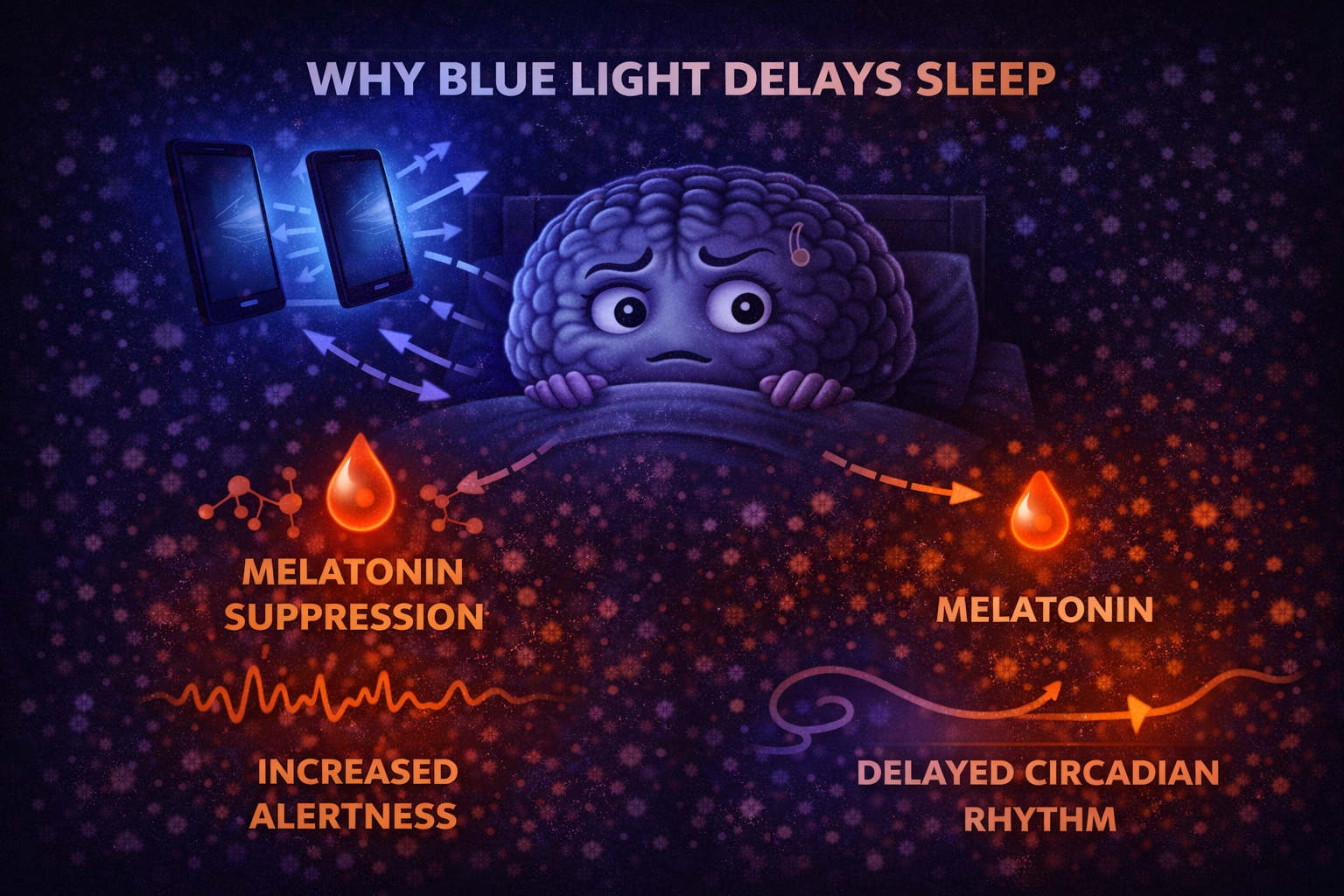
    As darkness increases, melatonin rises, promoting sleepiness and initiating nighttime physiology. Blue light suppresses melatonin production more powerfully than other wavelengths.

    Even brief evening exposure can delay melatonin release and push sleep timing later.


    Why Screens Are Especially Problematic

    Screens emit concentrated blue light.

    Phones, tablets, computers, and televisions deliver blue wavelengths directly into the eyes at close range. This exposure is intense and sustained, making it especially disruptive in the evening.

    Using screens close to bedtime delays sleep onset even if brightness is reduced.


    Blue Light and Increased Alertness

    Blue light does more than suppress melatonin.

    It actively increases alertness, reaction time, and cognitive stimulation. This makes the brain feel “wired” even when the body is tired.

    This mismatch explains why people often feel exhausted yet unable to fall asleep.


    How Blue Light Shifts the Circadian Clock

    Evening blue light delays circadian timing.

    The internal clock shifts later, causing sleepiness to appear later at night and wake time to drift later in the morning. Over time, this creates chronic misalignment.

    This shift occurs even without conscious awareness.


    Blue Light and Sleep Depth

    Delayed sleep timing affects sleep structure.

    When sleep is pushed later, the proportion of deep sleep and REM sleep can be reduced or fragmented. Sleep may feel long but unrefreshing.

    Quality declines even when quantity remains unchanged.


    Why Indoor Lighting Adds to the Problem

    Modern lighting extends exposure.

    LED lighting used in homes and public spaces often contains blue wavelengths. Bright indoor lighting in the evening reinforces the signal that it is still daytime.

    This prolongs alertness beyond biological night.


    Do Blue Light Filters Fully Solve the Problem?

    Filters help, but they are not enough.

    Blue light filters and night modes reduce wavelength intensity but do not eliminate alerting effects. The brain still responds to light exposure, brightness, and stimulation.

    Reducing exposure time matters more than filtering alone.


    How to Minimize Blue Light Exposure at Night

    Managing blue light requires behavior.

    Dimming lights, using warmer lighting, limiting screen use before bed, and creating a darker evening environment allow melatonin to rise naturally.

    Consistency is more important than perfection.


    Why Darkness Matters More Than You Think

    Darkness is an active biological signal.

    As light disappears, the brain transitions into night mode. This transition supports sleep onset, depth, and emotional regulation.

    Protecting darkness protects sleep.


    The Core Idea to Remember

    Blue light delays sleep because it sends a powerful daytime signal to the brain.

    By suppressing melatonin, increasing alertness, and shifting circadian timing, blue light makes falling asleep harder and sleep less restorative.

    Sleep improves not by forcing rest — but by aligning light exposure with biology.

  • Why Your Mind Races at Bedtime

    Why Your Mind Races at Bedtime

    How timing, stress, and learned arousal keep the brain active when it should slow down

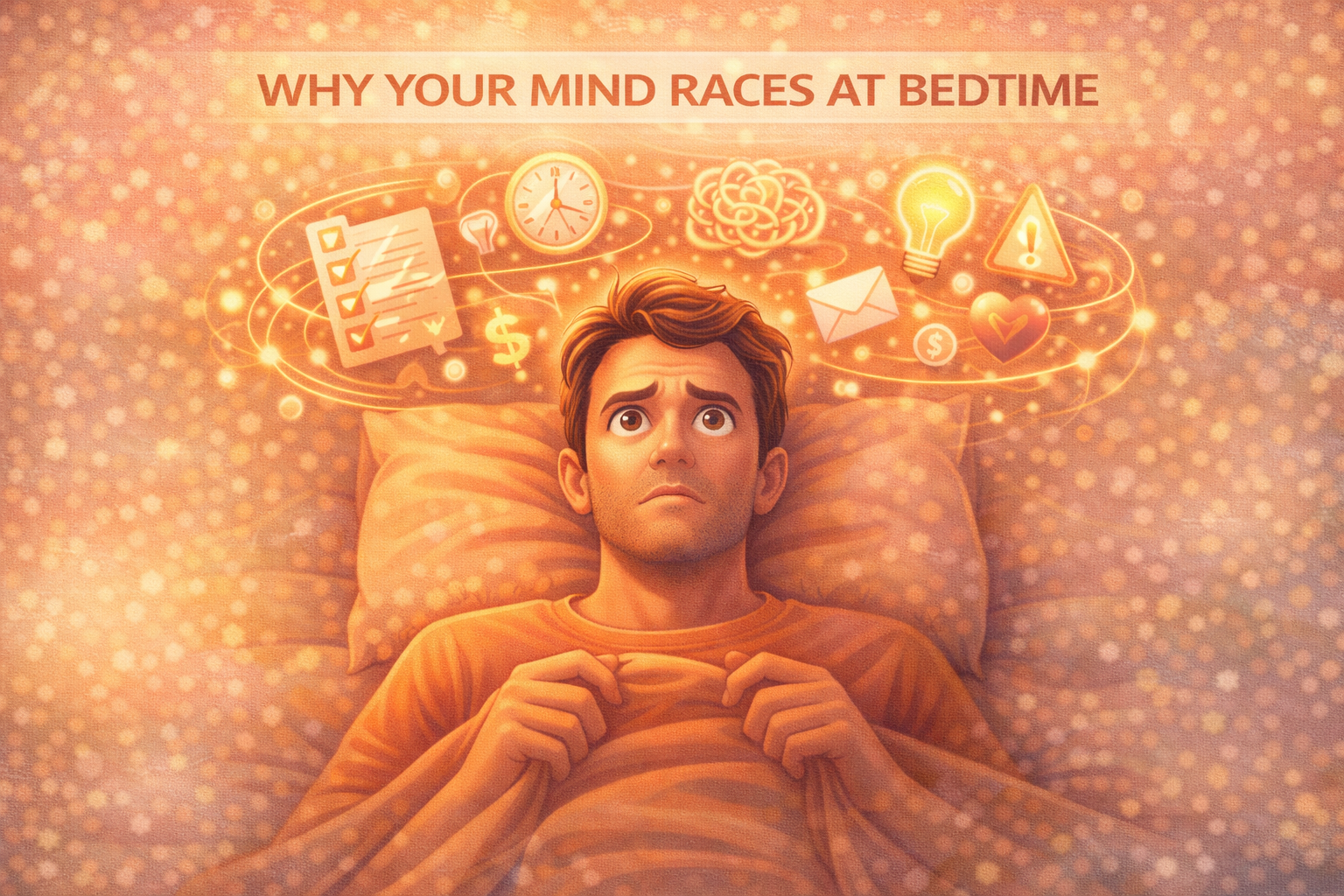
    Lying in bed with a tired body and an overactive mind is a common experience. Thoughts jump from one topic to another, worries resurface, plans replay, and sleep feels distant despite clear exhaustion.

    This racing mind is not a sign of poor discipline or a flawed personality. It reflects a state of heightened brain arousal that conflicts with sleep onset. Understanding why this happens reveals that the issue is not the presence of thoughts, but the conditions that keep the brain alert at the wrong time.


    Sleep Requires the Brain to Disengage

    Falling asleep is not about shutting thoughts off on command.

    Sleep begins when alertness systems quiet down and the brain reduces its engagement with problem-solving and monitoring. This disengagement is gradual and depends on timing, safety signals, and reduced stimulation.

    When these conditions are missing, the brain remains active even when the body is ready for rest.


    Stress Keeps the Brain in Problem-Solving Mode

    Stress is one of the strongest drivers of nighttime mental activity.

    Even low-grade or background stress keeps the brain oriented toward anticipation and control. Cortisol and other stress-related signals promote vigilance, making the brain more likely to scan for unresolved issues.

    At bedtime, when distractions disappear, this unresolved cognitive load becomes more noticeable, giving the impression that the mind suddenly “wakes up.”


    Why Thoughts Appear Louder at Night

    The mind does not usually become more active at night — the environment becomes quieter.

    During the day, attention is occupied by tasks, noise, and interaction. At night, external input drops sharply, leaving internal thoughts more prominent.

    Even small amounts of light can signal alertness to the brain.
    Some people use a comfortable sleep mask to create complete darkness and reduce visual stimulation, helping the brain shift away from environmental monitoring.

    This contrast makes normal cognitive activity feel intense, even though overall brain activity may not be higher than during the day.


    Circadian Timing and Evening Alertness

    Circadian timing influences how alert the brain feels in the evening.

    For later chronotypes, alertness naturally peaks later at night. If bedtime occurs before this alertness declines, the brain remains engaged and resistant to sleep.

    In these cases, racing thoughts reflect biological timing rather than anxiety or overthinking alone.


    Learned Arousal and the Bed–Wake Association

    Over time, the brain can learn to associate the bed with alertness.

    If bedtime repeatedly involves worrying, planning, or frustration about not sleeping, the brain links the bed environment with cognitive activity. This learned association triggers alertness as soon as you lie down.

    Sudden or inconsistent sounds can also reinforce this alert state.
    Consistent background sound, such as white noise, can help reduce the brain’s need to monitor the environment and support disengagement.

    The result is a conditioned response where the mind races automatically, even on low-stress days.


    Why Trying to Control Thoughts Backfires

    Efforts to suppress thoughts often increase arousal.

    When the brain detects effort or frustration, it interprets this as a need for control, activating alertness systems further. This creates a feedback loop where trying harder to sleep makes sleep less likely.

    Sleep emerges when effort drops, not when control increases.


    Sleep Pressure Isn’t Always Enough

    High sleep pressure does not guarantee mental quiet.

    You can be physically exhausted while cognitive systems remain active. Alertness driven by stress or timing can override sleep pressure, delaying sleep onset.

    This explains why extreme tiredness does not always lead to immediate sleep.


    Why the Mind Races Most Right Before Sleep

    Bedtime is a transition point.

    As the brain shifts from engagement to disengagement, unresolved thoughts surface briefly before fading — unless alertness is sustained. When timing or stress interferes, this transitional phase stretches longer than it should.

    The racing mind is often a sign that disengagement has stalled.


    Reducing Nighttime Mental Activation

    Calming the racing mind is about reducing arousal, not eliminating thoughts.

    Consistent sleep timing, reduced evening stimulation, and allowing alertness to decline naturally help the brain disengage. Creating a predictable wind-down period signals that problem-solving is no longer required.

    Supporting the nervous system’s transition into a calmer state can also play a role.
    Some people include magnesium glycinate in their evening routine, as it is involved in regulating relaxation and neural recovery.

    When the brain receives permission to disengage, thoughts slow without force.


    The Core Idea to Remember

    Your mind races at bedtime because the brain remains alert when it should be winding down.

    Stress, circadian timing, and learned associations keep cognitive systems active despite physical fatigue. Sleep does not arrive when thoughts are fought — it arrives when alertness is allowed to fade.

    Understanding this shifts the focus from controlling the mind to creating the conditions that let it rest.

  • Why You Feel Wired but Tired at Night

    Why You Feel Wired but Tired at Night

    How stress, timing, and overstimulation keep the brain alert when it should shut down

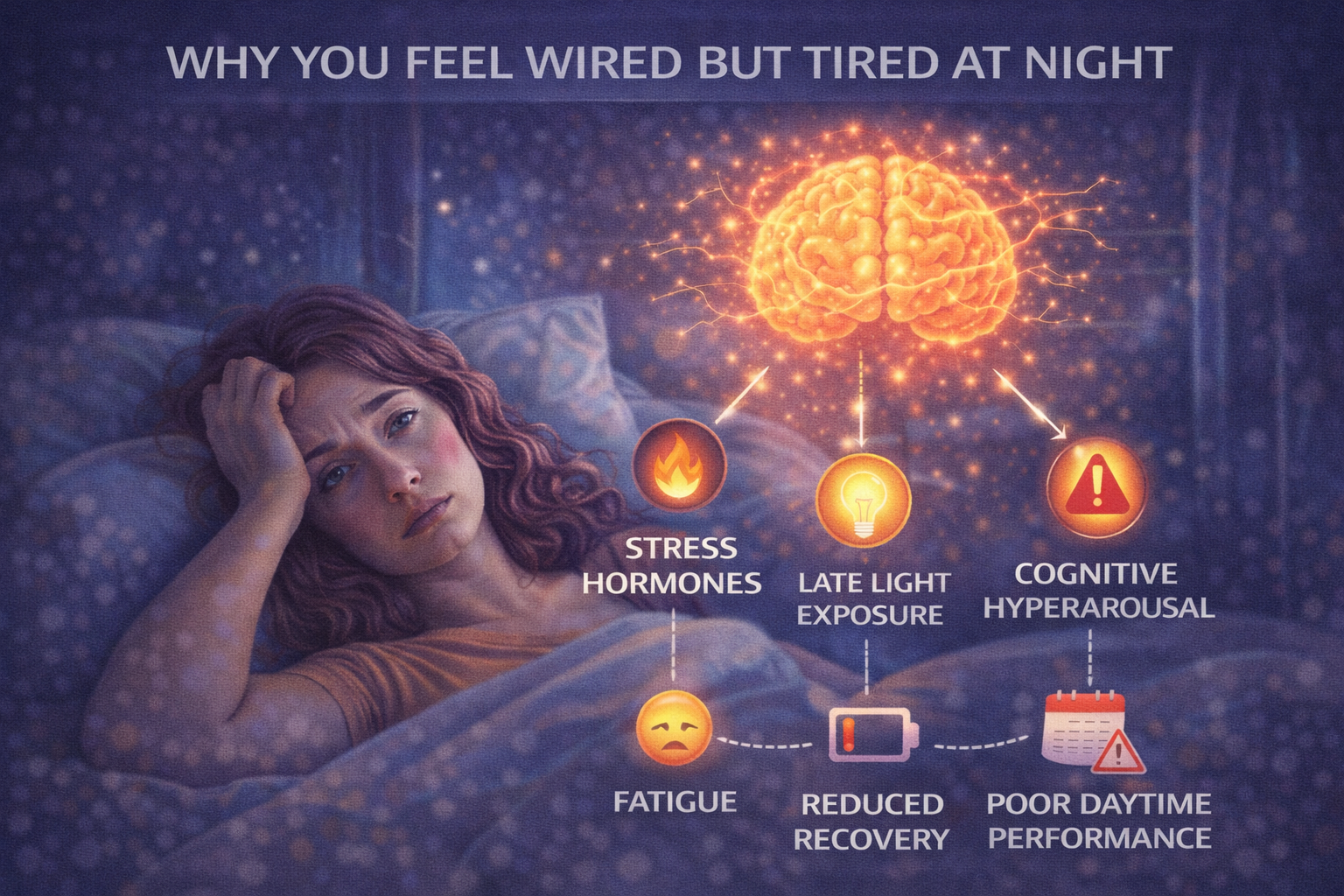
    Feeling exhausted yet unable to fall asleep is one of the most frustrating sleep experiences. The body feels depleted, but the mind remains alert, restless, and active. Thoughts race, tension lingers, and sleep feels just out of reach.

    This “wired but tired” state is not a contradiction. It reflects a mismatch between physical fatigue and neurological alertness. The problem is not a lack of tiredness — it is that the brain has not received the right signals to disengage.


    Physical Fatigue and Mental Arousal Are Different Systems

    Feeling tired does not automatically mean the brain is ready for sleep.

    Physical fatigue reflects energy depletion in muscles and body systems. Mental arousal reflects brain activity, stress signaling, and alertness regulation. These two systems can move in opposite directions.

    At night, it is possible for the body to be exhausted while the brain remains activated, especially under conditions of stress or circadian disruption.


    The Role of the Stress Response

    One of the main drivers of feeling wired at night is stress-related arousal.

    Stress hormones such as cortisol increase alertness and vigilance. When stress is prolonged — even psychological or low-grade stress — these hormones may remain elevated into the evening.

    This keeps the brain in a problem-solving, threat-monitoring mode that conflicts with sleep onset, even when the body needs rest.


    Why the Brain Struggles to Power Down

    Sleep requires a gradual reduction in neural activity.

    When the brain remains stimulated — by worry, planning, emotional processing, or mental load — it resists this transition. Thoughts continue to loop, attention remains externally or internally engaged, and sleep pressure is overridden by alertness.

    The result is lying in bed feeling mentally “on” despite physical exhaustion.


    Circadian Timing and Evening Alertness

    Circadian timing plays a critical role in nighttime alertness.

    For later chronotypes, biological alertness naturally peaks later in the evening. When combined with stress or stimulation, this peak can feel exaggerated, producing a wired sensation at night.

    In this case, tiredness reflects accumulated fatigue, while alertness reflects circadian and stress-driven activation.


    Overstimulation and Modern Evenings

    Modern evenings are rarely quiet for the brain.

    Screens, artificial light, information overload, and constant cognitive engagement keep alertness elevated. Even passive scrolling provides novelty and emotional input that the brain treats as stimulation.

    This environment delays the natural decline in alertness and reinforces the wired-but-tired state.


    Why Forcing Sleep Makes It Worse

    Trying to force sleep often backfires.

    When sleep does not arrive easily, frustration increases. This emotional response further activates stress systems, raising alertness even more.

    The brain interprets effort as a signal to stay awake, creating a feedback loop where trying harder to sleep increases wakefulness.


    Sleep Pressure Isn’t Always Enough

    Sleep pressure builds the longer you are awake.

    However, high sleep pressure alone does not guarantee sleep if alertness remains elevated. The brain prioritizes perceived threat or stimulation over rest.

    This explains why extreme tiredness does not always lead to immediate sleep when the brain is still “on.”


    Why This Pattern Repeats Night After Night

    The wired-but-tired state often becomes habitual.

    When nights repeatedly involve mental activation in bed, the brain learns to associate bedtime with alertness. This conditioning makes future nights more difficult, even when stress levels improve.

    The pattern is maintained by timing, stimulation, and learned arousal.


    Reducing Nighttime Arousal

    Breaking the cycle requires reducing arousal, not increasing effort.

    Supporting circadian alignment, reducing evening stimulation, and allowing alertness to decline gradually help the brain disengage. The goal is not to force sleep, but to remove the signals that prevent it.

    When alertness falls naturally, sleep follows.


    The Core Idea to Remember

    Feeling wired but tired at night means the brain is still activated despite physical fatigue.

    Stress, overstimulation, and circadian timing keep alertness high when it should be declining. Sleep does not arrive because the brain has not received permission to shut down.

    Sleep becomes easier when alertness is allowed to fade — not when tiredness is pushed harder.

  • Why You Can’t Fall Asleep Even When You’re Exhausted

    Why You Can’t Fall Asleep Even When You’re Exhausted

    Feeling completely exhausted but unable to fall asleep is deeply frustrating.

    Your body is tired.
    Your energy is gone.
    But your mind refuses to shut down.

    This isn’t a lack of discipline.

    It’s a biological mismatch between sleep pressure and nervous system activation.


    Why Being Tired Doesn’t Automatically Lead to Sleep

    Sleep happens when two systems work together.

    Sleep pressure builds the longer you stay awake.
    Circadian rhythm determines when your body is ready to sleep.

    You can be physically exhausted, but if your brain stays alert, sleep won’t come.

    Tiredness alone is not enough.


    The Nervous System Keeps You Awake

    When stress hormones remain elevated, your body stays in a defensive state.

    The brain interprets bedtime as unsafe.

    Instead of slowing down, it stays in problem-solving mode.

    This often shows up as:

    • racing thoughts

    • restlessness in bed

    • shallow breathing

    • sudden alertness at night

    • For individuals who struggle with racing thoughts, a consistent background sound — such as a white noise machine — may reduce sensory distractions and support a more stable sleep environment.

    Your body is tired.
    Your nervous system is not.

    In some cases, gentle nervous system support — such as magnesium glycinate — may help promote relaxation before bedtime, particularly for individuals experiencing persistent hyperarousal.


    Why Relaxation Techniques Often Don’t Work

    Many people try breathing exercises or meditation right before bed.

    Sometimes they help.
    Often, they don’t.

    Sleep is not a switch you flip at night.

    It’s the result of how your nervous system was regulated all day long.

    A single technique can’t undo an overstimulating day.

    This pattern is often linked to disruptions in the circadian rhythm.


    What Actually Helps You Fall Asleep

    Falling asleep improves when safety signals increase.

    Not force.

    The most effective principles are simple:

    • consistent wake-up times

    • morning light exposure

    • reduced evening stimulation

    • Creating a completely dark sleep environment can further support melatonin production. Some individuals use a 100% blackout sleep mask to eliminate residual light exposure.

    • predictable daily rhythms

    When the nervous system feels safe, sleep follows naturally.


    Final Thoughts

    If you’re exhausted but can’t sleep, your body isn’t broken.

    It’s responding logically to the signals it received.

    Sleep improves when biology is supported — not when it’s forced.

    Nighttime awakenings and difficulty falling asleep are often connected.