Tag: sleep quality

  • Does Blue Light Blocking Really Work?

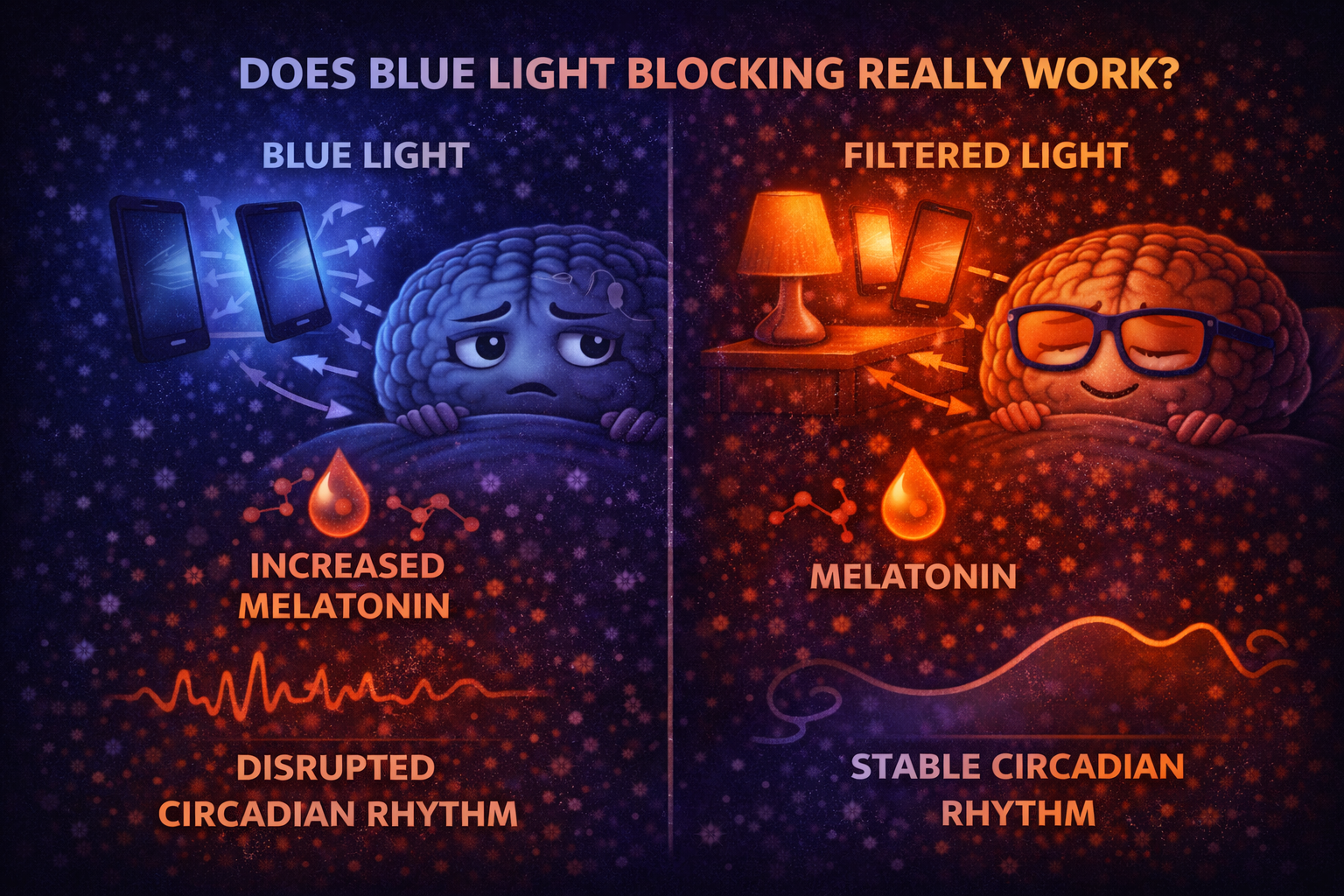
    Does Blue Light Blocking Really Work?

    What blue light blocking can and cannot do for your sleep

    Blue light blocking glasses, screen filters, and “night mode” settings are widely promoted as simple solutions for sleep problems. Many people use them hoping to fall asleep faster and sleep more deeply.

    But the reality is more nuanced. Blue light blocking can help—but it is not a complete fix. Its effectiveness depends on timing, behavior, and expectations. Understanding what blue light blocking actually does clarifies when it works and when it doesn’t.


    Why Blue Light Blocking Exists

    Blue light delays sleep by signaling daytime to the brain.

    Blocking blue wavelengths reduces melatonin suppression and limits circadian delay. This is the biological rationale behind blue light blocking tools.

    They are designed to weaken one specific signal—not to replace healthy sleep habits.


    What Blue Light Blocking Does Well

    Blue light blocking reduces one major disruptor.

    By filtering blue wavelengths, these tools decrease the alerting signal sent to the brain in the evening. This can support earlier melatonin release and make sleepiness feel more natural.

    For people exposed to screens at night, this reduction can be meaningful.


    Why Blue Light Blocking Is Not a Complete Solution

    Blocking blue light does not eliminate alertness.

    Brightness, screen content, mental stimulation, and timing still affect sleep. Even filtered light can delay sleep if exposure is long or intense.

    The brain responds to more than just wavelength.


    Screens Still Stimulate the Brain

    Visual content matters.

    Reading messages, watching videos, or engaging emotionally activates cognitive and emotional systems regardless of light color. This stimulation delays sleep independently of blue light.

    Blue light blocking does not prevent mental arousal.


    How Effective Are Blue Light Blocking Glasses?

    Glasses can reduce circadian disruption—but with limits.

    They are most helpful when worn consistently in the evening and combined with dim lighting. Their effect is smaller if screens are used intensively late at night.

    They work best as a support, not a solution.


    What About Screen Night Modes and Filters?

    Software filters help—but partially.

    Night modes reduce blue wavelengths but often maintain brightness and contrast. This still stimulates the visual system and the brain.

    Reducing screen time matters more than adjusting screen color alone.


    Why Timing Matters More Than Filtering

    Light timing is more important than light filtering.

    Blocking blue light late at night helps less than reducing exposure earlier in the evening. Prolonged exposure—even filtered—can still delay sleep.

    The circadian system responds to cumulative signals.


    Blue Light Blocking and Sleep Quality

    Blue light blocking mainly affects sleep timing.

    It may help you fall asleep earlier but does not guarantee deeper sleep. Sleep depth depends on overall circadian alignment, stress levels, and sleep continuity.

    Blocking blue light improves conditions—but doesn’t replace biology.


    When Blue Light Blocking Is Most Useful

    It works best when:

    • evening screen use is unavoidable

    • lighting is already dim

    • bedtime is consistent

    • exposure time is limited

    In these conditions, blue light blocking can meaningfully support sleep.


    When Blue Light Blocking Has Little Effect

    It helps less when:

    • screens are used intensively late at night

    • lighting is bright

    • sleep timing is irregular

    • stress and arousal remain high

    In these cases, behavior matters more than filtering.


    The Bigger Picture: Light Management

    Blue light is only part of the story.

    Sleep improves when light exposure is aligned across the entire day—bright mornings, dim evenings, consistent timing.

    Blocking blue light without managing overall light habits has limited impact.


    The Core Idea to Remember

    Blue light blocking works—but only within limits.

    It can reduce melatonin suppression and support earlier sleep onset, but it does not eliminate alertness, stimulation, or poor sleep habits.

    Blue light blocking is a tool—not a cure. Sleep improves most when light exposure, timing, and behavior work together.

  • Why Blue Light Delays Sleep

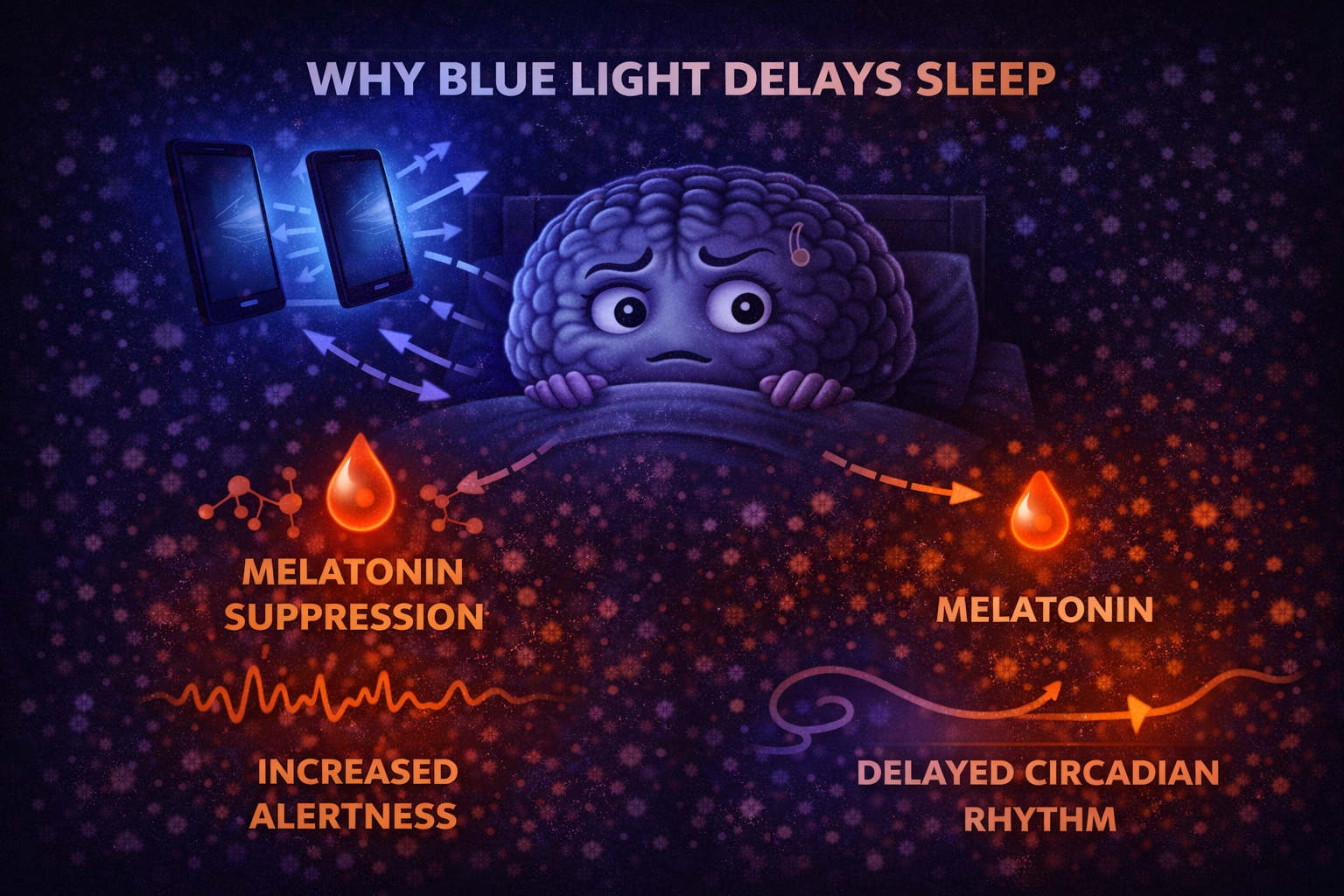
    Why Blue Light Delays Sleep

    How artificial light at night interferes with melatonin and sleep timing

    Many people struggle to fall asleep even when they feel tired. They go to bed on time, turn off the lights, and still lie awake. Often, the cause isn’t stress or lack of discipline — it’s light exposure earlier in the evening.

    Blue light is one of the strongest signals affecting the brain’s sleep system. In modern environments, exposure to blue light at night delays sleep onset, disrupts circadian timing, and weakens sleep quality, even when total sleep time seems adequate.


    The Brain Uses Light to Decide When to Sleep

    Sleep timing is regulated by the circadian rhythm.

    The brain relies on light signals from the eyes to determine whether it is day or night. When light is detected, the brain increases alertness. When light fades, it prepares the body for sleep.

    Blue light sends a particularly strong “daytime” signal.


    Why Blue Light Is More Disruptive Than Other Light

    Not all light affects sleep equally.

    Blue wavelengths strongly activate specialized light-sensitive cells in the eyes that communicate directly with the brain’s internal clock. These cells evolved to respond to daylight, which is rich in blue light.

    When blue light appears at night, the brain interprets it as extended daytime.


    Blue Light and Melatonin Suppression

    Melatonin is the hormone that signals night.

    As darkness increases, melatonin rises, promoting sleepiness and initiating nighttime physiology. Blue light suppresses melatonin production more powerfully than other wavelengths.

    Even brief evening exposure can delay melatonin release and push sleep timing later.


    Why Screens Are Especially Problematic

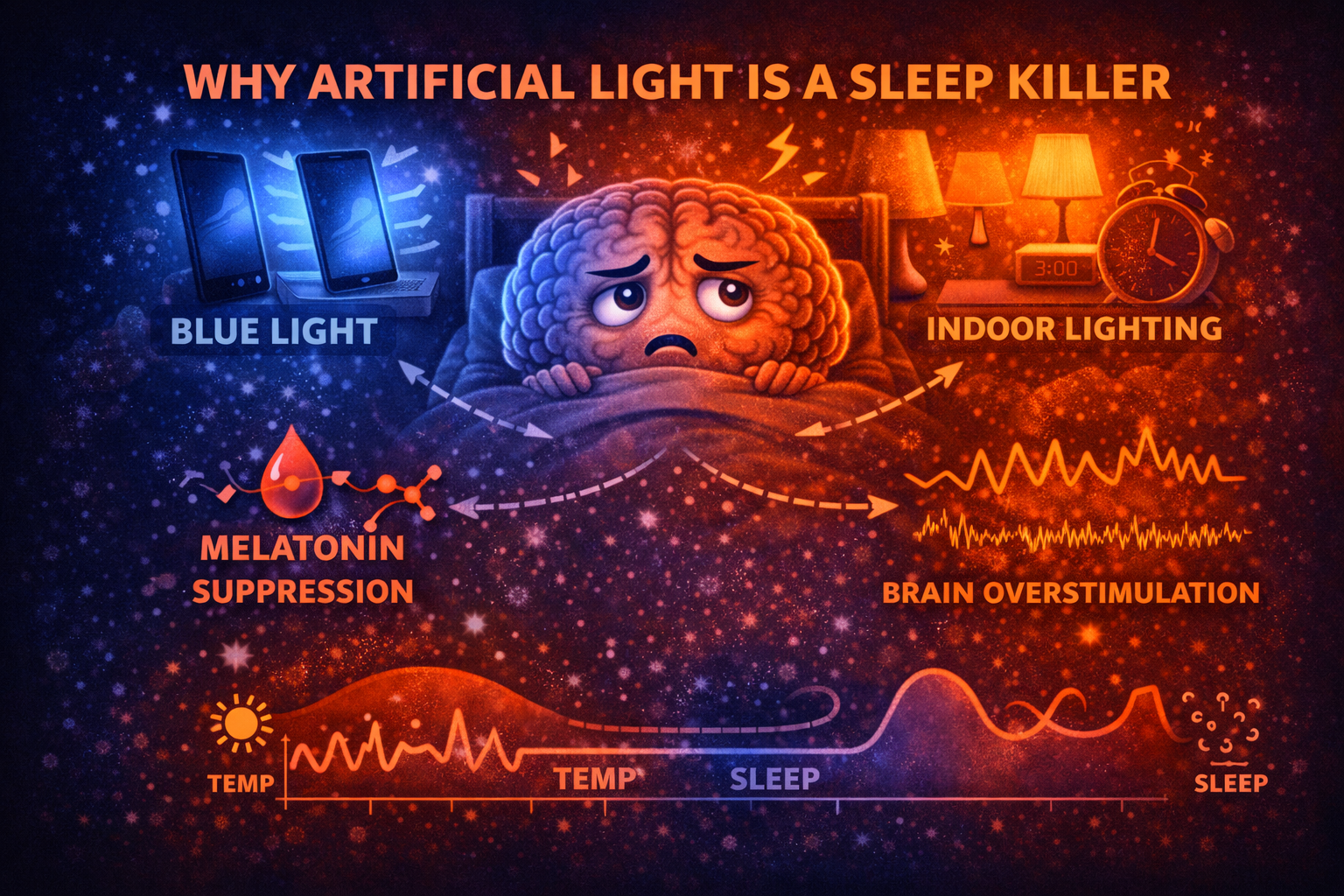
    Screens emit concentrated blue light.

    Phones, tablets, computers, and televisions deliver blue wavelengths directly into the eyes at close range. This exposure is intense and sustained, making it especially disruptive in the evening.

    Using screens close to bedtime delays sleep onset even if brightness is reduced.


    Blue Light and Increased Alertness

    Blue light does more than suppress melatonin.

    It actively increases alertness, reaction time, and cognitive stimulation. This makes the brain feel “wired” even when the body is tired.

    This mismatch explains why people often feel exhausted yet unable to fall asleep.


    How Blue Light Shifts the Circadian Clock

    Evening blue light delays circadian timing.

    The internal clock shifts later, causing sleepiness to appear later at night and wake time to drift later in the morning. Over time, this creates chronic misalignment.

    This shift occurs even without conscious awareness.


    Blue Light and Sleep Depth

    Delayed sleep timing affects sleep structure.

    When sleep is pushed later, the proportion of deep sleep and REM sleep can be reduced or fragmented. Sleep may feel long but unrefreshing.

    Quality declines even when quantity remains unchanged.


    Why Indoor Lighting Adds to the Problem

    Modern lighting extends exposure.

    LED lighting used in homes and public spaces often contains blue wavelengths. Bright indoor lighting in the evening reinforces the signal that it is still daytime.

    This prolongs alertness beyond biological night.


    Do Blue Light Filters Fully Solve the Problem?

    Filters help, but they are not enough.

    Blue light filters and night modes reduce wavelength intensity but do not eliminate alerting effects. The brain still responds to light exposure, brightness, and stimulation.

    Reducing exposure time matters more than filtering alone.


    How to Minimize Blue Light Exposure at Night

    Managing blue light requires behavior.

    Dimming lights, using warmer lighting, limiting screen use before bed, and creating a darker evening environment allow melatonin to rise naturally.

    Consistency is more important than perfection.


    Why Darkness Matters More Than You Think

    Darkness is an active biological signal.

    As light disappears, the brain transitions into night mode. This transition supports sleep onset, depth, and emotional regulation.

    Protecting darkness protects sleep.


    The Core Idea to Remember

    Blue light delays sleep because it sends a powerful daytime signal to the brain.

    By suppressing melatonin, increasing alertness, and shifting circadian timing, blue light makes falling asleep harder and sleep less restorative.

    Sleep improves not by forcing rest — but by aligning light exposure with biology.

  • How Light Exposure Affects Your Sleep (And What to Do About It)

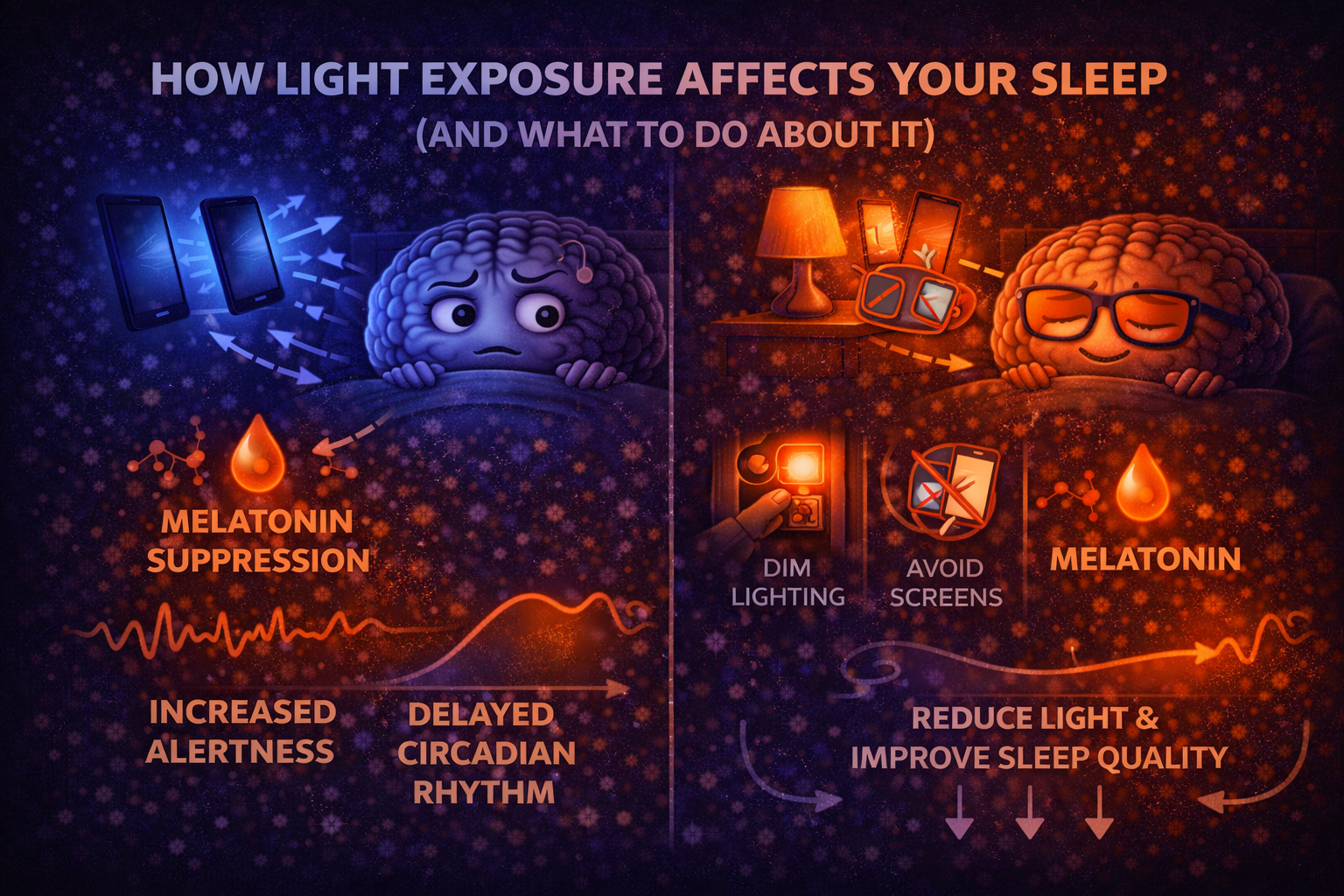
    How Light Exposure Affects Your Sleep (And What to Do About It)

    Why light is the strongest signal controlling your sleep–wake cycle

    Sleep is often treated as something that happens when the day ends. In reality, sleep is actively controlled by signals the brain receives long before bedtime. Among all of them, light is the most powerful.

    Light exposure determines when you feel alert, when you feel sleepy, and how deeply you sleep. Understanding how light affects sleep explains why modern environments make sleep harder—and what can be done to restore alignment.


    Light Is the Brain’s Primary Time Signal

    The brain uses light to tell time.

    Specialized cells in the eyes detect light and send timing signals directly to the brain’s central clock. This system evolved to synchronize the body with sunrise and sunset.

    When light exposure follows natural patterns, sleep timing feels effortless. When it doesn’t, sleep becomes fragmented and mistimed.


    How Morning Light Sets Your Sleep Schedule

    Morning light anchors your circadian rhythm.

    Exposure to bright light early in the day signals the brain that the day has begun. This timing cue starts the internal clock and determines when melatonin will be released later at night.

    Without sufficient morning light, the sleep schedule drifts later, making it harder to fall asleep at night.


    Why Evening Light Delays Sleep

    Evening light sends the wrong signal.

    Artificial light at night tells the brain that it is still daytime. This delays melatonin release, increases alertness, and shifts sleep timing later.

    The brighter and bluer the light, the stronger this delay becomes.


    Blue Light and Its Unique Impact on Sleep

    Blue light is especially disruptive.

    Screens, LED lighting, and modern devices emit high levels of blue light. This wavelength strongly suppresses melatonin and increases alertness.

    Even short exposure in the evening can delay sleep onset and reduce sleep quality.


    Light Exposure and Sleep Depth

    Light affects more than sleep timing.

    Improper light exposure reduces sleep depth and continuity. Fragmented sleep, reduced deep sleep, and disrupted REM sleep are common consequences of circadian misalignment caused by light.

    Sleep may feel long but unrefreshing.


    Why Indoor Living Confuses the Brain

    Modern light environments are unnatural.

    Indoor lighting during the day is often too dim, while evening lighting is too bright. This reverses natural light signals and confuses the circadian system.

    The brain struggles to distinguish day from night.


    How Irregular Light Exposure Disrupts Sleep Consistency

    Inconsistent light patterns prevent stabilization.

    When light exposure changes daily—late nights, screens, irregular schedules—the circadian rhythm cannot settle. Sleep timing becomes unpredictable.

    Consistency matters more than perfection.


    What to Do About Morning Light

    Prioritize early light exposure.

    Spending time outdoors in the morning or near a bright window helps anchor the circadian rhythm. Even on cloudy days, outdoor light is far stronger than indoor lighting.

    This single habit improves nighttime sleep quality.


    How to Reduce Harmful Evening Light

    Evening light should be minimized.

    Dimming lights, avoiding screens close to bedtime, and using warmer lighting reduces melatonin suppression. The goal is not darkness all day—but darkness at the right time.

    This allows the brain to prepare for sleep naturally.


    Do Blue Light Filters Actually Help?

    Blue light filters help—but only partially.

    They reduce the intensity of blue wavelengths but do not eliminate alerting effects entirely. Behavioral changes matter more than filters alone.

    Reducing exposure time is more effective than relying on software.


    Why Darkness Signals the Brain to Sleep

    Darkness is an active signal.

    As light fades, melatonin rises and the brain shifts into night mode. This transition supports sleep onset, depth, and emotional regulation.

    True darkness strengthens this signal.


    Long-Term Effects of Poor Light Management

    Chronic light misalignment accumulates.

    Over time, poor light exposure contributes to insomnia, fatigue, mood instability, and reduced cognitive performance. These effects develop gradually and are often overlooked.

    Correcting light exposure can reverse many of them.


    The Core Idea to Remember

    Light exposure controls sleep timing, depth, and quality.

    Morning light anchors the circadian rhythm. Evening light delays sleep and weakens recovery. Managing light is one of the most powerful, non-invasive ways to improve sleep.

    Sleep improves not when you force it—but when light cues are aligned with biology.


    Slug

  • Why Your Mood Depends on Sleep Quality

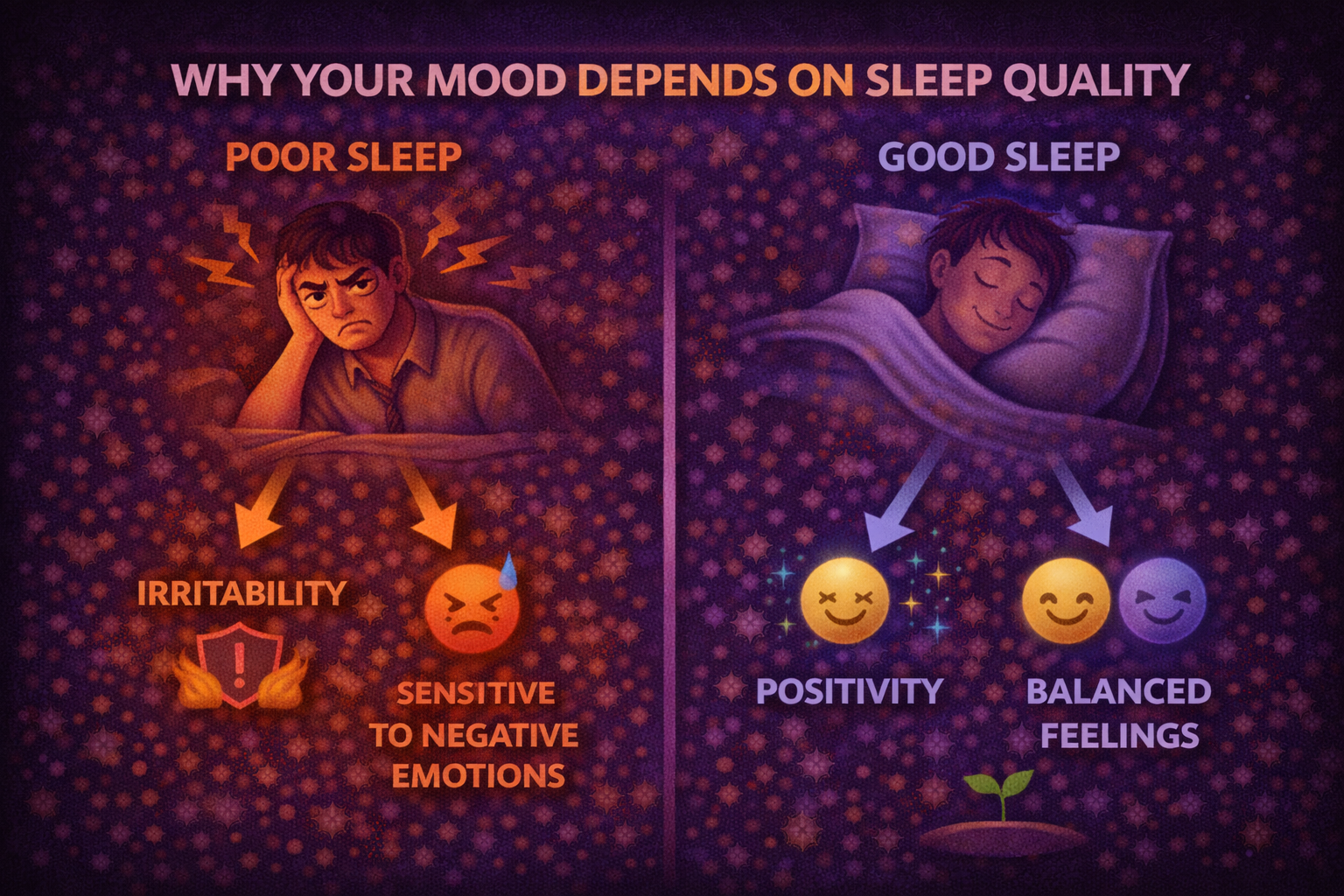
    Why Your Mood Depends on Sleep Quality

    How sleep quality shapes emotional stability, resilience, and daily mood

    Mood often feels like a reaction to circumstances. A good day lifts it, a stressful event lowers it. When mood worsens, people usually search for psychological or situational explanations.

    But mood is not only shaped by what happens during the day. It is strongly influenced by how the brain recovers at night. Sleep quality — not just sleep duration — plays a central role in determining emotional tone, stress tolerance, and mood stability from one day to the next.


    Mood Is Regulated by Brain State

    Mood reflects how the brain processes emotional input.

    A well-regulated brain evaluates situations proportionally, recovers quickly from stress, and maintains emotional balance. A poorly regulated brain reacts more strongly and recovers more slowly.

    Sleep quality is one of the main factors determining which of these states dominates.


    Why Sleep Quality Matters More Than Hours Slept

    Sleeping longer does not guarantee emotional stability.

    If sleep is fragmented, mistimed, or lacking restorative stages, the brain does not fully reset emotional systems. Mood may decline even after a long night in bed.

    High-quality sleep allows emotional regulation to complete its overnight cycle.


    How Sleep Recalibrates Emotional Thresholds

    During sleep, emotional sensitivity is recalibrated.

    Stress-related signaling decreases, emotional thresholds reset, and the brain restores balance between emotional reactivity and control. This allows emotions to arise without becoming overwhelming.

    Poor sleep leaves this recalibration incomplete, increasing emotional volatility.


    The Role of Deep Sleep in Mood Stability

    Deep sleep supports baseline emotional stability.

    It restores core neural networks involved in emotional regulation and reduces background neural noise. This creates a stable emotional baseline the next day.

    When deep sleep is reduced, mood becomes more fragile and reactive.


    REM Sleep and Emotional Processing

    REM sleep plays a critical role in emotional integration.

    During REM, emotional experiences are processed in a low-stress chemical environment. This allows emotional memories to be integrated without maintaining high emotional charge.

    Disrupted REM sleep leaves emotional experiences unprocessed, increasing emotional sensitivity and mood instability.


    Why Poor Sleep Increases Irritability

    Irritability is one of the most common signs of poor sleep.

    Sleep loss lowers tolerance for frustration and reduces impulse control. Minor inconveniences trigger disproportionate emotional reactions.

    This irritability is not a character flaw — it reflects reduced emotional regulation capacity.


    Sleep Quality and Emotional Recovery Speed

    Mood depends not only on reaction, but on recovery.

    After stress or negative emotion, a well-rested brain returns to baseline quickly. Poor sleep slows this recovery, allowing negative mood to persist longer.

    Sleep quality determines how fast emotional balance is restored.


    Negative Mood Bias After Poor Sleep

    Poor sleep creates a negative mood bias.

    The brain prioritizes negative information, memories, and interpretations. Positive experiences feel muted, while negative ones dominate attention.

    This bias shapes overall mood even when external circumstances are neutral.


    Cumulative Effects on Mood Over Time

    Repeated nights of poor sleep compound mood instability.

    Emotional regulation weakens, stress tolerance declines, and low mood becomes more persistent. Over time, this pattern increases vulnerability to anxiety and depressive symptoms.

    Mood changes often precede conscious awareness of sleep problems.


    Why Effort Can’t Stabilize Mood Without Sleep

    Trying to “stay positive” does not restore mood regulation.

    Effort requires neural resources that are replenished during sleep. Without recovery, emotional control remains impaired regardless of intention.

    Sleep supports mood regulation at a biological level.


    Why Mood Improves After High-Quality Sleep

    After good sleep, mood often improves without explanation.

    Emotions feel lighter, stress feels manageable, and perspective returns. This reflects restored regulation rather than changes in life circumstances.

    Sleep allows the brain to process emotions before the day begins.


    The Core Idea to Remember

    Mood depends on sleep quality because sleep regulates emotional balance.

    Through deep sleep and REM sleep, the brain restores emotional thresholds, processes experiences, and reduces negative bias. Poor sleep disrupts this process, amplifying mood instability.

    Stable mood is not forced — it is supported overnight by high-quality sleep.

  • Can Sleeping Too Much Make You Tired?

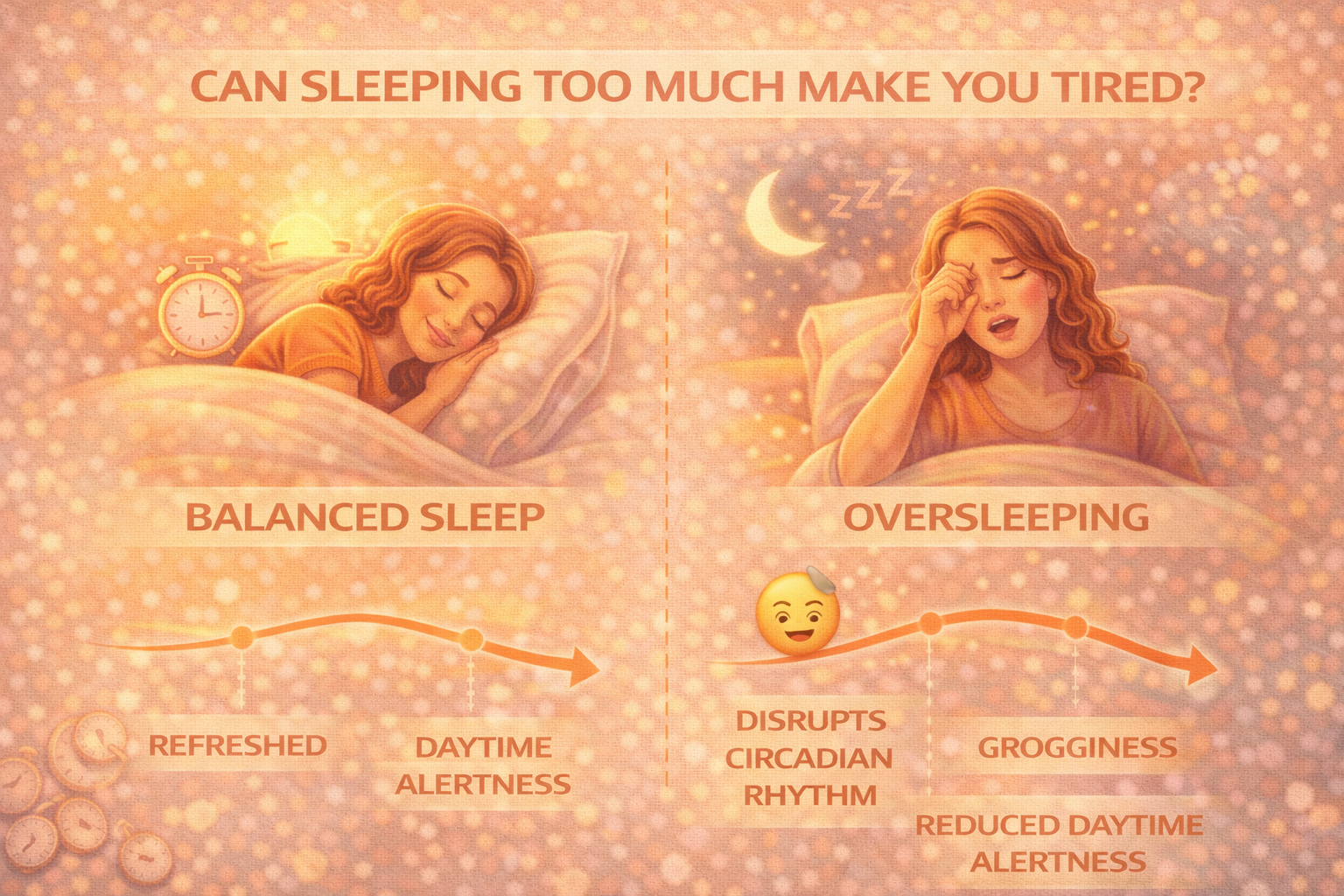
    Can Sleeping Too Much Make You Tired?

    Why excessive or poorly timed sleep can leave you feeling drained instead of restored

    Sleep is usually seen as the cure for fatigue. When energy drops, the natural response is to sleep longer, stay in bed more, or “catch up” on rest. Yet many people discover an uncomfortable paradox: after sleeping a lot, they feel heavier, foggier, and less motivated.

    This does not mean sleep is harmful. It means that more sleep is not always better sleep. When sleep duration exceeds what the brain can use efficiently — or when it occurs at the wrong time — it can actually worsen how rested you feel.


    Sleep Restores Through Quality, Not Quantity

    Sleep works through efficiency, not accumulation.

    The brain restores itself during specific sleep stages that occur at biologically appropriate times. Once those processes are completed, additional time in bed adds little benefit.

    When sleep extends beyond the optimal window, recovery does not increase proportionally. Instead, sleep quality can decline.


    Circadian Rhythm and Oversleeping

    The circadian rhythm determines when the brain is ready to wake up.

    If you continue sleeping past this natural wake window, the brain begins shifting toward alertness even while you remain asleep. This creates internal conflict between sleep and wake systems.

    As a result, waking up after oversleeping often feels sluggish and disorienting rather than refreshing.


    Why Oversleeping Increases Sleep Inertia

    Sleep inertia is the groggy, heavy feeling after waking.

    Long sleep episodes increase the likelihood of waking from deep sleep stages. When this happens, the brain requires more time to fully transition into alertness.

    Instead of easing the wake-up process, oversleeping can intensify inertia and reduce mental clarity.


    Long Sleep Often Signals Poor Sleep Quality

    Sleeping too much is frequently a response to inadequate recovery.

    Fragmented sleep, reduced deep sleep, or circadian misalignment can leave the brain under-restored. In response, sleep pressure remains high, driving longer sleep durations without improving how rested you feel.

    In these cases, long sleep is a symptom, not a solution.


    Oversleeping and Circadian Drift

    Regularly sleeping in can shift the circadian rhythm later.

    This delay makes it harder to fall asleep the following night, creating a cycle of late bedtimes and late wake-ups. Over time, this pattern increases fatigue rather than resolving it.

    What feels like recovery may quietly reinforce misalignment.


    Mental and Emotional Effects of Excessive Sleep

    Oversleeping affects more than physical energy.

    It is often associated with:

    • reduced mental sharpness

    • lower motivation

    • emotional flatness

    • difficulty initiating tasks

    These effects reflect circadian disruption and incomplete recovery rather than restfulness.


    Why More Sleep Doesn’t Fix Chronic Fatigue

    Chronic fatigue is rarely caused by insufficient sleep alone.

    When fatigue results from stress, disrupted sleep architecture, or circadian instability, extending sleep duration does not address the underlying cause. The brain remains out of sync.

    This is why some people feel better with slightly less but better-timed sleep.


    When Longer Sleep Is Actually Appropriate

    There are situations where longer sleep is necessary.

    Acute sleep deprivation, illness, intense physical exertion, or recovery periods can legitimately increase sleep needs. In these contexts, longer sleep supports healing rather than undermines energy.

    The key difference is whether longer sleep restores clarity or perpetuates fatigue.


    Finding the Right Amount of Sleep

    The optimal amount of sleep is individual and timing-dependent.

    When sleep is well-aligned, duration often stabilizes naturally. The body wakes more easily, and energy feels more consistent throughout the day.

    The goal is not maximizing hours in bed, but matching sleep duration to biological need and timing.


    The Core Idea to Remember

    Sleeping too much can make you feel tired when it disrupts circadian timing or reflects poor sleep quality.

    Energy does not come from accumulating hours in bed. It comes from sleep that is efficient, well-timed, and biologically aligned.

    When sleep timing is right, the brain takes what it needs — and more sleep stops being necessary.

  • Why You Sleep Better Some Nights Than Others

    Why You Sleep Better Some Nights Than Others

    How subtle shifts in timing, stress, and physiology change sleep quality from night to night

    Most people notice that sleep quality fluctuates. One night feels deep and effortless, the next feels light and fragmented — even when bedtime, duration, and routine appear unchanged.

    These differences are not random. Sleep quality varies because the brain’s readiness for sleep changes from day to day. Small shifts in circadian timing, stress load, sleep pressure, and environmental cues can significantly alter how restorative sleep feels.


    Sleep Quality Is Context-Dependent

    Sleep is not produced in isolation.

    Each night’s sleep reflects what happened during the day — physically, mentally, and biologically. Stress exposure, light timing, activity levels, and emotional load all influence how easily the brain can enter and maintain restorative sleep.

    Two nights with identical bedtimes can produce very different outcomes because the internal context is different.


    Circadian Alignment Changes Daily

    The circadian rhythm is stable, but not rigid.

    Light exposure, meal timing, and daily routines can subtly shift circadian signals from one day to the next. When sleep timing aligns well with these signals, sleep feels smooth and consolidated.

    When alignment is slightly off, sleep becomes lighter or more fragmented, even if the change is barely noticeable.


    Sleep Pressure Is Not the Same Every Night

    Sleep pressure builds based on how long and how intensely the brain has been awake.

    Days with high cognitive load, physical activity, or extended wakefulness increase sleep pressure, often leading to deeper sleep. Quieter or less demanding days may produce lower pressure, making sleep lighter.

    This variation explains why sleep can feel deeper after demanding days and lighter after low-activity days.


    Stress Fluctuations Shape Nighttime Arousal

    Stress levels vary daily, even when they feel “normal.”

    Small increases in emotional load, unresolved concerns, or anticipation can elevate nighttime arousal. This makes it harder for the brain to fully disengage, reducing sleep depth and increasing awakenings.

    On lower-stress days, the brain enters recovery mode more easily, improving sleep quality.


    The Role of Light and Evening Stimulation

    Evening light exposure is rarely identical from night to night.

    Screens, indoor lighting, and cognitive stimulation can delay the brain’s transition into sleep. Minor differences — such as extra screen time or later light exposure — can shift sleep onset and depth.

    These small changes accumulate into noticeable differences in sleep quality.


    Why Sleep Architecture Varies Nightly

    Sleep stages do not follow a fixed pattern every night.

    The distribution of deep sleep and REM sleep adapts to recent needs. After sleep loss or high stress, the brain may prioritize certain stages. On other nights, lighter sleep may dominate.

    This flexibility is normal, but it means that sleep quality naturally varies.


    Environmental Sensitivity Changes Over Time

    Sensitivity to noise, temperature, and comfort can fluctuate.

    On some nights, minor disturbances are ignored. On others, they trigger awakenings. This variability reflects changes in arousal threshold rather than environmental failure.

    As a result, identical environments can produce different sleep outcomes.


    Why “Doing Everything Right” Doesn’t Guarantee Good Sleep

    Many people expect perfect sleep when routines are followed precisely.

    However, sleep depends on internal readiness more than external rules. Even ideal habits cannot override biological variability from day to day.

    Good sleep increases the probability of restorative nights — it does not guarantee them.


    Why Variability Is Normal, Not a Problem

    Some night-to-night variation in sleep quality is healthy.

    The brain adapts sleep architecture to changing needs. Expecting identical sleep every night creates unnecessary frustration and increases sleep-related stress.

    Understanding variability reduces pressure and helps prevent overreaction to single bad nights.


    Improving the Odds of Better Nights

    The goal is not control, but consistency.

    Stable wake times, regular light exposure, and reduced evening stimulation increase the likelihood of good sleep across many nights. When the brain receives clear, repeated signals, sleep quality improves on average.

    Good sleep is a trend, not a single event.


    The Core Idea to Remember

    You sleep better some nights than others because sleep is shaped by daily biology, not rigid rules.

    Small changes in circadian alignment, stress, sleep pressure, and stimulation alter how the brain recovers each night. Variability is normal — patterns matter more than perfection.

    Understanding this makes sleep easier to support and less stressful to manage.

  • Sleep Fragmentation: Why Interrupted Sleep Feels So Bad

    Sleep Fragmentation: Why Interrupted Sleep Feels So Bad

    How repeated awakenings disrupt recovery even when total sleep time looks normal

    Many people sleep for what appears to be a full night yet wake up feeling exhausted, foggy, or irritable. They may not remember waking up often, but the sleep still feels shallow and unrefreshing.

    This experience is usually caused by sleep fragmentation. Interrupted sleep prevents the brain from completing the continuous processes required for restoration. The problem is not always how long you sleep, but how often that sleep is broken.


    What Sleep Fragmentation Really Is

    Sleep fragmentation occurs when sleep is repeatedly interrupted throughout the night.

    These interruptions can be brief awakenings, shifts to lighter sleep stages, or micro-arousals that are not consciously remembered. Even short disruptions can break the continuity the brain needs to maintain restorative sleep.

    From a biological perspective, fragmented sleep is very different from uninterrupted sleep, even if total hours are identical.


    Why Continuous Sleep Matters

    Sleep is designed to unfold in cycles.

    Each cycle builds on the previous one, allowing deeper stages of sleep and REM sleep to stabilize. When sleep is interrupted, these cycles are cut short or restarted.

    As a result, the brain spends more time transitioning between stages and less time in the stages responsible for recovery, memory processing, and emotional regulation.


    Deep Sleep and Fragmentation

    Deep sleep is particularly vulnerable to fragmentation.

    This stage requires sustained stability in brain activity. Frequent interruptions prevent deep sleep from consolidating, reducing its total duration and effectiveness.

    Even small disturbances can significantly reduce the amount of deep sleep across the night, weakening physical and cognitive recovery.


    REM Sleep Disruption and Emotional Effects

    Fragmentation also affects REM sleep.

    REM sleep plays a key role in emotional processing and memory integration. When REM periods are repeatedly interrupted, emotional regulation suffers.

    This contributes to irritability, heightened stress sensitivity, and emotional volatility the following day.


    Why Fragmented Sleep Feels Worse Than Short Sleep

    Many people report feeling worse after fragmented sleep than after intentionally short but uninterrupted sleep.

    This is because the brain never fully settles into restorative states. Constant disruption keeps neural systems partially alert, increasing biological effort and reducing efficiency.

    Sleep becomes work instead of recovery.


    Common Causes of Sleep Fragmentation

    Sleep fragmentation can arise from many sources, including:

    • stress and hyperarousal

    • noise or light exposure

    • irregular sleep schedules

    • sleep-disordered breathing

    • physical discomfort or pain

    Often, multiple factors interact to create repeated disruption.


    Fragmentation and the Stress Response

    Interrupted sleep activates stress systems.

    Each awakening triggers a brief stress response, increasing heart rate and alertness. When this happens repeatedly, the body remains in a semi-alert state throughout the night.

    This prevents full downregulation of stress hormones and contributes to morning fatigue.


    Why Fragmentation Accumulates Over Time

    One night of fragmented sleep is manageable.

    Repeated nights create cumulative effects. As restorative processes remain incomplete, sleep debt builds and resilience declines.

    Over time, fragmented sleep can lead to persistent fatigue, reduced concentration, and emotional instability.


    Why Sleeping Longer Doesn’t Fix Fragmentation

    Sleeping longer does not necessarily solve fragmented sleep.

    If interruptions continue, additional time in bed simply adds more broken sleep cycles. Recovery remains inefficient, and fatigue persists.

    Improving sleep continuity is more effective than increasing sleep duration.


    Supporting Sleep Continuity

    Improving sleep continuity involves reducing disruptions rather than forcing sleep.

    Stable sleep timing, reduced nighttime stimulation, and minimizing environmental disturbances help the brain maintain uninterrupted sleep cycles.

    When continuity improves, sleep often feels deeper and more refreshing without increasing total hours.


    The Core Idea to Remember

    Interrupted sleep feels bad because it breaks the brain’s recovery process.

    Sleep fragmentation prevents deep and REM sleep from stabilizing, increases nighttime stress responses, and reduces overall sleep efficiency.

    Sleep quality depends heavily on continuity. When sleep remains uninterrupted, the brain can recover as designed

  • How Sleep Quality Declines With Age

    How Sleep Quality Declines With Age

    Why the brain’s ability to generate restorative sleep changes over time

    As people get older, sleep often becomes lighter and less predictable. Nights that once felt deep and uninterrupted are replaced by longer time spent falling asleep, frequent awakenings, and mornings that feel less refreshing.

    These changes are commonly blamed on habits, lifestyle, or simply “getting older.” In reality, sleep quality declines with age because the biological systems that regulate sleep gradually change. The brain still needs sleep, but it becomes less efficient at producing the kind of sleep that feels truly restorative.


    Aging Does Not Eliminate the Need for Sleep

    One widespread belief is that older adults simply require less sleep.

    Biologically, this is not accurate. The brain’s need for recovery, memory processing, and metabolic regulation remains largely intact across adulthood. What changes is the brain’s capacity to generate consolidated, high-quality sleep.

    This is why many older individuals spend enough time in bed yet still feel unrefreshed the next day.


    How Sleep Architecture Shifts With Age

    Sleep is organized into stages that follow a repeating pattern throughout the night.

    With age, this structure becomes less stable. Deep sleep tends to decrease, light sleep occupies a larger portion of the night, and transitions between stages become more frequent.

    These shifts reduce sleep continuity. Even when total sleep time remains similar, the restorative value of sleep declines because the most recovery-focused stages occur less consistently.


    Why Deep Sleep Becomes More Fragile

    Deep sleep depends on synchronized, slow brain activity.

    As the brain ages, neural networks become less tightly coordinated. The brain also becomes more reactive to internal signals and external disturbances. This makes it harder to maintain the slow, stable activity patterns required for deep sleep.

    As a result, deep sleep becomes shorter, lighter, and more easily disrupted.


    Circadian Rhythm Changes Across the Lifespan

    The circadian rhythm also evolves with age.

    Many people experience an advance in circadian timing, meaning they feel sleepy earlier in the evening and wake earlier in the morning. While this shift is biological, it can conflict with modern schedules and social routines.

    When circadian timing and lifestyle are misaligned, sleep efficiency declines and nighttime awakenings become more frequent.


    Increased Sensitivity to Sleep Disruption

    With age, the brain becomes more sensitive to disturbance.

    Light, noise, temperature changes, physical discomfort, and stress that once had little impact can now interrupt sleep. These interruptions may be brief and unnoticed, but they fragment sleep and reduce overall quality.

    Sleep becomes more dependent on a stable, supportive environment.


    Hormonal Regulation and Sleep Stability

    Sleep quality is influenced by hormonal signaling.

    Age-related changes in melatonin release, stress hormone regulation, and body temperature rhythms alter how smoothly the brain transitions into sleep and maintains it through the night.

    These changes do not prevent sleep, but they reduce its stability and depth, making sleep more vulnerable to disruption.


    Why Fragmentation Matters More Than Hours Slept

    Fragmented sleep is one of the most important contributors to declining sleep quality.

    Frequent micro-awakenings interrupt restorative processes, even if total sleep duration appears sufficient. The brain exits deeper sleep stages repeatedly, limiting recovery.

    This is why people can sleep for many hours yet still feel mentally and physically tired.


    Cognitive and Emotional Consequences

    As sleep quality declines, daytime effects become more noticeable.

    Common experiences include slower thinking, reduced concentration, increased emotional reactivity, and lower stress tolerance. These effects are often attributed to aging itself, when disrupted sleep plays a significant role.

    Sleep quality strongly influences how aging is experienced cognitively and emotionally.


    Why Declining Sleep Quality Is Not Inevitable

    Although sleep changes with age, poor sleep is not unavoidable.

    The aging brain responds strongly to consistency. Stable sleep timing, protected circadian rhythms, and reduced nighttime disruption can significantly improve sleep quality at any age.

    While sleep may differ from earlier life, it can remain restorative when biological needs are respected.


    The Core Idea to Remember

    Sleep quality declines with age because the brain becomes less efficient at producing deep, stable sleep — not because sleep is no longer needed.

    Changes in sleep architecture, circadian timing, and sensitivity to disruption all contribute to lighter, more fragmented nights.

    Understanding these biological shifts allows sleep to be supported intelligently, improving quality of life rather than accepting poor sleep as inevitable.

  • Why Deep Sleep Declines With Stress

    Why Deep Sleep Declines With Stress

    How chronic stress interferes with the brain’s ability to enter restorative sleep

    Many people under stress notice the same pattern: sleep becomes lighter, more fragmented, and less refreshing. Even when they spend enough hours in bed, they wake up feeling unrested, tense, or mentally drained.

    This is not a coincidence. Stress directly interferes with the brain processes that generate deep sleep. The problem is not simply worry or racing thoughts — it is a biological shift that changes how the brain regulates sleep depth and recovery.


    What Deep Sleep Actually Does

    Deep sleep, also known as slow-wave sleep, is the most restorative stage of sleep.

    During deep sleep, brain activity slows, metabolic waste is cleared more efficiently, and neural repair processes are prioritized. This stage supports physical recovery, cognitive resilience, and emotional stability.

    When deep sleep is reduced, sleep may still occur, but recovery is incomplete.


    How Stress Changes Brain Chemistry

    Stress activates systems designed for short-term survival.

    Hormones such as cortisol and adrenaline increase alertness and prepare the body for action. While useful in acute situations, chronic activation keeps the brain in a state of readiness that conflicts with the conditions required for deep sleep.

    When stress signals remain elevated into the night, the brain struggles to downshift into slow-wave activity.


    Why Stress Prevents the Brain From Slowing Down

    Deep sleep requires a reduction in neural firing and mental activity.

    Stress increases cortical activation, emotional processing, and threat monitoring. Even when the body is physically tired, the brain remains partially alert.

    This heightened arousal makes it difficult to enter and sustain deep sleep, leading to lighter sleep stages and more frequent awakenings.


    The Role of the Autonomic Nervous System

    Stress shifts the balance of the autonomic nervous system.

    The sympathetic branch, associated with alertness and action, becomes dominant. Deep sleep depends on parasympathetic activity, which supports relaxation and recovery.

    When sympathetic activation persists, the physiological environment needed for deep sleep is weakened.


    Why Sleep Duration Doesn’t Compensate for Lost Depth

    Many stressed individuals try to sleep longer to compensate.

    However, extended sleep does not necessarily restore deep sleep if stress remains high. The brain may cycle through lighter stages repeatedly without spending sufficient time in slow-wave sleep.

    As a result, long nights can still feel unrefreshing.


    Stress, Fragmentation, and Micro-Awakenings

    Stress increases sleep fragmentation.

    Micro-awakenings become more frequent, even if they are not consciously remembered. Each interruption disrupts the continuity required for deep sleep to stabilize.

    Over time, this fragmentation significantly reduces total deep sleep across the night.


    The Feedback Loop Between Stress and Poor Sleep

    Reduced deep sleep increases vulnerability to stress.

    Without sufficient deep sleep, emotional regulation weakens, stress tolerance declines, and cognitive resilience drops. This makes daily stressors feel more intense, which further disrupts sleep depth.

    The result is a self-reinforcing cycle of stress and poor recovery.


    Why the Brain Prioritizes Vigilance Over Recovery

    From an evolutionary perspective, stress signals danger.

    When the brain perceives threat — even psychological threat — it prioritizes vigilance over recovery. Deep sleep becomes biologically risky when danger is perceived.

    Modern stress triggers this ancient response, even when no physical danger exists.


    Restoring Conditions for Deep Sleep

    Improving deep sleep under stress is not about forcing relaxation.

    It involves reducing physiological arousal over time and restoring predictability to daily rhythms. Consistent sleep timing, reduced evening stimulation, and gradual stress regulation help the brain relearn when it is safe to enter deep sleep.

    Recovery emerges when the brain no longer expects constant threat.


    The Core Idea to Remember

    Deep sleep declines with stress because stress keeps the brain in a state of alertness.

    When survival systems dominate, recovery systems are suppressed. Sleep still occurs, but its most restorative stage is reduced.

    Protecting deep sleep means reducing chronic stress signals — not just trying harder to sleep. When the brain feels safe enough to slow down, deep sleep returns naturally.

  • Can Sleeping Too Much Make You Tired?

    Can Sleeping Too Much Make You Tired?

    Why excessive or mistimed sleep can reduce energy instead of restoring it

    Sleep is usually seen as the solution to fatigue. When people feel exhausted, the instinctive response is to sleep more. Yet many discover a paradox: after long nights or extended time in bed, they feel even more sluggish, foggy, or unmotivated.

    This experience is not a contradiction. Sleeping too much can make you feel tired — not because sleep is harmful, but because sleep duration alone does not guarantee biological alignment. Energy depends on how sleep fits into the brain’s timing systems.


    More Sleep Is Not Always Better Sleep

    Sleep is restorative only when it is efficient and well-timed.

    Beyond a certain point, additional sleep does not provide extra recovery. Instead, it can dilute sleep quality, fragment sleep stages, and interfere with circadian timing.

    Long sleep episodes often reflect underlying disruption rather than optimal rest.


    The Role of Circadian Rhythm in Feeling Rested

    The circadian rhythm determines when the brain is prepared for sleep and when it is prepared for wakefulness.

    When sleep extends beyond the natural wake window, the brain begins transitioning toward alertness even while the body remains in bed. This creates a mismatch between internal signals and behavior.

    As a result, waking up after excessive sleep can feel heavy and disorienting rather than refreshing.


    Sleep Inertia and Oversleeping

    One common effect of oversleeping is intensified sleep inertia.

    Sleep inertia refers to the grogginess and reduced mental clarity that occur immediately after waking. Longer sleep episodes increase the chance of waking from deeper sleep stages, which amplifies inertia.

    Instead of easing the transition to wakefulness, excessive sleep can make it harder.


    Why Long Sleep Often Signals Poor Sleep Quality

    Sleeping too much is often a response to non-restorative sleep.

    Fragmented sleep, reduced deep sleep, or circadian misalignment can leave the brain under-recovered. In response, sleep pressure remains high, driving longer sleep durations without improving quality.

    In this context, long sleep is a symptom, not a solution.


    Oversleeping and Circadian Drift

    Extended sleep times can push the circadian rhythm later.

    Sleeping in regularly delays internal timing, making it harder to fall asleep at a consistent hour the following night. This drift creates a cycle of late nights, late mornings, and persistent fatigue.

    What feels like recovery can quietly reinforce misalignment.


    Mental and Emotional Effects of Excessive Sleep

    Sleeping too much affects more than physical energy.

    Extended time in bed is associated with:

    • reduced mental sharpness

    • lower motivation

    • emotional flatness or irritability

    • difficulty initiating tasks

    These effects often overlap with symptoms of circadian disruption rather than simple rest needs.


    Why Sleeping More Doesn’t Fix Chronic Fatigue

    Chronic fatigue rarely results from sleep deprivation alone.

    When fatigue is driven by timing instability, stress, or disrupted sleep architecture, adding more sleep hours does not correct the underlying problem. The brain remains out of sync, and energy does not return.

    This explains why some people feel better with slightly less but better-timed sleep.


    When Longer Sleep Is Actually Appropriate

    There are situations where longer sleep is necessary.

    Illness, acute sleep deprivation, intense physical demands, and recovery periods may require extended rest. In these cases, increased sleep supports healing rather than undermines energy.

    The difference lies in context and consistency, not in the number of hours alone.


    Finding the Right Balance

    Restorative sleep occurs when duration, timing, and quality align.

    Consistent wake times, appropriate light exposure, and stable routines help regulate how much sleep the body truly needs. When alignment improves, sleep duration often shortens naturally without reducing energy.

    The goal is not maximizing sleep, but optimizing it.


    The Core Idea to Remember

    Sleeping too much can make you feel tired when it disrupts circadian timing or reflects poor sleep quality.

    Energy does not come from accumulating hours in bed. It comes from sleep that occurs at the right time, with sufficient depth and consistency.

    When sleep is aligned with biology, less can feel like more — and waking up no longer feels like a struggle.