Tag: sleep science

  • How Temperature Affects Sleep Depth

    How Temperature Affects Sleep Depth

    Why body and room temperature determine how deeply you sleep

    Sleep depth is not controlled by fatigue alone. Many people feel tired yet struggle to reach deep, restorative sleep. One of the most influential—and overlooked—factors is temperature.

    Both body temperature and environmental temperature play a critical role in how easily the brain enters deep sleep and how long it stays there. When temperature signals are misaligned, sleep becomes lighter, more fragmented, and less restorative, even if sleep duration is sufficient.


    Sleep Requires a Drop in Core Body Temperature

    Deep sleep depends on cooling.

    As night approaches, the brain initiates a gradual drop in core body temperature. This decline signals that it is safe to transition into deeper sleep stages.

    If the body cannot cool effectively, deep sleep becomes harder to access and maintain.


    Why Cooler Environments Support Deeper Sleep

    A slightly cool room supports natural temperature regulation.

    Cooler environments help the body release heat, reinforcing the nighttime temperature drop. This promotes faster sleep onset and increases time spent in deep sleep.

    Rooms that are too warm interfere with this cooling process.


    How Heat Disrupts Sleep Depth

    Excess warmth keeps the body alert.

    When the environment is too warm, the body struggles to lower core temperature. This increases nighttime awakenings and prevents sustained deep sleep.

    Sleep becomes lighter, and recovery suffers.


    Temperature and Sleep Stage Transitions

    Deep sleep requires stability.

    Temperature fluctuations during the night disrupt transitions between sleep stages. Sudden warmth or overheating increases micro-awakenings, pulling the brain out of deep sleep.

    Stable, cool conditions support uninterrupted sleep cycles.


    Why You Wake Up More in Warm Rooms

    Heat increases arousal.

    When the body overheats, stress and alertness signals increase. The brain partially activates to regulate temperature, increasing the likelihood of waking.

    These awakenings often go unnoticed but reduce sleep quality.


    The Role of Skin Temperature in Sleep

    Skin temperature matters as much as core temperature.

    The brain uses skin temperature to assess environmental conditions. Cooler skin signals night and safety, supporting deeper sleep.

    Warm skin delays this signal and weakens sleep depth.


    Temperature and REM Sleep

    REM sleep is also temperature-sensitive.

    Excessive warmth disrupts REM sleep continuity, reducing emotional processing and mental recovery. REM sleep requires stable conditions to remain uninterrupted.

    Temperature misalignment fragments REM cycles.


    Why Bedding and Clothing Matter

    Heat retention affects sleep depth.

    Heavy bedding, non-breathable materials, and warm sleepwear trap heat and interfere with cooling. This increases nighttime awakenings and reduces deep sleep.

    Breathable materials support temperature regulation.


    Circadian Timing and Temperature Regulation

    Body temperature follows a circadian rhythm.

    The natural nighttime temperature drop is timed to sleep onset. Irregular sleep schedules disrupt this rhythm, weakening the temperature signal and reducing sleep depth.

    Consistent timing improves thermal regulation.


    Why Cold Is Less Disruptive Than Heat

    Mild coolness supports sleep.

    While extreme cold can be uncomfortable, slightly cooler conditions are far less disruptive than warmth. The body can generate heat more easily than it can release it.

    This is why cool rooms generally improve sleep quality.


    Improving Sleep Depth Through Temperature Control

    Optimizing temperature improves sleep depth directly.

    Keeping the bedroom cool, using breathable bedding, and avoiding overheating before bed strengthen the body’s nighttime cooling response.

    Small adjustments produce noticeable improvements.


    The Core Idea to Remember

    Sleep depth depends on temperature regulation.

    Deep sleep occurs when the body can cool effectively and remain thermally stable throughout the night. Excess warmth disrupts this process, leading to lighter, fragmented sleep.

    Better sleep depth often starts by making the environment cooler—not by sleeping longer.
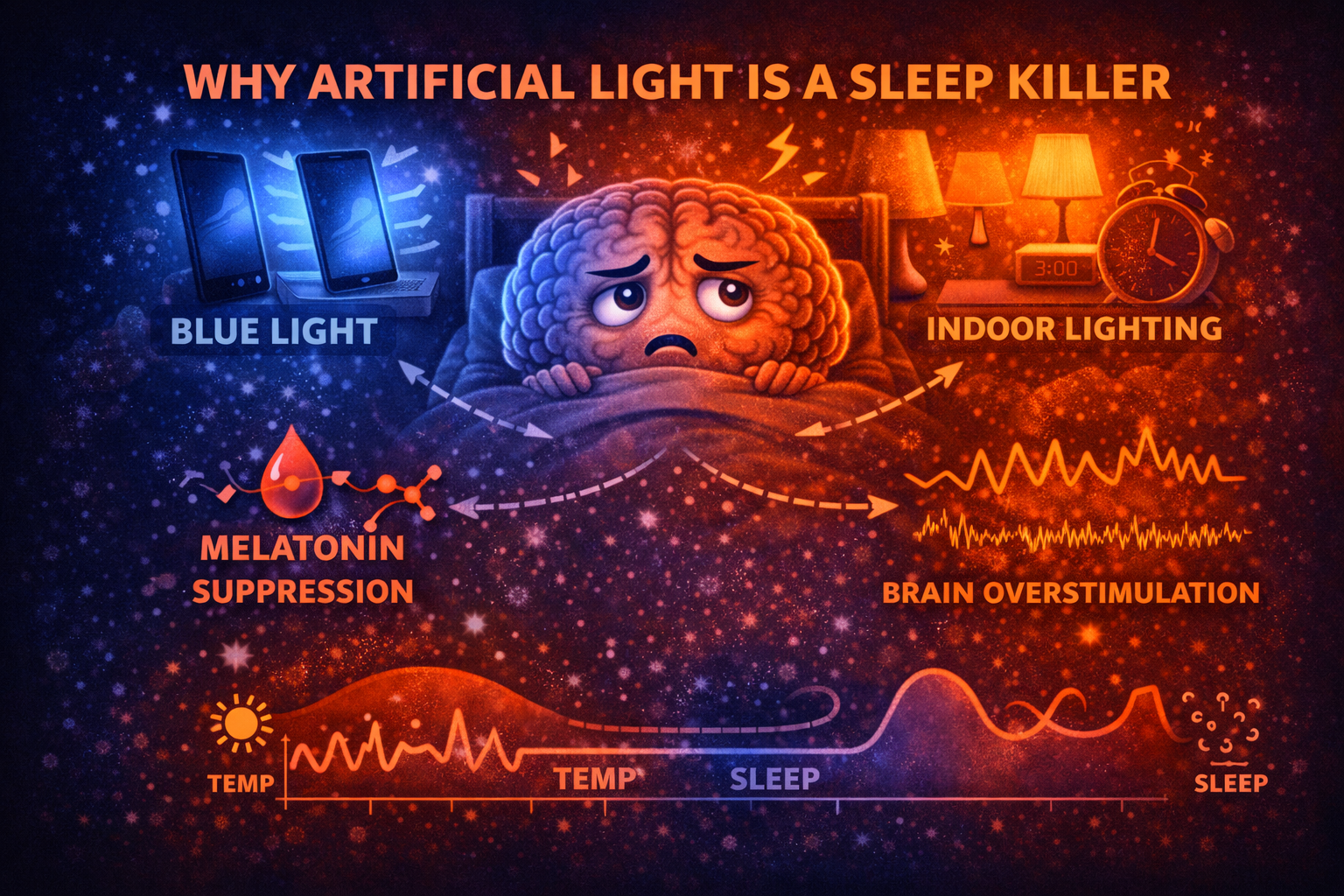
  • Why Artificial Light Is a Sleep Killer

    Why Artificial Light Is a Sleep Killer

    How modern lighting disrupts circadian timing and degrades sleep quality

    Artificial light has transformed modern life, allowing activity, work, and entertainment to continue long after sunset. While this has improved convenience, it has quietly disrupted one of the most important biological systems regulating sleep.

    The human brain evolved under conditions of bright daylight and near-total darkness at night. Artificial light breaks this pattern. When light is present at the wrong time, the brain delays sleep signals, weakens sleep depth, and reduces recovery—even when you feel physically tired.


    The Brain Interprets Artificial Light as Daytime

    The circadian system cannot distinguish natural from artificial light.

    Specialized cells in the eyes respond to light intensity and wavelength, not its source. When artificial light is present at night, the brain interprets it as extended daytime.

    This delays the transition into nighttime physiology.


    How Artificial Light Suppresses Melatonin

    Melatonin signals night to the body.

    As darkness increases, melatonin rises, promoting sleepiness and initiating recovery processes. Artificial light—especially white and blue-rich light—suppresses melatonin production.

    Even moderate evening light can delay melatonin release and push sleep later.


    Why Artificial Light Increases Nighttime Alertness

    Artificial light does more than block sleep hormones.

    It actively stimulates alerting systems in the brain, increasing reaction time, focus, and cognitive activity. This keeps the brain in a semi-awake state even when the body is exhausted.

    This mismatch explains why people often feel “wired but tired” at night.


    Artificial Light and Circadian Delay

    Exposure to light at night shifts the internal clock.

    The circadian rhythm gradually moves later, causing sleepiness to appear later and wake times to drift. Over time, this creates chronic misalignment between biological night and social schedules.

    Sleep becomes inconsistent and fragmented.


    Why Indoor Lighting Is Especially Disruptive

    Modern indoor lighting is poorly timed.

    During the day, indoor environments are often too dim to provide strong circadian signals. At night, indoor lighting is too bright and persistent.

    This reverses natural light cues and confuses the brain’s sense of time.


    Artificial Light and Reduced Sleep Depth

    Artificial light affects more than sleep onset.

    Delayed circadian timing reduces deep sleep and disrupts REM sleep. Sleep may be long but shallow, leading to unrefreshing rest.

    Recovery processes remain incomplete.


    Nighttime Light and Sleep Fragmentation

    Light exposure increases nighttime awakenings.

    Even brief exposure to artificial light during the night can partially activate the brain, increasing micro-awakenings and reducing sleep continuity.

    Fragmented sleep lowers overall sleep quality.


    Why Artificial Light Affects Mood and Stress

    Sleep disruption affects emotional regulation.

    By degrading sleep depth and timing, artificial light indirectly increases emotional reactivity, stress sensitivity, and mood instability.

    The effects accumulate gradually and often go unnoticed.


    Why Darkness Matters More Than Comfort

    Comfort alone does not guarantee sleep quality.

    A quiet, comfortable bed cannot compensate for constant light exposure. The brain requires darkness to fully shut down alert systems.

    Without darkness, sleep remains biologically incomplete.


    Reducing the Impact of Artificial Light

    Managing artificial light requires intention.

    Dimming lights in the evening, using warmer lighting, limiting screens, and reducing nighttime exposure help restore biological night signals.

    Consistency matters more than perfection.


    Why Artificial Light Is Hard to Escape

    Artificial light is everywhere.

    Streetlights, devices, household lighting, and ambient glow make true darkness rare. The brain is exposed to light far beyond what it evolved to handle.

    Recognizing this is the first step toward protecting sleep.


    The Core Idea to Remember

    Artificial light is a sleep killer because it sends the brain a daytime signal at night.

    By suppressing melatonin, increasing alertness, and delaying circadian timing, artificial light weakens sleep quality and recovery—even when sleep duration is adequate.

    Sleep improves not by forcing rest—but by restoring darkness where biology expects it.

  • The Role of Darkness in Sleep Quality

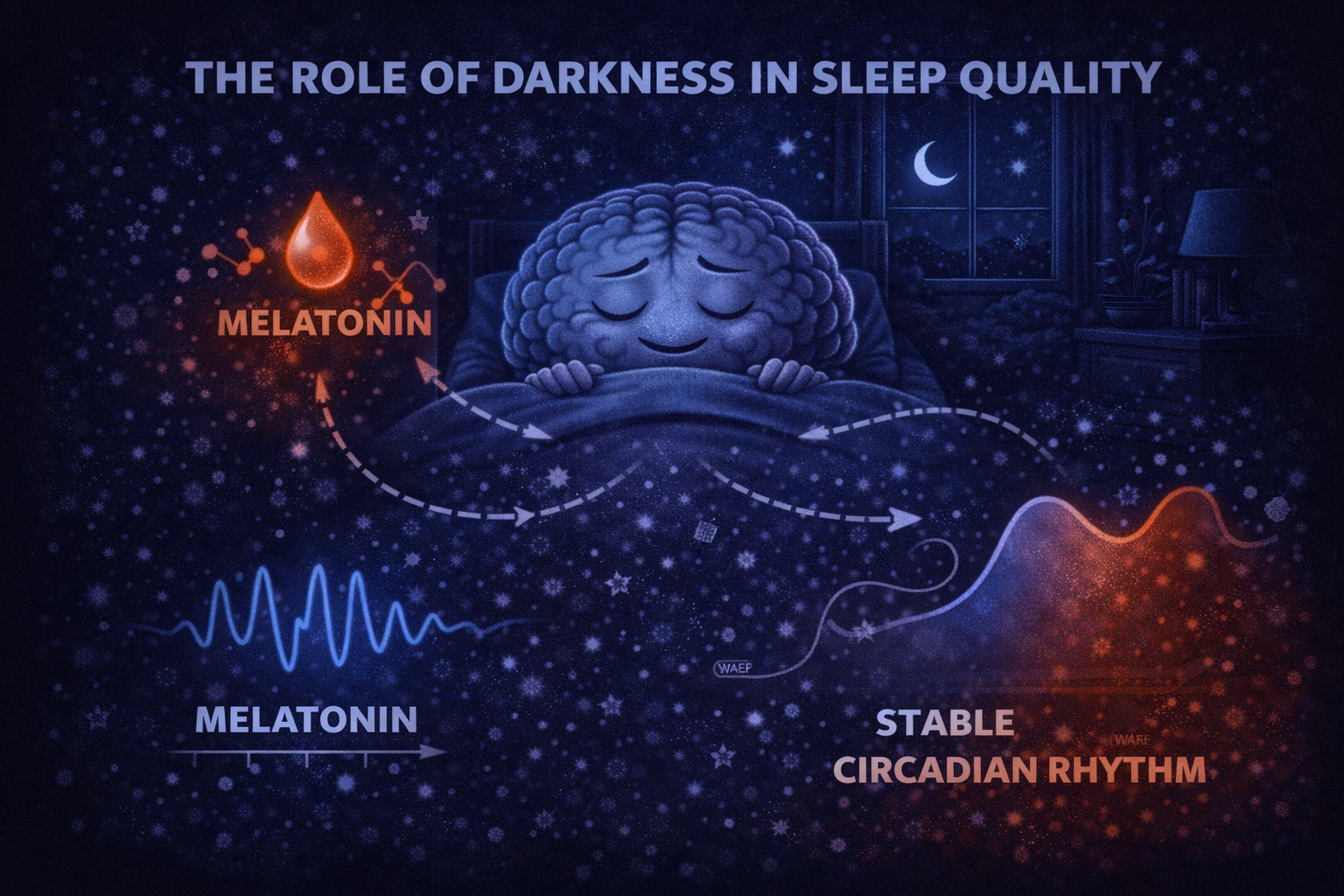
    The Role of Darkness in Sleep Quality

    Why darkness determines how deeply and restoratively you sleep

    Sleep quality is often blamed on stress, noise, or sleep duration. While these factors matter, one of the most overlooked influences on sleep quality is darkness.

    Darkness does more than help you fall asleep. It determines how deeply you sleep, how stable your sleep cycles are, and how restored you feel the next day. When darkness is incomplete or inconsistent, sleep becomes lighter, more fragmented, and less restorative—even if total sleep time seems adequate.


    Sleep Quality Depends on Clear Nighttime Signals

    The brain needs certainty to sleep well.

    Sleep quality improves when the brain receives a clear, unambiguous signal that night has arrived. Darkness provides this signal by telling the brain to fully shift into recovery mode.

    When light remains present, the brain hesitates. Sleep still happens, but it is less efficient.


    How Darkness Supports Melatonin Stability

    Melatonin is central to sleep quality.

    Darkness allows melatonin levels to rise steadily and remain elevated throughout the night. This stable melatonin signal supports continuous sleep and proper cycling through sleep stages.

    When darkness is interrupted, melatonin production fluctuates, weakening sleep depth and continuity.


    Darkness and Sleep Depth

    Deep sleep depends on environmental signals.

    In darkness, the brain is more likely to enter and maintain deep sleep stages. These stages are responsible for physical recovery, immune support, and neural restoration.

    Exposure to light during the night reduces time spent in deep sleep, making rest feel shallow.


    REM Sleep and Darkness

    REM sleep is sensitive to light disruption.

    Darkness supports stable REM sleep cycles by maintaining circadian alignment and reducing nighttime alertness. When light exposure occurs at night, REM sleep becomes fragmented or shortened.

    Poor REM sleep reduces emotional processing and mental clarity.


    Why Even Low Light Can Reduce Sleep Quality

    The circadian system is highly sensitive.

    Dim light sources—night lights, hallway lighting, electronic indicators—can still interfere with nighttime signaling. The brain does not require bright light to detect disruption.

    Small amounts of light can reduce sleep efficiency over time.


    Darkness and Sleep Continuity

    Quality sleep requires continuity.

    Darkness reduces micro-awakenings and nighttime alertness. When light intrudes, the brain partially reactivates, increasing the likelihood of fragmented sleep.

    Sleep becomes lighter and more easily disturbed.


    How Darkness Reduces Nighttime Arousal

    Darkness quiets alerting systems.

    Heart rate slows, stress signaling decreases, and the nervous system shifts into recovery mode. This physiological downregulation allows sleep to deepen naturally.

    Light exposure prevents full shutdown, keeping the body partially alert.


    Modern Environments and Poor Darkness

    Modern life weakens natural darkness.

    Streetlights, indoor lighting, screens, and ambient glow keep nighttime light levels higher than biology expects. This constant exposure degrades sleep quality gradually.

    People often adapt without realizing sleep depth is declining.


    Why Darkness Matters More Than Sleep Duration

    Long sleep does not guarantee quality sleep.

    Without proper darkness, sleep can be long but inefficient. Deep and REM sleep suffer, and recovery remains incomplete.

    Darkness determines how effectively sleep performs its function.


    Improving Sleep Quality by Improving Darkness

    Enhancing darkness improves sleep quality directly.

    Reducing evening light, eliminating nighttime light sources, and creating a darker sleep environment strengthen nighttime signaling and deepen sleep.

    Consistency is more important than perfection.


    Why Darkness Improves How You Feel the Next Day

    Restorative sleep depends on depth.

    When darkness supports deep and REM sleep, the brain completes recovery processes. Energy, mood, and clarity improve without extra effort.

    Darkness allows sleep to do its work fully.


    The Core Idea to Remember

    Darkness plays a central role in sleep quality by supporting depth, continuity, and recovery.

    By stabilizing melatonin, reducing alertness, and reinforcing circadian timing, darkness allows sleep to become truly restorative. Without it, sleep becomes lighter and less effective.

    Improving sleep quality often starts by improving darkness.

  • How Darkness Signals the Brain to Sleep

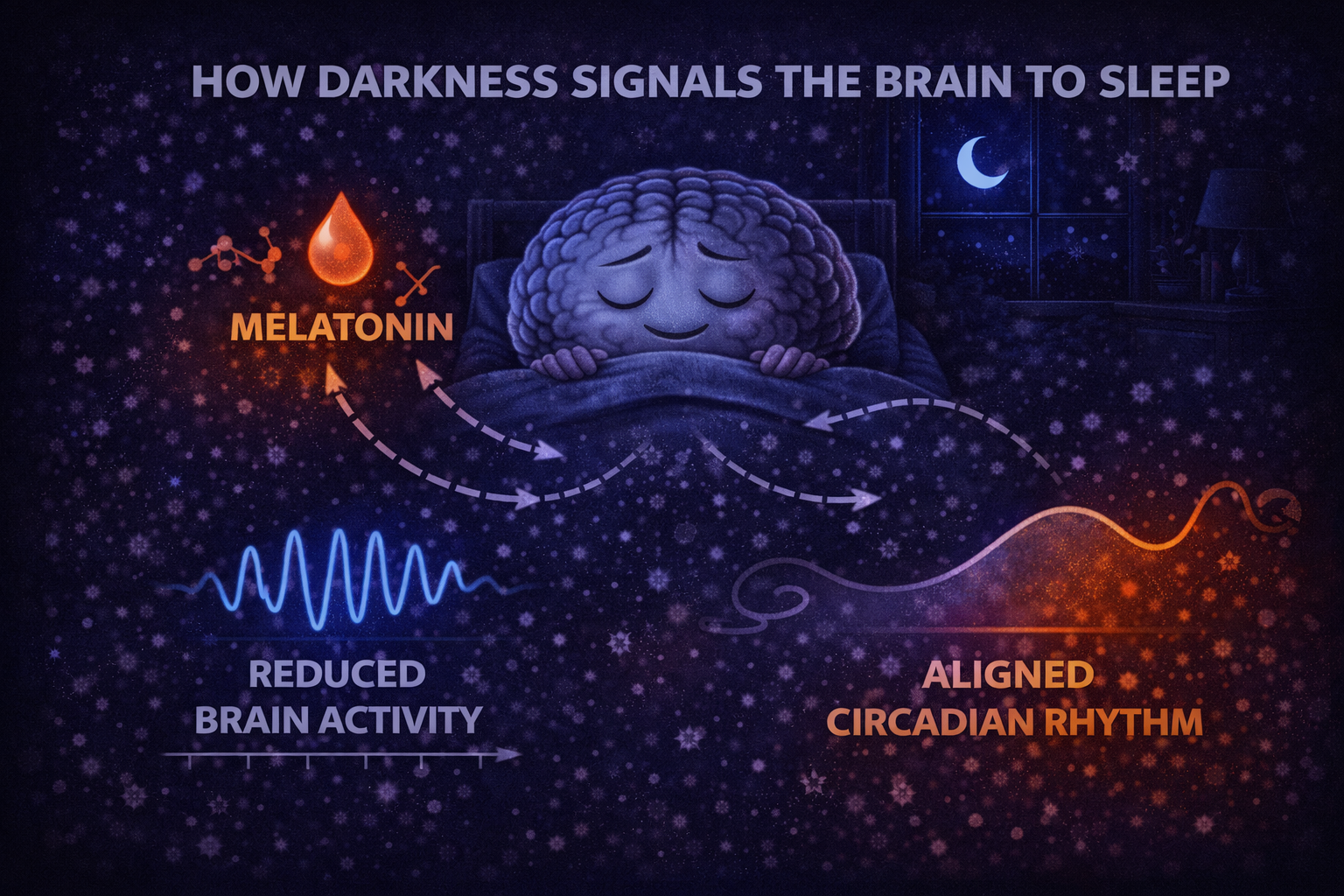
    How Darkness Signals the Brain to Sleep

    Why the absence of light actively triggers the body’s night mode

    Sleep does not start simply because the body is tired. It starts when the brain receives a clear biological signal that night has arrived. That signal is darkness.

    Darkness is not passive. It actively tells the brain to shut down alert systems, release sleep-promoting hormones, and shift the body into recovery mode. When darkness is delayed or incomplete, sleep timing and quality suffer—even if exhaustion is present.


    Darkness Is a Biological Signal, Not Just a Lack of Light

    The brain treats darkness as information.

    Specialized light-sensitive cells in the eyes continuously monitor ambient light levels. When light decreases, signaling to the brain’s internal clock changes. This shift tells the brain that daytime has ended.

    Darkness initiates a chain reaction that prepares the body for sleep.


    How Darkness Triggers Melatonin Release

    Melatonin is the hormone of night.

    As darkness increases, melatonin production rises. This hormone signals sleepiness, lowers body temperature, and coordinates nighttime physiology.

    Without sufficient darkness, melatonin release is delayed or suppressed, making sleep harder to initiate.


    Darkness and the Circadian Clock

    The circadian rhythm relies on contrast.

    Bright light during the day and darkness at night create a clear day–night pattern. Darkness anchors the nighttime phase of this rhythm.

    When darkness is weak or inconsistent, circadian timing becomes unstable, leading to delayed sleep and fragmented rest.


    Why Even Dim Light Can Disrupt the Signal

    The circadian system is highly sensitive.

    Low levels of light in the evening—especially blue or white light—can weaken the darkness signal. The brain interprets this as extended daytime.

    As a result, alertness remains elevated and sleep onset is delayed.


    Darkness and Sleep Depth

    Darkness affects more than sleep onset.

    Proper darkness supports deeper sleep stages, including deep sleep and REM sleep. When darkness is incomplete, sleep may feel lighter and less restorative.

    Sleep duration may be adequate, but quality declines.


    How Darkness Reduces Nighttime Alertness

    Alertness systems depend on light.

    In darkness, neural alerting systems quiet down. Heart rate slows, stress signaling decreases, and the brain shifts into recovery mode.

    Light exposure at night prevents this shutdown, keeping the brain partially alert.


    Why Modern Environments Reduce Darkness

    Modern life minimizes natural darkness.

    Streetlights, indoor lighting, screens, and ambient glow keep light levels elevated well into the night. This blurs the boundary between day and night.

    The brain struggles to identify when sleep should begin.


    Darkness and Emotional Regulation

    Darkness supports emotional recovery.

    By enabling melatonin release and proper sleep architecture, darkness indirectly improves emotional regulation, stress recovery, and mood stability.

    Poor darkness contributes to emotional reactivity and mental fatigue.


    Why Total Darkness Is Not Always Necessary

    The goal is clarity, not perfection.

    The brain does not require absolute darkness, but it does require a clear reduction in light. Gradual dimming and consistency matter more than extreme measures.

    Biology responds to patterns, not absolutes.


    How to Strengthen the Darkness Signal

    Supporting darkness means reducing competing signals.

    Dimming lights, avoiding screens late at night, and minimizing ambient glow allow the brain to recognize nighttime properly.

    Consistency trains the circadian system to respond more effectively.


    Why Darkness Makes Falling Asleep Easier

    When darkness is clear, sleep feels natural.

    Sleepiness increases without effort, alertness fades, and the body transitions smoothly into rest. This reflects proper biological signaling rather than forced relaxation.

    Darkness tells the brain that it is safe to sleep.


    The Core Idea to Remember

    Darkness signals the brain to sleep by activating nighttime biology.

    By allowing melatonin to rise and alert systems to quiet down, darkness initiates sleep timing, depth, and recovery. Without sufficient darkness, the brain delays sleep even when tired.

    Sleep improves not by forcing rest—but by allowing darkness to do its job.

  • How to Reduce Light Exposure Before Bed

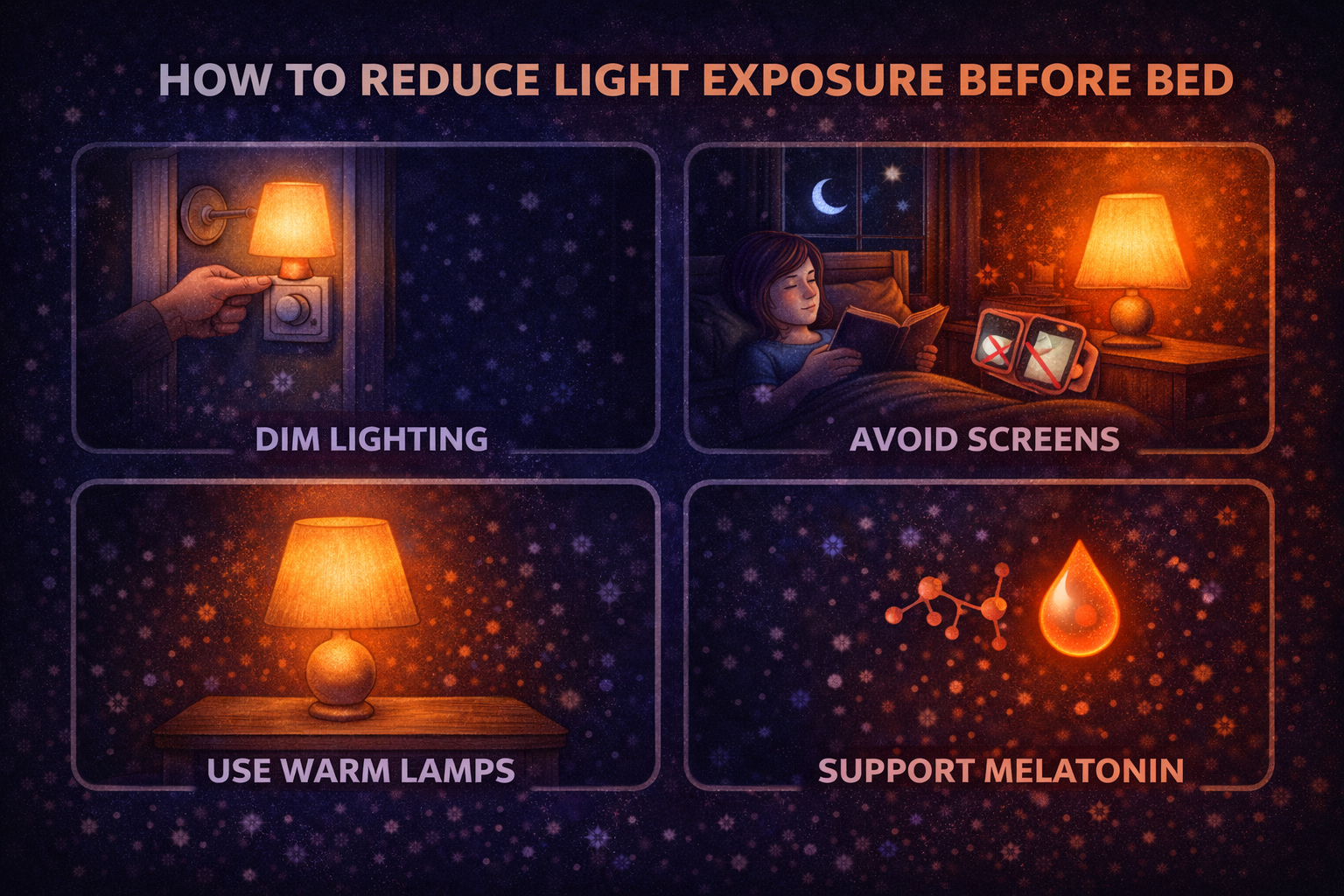
    How to Reduce Light Exposure Before Bed

    Practical ways to protect melatonin and prepare your brain for sleep

    Many sleep problems don’t begin at bedtime. They begin hours earlier, when light exposure quietly tells the brain to stay alert. By the time you try to sleep, the biological signals are already misaligned.

    Reducing light exposure before bed is one of the most effective, non-medical ways to improve sleep timing and quality. It doesn’t require extreme measures—only intentional changes that align evening light with biology.


    Why Evening Light Matters So Much

    Light is the brain’s strongest timing signal.

    As evening approaches, the brain expects light levels to fall. This drop allows melatonin to rise and initiates nighttime physiology. When light remains bright, the brain delays this transition.

    Reducing evening light is not about darkness all day—it’s about darkness at the right time.


    Start Reducing Light Earlier Than You Think

    Timing matters more than intensity alone.

    Reducing light exposure only at bedtime is often too late. The circadian system responds to cumulative light signals over several hours.

    Dimming lights 2–3 hours before bed is far more effective than sudden darkness right before sleep.


    Dim Indoor Lighting in the Evening

    Brightness signals alertness.

    Lowering overall room brightness in the evening tells the brain that night is approaching. This includes overhead lights, lamps, and decorative lighting.

    Using fewer light sources with softer intensity helps initiate the sleep transition.


    Use Warm, Low-Intensity Light Sources

    Color temperature affects melatonin.

    Warm light (amber, red, or soft yellow) interferes less with melatonin than cool white or blue light. Switching to warmer bulbs in the evening reduces circadian disruption.

    The goal is light that supports visibility without stimulating alertness.


    Limit Screen Exposure Before Bed

    Screens are concentrated light sources.

    Phones, tablets, computers, and televisions deliver bright, blue-rich light directly into the eyes. Reducing screen use in the evening significantly improves sleep readiness.

    When screens are unavoidable, shorter exposure and earlier cutoffs matter more than filters alone.


    Lower Screen Brightness and Use Night Modes

    Brightness amplifies disruption.

    Reducing screen brightness and enabling night modes lowers the alerting signal sent to the brain. While not a complete solution, these steps reduce harm when screens are used.

    Behavior still matters more than settings.


    Avoid Overhead Lighting at Night

    Overhead lights mimic daytime conditions.

    Turning off ceiling lights and relying on localized, low-level lighting reduces the brain’s perception of daytime. This supports melatonin release and relaxation.

    Smaller light sources create a more sleep-friendly environment.


    Create a “Light Curfew” Routine

    Consistency trains the brain.

    Establishing a routine where lights are dimmed at the same time each evening helps stabilize circadian timing. Over time, sleepiness begins to appear more naturally.

    Routine reduces the need for conscious effort.


    Use Darkness as a Signal, Not an Obstacle

    Darkness is biologically meaningful.

    As light fades, the brain shifts into night mode. Allowing this transition supports sleep onset, depth, and emotional regulation.

    Darkness is not the absence of activity—it is an active signal for sleep.


    Be Careful With Late-Night Bright Environments

    Light exposure outside the home counts.

    Bright stores, gyms, offices, and street lighting can delay sleep when encountered late at night. Being mindful of late-evening environments helps protect sleep timing.

    Even short exposures can shift circadian signals.


    Why Small Changes Make a Big Difference

    The circadian system is sensitive.

    You don’t need perfect darkness or extreme measures. Gradual, consistent reductions in evening light exposure are enough to improve sleep over time.

    Biology responds to patterns, not perfection.


    The Core Idea to Remember

    Reducing light exposure before bed helps the brain transition into sleep mode.

    By dimming lights, limiting screens, and prioritizing darkness at the right time, melatonin rises naturally and sleep becomes easier.

    Sleep improves not by forcing rest—but by removing the signals that keep the brain awake.

  • Does Blue Light Blocking Really Work?

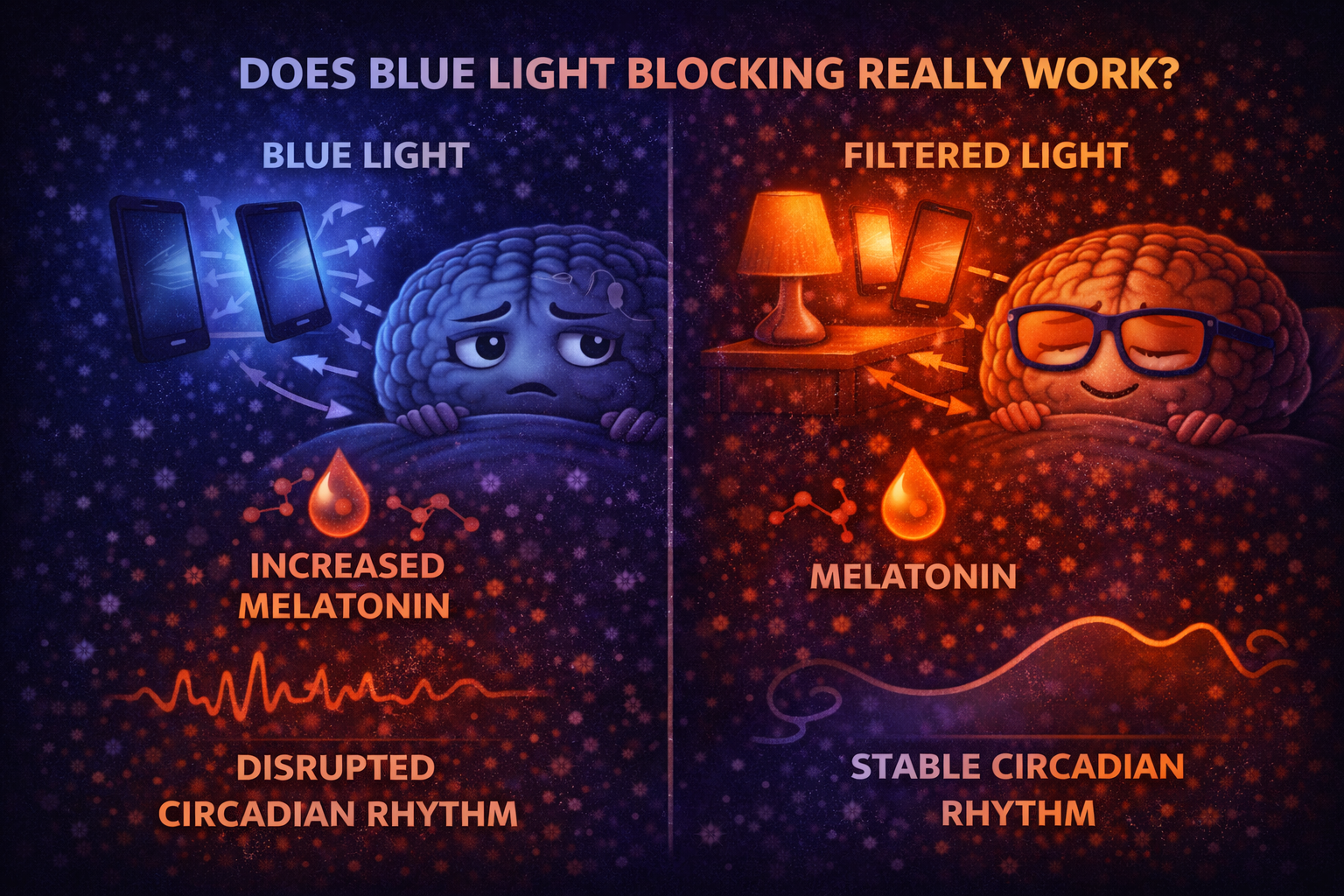
    Does Blue Light Blocking Really Work?

    What blue light blocking can and cannot do for your sleep

    Blue light blocking glasses, screen filters, and “night mode” settings are widely promoted as simple solutions for sleep problems. Many people use them hoping to fall asleep faster and sleep more deeply.

    But the reality is more nuanced. Blue light blocking can help—but it is not a complete fix. Its effectiveness depends on timing, behavior, and expectations. Understanding what blue light blocking actually does clarifies when it works and when it doesn’t.


    Why Blue Light Blocking Exists

    Blue light delays sleep by signaling daytime to the brain.

    Blocking blue wavelengths reduces melatonin suppression and limits circadian delay. This is the biological rationale behind blue light blocking tools.

    They are designed to weaken one specific signal—not to replace healthy sleep habits.


    What Blue Light Blocking Does Well

    Blue light blocking reduces one major disruptor.

    By filtering blue wavelengths, these tools decrease the alerting signal sent to the brain in the evening. This can support earlier melatonin release and make sleepiness feel more natural.

    For people exposed to screens at night, this reduction can be meaningful.


    Why Blue Light Blocking Is Not a Complete Solution

    Blocking blue light does not eliminate alertness.

    Brightness, screen content, mental stimulation, and timing still affect sleep. Even filtered light can delay sleep if exposure is long or intense.

    The brain responds to more than just wavelength.


    Screens Still Stimulate the Brain

    Visual content matters.

    Reading messages, watching videos, or engaging emotionally activates cognitive and emotional systems regardless of light color. This stimulation delays sleep independently of blue light.

    Blue light blocking does not prevent mental arousal.


    How Effective Are Blue Light Blocking Glasses?

    Glasses can reduce circadian disruption—but with limits.

    They are most helpful when worn consistently in the evening and combined with dim lighting. Their effect is smaller if screens are used intensively late at night.

    They work best as a support, not a solution.


    What About Screen Night Modes and Filters?

    Software filters help—but partially.

    Night modes reduce blue wavelengths but often maintain brightness and contrast. This still stimulates the visual system and the brain.

    Reducing screen time matters more than adjusting screen color alone.


    Why Timing Matters More Than Filtering

    Light timing is more important than light filtering.

    Blocking blue light late at night helps less than reducing exposure earlier in the evening. Prolonged exposure—even filtered—can still delay sleep.

    The circadian system responds to cumulative signals.


    Blue Light Blocking and Sleep Quality

    Blue light blocking mainly affects sleep timing.

    It may help you fall asleep earlier but does not guarantee deeper sleep. Sleep depth depends on overall circadian alignment, stress levels, and sleep continuity.

    Blocking blue light improves conditions—but doesn’t replace biology.


    When Blue Light Blocking Is Most Useful

    It works best when:

    • evening screen use is unavoidable

    • lighting is already dim

    • bedtime is consistent

    • exposure time is limited

    In these conditions, blue light blocking can meaningfully support sleep.


    When Blue Light Blocking Has Little Effect

    It helps less when:

    • screens are used intensively late at night

    • lighting is bright

    • sleep timing is irregular

    • stress and arousal remain high

    In these cases, behavior matters more than filtering.


    The Bigger Picture: Light Management

    Blue light is only part of the story.

    Sleep improves when light exposure is aligned across the entire day—bright mornings, dim evenings, consistent timing.

    Blocking blue light without managing overall light habits has limited impact.


    The Core Idea to Remember

    Blue light blocking works—but only within limits.

    It can reduce melatonin suppression and support earlier sleep onset, but it does not eliminate alertness, stimulation, or poor sleep habits.

    Blue light blocking is a tool—not a cure. Sleep improves most when light exposure, timing, and behavior work together.

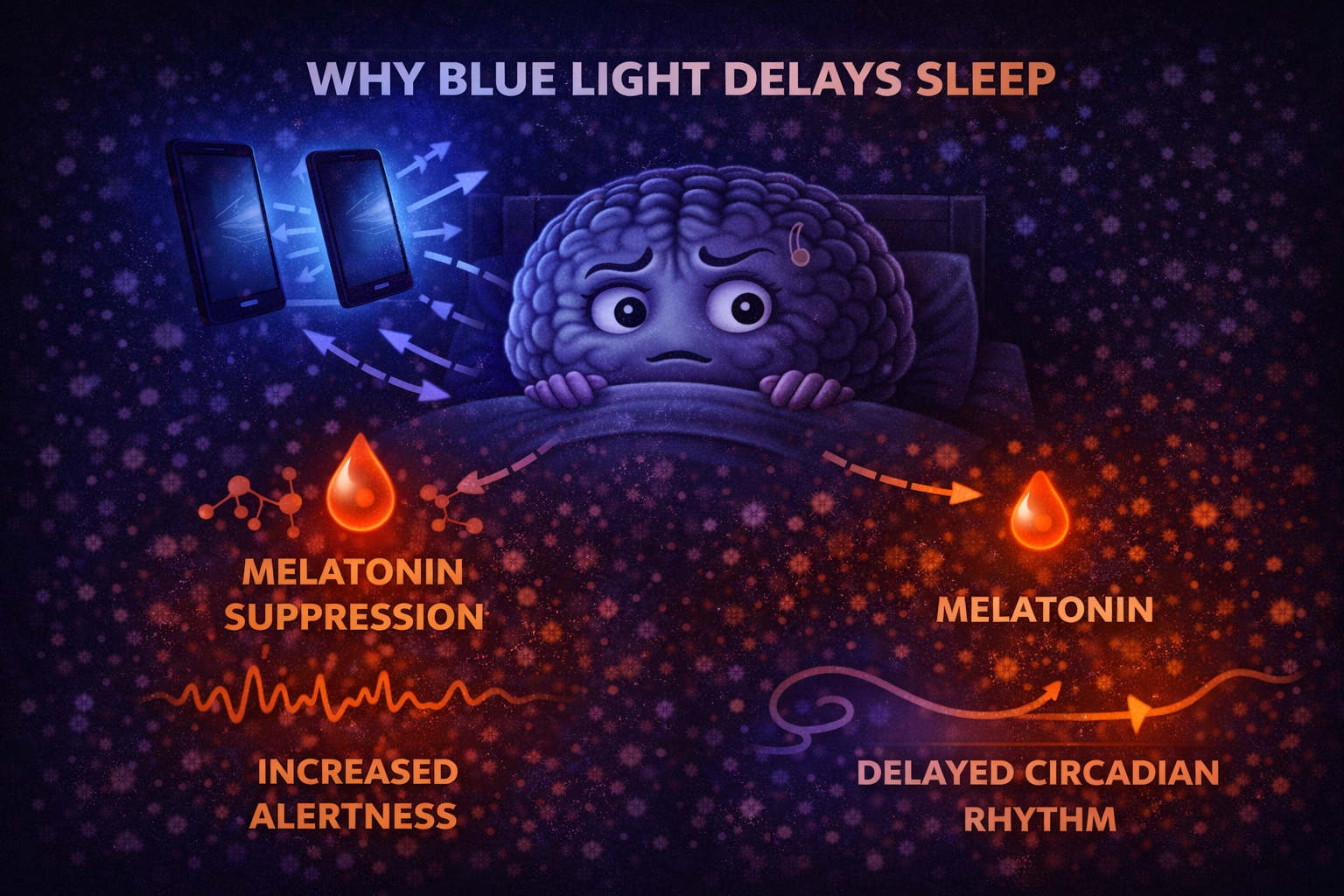
  • Why Blue Light Delays Sleep

    Why Blue Light Delays Sleep

    How artificial light at night interferes with melatonin and sleep timing

    Many people struggle to fall asleep even when they feel tired. They go to bed on time, turn off the lights, and still lie awake. Often, the cause isn’t stress or lack of discipline — it’s light exposure earlier in the evening.

    Blue light is one of the strongest signals affecting the brain’s sleep system. In modern environments, exposure to blue light at night delays sleep onset, disrupts circadian timing, and weakens sleep quality, even when total sleep time seems adequate.


    The Brain Uses Light to Decide When to Sleep

    Sleep timing is regulated by the circadian rhythm.

    The brain relies on light signals from the eyes to determine whether it is day or night. When light is detected, the brain increases alertness. When light fades, it prepares the body for sleep.

    Blue light sends a particularly strong “daytime” signal.


    Why Blue Light Is More Disruptive Than Other Light

    Not all light affects sleep equally.

    Blue wavelengths strongly activate specialized light-sensitive cells in the eyes that communicate directly with the brain’s internal clock. These cells evolved to respond to daylight, which is rich in blue light.

    When blue light appears at night, the brain interprets it as extended daytime.


    Blue Light and Melatonin Suppression

    Melatonin is the hormone that signals night.

    As darkness increases, melatonin rises, promoting sleepiness and initiating nighttime physiology. Blue light suppresses melatonin production more powerfully than other wavelengths.

    Even brief evening exposure can delay melatonin release and push sleep timing later.


    Why Screens Are Especially Problematic

    Screens emit concentrated blue light.

    Phones, tablets, computers, and televisions deliver blue wavelengths directly into the eyes at close range. This exposure is intense and sustained, making it especially disruptive in the evening.

    Using screens close to bedtime delays sleep onset even if brightness is reduced.


    Blue Light and Increased Alertness

    Blue light does more than suppress melatonin.

    It actively increases alertness, reaction time, and cognitive stimulation. This makes the brain feel “wired” even when the body is tired.

    This mismatch explains why people often feel exhausted yet unable to fall asleep.


    How Blue Light Shifts the Circadian Clock

    Evening blue light delays circadian timing.

    The internal clock shifts later, causing sleepiness to appear later at night and wake time to drift later in the morning. Over time, this creates chronic misalignment.

    This shift occurs even without conscious awareness.


    Blue Light and Sleep Depth

    Delayed sleep timing affects sleep structure.

    When sleep is pushed later, the proportion of deep sleep and REM sleep can be reduced or fragmented. Sleep may feel long but unrefreshing.

    Quality declines even when quantity remains unchanged.


    Why Indoor Lighting Adds to the Problem

    Modern lighting extends exposure.

    LED lighting used in homes and public spaces often contains blue wavelengths. Bright indoor lighting in the evening reinforces the signal that it is still daytime.

    This prolongs alertness beyond biological night.


    Do Blue Light Filters Fully Solve the Problem?

    Filters help, but they are not enough.

    Blue light filters and night modes reduce wavelength intensity but do not eliminate alerting effects. The brain still responds to light exposure, brightness, and stimulation.

    Reducing exposure time matters more than filtering alone.


    How to Minimize Blue Light Exposure at Night

    Managing blue light requires behavior.

    Dimming lights, using warmer lighting, limiting screen use before bed, and creating a darker evening environment allow melatonin to rise naturally.

    Consistency is more important than perfection.


    Why Darkness Matters More Than You Think

    Darkness is an active biological signal.

    As light disappears, the brain transitions into night mode. This transition supports sleep onset, depth, and emotional regulation.

    Protecting darkness protects sleep.


    The Core Idea to Remember

    Blue light delays sleep because it sends a powerful daytime signal to the brain.

    By suppressing melatonin, increasing alertness, and shifting circadian timing, blue light makes falling asleep harder and sleep less restorative.

    Sleep improves not by forcing rest — but by aligning light exposure with biology.

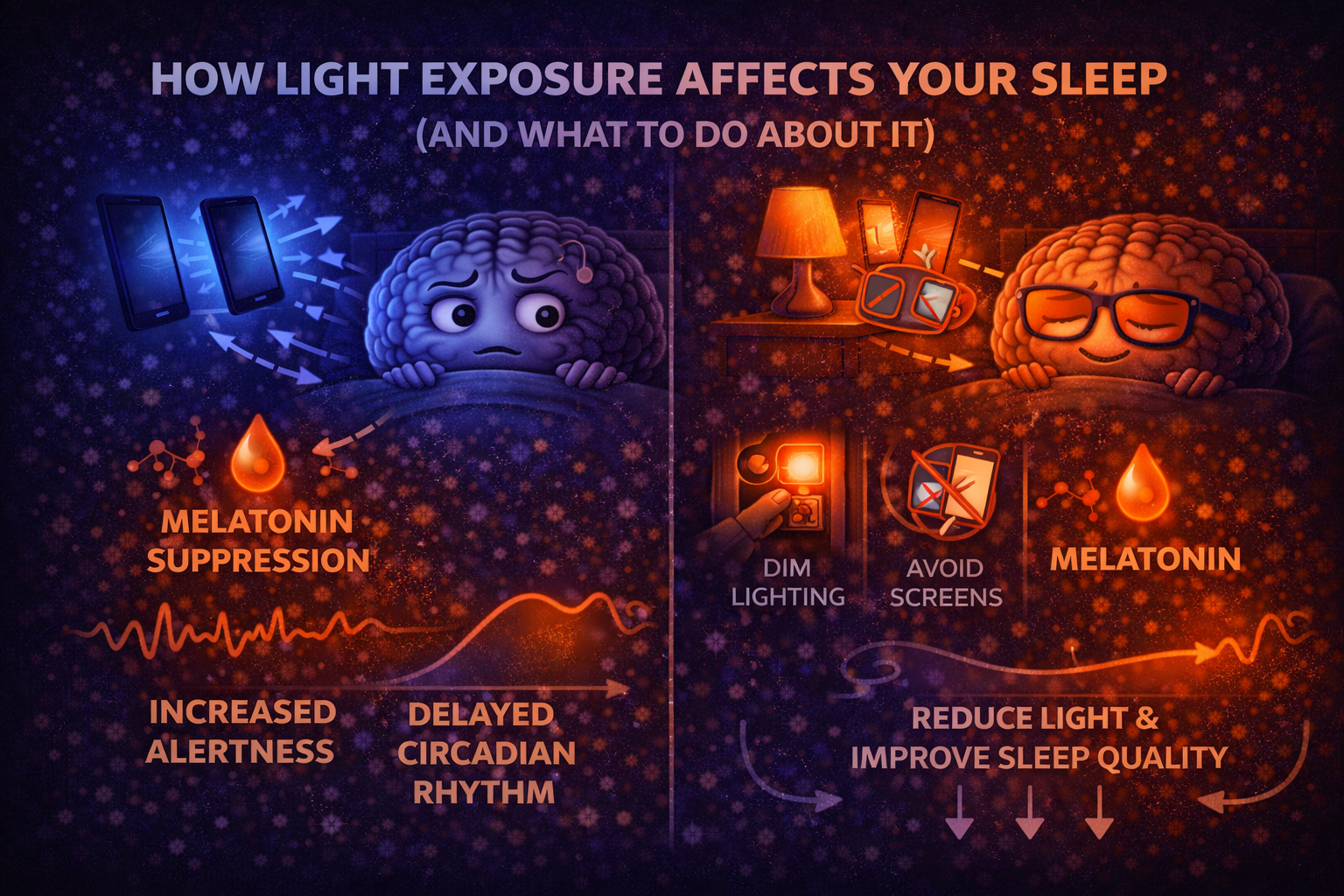
  • How Light Exposure Affects Your Sleep (And What to Do About It)

    How Light Exposure Affects Your Sleep (And What to Do About It)

    Why light is the strongest signal controlling your sleep–wake cycle

    Sleep is often treated as something that happens when the day ends. In reality, sleep is actively controlled by signals the brain receives long before bedtime. Among all of them, light is the most powerful.

    Light exposure determines when you feel alert, when you feel sleepy, and how deeply you sleep. Understanding how light affects sleep explains why modern environments make sleep harder—and what can be done to restore alignment.


    Light Is the Brain’s Primary Time Signal

    The brain uses light to tell time.

    Specialized cells in the eyes detect light and send timing signals directly to the brain’s central clock. This system evolved to synchronize the body with sunrise and sunset.

    When light exposure follows natural patterns, sleep timing feels effortless. When it doesn’t, sleep becomes fragmented and mistimed.


    How Morning Light Sets Your Sleep Schedule

    Morning light anchors your circadian rhythm.

    Exposure to bright light early in the day signals the brain that the day has begun. This timing cue starts the internal clock and determines when melatonin will be released later at night.

    Without sufficient morning light, the sleep schedule drifts later, making it harder to fall asleep at night.


    Why Evening Light Delays Sleep

    Evening light sends the wrong signal.

    Artificial light at night tells the brain that it is still daytime. This delays melatonin release, increases alertness, and shifts sleep timing later.

    The brighter and bluer the light, the stronger this delay becomes.


    Blue Light and Its Unique Impact on Sleep

    Blue light is especially disruptive.

    Screens, LED lighting, and modern devices emit high levels of blue light. This wavelength strongly suppresses melatonin and increases alertness.

    Even short exposure in the evening can delay sleep onset and reduce sleep quality.


    Light Exposure and Sleep Depth

    Light affects more than sleep timing.

    Improper light exposure reduces sleep depth and continuity. Fragmented sleep, reduced deep sleep, and disrupted REM sleep are common consequences of circadian misalignment caused by light.

    Sleep may feel long but unrefreshing.


    Why Indoor Living Confuses the Brain

    Modern light environments are unnatural.

    Indoor lighting during the day is often too dim, while evening lighting is too bright. This reverses natural light signals and confuses the circadian system.

    The brain struggles to distinguish day from night.


    How Irregular Light Exposure Disrupts Sleep Consistency

    Inconsistent light patterns prevent stabilization.

    When light exposure changes daily—late nights, screens, irregular schedules—the circadian rhythm cannot settle. Sleep timing becomes unpredictable.

    Consistency matters more than perfection.


    What to Do About Morning Light

    Prioritize early light exposure.

    Spending time outdoors in the morning or near a bright window helps anchor the circadian rhythm. Even on cloudy days, outdoor light is far stronger than indoor lighting.

    This single habit improves nighttime sleep quality.


    How to Reduce Harmful Evening Light

    Evening light should be minimized.

    Dimming lights, avoiding screens close to bedtime, and using warmer lighting reduces melatonin suppression. The goal is not darkness all day—but darkness at the right time.

    This allows the brain to prepare for sleep naturally.


    Do Blue Light Filters Actually Help?

    Blue light filters help—but only partially.

    They reduce the intensity of blue wavelengths but do not eliminate alerting effects entirely. Behavioral changes matter more than filters alone.

    Reducing exposure time is more effective than relying on software.


    Why Darkness Signals the Brain to Sleep

    Darkness is an active signal.

    As light fades, melatonin rises and the brain shifts into night mode. This transition supports sleep onset, depth, and emotional regulation.

    True darkness strengthens this signal.


    Long-Term Effects of Poor Light Management

    Chronic light misalignment accumulates.

    Over time, poor light exposure contributes to insomnia, fatigue, mood instability, and reduced cognitive performance. These effects develop gradually and are often overlooked.

    Correcting light exposure can reverse many of them.


    The Core Idea to Remember

    Light exposure controls sleep timing, depth, and quality.

    Morning light anchors the circadian rhythm. Evening light delays sleep and weakens recovery. Managing light is one of the most powerful, non-invasive ways to improve sleep.

    Sleep improves not when you force it—but when light cues are aligned with biology.


    Slug

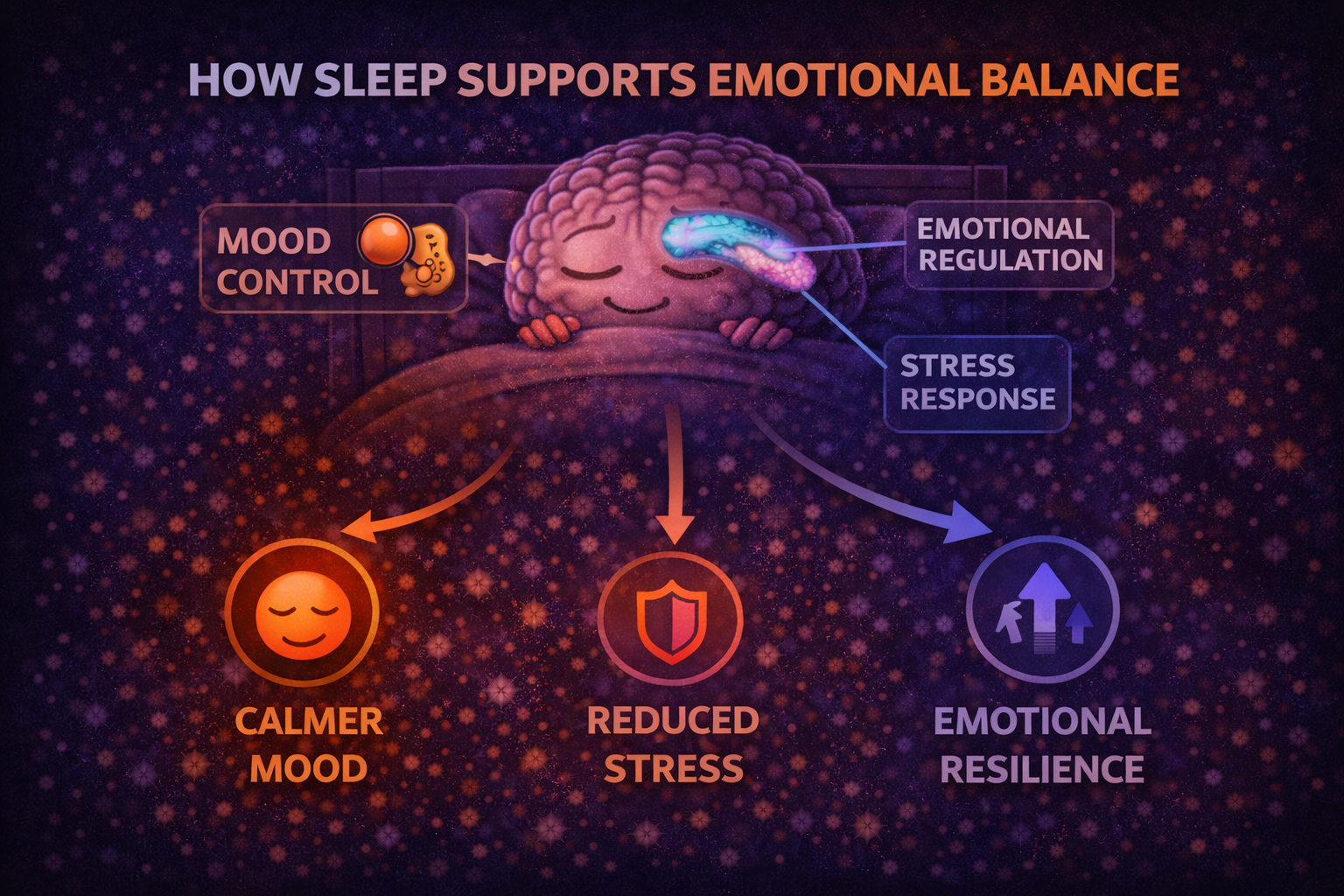
  • How Sleep Supports Emotional Balance

    How Sleep Supports Emotional Balance

    Why consistent sleep keeps emotions proportional, steady, and easier to manage

    Emotional balance is often mistaken for calmness or the absence of strong feelings. In reality, it’s the ability to experience emotions without being overwhelmed by them—and to return to baseline after stress.

    That ability depends heavily on sleep. When sleep is consistent and restorative, emotions remain proportional and recover quickly. When sleep is disrupted, emotional balance weakens, reactions intensify, and recovery slows. Sleep does not eliminate emotion—it stabilizes it.


    Emotional Balance Is a Regulatory State

    Emotional balance reflects how well the brain regulates emotion.

    Some brain systems generate emotional responses; others modulate intensity, context, and recovery. Balance emerges when these systems communicate efficiently.

    Sleep is the primary time when this communication is restored. Without sleep, regulation falters and emotions become harder to manage.


    How Sleep Resets Emotional Baselines

    Each day adds emotional load.

    During sleep, the brain lowers emotional sensitivity and resets baseline thresholds. This recalibration allows emotions to arise without tipping into overwhelm.

    Poor sleep leaves thresholds elevated, making emotions feel heavier the next day.


    Deep Sleep and Emotional Stability

    Deep sleep supports baseline emotional steadiness.

    During slow-wave sleep, neural noise decreases and core regulatory networks recover. This creates a calmer emotional baseline during waking hours.

    When deep sleep is reduced, emotional reactions become more volatile and less predictable.


    REM Sleep and Emotional Integration

    REM sleep is essential for emotional processing.

    During REM, emotional experiences are revisited in a low-stress chemical environment. This allows emotions to be integrated without retaining high emotional charge.

    Disrupted REM sleep leaves emotions unresolved, increasing reactivity and emotional spillover.


    Why Poor Sleep Disrupts Emotional Proportionality

    Sleep loss reduces proportionality.

    Minor stressors trigger outsized reactions because regulation capacity is depleted. Emotions escalate faster and settle more slowly.

    The stressor hasn’t changed—the brain’s ability to regulate it has.


    Sleep and Emotional Recovery Speed

    Balance depends on recovery speed.

    After emotional events, a well-rested brain returns to baseline quickly. Poor sleep slows this recovery, allowing emotions to linger and accumulate.

    Sleep determines how long emotions stay activated.


    Circadian Timing and Emotional Balance

    Emotional balance follows biological timing.

    Aligned sleep schedules support predictable regulation across the day. Irregular timing disrupts this rhythm, increasing emotional variability—even with adequate sleep duration.

    Timing matters as much as hours slept.


    Sleep Fragmentation and Emotional Drift

    Interrupted sleep undermines balance.

    Frequent awakenings prevent full emotional reset, leaving partial activation overnight. Over time, this leads to persistent tension and irritability.

    Fragmentation often harms balance more than short but continuous sleep.


    Why Effort Alone Can’t Create Balance

    Trying to “stay balanced” without sleep doesn’t work.

    Emotional regulation requires neural resources replenished during sleep. Without recovery, effort increases strain without restoring stability.

    Balance is biological before it is intentional.


    How Emotional Balance Returns After Good Sleep

    After high-quality sleep, balance often returns naturally.

    Emotions feel steadier, stress feels manageable, and perspective improves—without deliberate effort. This reflects restored regulation, not changes in circumstances.

    Sleep prepares the brain to regulate emotions before the day begins.


    The Core Idea to Remember

    Sleep supports emotional balance by restoring emotional regulation.

    Through deep sleep and REM sleep, the brain resets thresholds, integrates experiences, and improves recovery speed. Without sleep, balance weakens and emotions dominate.

    Emotional balance is not forced—it is rebuilt overnight by sleep.

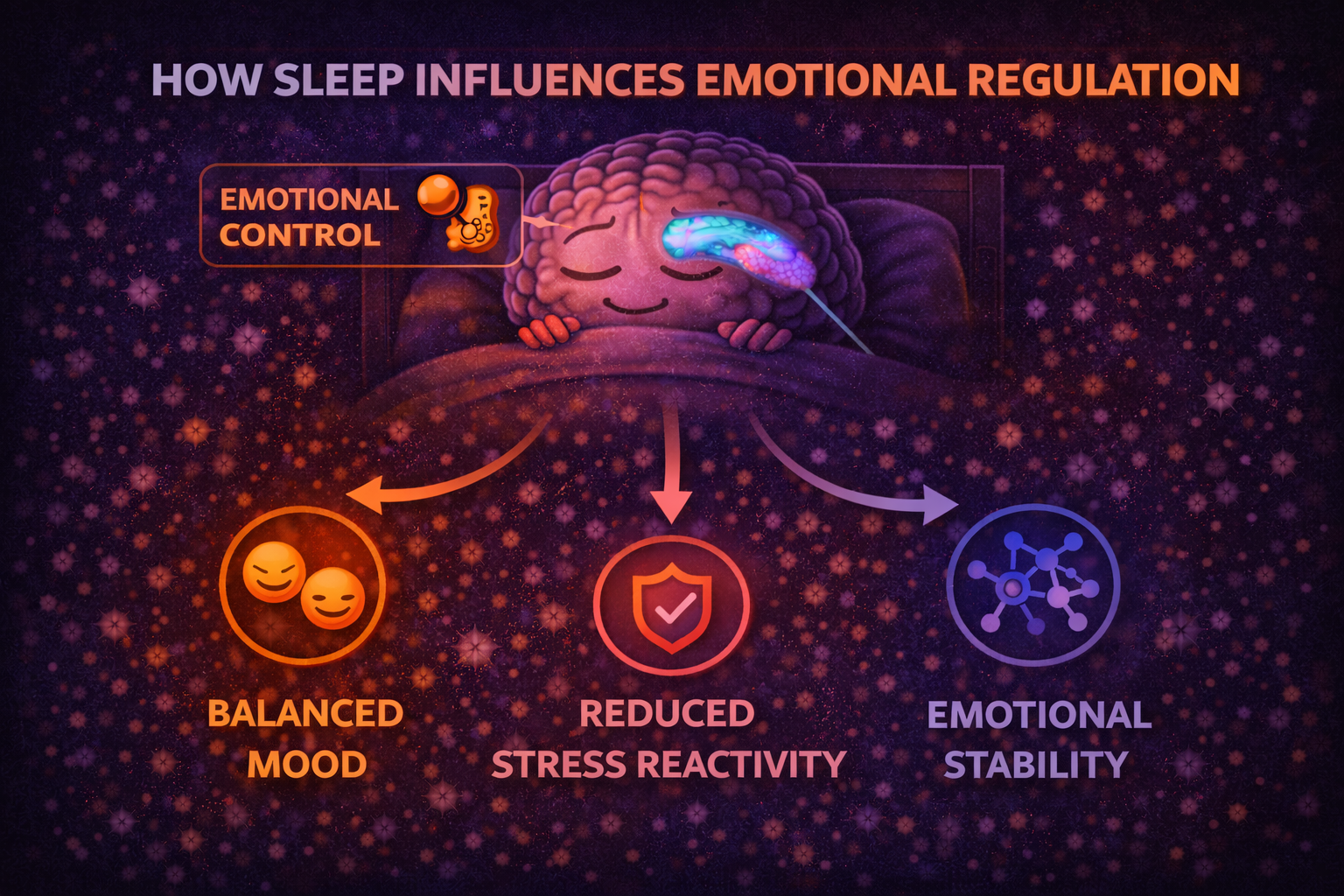
  • How Sleep Influences Emotional Regulation

    How Sleep Influences Emotional Regulation

    Why sleep determines how well the brain manages emotions and stress responses

    Emotional regulation is often framed as a skill — something that improves with awareness, effort, or practice. When emotions feel overwhelming or difficult to control, people tend to assume they need better coping strategies.

    But emotional regulation is not only psychological. It is deeply biological. The brain’s ability to manage emotions depends heavily on sleep. When sleep is disrupted, emotional regulation weakens. When sleep is consistent and restorative, emotional balance becomes far easier to maintain.


    Emotional Regulation Is a Brain Function

    Regulating emotions requires coordination.

    Some brain systems generate emotional responses, while others evaluate context, apply restraint, and reduce intensity. Emotional regulation depends on smooth communication between these systems.

    Sleep is the primary period when this coordination is restored. Without it, emotional responses become stronger and harder to modulate.


    How Sleep Resets Emotional Control Systems

    During sleep, emotional control systems recalibrate.

    Neural sensitivity decreases, stress signaling lowers, and regulatory circuits regain efficiency. This reset allows emotions to arise without overwhelming the system.

    Poor sleep leaves these control systems partially depleted, reducing emotional flexibility the next day.


    The Role of Deep Sleep in Regulation Stability

    Deep sleep supports baseline emotional stability.

    During slow-wave sleep, the brain reduces background noise and restores core regulatory networks. This creates a stable emotional baseline during waking hours.

    When deep sleep is reduced, emotional reactions become more volatile and less predictable.


    REM Sleep and Emotional Processing

    REM sleep plays a central role in emotional regulation.

    During REM, emotional experiences are processed in a low-stress neurochemical environment. This allows emotions to be integrated without retaining excessive emotional charge.

    Disrupted REM sleep leaves emotional experiences unresolved, increasing reactivity and emotional intensity.


    Why Poor Sleep Increases Emotional Reactivity

    Sleep deprivation amplifies emotional responses.

    Negative stimuli provoke stronger reactions, while positive experiences feel less rewarding. Emotional responses feel immediate and difficult to pause.

    This heightened reactivity reflects reduced regulatory capacity, not increased emotional sensitivity by choice.


    Sleep Loss and Reduced Emotional Insight

    Poor sleep impairs emotional awareness.

    The brain becomes less accurate at identifying internal emotional states and interpreting others’ emotions. This reduces empathy and increases misunderstandings.

    As a result, social interactions feel more emotionally draining.


    Why Emotions Feel Harder to Control When Tired

    Emotional control requires cognitive resources.

    Sleep restores the neural energy needed to pause, evaluate, and respond intentionally. Without sleep, emotions bypass regulation and feel automatic.

    This explains why emotional reactions are often regretted after poor sleep.


    Cumulative Effects of Chronic Sleep Disruption

    Emotional dysregulation compounds over time.

    Repeated nights of poor sleep weaken regulation, lower stress tolerance, and increase emotional fatigue. Over time, emotional instability becomes the baseline state.

    These changes are often misattributed to personality or mental health alone.


    Circadian Alignment and Emotional Balance

    Emotional regulation follows circadian timing.

    When sleep timing aligns with biological rhythms, emotional control is more consistent. Irregular schedules disrupt this timing, increasing emotional variability.

    Timing influences regulation as much as sleep duration.


    Why Emotional Regulation Improves After Good Sleep

    After high-quality sleep, emotional regulation feels natural.

    Reactions are more proportional, recovery is faster, and emotional clarity returns. This reflects restored regulation rather than changes in circumstances.

    Sleep prepares the brain to regulate emotions before the day begins.


    Why Effort Alone Cannot Replace Sleep

    Trying harder does not restore regulation.

    Emotional regulation requires biological recovery. Without sleep, effort increases strain without improving control.

    Sleep supports emotional regulation at its foundation.


    The Core Idea to Remember

    Sleep influences emotional regulation because it restores the brain’s ability to manage emotions.

    Through deep sleep and REM sleep, emotional control systems reset, reactivity decreases, and balance returns. Without sleep, emotional regulation weakens regardless of intention.

    Emotional regulation is not forced — it is supported overnight by sleep.