Tag: stress and sleep

  • How Noise Affects Sleep Quality

    How Noise Affects Sleep Quality

    Why sound exposure fragments sleep even when you don’t fully wake up

    Sleep quality is often judged by how long you sleep or how quickly you fall asleep. Noise is frequently overlooked—especially when it doesn’t fully wake you. Yet sound is one of the most powerful disruptors of sleep depth and continuity.

    The brain remains responsive to sound throughout the night. Even when you stay asleep, noise can trigger micro-arousals that fragment sleep, reduce deep and REM sleep, and leave you feeling unrefreshed the next day.


    The Sleeping Brain Never Fully Turns Off Hearing

    Hearing stays active during sleep.

    Unlike vision, the auditory system continues to monitor the environment for potential threats. This evolutionary feature increases safety—but it comes at a cost in modern environments.

    Noise keeps parts of the brain on alert, preventing full shutdown.


    How Noise Causes Micro-Arousals

    Most noise disruptions are invisible.

    Sounds don’t need to wake you fully to disrupt sleep. Brief increases in brain activity—called micro-arousals—pull the brain out of deeper sleep stages for seconds at a time.

    You may not remember waking up, but sleep quality still declines.


    Why Intermittent Noise Is Worse Than Constant Noise

    Irregular sounds are more disruptive.

    Sudden or unpredictable noises—traffic, voices, doors, notifications—trigger stronger brain responses than steady background noise.

    The brain cannot habituate to unpredictability, increasing fragmentation.


    Noise and Deep Sleep Reduction

    Deep sleep is highly sensitive to sound.

    Noise reduces the amount of time spent in slow-wave sleep, the stage responsible for physical recovery, immune function, and neural repair.

    Even small reductions in deep sleep impact how restored you feel.


    REM Sleep and Sound Sensitivity

    REM sleep is easily disrupted by noise.

    Because REM sleep involves higher brain activity, it is more vulnerable to auditory disturbances. Noise fragments REM cycles, reducing emotional processing and mental clarity.

    Poor REM sleep contributes to mood instability and cognitive fog.


    Why You Feel Tired After a Noisy Night

    Sleep duration can be misleading.

    You may sleep for many hours, yet feel exhausted because noise prevented sustained deep and REM sleep. Recovery processes were repeatedly interrupted.

    The problem isn’t how long you slept—it’s how continuously.


    Noise and Stress Activation

    Noise triggers stress responses.

    Sudden sounds increase heart rate, blood pressure, and stress signaling—even during sleep. Over time, this increases baseline stress and reduces resilience.

    Nighttime noise prevents full nervous system downregulation.


    Why the Brain Reacts to Familiar Sounds

    Familiar sounds still matter.

    Even noises you “get used to,” like traffic or appliances, can continue to trigger micro-arousals. The brain prioritizes safety over comfort.

    Habituation is often incomplete.


    Noise Timing Matters

    Noise early in the night affects sleep onset.

    Noise later in the night disrupts REM sleep and causes early awakenings. Both reduce sleep quality, but late-night noise often has stronger emotional effects.

    Timing influences which sleep stages are disrupted.


    Why Silence Isn’t Always the Solution

    Absolute silence can feel uncomfortable.

    In some cases, very quiet environments make the brain more sensitive to sudden sounds. This can increase reactivity rather than reduce it.

    The goal is sound stability, not total silence.


    How Consistent Background Noise Can Help

    Stable sound reduces contrast.

    Consistent background noise can mask sudden sounds, reducing micro-arousals. The brain adapts more easily to predictable auditory input.

    This explains why some people sleep better with steady background sound.


    Improving Sleep Quality by Managing Noise

    Protecting sleep from noise improves recovery.

    Reducing unpredictable sounds, improving sound insulation, and stabilizing the auditory environment help the brain remain in deeper sleep stages.

    Even small improvements increase sleep efficiency.


    The Core Idea to Remember

    Noise affects sleep quality by fragmenting sleep, not just waking you up.

    Through micro-arousals and stress activation, sound reduces deep and REM sleep even when you remain asleep. Sleep becomes lighter and less restorative.

    Better sleep quality often comes from quieter—or more stable—nights, not longer ones.

  • Why Sleep Loss Amplifies Negative Emotions

    Why Sleep Loss Amplifies Negative Emotions

    How insufficient sleep intensifies emotional reactions and weakens regulation

    After a poor night of sleep, emotions often feel sharper and harder to manage. Minor frustrations trigger outsized reactions, stress feels heavier, and negative thoughts linger longer than they should.

    This shift is not a change in personality or attitude. It is a biological consequence of sleep loss. When sleep is insufficient, the brain’s emotional systems become more reactive while the systems that regulate and calm emotions lose efficiency. The result is an amplification of negative emotional experience.


    Emotional Regulation Depends on Brain Balance

    Emotions are controlled by a balance between reactive and regulatory brain systems.

    Some regions generate emotional responses, while others evaluate context, apply restraint, and reduce intensity. Emotional stability depends on coordination between these systems.

    Sleep is essential for maintaining this balance. When sleep is disrupted, emotional reactivity increases while control weakens.


    How Sleep Restores Emotional Control

    During sleep, the brain recalibrates emotional thresholds.

    Stress signaling decreases, neural sensitivity is reduced, and emotional circuits reset. This overnight regulation allows emotions to rise and fall without becoming overwhelming.

    Without adequate sleep, this recalibration remains incomplete.


    Sleep Loss and Heightened Emotional Reactivity

    One of the earliest effects of sleep deprivation is increased emotional reactivity.

    Negative stimuli provoke stronger responses, while positive experiences feel muted. The brain becomes more sensitive to perceived threats, criticism, or uncertainty.

    This explains why irritability, anxiety, and low mood intensify after poor sleep.


    Why Negative Emotions Dominate After Poor Sleep

    Sleep loss creates a negative emotional bias.

    The brain prioritizes negative information and memories, while positive emotional processing weakens. As a result, the world feels more stressful and less rewarding — even when circumstances have not changed.

    This bias is biological, not intentional.


    The Role of REM Sleep in Emotional Processing

    REM sleep plays a key role in emotional integration.

    During REM sleep, emotional experiences are processed in a low-stress chemical environment. This allows emotional memories to be stored without retaining high emotional charge.

    When REM sleep is reduced, emotions remain raw and reactive the next day.


    Deep Sleep and Emotional Stability

    Deep sleep supports emotional baseline stability.

    It restores core regulatory networks and reduces background neural noise. This creates a calmer emotional baseline during waking hours.

    Reduced deep sleep lowers emotional resilience and increases volatility.


    Why Small Stressors Feel Bigger When Sleep-Deprived

    Sleep deprivation lowers emotional tolerance.

    With fewer regulatory resources available, small challenges consume disproportionate emotional energy. What feels manageable when rested feels overwhelming when tired.

    The problem is not increased stress — it is reduced regulation.


    Sleep Loss and Reduced Emotional Insight

    Poor sleep impairs emotional awareness.

    The brain becomes less accurate at interpreting both internal emotional states and the emotions of others. Empathy declines, misunderstandings increase, and social interactions feel more draining.

    These effects contribute to emotional friction.


    Cumulative Effects of Repeated Sleep Loss

    Emotional amplification accumulates over time.

    Repeated nights of poor sleep reinforce negative bias and reduce recovery between stressors. Emotional fatigue builds even in the absence of major stress.

    This cumulative effect increases vulnerability to anxiety, burnout, and mood instability.


    Why Effort Alone Can’t Control Emotions Without Sleep

    Trying harder to control emotions does not restore regulation.

    Emotional control requires neural resources that are replenished during sleep. Without recovery, effort increases strain without improving stability.

    Sleep restores the capacity for emotional regulation.


    Why Emotional Balance Returns After Good Sleep

    After sufficient sleep, emotional balance often returns naturally.

    Reactions feel more proportional, stress feels manageable, and negative emotions lose intensity. This reflects restored regulation rather than changes in circumstances.

    Sleep gives the brain the stability it needs to regulate emotions.


    The Core Idea to Remember

    Sleep loss amplifies negative emotions because it disrupts emotional regulation.

    Without sleep, emotional systems become more reactive while control mechanisms weaken. Negative experiences feel stronger, more persistent, and harder to manage.

    Emotional balance is not forced — it is restored overnight when the brain is allowed to recover.

  • Why Your Mood Depends on Sleep Quality

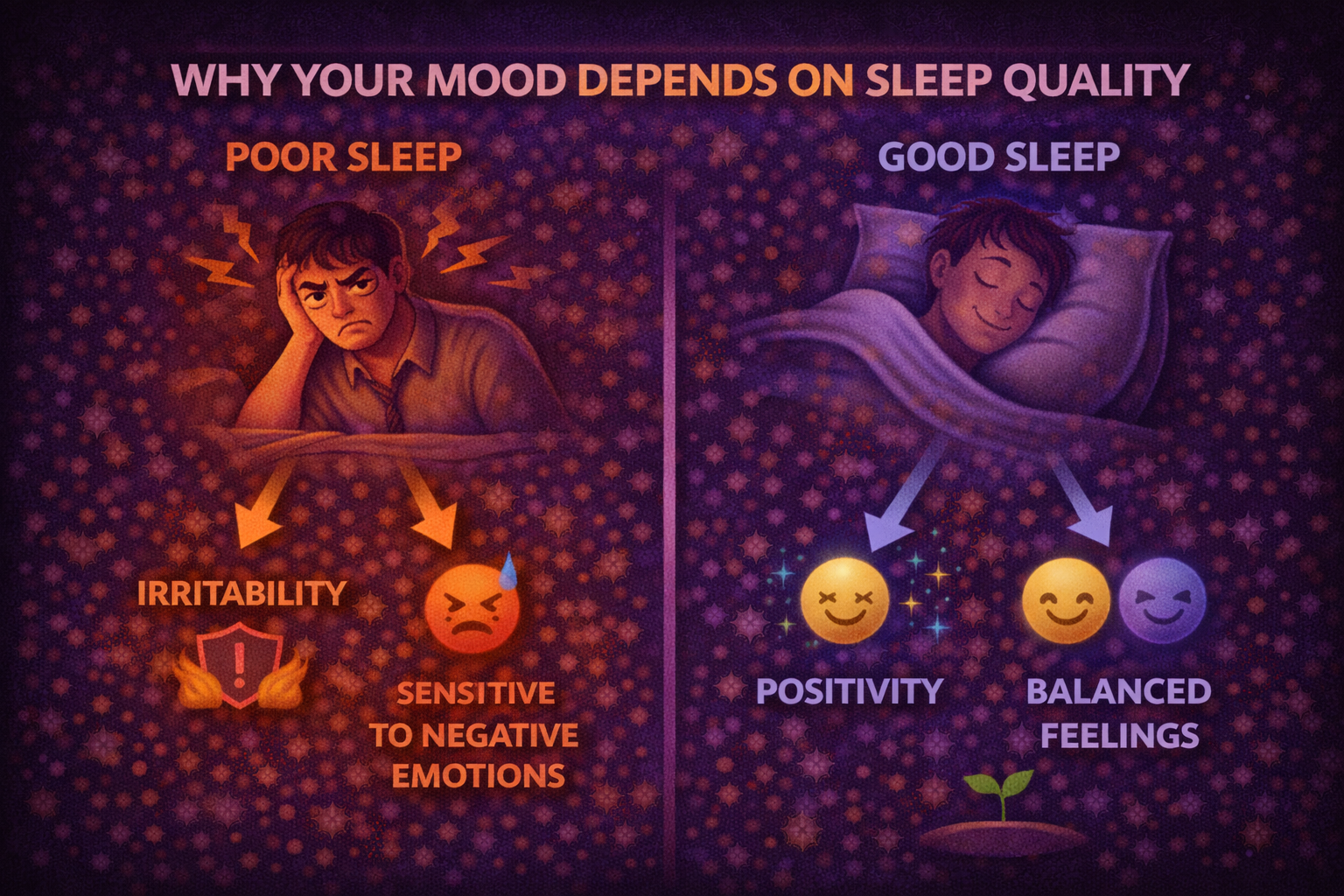
    Why Your Mood Depends on Sleep Quality

    How sleep quality shapes emotional stability, resilience, and daily mood

    Mood often feels like a reaction to circumstances. A good day lifts it, a stressful event lowers it. When mood worsens, people usually search for psychological or situational explanations.

    But mood is not only shaped by what happens during the day. It is strongly influenced by how the brain recovers at night. Sleep quality — not just sleep duration — plays a central role in determining emotional tone, stress tolerance, and mood stability from one day to the next.


    Mood Is Regulated by Brain State

    Mood reflects how the brain processes emotional input.

    A well-regulated brain evaluates situations proportionally, recovers quickly from stress, and maintains emotional balance. A poorly regulated brain reacts more strongly and recovers more slowly.

    Sleep quality is one of the main factors determining which of these states dominates.


    Why Sleep Quality Matters More Than Hours Slept

    Sleeping longer does not guarantee emotional stability.

    If sleep is fragmented, mistimed, or lacking restorative stages, the brain does not fully reset emotional systems. Mood may decline even after a long night in bed.

    High-quality sleep allows emotional regulation to complete its overnight cycle.


    How Sleep Recalibrates Emotional Thresholds

    During sleep, emotional sensitivity is recalibrated.

    Stress-related signaling decreases, emotional thresholds reset, and the brain restores balance between emotional reactivity and control. This allows emotions to arise without becoming overwhelming.

    Poor sleep leaves this recalibration incomplete, increasing emotional volatility.


    The Role of Deep Sleep in Mood Stability

    Deep sleep supports baseline emotional stability.

    It restores core neural networks involved in emotional regulation and reduces background neural noise. This creates a stable emotional baseline the next day.

    When deep sleep is reduced, mood becomes more fragile and reactive.


    REM Sleep and Emotional Processing

    REM sleep plays a critical role in emotional integration.

    During REM, emotional experiences are processed in a low-stress chemical environment. This allows emotional memories to be integrated without maintaining high emotional charge.

    Disrupted REM sleep leaves emotional experiences unprocessed, increasing emotional sensitivity and mood instability.


    Why Poor Sleep Increases Irritability

    Irritability is one of the most common signs of poor sleep.

    Sleep loss lowers tolerance for frustration and reduces impulse control. Minor inconveniences trigger disproportionate emotional reactions.

    This irritability is not a character flaw — it reflects reduced emotional regulation capacity.


    Sleep Quality and Emotional Recovery Speed

    Mood depends not only on reaction, but on recovery.

    After stress or negative emotion, a well-rested brain returns to baseline quickly. Poor sleep slows this recovery, allowing negative mood to persist longer.

    Sleep quality determines how fast emotional balance is restored.


    Negative Mood Bias After Poor Sleep

    Poor sleep creates a negative mood bias.

    The brain prioritizes negative information, memories, and interpretations. Positive experiences feel muted, while negative ones dominate attention.

    This bias shapes overall mood even when external circumstances are neutral.


    Cumulative Effects on Mood Over Time

    Repeated nights of poor sleep compound mood instability.

    Emotional regulation weakens, stress tolerance declines, and low mood becomes more persistent. Over time, this pattern increases vulnerability to anxiety and depressive symptoms.

    Mood changes often precede conscious awareness of sleep problems.


    Why Effort Can’t Stabilize Mood Without Sleep

    Trying to “stay positive” does not restore mood regulation.

    Effort requires neural resources that are replenished during sleep. Without recovery, emotional control remains impaired regardless of intention.

    Sleep supports mood regulation at a biological level.


    Why Mood Improves After High-Quality Sleep

    After good sleep, mood often improves without explanation.

    Emotions feel lighter, stress feels manageable, and perspective returns. This reflects restored regulation rather than changes in life circumstances.

    Sleep allows the brain to process emotions before the day begins.


    The Core Idea to Remember

    Mood depends on sleep quality because sleep regulates emotional balance.

    Through deep sleep and REM sleep, the brain restores emotional thresholds, processes experiences, and reduces negative bias. Poor sleep disrupts this process, amplifying mood instability.

    Stable mood is not forced — it is supported overnight by high-quality sleep.

  • Why Sleep Loss Amplifies Negative Emotions

    Why Sleep Loss Amplifies Negative Emotions

    How insufficient sleep intensifies emotional reactions and reduces regulation

    After a poor night of sleep, emotions often feel sharper and harder to control. Minor frustrations trigger strong reactions, stress feels heavier, and negative thoughts linger longer than usual. Situations that would normally feel manageable suddenly feel overwhelming.

    This emotional shift is not a personality change. It is a biological response to sleep loss. When sleep is insufficient, the brain’s emotional systems become more reactive while regulatory systems weaken, creating a bias toward negative emotional experience.


    Emotion Regulation Depends on Brain Balance

    Emotions are regulated through coordination between multiple brain regions.

    Some systems generate emotional responses, while others evaluate context, apply control, and reduce intensity. Healthy emotional regulation depends on balance between these systems.

    Sleep is essential for maintaining this balance. When sleep is disrupted, emotional responses gain strength while control mechanisms lose efficiency.


    How Sleep Supports Emotional Control

    During sleep, the brain recalibrates emotional thresholds.

    Stress signals decrease, neural sensitivity is reduced, and emotional processing systems reset. This overnight regulation allows emotions to rise and fall without becoming extreme.

    Without adequate sleep, this recalibration remains incomplete.


    Sleep Loss and Heightened Emotional Reactivity

    One of the earliest effects of sleep loss is increased emotional reactivity.

    Negative stimuli trigger stronger responses, while positive experiences feel muted. The brain becomes more sensitive to perceived threats, criticism, or uncertainty.

    This explains why irritability, anxiety, and low mood increase after even modest sleep deprivation.


    Why Negative Emotions Dominate After Poor Sleep

    Sleep loss creates a negative emotional bias.

    The brain prioritizes negative information and memories while positive emotional processing weakens. This bias shapes perception, making the world feel more stressful and less rewarding.

    Importantly, this shift occurs even when external circumstances have not changed.


    The Role of REM Sleep in Emotional Processing

    REM sleep plays a critical role in emotional integration.

    During REM, emotional experiences are processed in a low-stress chemical environment. This allows the brain to separate emotional intensity from factual memory.

    When REM sleep is reduced, emotional experiences remain raw and reactive, increasing emotional intensity the next day.


    Deep Sleep and Emotional Stability

    Deep sleep supports emotional baseline stability.

    It restores core neural networks and reduces background emotional noise. This stability allows emotional responses to remain proportional to situations.

    Reduced deep sleep lowers emotional resilience, making reactions more extreme and less predictable.


    Sleep Loss and Reduced Emotional Insight

    Poor sleep impairs emotional awareness.

    The brain becomes less accurate at interpreting its own emotional state and the emotions of others. This reduces empathy and increases misunderstandings.

    As a result, social interactions feel more strained after sleep loss.


    Why Small Stressors Feel Bigger

    Sleep deprivation lowers emotional tolerance.

    With reduced regulatory capacity, small challenges consume disproportionate emotional energy. What feels trivial on a well-rested day feels significant after poor sleep.

    This amplification contributes to the sense that “everything feels harder” when tired.


    Cumulative Effects of Repeated Sleep Loss

    Emotional amplification accumulates over time.

    Repeated nights of insufficient sleep reinforce negative emotional bias and reduce recovery between stressors. Emotional exhaustion builds, even without major life events.

    Over time, this pattern increases vulnerability to anxiety, burnout, and mood instability.


    Why Effort Can’t Control Emotions Without Sleep

    Trying to control emotions while sleep-deprived is inefficient.

    Effort increases cognitive strain without restoring regulation capacity. Emotional control requires neural resources that are replenished during sleep.

    Without recovery, emotions overpower intention.


    Why Emotional Balance Returns After Good Sleep

    After sufficient sleep, emotional balance improves naturally.

    Reactions feel more proportional, stress feels manageable, and negative emotions lose intensity. This reflects restored regulation, not changes in circumstances.

    Sleep does not remove emotions — it restores perspective.


    The Core Idea to Remember

    Sleep loss amplifies negative emotions because it disrupts emotional regulation.

    Without sleep, emotional systems become more reactive while control mechanisms weaken. Negative experiences feel stronger, more persistent, and harder to manage.

    Emotional balance is not forced — it is restored overnight when the brain is allowed to recover.

  • Why Your Mind Races at Bedtime

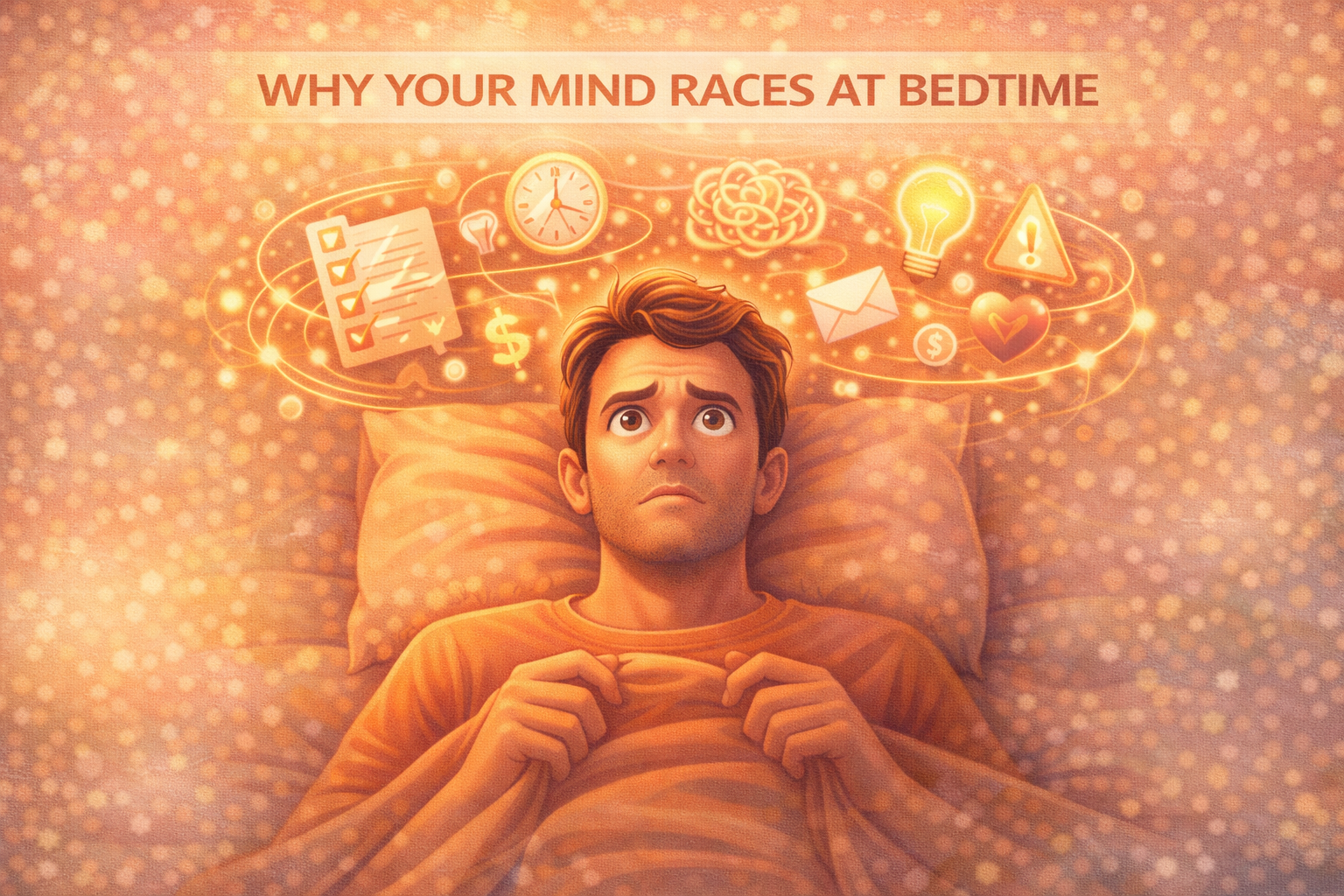
    Why Your Mind Races at Bedtime

    How timing, stress, and learned arousal keep the brain active when it should slow down

    Lying in bed with a tired body and an overactive mind is a common experience. Thoughts jump from one topic to another, worries resurface, plans replay, and sleep feels distant despite clear exhaustion.

    This racing mind is not a sign of poor discipline or a flawed personality. It reflects a state of heightened brain arousal that conflicts with sleep onset. Understanding why this happens reveals that the issue is not the presence of thoughts, but the conditions that keep the brain alert at the wrong time.


    Sleep Requires the Brain to Disengage

    Falling asleep is not about shutting thoughts off on command.

    Sleep begins when alertness systems quiet down and the brain reduces its engagement with problem-solving and monitoring. This disengagement is gradual and depends on timing, safety signals, and reduced stimulation.

    When these conditions are missing, the brain remains active even when the body is ready for rest.


    Stress Keeps the Brain in Problem-Solving Mode

    Stress is one of the strongest drivers of nighttime mental activity.

    Even low-grade or background stress keeps the brain oriented toward anticipation and control. Cortisol and other stress-related signals promote vigilance, making the brain more likely to scan for unresolved issues.

    At bedtime, when distractions disappear, this unresolved cognitive load becomes more noticeable, giving the impression that the mind suddenly “wakes up.”


    Why Thoughts Appear Louder at Night

    The mind does not usually become more active at night — the environment becomes quieter.

    During the day, attention is occupied by tasks, noise, and interaction. At night, external input drops sharply, leaving internal thoughts more prominent.

    Even small amounts of light can signal alertness to the brain.
    Some people use a comfortable sleep mask to create complete darkness and reduce visual stimulation, helping the brain shift away from environmental monitoring.

    This contrast makes normal cognitive activity feel intense, even though overall brain activity may not be higher than during the day.


    Circadian Timing and Evening Alertness

    Circadian timing influences how alert the brain feels in the evening.

    For later chronotypes, alertness naturally peaks later at night. If bedtime occurs before this alertness declines, the brain remains engaged and resistant to sleep.

    In these cases, racing thoughts reflect biological timing rather than anxiety or overthinking alone.


    Learned Arousal and the Bed–Wake Association

    Over time, the brain can learn to associate the bed with alertness.

    If bedtime repeatedly involves worrying, planning, or frustration about not sleeping, the brain links the bed environment with cognitive activity. This learned association triggers alertness as soon as you lie down.

    Sudden or inconsistent sounds can also reinforce this alert state.
    Consistent background sound, such as white noise, can help reduce the brain’s need to monitor the environment and support disengagement.

    The result is a conditioned response where the mind races automatically, even on low-stress days.


    Why Trying to Control Thoughts Backfires

    Efforts to suppress thoughts often increase arousal.

    When the brain detects effort or frustration, it interprets this as a need for control, activating alertness systems further. This creates a feedback loop where trying harder to sleep makes sleep less likely.

    Sleep emerges when effort drops, not when control increases.


    Sleep Pressure Isn’t Always Enough

    High sleep pressure does not guarantee mental quiet.

    You can be physically exhausted while cognitive systems remain active. Alertness driven by stress or timing can override sleep pressure, delaying sleep onset.

    This explains why extreme tiredness does not always lead to immediate sleep.


    Why the Mind Races Most Right Before Sleep

    Bedtime is a transition point.

    As the brain shifts from engagement to disengagement, unresolved thoughts surface briefly before fading — unless alertness is sustained. When timing or stress interferes, this transitional phase stretches longer than it should.

    The racing mind is often a sign that disengagement has stalled.


    Reducing Nighttime Mental Activation

    Calming the racing mind is about reducing arousal, not eliminating thoughts.

    Consistent sleep timing, reduced evening stimulation, and allowing alertness to decline naturally help the brain disengage. Creating a predictable wind-down period signals that problem-solving is no longer required.

    Supporting the nervous system’s transition into a calmer state can also play a role.
    Some people include magnesium glycinate in their evening routine, as it is involved in regulating relaxation and neural recovery.

    When the brain receives permission to disengage, thoughts slow without force.


    The Core Idea to Remember

    Your mind races at bedtime because the brain remains alert when it should be winding down.

    Stress, circadian timing, and learned associations keep cognitive systems active despite physical fatigue. Sleep does not arrive when thoughts are fought — it arrives when alertness is allowed to fade.

    Understanding this shifts the focus from controlling the mind to creating the conditions that let it rest.

  • Why You Sleep Better Some Nights Than Others

    Why You Sleep Better Some Nights Than Others

    How subtle shifts in timing, stress, and physiology change sleep quality from night to night

    Most people notice that sleep quality fluctuates. One night feels deep and effortless, the next feels light and fragmented — even when bedtime, duration, and routine appear unchanged.

    These differences are not random. Sleep quality varies because the brain’s readiness for sleep changes from day to day. Small shifts in circadian timing, stress load, sleep pressure, and environmental cues can significantly alter how restorative sleep feels.


    Sleep Quality Is Context-Dependent

    Sleep is not produced in isolation.

    Each night’s sleep reflects what happened during the day — physically, mentally, and biologically. Stress exposure, light timing, activity levels, and emotional load all influence how easily the brain can enter and maintain restorative sleep.

    Two nights with identical bedtimes can produce very different outcomes because the internal context is different.


    Circadian Alignment Changes Daily

    The circadian rhythm is stable, but not rigid.

    Light exposure, meal timing, and daily routines can subtly shift circadian signals from one day to the next. When sleep timing aligns well with these signals, sleep feels smooth and consolidated.

    When alignment is slightly off, sleep becomes lighter or more fragmented, even if the change is barely noticeable.


    Sleep Pressure Is Not the Same Every Night

    Sleep pressure builds based on how long and how intensely the brain has been awake.

    Days with high cognitive load, physical activity, or extended wakefulness increase sleep pressure, often leading to deeper sleep. Quieter or less demanding days may produce lower pressure, making sleep lighter.

    This variation explains why sleep can feel deeper after demanding days and lighter after low-activity days.


    Stress Fluctuations Shape Nighttime Arousal

    Stress levels vary daily, even when they feel “normal.”

    Small increases in emotional load, unresolved concerns, or anticipation can elevate nighttime arousal. This makes it harder for the brain to fully disengage, reducing sleep depth and increasing awakenings.

    On lower-stress days, the brain enters recovery mode more easily, improving sleep quality.


    The Role of Light and Evening Stimulation

    Evening light exposure is rarely identical from night to night.

    Screens, indoor lighting, and cognitive stimulation can delay the brain’s transition into sleep. Minor differences — such as extra screen time or later light exposure — can shift sleep onset and depth.

    These small changes accumulate into noticeable differences in sleep quality.


    Why Sleep Architecture Varies Nightly

    Sleep stages do not follow a fixed pattern every night.

    The distribution of deep sleep and REM sleep adapts to recent needs. After sleep loss or high stress, the brain may prioritize certain stages. On other nights, lighter sleep may dominate.

    This flexibility is normal, but it means that sleep quality naturally varies.


    Environmental Sensitivity Changes Over Time

    Sensitivity to noise, temperature, and comfort can fluctuate.

    On some nights, minor disturbances are ignored. On others, they trigger awakenings. This variability reflects changes in arousal threshold rather than environmental failure.

    As a result, identical environments can produce different sleep outcomes.


    Why “Doing Everything Right” Doesn’t Guarantee Good Sleep

    Many people expect perfect sleep when routines are followed precisely.

    However, sleep depends on internal readiness more than external rules. Even ideal habits cannot override biological variability from day to day.

    Good sleep increases the probability of restorative nights — it does not guarantee them.


    Why Variability Is Normal, Not a Problem

    Some night-to-night variation in sleep quality is healthy.

    The brain adapts sleep architecture to changing needs. Expecting identical sleep every night creates unnecessary frustration and increases sleep-related stress.

    Understanding variability reduces pressure and helps prevent overreaction to single bad nights.


    Improving the Odds of Better Nights

    The goal is not control, but consistency.

    Stable wake times, regular light exposure, and reduced evening stimulation increase the likelihood of good sleep across many nights. When the brain receives clear, repeated signals, sleep quality improves on average.

    Good sleep is a trend, not a single event.


    The Core Idea to Remember

    You sleep better some nights than others because sleep is shaped by daily biology, not rigid rules.

    Small changes in circadian alignment, stress, sleep pressure, and stimulation alter how the brain recovers each night. Variability is normal — patterns matter more than perfection.

    Understanding this makes sleep easier to support and less stressful to manage.

  • Why You Wake Up Before Your Alarm

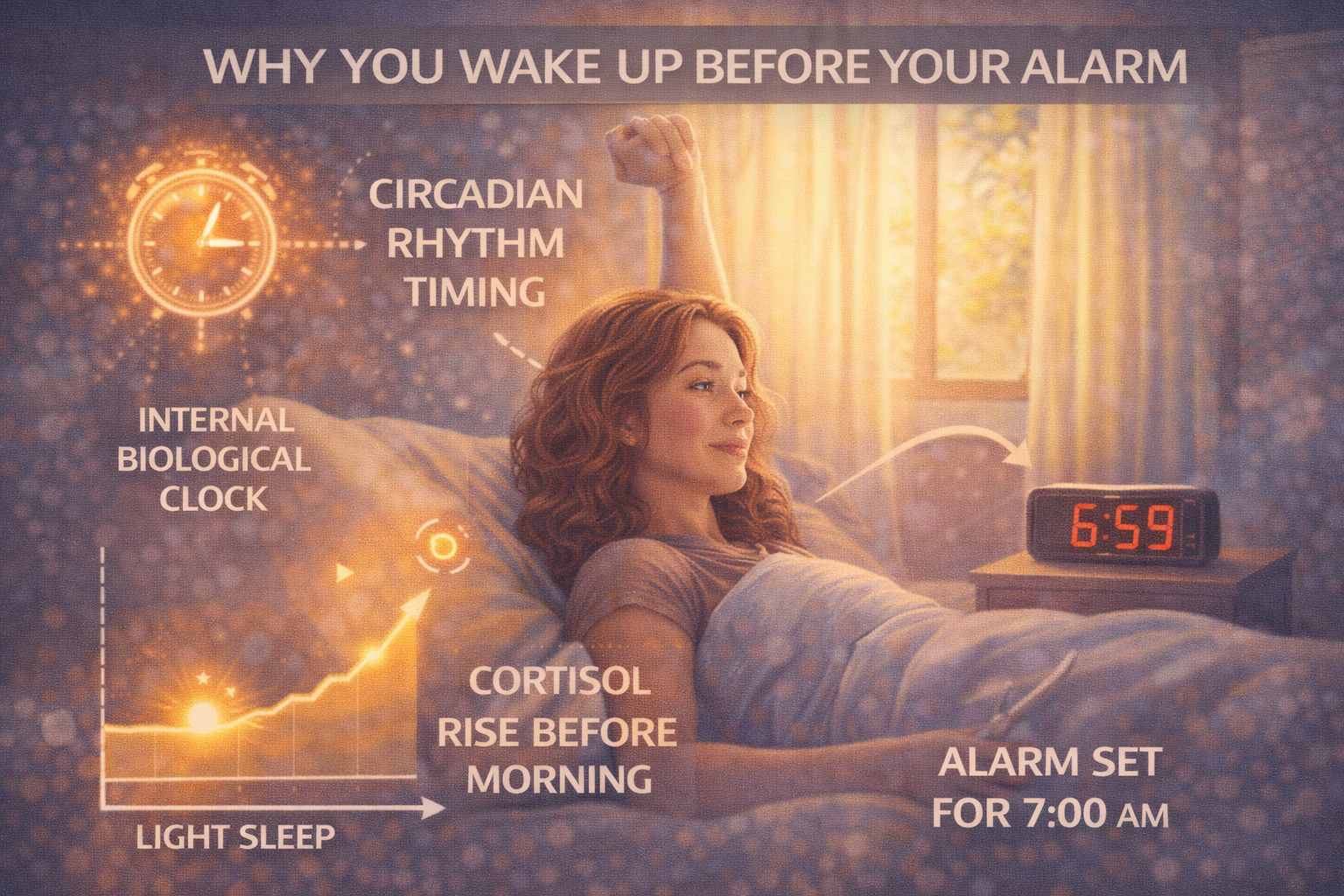
    Why You Wake Up Before Your Alarm

    Why You Wake Up Before Your Alarm

    How circadian timing, stress, and anticipation trigger early awakenings

    Waking up before your alarm can feel confusing or frustrating. Sometimes it happens once and feels harmless. Other times it becomes a pattern — early mornings, alertness too soon, and difficulty falling back asleep.

    This experience is rarely random. Waking before the alarm is often a sign that the brain has already transitioned toward wakefulness. The reason lies in how circadian timing, stress systems, and learned anticipation interact during the final hours of sleep.


    The Brain Wakes Up Before the Alarm Does

    Waking up is not caused by the alarm itself.

    The brain begins preparing for wakefulness well before morning. Hormones shift, body temperature rises, and alertness gradually increases as part of the circadian rhythm.

    If this transition reaches a certain threshold before the alarm goes off, you wake naturally — sometimes minutes, sometimes much earlier.


    Circadian Rhythm and Early Wake Signals

    The circadian rhythm determines when the brain expects the day to begin.

    If your internal clock is shifted earlier than your alarm time, wake-promoting signals may rise sooner than intended. This can happen due to consistent early schedules, light exposure, or gradual shifts in sleep timing.

    In these cases, waking before the alarm is a sign of circadian alignment — not necessarily a problem.


    Stress and the Early Morning Alert Response

    Stress is a common cause of unwanted early awakenings.

    Stress hormones naturally rise in the early morning to support waking. When stress levels are elevated, this rise can occur earlier or more intensely, triggering premature alertness.

    Even low-grade or subconscious stress can activate the brain before the desired wake time.


    Why Anticipation Wakes You Up

    The brain learns patterns quickly.

    If you regularly wake at a certain time, worry about waking early, or anticipate an upcoming obligation, the brain begins preparing earlier. This learned anticipation can override sleep continuity.

    As a result, the brain exits sleep not because rest is complete, but because it expects action.


    Sleep Pressure Is Lowest in the Morning

    Sleep pressure decreases across the night.

    By early morning, sleep pressure is naturally lower than at bedtime. This makes sleep more fragile and easier to interrupt.

    When combined with rising circadian alertness or stress signals, even small disturbances can cause full awakening.


    Why Falling Back Asleep Is Hard

    Once the brain transitions toward wakefulness, returning to sleep becomes difficult.

    Alertness systems activate quickly, while sleep-promoting systems take longer to re-engage. The brain interprets early waking as the start of the day, even if the alarm has not sounded.

    This imbalance explains why early awakenings often end the night entirely.


    Early Waking and Sleep Fragmentation

    Frequent early awakenings fragment sleep.

    While total sleep time may not appear drastically reduced, the final and often REM-rich portion of sleep is shortened. This can affect emotional processing and leave sleep feeling incomplete.

    Repeated early waking contributes to cumulative fatigue over time.


    Why Sleeping Earlier Doesn’t Always Help

    Many people respond to early awakenings by going to bed earlier.

    If circadian timing does not shift accordingly, this strategy increases time in bed without extending sleep. The brain still wakes at the same internal time.

    Timing alignment matters more than bedtime alone.


    When Early Waking Is Actually Normal

    Not all early awakenings are negative.

    If you wake feeling alert, rested, and calm, early waking may simply reflect a well-aligned circadian rhythm. Problems arise when early waking is accompanied by fatigue, anxiety, or sleep loss.

    The context determines whether the pattern is healthy or disruptive.


    Reducing Unwanted Early Wake-Ups

    Improving early waking often involves reducing early-morning alert signals.

    Supporting circadian alignment, managing stress, and protecting sleep continuity help the brain maintain sleep through the final hours. The goal is not forcing sleep, but preventing premature activation.

    When the brain stays in recovery mode longer, sleep naturally extends closer to the alarm.


    The Core Idea to Remember

    Waking up before your alarm happens because the brain has already begun waking.

    Circadian timing, stress hormones, anticipation, and low sleep pressure combine to trigger early alertness. This process is biological, not random.

    Understanding why it happens helps distinguish healthy early waking from patterns that undermine sleep — and points toward alignment rather than effort as the solution.

  • Why You Feel Wired but Tired at Night

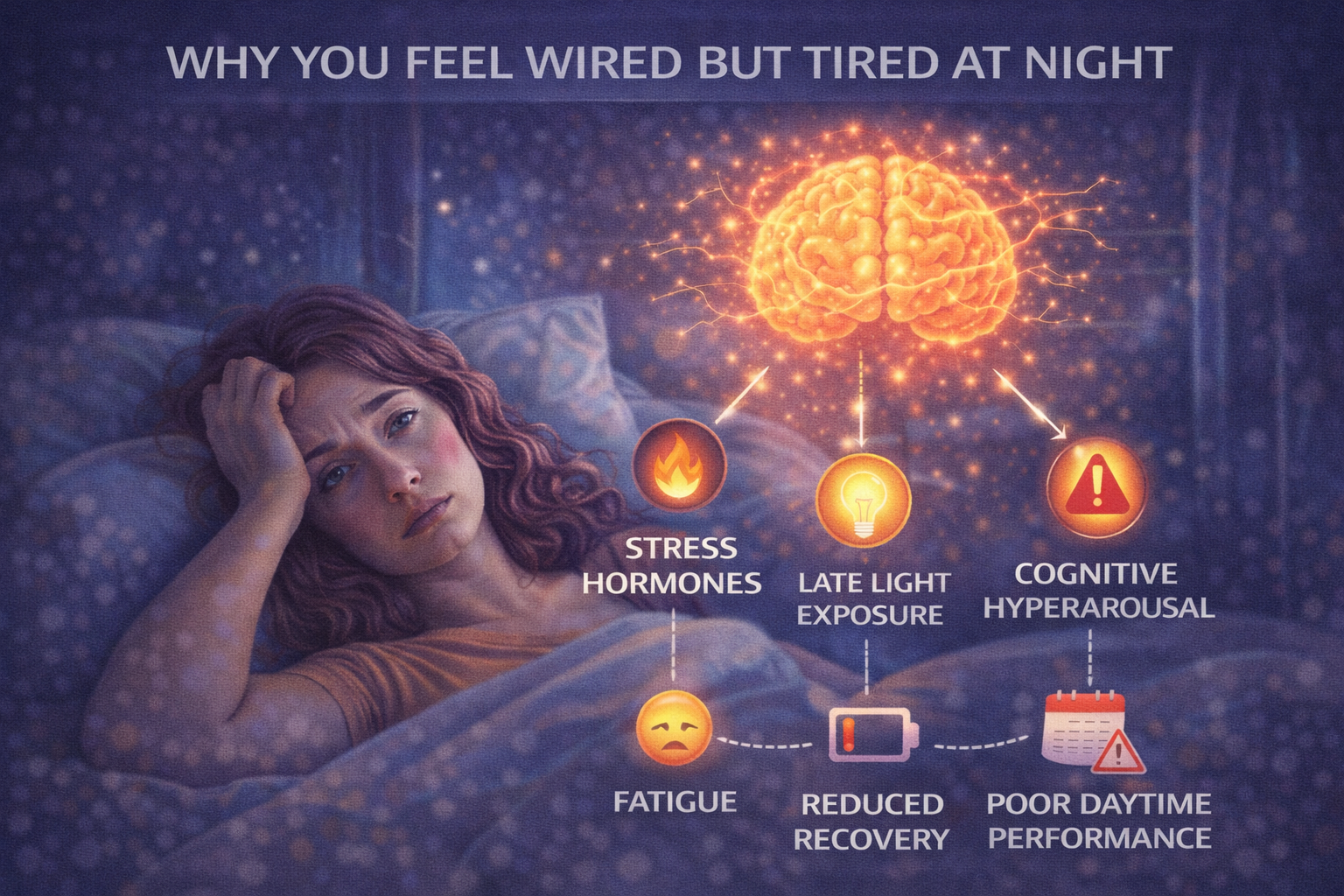
    Why You Feel Wired but Tired at Night

    How stress, timing, and overstimulation keep the brain alert when it should shut down

    Feeling exhausted yet unable to fall asleep is one of the most frustrating sleep experiences. The body feels depleted, but the mind remains alert, restless, and active. Thoughts race, tension lingers, and sleep feels just out of reach.

    This “wired but tired” state is not a contradiction. It reflects a mismatch between physical fatigue and neurological alertness. The problem is not a lack of tiredness — it is that the brain has not received the right signals to disengage.


    Physical Fatigue and Mental Arousal Are Different Systems

    Feeling tired does not automatically mean the brain is ready for sleep.

    Physical fatigue reflects energy depletion in muscles and body systems. Mental arousal reflects brain activity, stress signaling, and alertness regulation. These two systems can move in opposite directions.

    At night, it is possible for the body to be exhausted while the brain remains activated, especially under conditions of stress or circadian disruption.


    The Role of the Stress Response

    One of the main drivers of feeling wired at night is stress-related arousal.

    Stress hormones such as cortisol increase alertness and vigilance. When stress is prolonged — even psychological or low-grade stress — these hormones may remain elevated into the evening.

    This keeps the brain in a problem-solving, threat-monitoring mode that conflicts with sleep onset, even when the body needs rest.


    Why the Brain Struggles to Power Down

    Sleep requires a gradual reduction in neural activity.

    When the brain remains stimulated — by worry, planning, emotional processing, or mental load — it resists this transition. Thoughts continue to loop, attention remains externally or internally engaged, and sleep pressure is overridden by alertness.

    The result is lying in bed feeling mentally “on” despite physical exhaustion.


    Circadian Timing and Evening Alertness

    Circadian timing plays a critical role in nighttime alertness.

    For later chronotypes, biological alertness naturally peaks later in the evening. When combined with stress or stimulation, this peak can feel exaggerated, producing a wired sensation at night.

    In this case, tiredness reflects accumulated fatigue, while alertness reflects circadian and stress-driven activation.


    Overstimulation and Modern Evenings

    Modern evenings are rarely quiet for the brain.

    Screens, artificial light, information overload, and constant cognitive engagement keep alertness elevated. Even passive scrolling provides novelty and emotional input that the brain treats as stimulation.

    This environment delays the natural decline in alertness and reinforces the wired-but-tired state.


    Why Forcing Sleep Makes It Worse

    Trying to force sleep often backfires.

    When sleep does not arrive easily, frustration increases. This emotional response further activates stress systems, raising alertness even more.

    The brain interprets effort as a signal to stay awake, creating a feedback loop where trying harder to sleep increases wakefulness.


    Sleep Pressure Isn’t Always Enough

    Sleep pressure builds the longer you are awake.

    However, high sleep pressure alone does not guarantee sleep if alertness remains elevated. The brain prioritizes perceived threat or stimulation over rest.

    This explains why extreme tiredness does not always lead to immediate sleep when the brain is still “on.”


    Why This Pattern Repeats Night After Night

    The wired-but-tired state often becomes habitual.

    When nights repeatedly involve mental activation in bed, the brain learns to associate bedtime with alertness. This conditioning makes future nights more difficult, even when stress levels improve.

    The pattern is maintained by timing, stimulation, and learned arousal.


    Reducing Nighttime Arousal

    Breaking the cycle requires reducing arousal, not increasing effort.

    Supporting circadian alignment, reducing evening stimulation, and allowing alertness to decline gradually help the brain disengage. The goal is not to force sleep, but to remove the signals that prevent it.

    When alertness falls naturally, sleep follows.


    The Core Idea to Remember

    Feeling wired but tired at night means the brain is still activated despite physical fatigue.

    Stress, overstimulation, and circadian timing keep alertness high when it should be declining. Sleep does not arrive because the brain has not received permission to shut down.

    Sleep becomes easier when alertness is allowed to fade — not when tiredness is pushed harder.

  • Why You Can’t Fall Asleep Even When You’re Exhausted

    Why You Can’t Fall Asleep Even When You’re Exhausted

    Feeling completely exhausted but unable to fall asleep is deeply frustrating.

    Your body is tired.
    Your energy is gone.
    But your mind refuses to shut down.

    This isn’t a lack of discipline.

    It’s a biological mismatch between sleep pressure and nervous system activation.


    Why Being Tired Doesn’t Automatically Lead to Sleep

    Sleep happens when two systems work together.

    Sleep pressure builds the longer you stay awake.
    Circadian rhythm determines when your body is ready to sleep.

    You can be physically exhausted, but if your brain stays alert, sleep won’t come.

    Tiredness alone is not enough.


    The Nervous System Keeps You Awake

    When stress hormones remain elevated, your body stays in a defensive state.

    The brain interprets bedtime as unsafe.

    Instead of slowing down, it stays in problem-solving mode.

    This often shows up as:

    • racing thoughts

    • restlessness in bed

    • shallow breathing

    • sudden alertness at night

    • For individuals who struggle with racing thoughts, a consistent background sound — such as a white noise machine — may reduce sensory distractions and support a more stable sleep environment.

    Your body is tired.
    Your nervous system is not.

    In some cases, gentle nervous system support — such as magnesium glycinate — may help promote relaxation before bedtime, particularly for individuals experiencing persistent hyperarousal.


    Why Relaxation Techniques Often Don’t Work

    Many people try breathing exercises or meditation right before bed.

    Sometimes they help.
    Often, they don’t.

    Sleep is not a switch you flip at night.

    It’s the result of how your nervous system was regulated all day long.

    A single technique can’t undo an overstimulating day.

    This pattern is often linked to disruptions in the circadian rhythm.


    What Actually Helps You Fall Asleep

    Falling asleep improves when safety signals increase.

    Not force.

    The most effective principles are simple:

    • consistent wake-up times

    • morning light exposure

    • reduced evening stimulation

    • Creating a completely dark sleep environment can further support melatonin production. Some individuals use a 100% blackout sleep mask to eliminate residual light exposure.

    • predictable daily rhythms

    When the nervous system feels safe, sleep follows naturally.


    Final Thoughts

    If you’re exhausted but can’t sleep, your body isn’t broken.

    It’s responding logically to the signals it received.

    Sleep improves when biology is supported — not when it’s forced.

    Nighttime awakenings and difficulty falling asleep are often connected.