Tag: stress recovery

  • How Sleep Impacts Stress Recovery Long-Term

    How Sleep Impacts Stress Recovery Long-Term

    Why consistent sleep determines whether stress resolves or becomes chronic

    Stress is not inherently harmful. The body is designed to activate under pressure and then return to baseline. Problems arise when this recovery does not occur. Over time, unresolved stress accumulates and reshapes both mental and physical health.

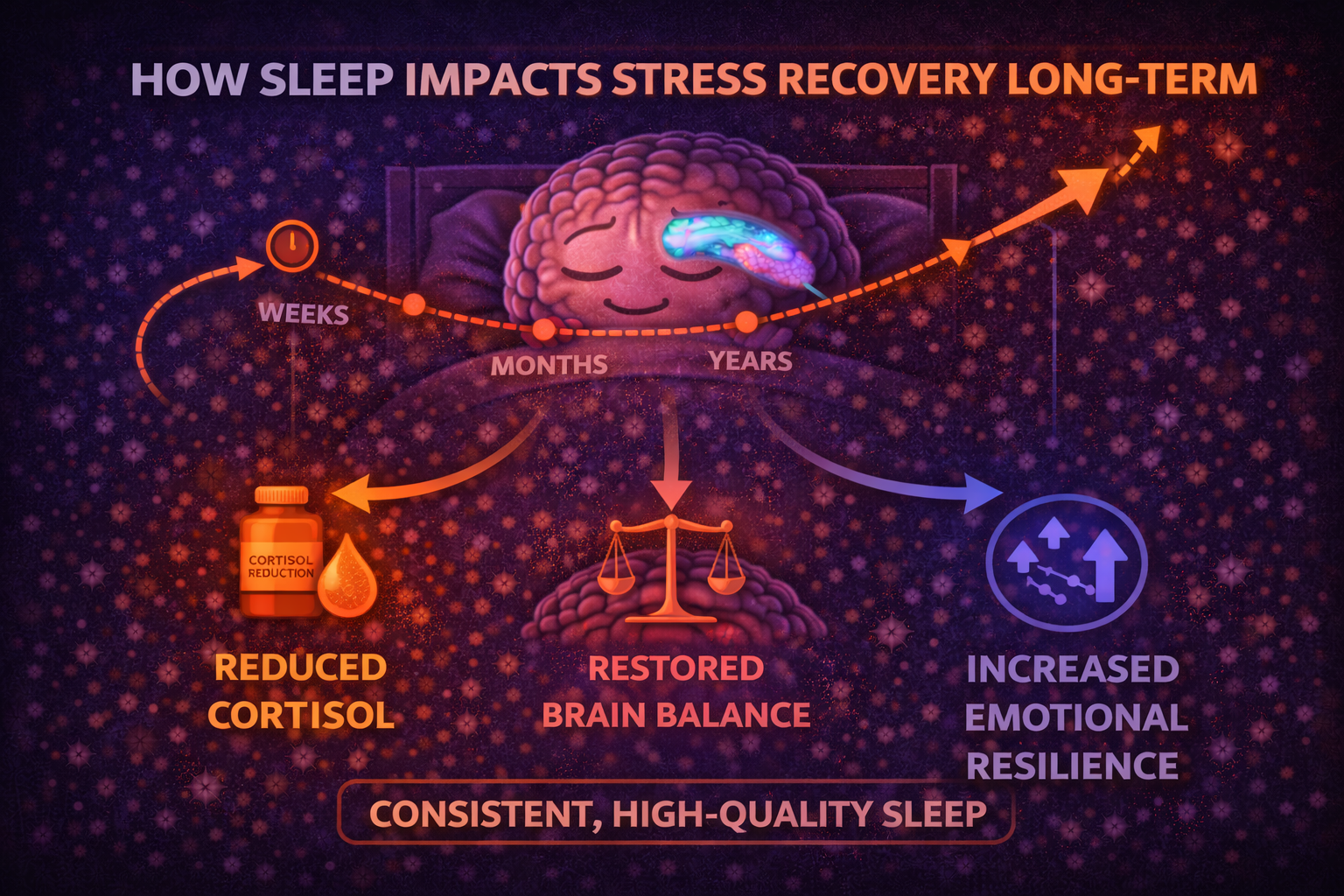
    Long-term stress recovery depends less on occasional rest and more on what happens night after night. Sleep is the primary mechanism through which the brain and body resolve stress. When sleep is consistently disrupted, stress stops being temporary and becomes chronic.


    Stress Recovery Is a Cumulative Process

    Recovery does not reset instantly.

    Each night of sleep contributes a small but essential amount of stress resolution. When sleep is consistent and restorative, these nightly resets accumulate, maintaining balance over weeks and months.

    When sleep is poor, stress carries forward. Over time, the nervous system adapts to a state of persistent activation.


    How Sleep Repeatedly Resets the Stress System

    During healthy sleep, stress-related systems downregulate.

    Stress hormones decline, autonomic balance shifts toward recovery, and neural circuits involved in threat detection quiet down. This nightly reset prevents stress responses from becoming the baseline state.

    Without regular sleep-driven resets, stress systems remain partially activated long-term.


    Deep Sleep and Long-Term Physiological Recovery

    Deep sleep is central to sustained stress recovery.

    Across repeated nights, deep sleep supports cardiovascular regulation, metabolic repair, and immune balance. These systems are highly sensitive to chronic stress load.

    Reduced deep sleep over time leads to sustained physiological strain, even if daily stressors appear moderate.


    REM Sleep and Emotional Stress Resolution Over Time

    REM sleep plays a key role in emotional stress recovery.

    Night after night, REM sleep processes emotional experiences in a low-stress chemical environment. This repeated integration prevents emotional stress from accumulating.

    Chronic disruption of REM sleep allows emotional stress to build, increasing long-term emotional exhaustion and reactivity.


    Why Short-Term Coping Isn’t Enough

    Short-term stress relief does not equal recovery.

    Relaxation techniques, breaks, or time off may reduce stress temporarily. However, without consistent sleep, the nervous system does not fully reset.

    Long-term recovery requires repeated biological downregulation, not occasional relief.


    Sleep Loss and the Shift Toward Chronic Stress

    Chronic sleep disruption changes stress physiology.

    Over time, baseline stress hormone levels rise, stress responses become exaggerated, and recovery slows. The body begins to treat normal demands as threats.

    This shift explains why chronic stress often persists even after external stressors decrease.


    Circadian Disruption and Long-Term Stress Load

    Stress recovery is timing-dependent.

    Misaligned sleep schedules interfere with the natural nighttime decline of stress hormones. Even sufficient sleep duration may fail to produce recovery if timing is inconsistent.

    Circadian alignment improves the efficiency of long-term stress resolution.


    Why Burnout Develops When Sleep Is Inadequate

    Burnout reflects long-term recovery failure.

    When sleep does not resolve stress consistently, emotional exhaustion and disengagement accumulate. Motivation declines, resilience erodes, and stress feels constant.

    Burnout is not caused by stress alone — it is caused by stress without recovery.


    The Compounding Effect of Fragmented Sleep

    Fragmented sleep undermines long-term recovery.

    Frequent awakenings prevent full downregulation each night. Over weeks and months, this partial recovery produces chronic tension and fatigue.

    Fragmentation is often more damaging long-term than short sleep duration alone.


    Why Stress Becomes “Normal” Without Sleep

    Chronic stress can feel normal over time.

    As recovery remains incomplete, heightened arousal becomes the baseline state. People adapt to feeling tense, alert, or exhausted without recognizing the cause.

    Sleep loss gradually resets the body’s definition of normal.


    Restoring Long-Term Stress Recovery Through Sleep

    Long-term recovery begins with sleep consistency.

    Protecting sleep timing, continuity, and depth allows nightly stress resolution to accumulate. Over time, baseline arousal decreases and resilience returns.

    Recovery is not sudden — it rebuilds across many nights of sleep.


    The Core Idea to Remember

    Long-term stress recovery depends on sleep because sleep resolves stress repeatedly, not once.

    Through deep sleep and REM sleep, the brain and body downregulate stress systems night after night. Without this process, stress accumulates and becomes chronic.

    Stress is resolved over time — and sleep is the mechanism that makes long-term recovery possible.
  • How Sleep Impacts Stress Recovery

    How Sleep Impacts Stress Recovery

    Why the ability to recover from stress depends on what happens during sleep

    Stress is unavoidable. What determines its impact is not how often it appears, but how effectively the brain and body recover afterward. Two people can experience similar stressors and have completely different outcomes — one rebounds quickly, the other remains tense, exhausted, and overwhelmed.

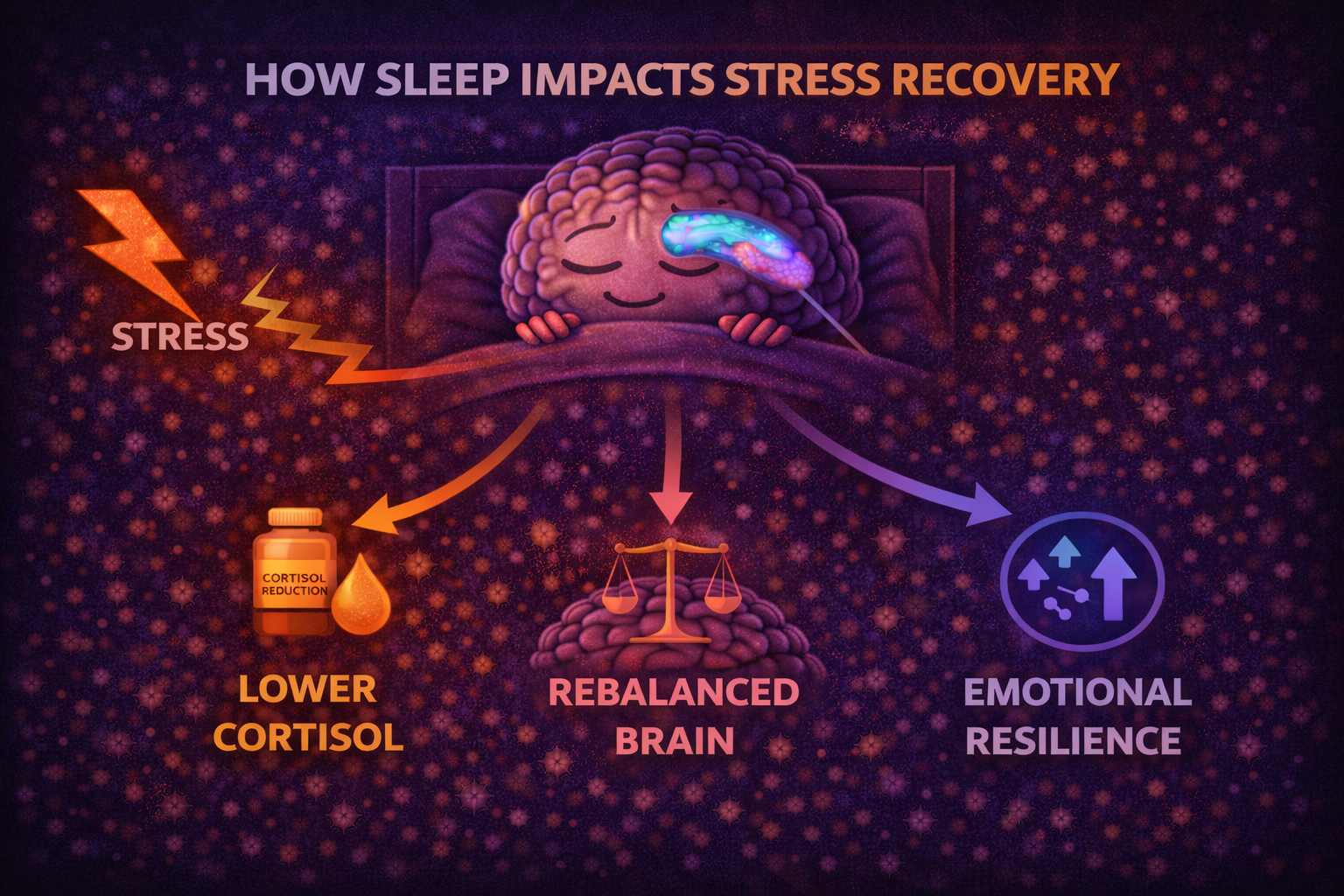
    Sleep is the dividing line. Stress recovery is not a passive process; it is an active biological reset that occurs primarily during sleep. When sleep is disrupted, stress does not resolve — it accumulates.


    Stress Is Meant to Be Temporary

    The stress response is designed to activate and then shut down.

    In a healthy system, stress hormones rise to meet a challenge and then fall once the threat passes. This return to baseline is essential for physical and mental health.

    Sleep is the primary window during which this shutdown occurs. Without it, stress systems remain partially activated.


    How Sleep Turns Off the Stress Response

    During healthy sleep, stress-related activity declines.

    Stress hormones decrease, sympathetic nervous system activity lowers, and the body shifts into recovery mode. This allows tissues, neural circuits, and emotional systems to reset.

    Poor sleep leaves this process incomplete, keeping the body in a semi-alert state.


    Deep Sleep and Physiological Recovery

    Deep sleep is critical for physical stress recovery.

    During slow-wave sleep, heart rate slows, blood pressure drops, and metabolic repair accelerates. These changes signal safety to the nervous system.

    Reduced deep sleep prevents full physiological downregulation, prolonging stress effects into the next day.


    REM Sleep and Emotional Stress Processing

    REM sleep plays a key role in emotional recovery.

    During REM, emotional experiences are processed in a low-stress neurochemical environment. This allows stressful memories to be integrated without maintaining high emotional charge.

    Disrupted REM sleep leaves emotional stress unresolved, increasing emotional fatigue and reactivity.


    Why Poor Sleep Makes Stress Feel Constant

    Without sleep, stress lacks closure.

    The brain does not receive the signal that the challenge has ended. As a result, stress-related thoughts and bodily tension persist even when nothing new is happening.

    This creates the sensation of constant pressure rather than discrete stressful events.


    Sleep Loss and Reduced Stress Tolerance

    Sleep deprivation lowers the threshold for stress.

    Minor challenges trigger disproportionate reactions because regulatory systems are already strained. What would normally feel manageable becomes exhausting.

    Stress tolerance depends on prior recovery, not willpower.


    Cumulative Stress Without Recovery

    Stress accumulates when recovery is missing.

    Each night of poor sleep adds to unresolved stress load. Over time, this leads to emotional exhaustion, burnout, and chronic tension.

    The body keeps score when stress is not resolved.


    Why Time Off Doesn’t Always Reduce Stress

    Taking time off does not guarantee recovery.

    If sleep remains disrupted, stress systems stay active. The body cannot reset without consistent, high-quality sleep.

    This explains why people sometimes return from breaks still feeling stressed.


    Circadian Timing and Stress Recovery

    Stress recovery is influenced by circadian rhythm.

    Poorly timed sleep interferes with the natural decline of stress hormones at night. Even adequate sleep duration may fail to produce recovery if timing is misaligned.

    Alignment improves the efficiency of stress resolution.


    Why Relaxation Techniques Work Better After Sleep

    Relaxation requires regulation.

    Sleep restores the neural capacity needed for relaxation techniques to be effective. Without sleep, these techniques feel forced and temporary.

    Sleep provides the foundation upon which relaxation can work.


    Restoring Stress Recovery Through Sleep

    Improving stress recovery begins with improving sleep.

    Protecting sleep timing, continuity, and depth allows stress systems to downregulate naturally. Emotional and physical resilience rebuild without additional effort.

    Sleep is not an escape from stress — it is how the body recovers from it.


    The Core Idea to Remember

    Stress recovery depends on sleep because sleep turns off the stress response.

    Through deep sleep and REM sleep, the brain and body reset physiological and emotional stress systems. Without sleep, stress accumulates and becomes chronic.

    Recovering from stress is not optional — it is biological, and it happens at night.