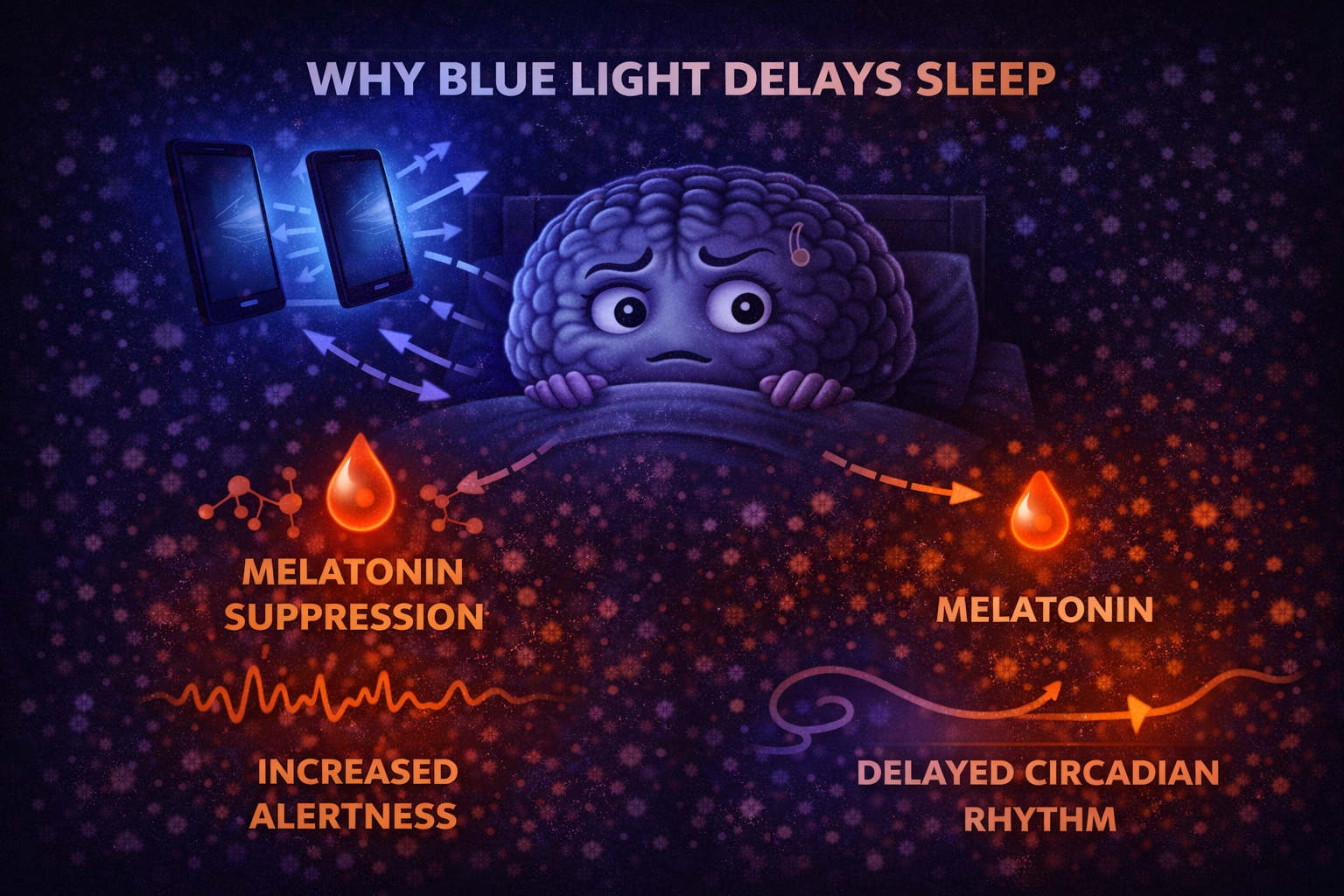
How artificial light at night interferes with melatonin and sleep timing
Many people struggle to fall asleep even when they feel tired. They go to bed on time, turn off the lights, and still lie awake. Often, the cause isn’t stress or lack of discipline — it’s light exposure earlier in the evening.
Blue light is one of the strongest signals affecting the brain’s sleep system. In modern environments, exposure to blue light at night delays sleep onset, disrupts circadian timing, and weakens sleep quality, even when total sleep time seems adequate.
The Brain Uses Light to Decide When to Sleep
Sleep timing is regulated by the circadian rhythm.
The brain relies on light signals from the eyes to determine whether it is day or night. When light is detected, the brain increases alertness. When light fades, it prepares the body for sleep.
Blue light sends a particularly strong “daytime” signal.
Why Blue Light Is More Disruptive Than Other Light
Not all light affects sleep equally.
Blue wavelengths strongly activate specialized light-sensitive cells in the eyes that communicate directly with the brain’s internal clock. These cells evolved to respond to daylight, which is rich in blue light.
When blue light appears at night, the brain interprets it as extended daytime.
Blue Light and Melatonin Suppression
Melatonin is the hormone that signals night.
As darkness increases, melatonin rises, promoting sleepiness and initiating nighttime physiology. Blue light suppresses melatonin production more powerfully than other wavelengths.
Even brief evening exposure can delay melatonin release and push sleep timing later.
Why Screens Are Especially Problematic
Screens emit concentrated blue light.
Phones, tablets, computers, and televisions deliver blue wavelengths directly into the eyes at close range. This exposure is intense and sustained, making it especially disruptive in the evening.
Using screens close to bedtime delays sleep onset even if brightness is reduced.
Blue Light and Increased Alertness
Blue light does more than suppress melatonin.
It actively increases alertness, reaction time, and cognitive stimulation. This makes the brain feel “wired” even when the body is tired.
This mismatch explains why people often feel exhausted yet unable to fall asleep.
How Blue Light Shifts the Circadian Clock
Evening blue light delays circadian timing.
The internal clock shifts later, causing sleepiness to appear later at night and wake time to drift later in the morning. Over time, this creates chronic misalignment.
This shift occurs even without conscious awareness.
Blue Light and Sleep Depth
Delayed sleep timing affects sleep structure.
When sleep is pushed later, the proportion of deep sleep and REM sleep can be reduced or fragmented. Sleep may feel long but unrefreshing.
Quality declines even when quantity remains unchanged.
Why Indoor Lighting Adds to the Problem
Modern lighting extends exposure.
LED lighting used in homes and public spaces often contains blue wavelengths. Bright indoor lighting in the evening reinforces the signal that it is still daytime.
This prolongs alertness beyond biological night.
Do Blue Light Filters Fully Solve the Problem?
Filters help, but they are not enough.
Blue light filters and night modes reduce wavelength intensity but do not eliminate alerting effects. The brain still responds to light exposure, brightness, and stimulation.
Reducing exposure time matters more than filtering alone.
How to Minimize Blue Light Exposure at Night
Managing blue light requires behavior.
Dimming lights, using warmer lighting, limiting screen use before bed, and creating a darker evening environment allow melatonin to rise naturally.
Consistency is more important than perfection.
Why Darkness Matters More Than You Think
Darkness is an active biological signal.
As light disappears, the brain transitions into night mode. This transition supports sleep onset, depth, and emotional regulation.
Protecting darkness protects sleep.
The Core Idea to Remember
Blue light delays sleep because it sends a powerful daytime signal to the brain.
By suppressing melatonin, increasing alertness, and shifting circadian timing, blue light makes falling asleep harder and sleep less restorative.
Sleep improves not by forcing rest — but by aligning light exposure with biology.