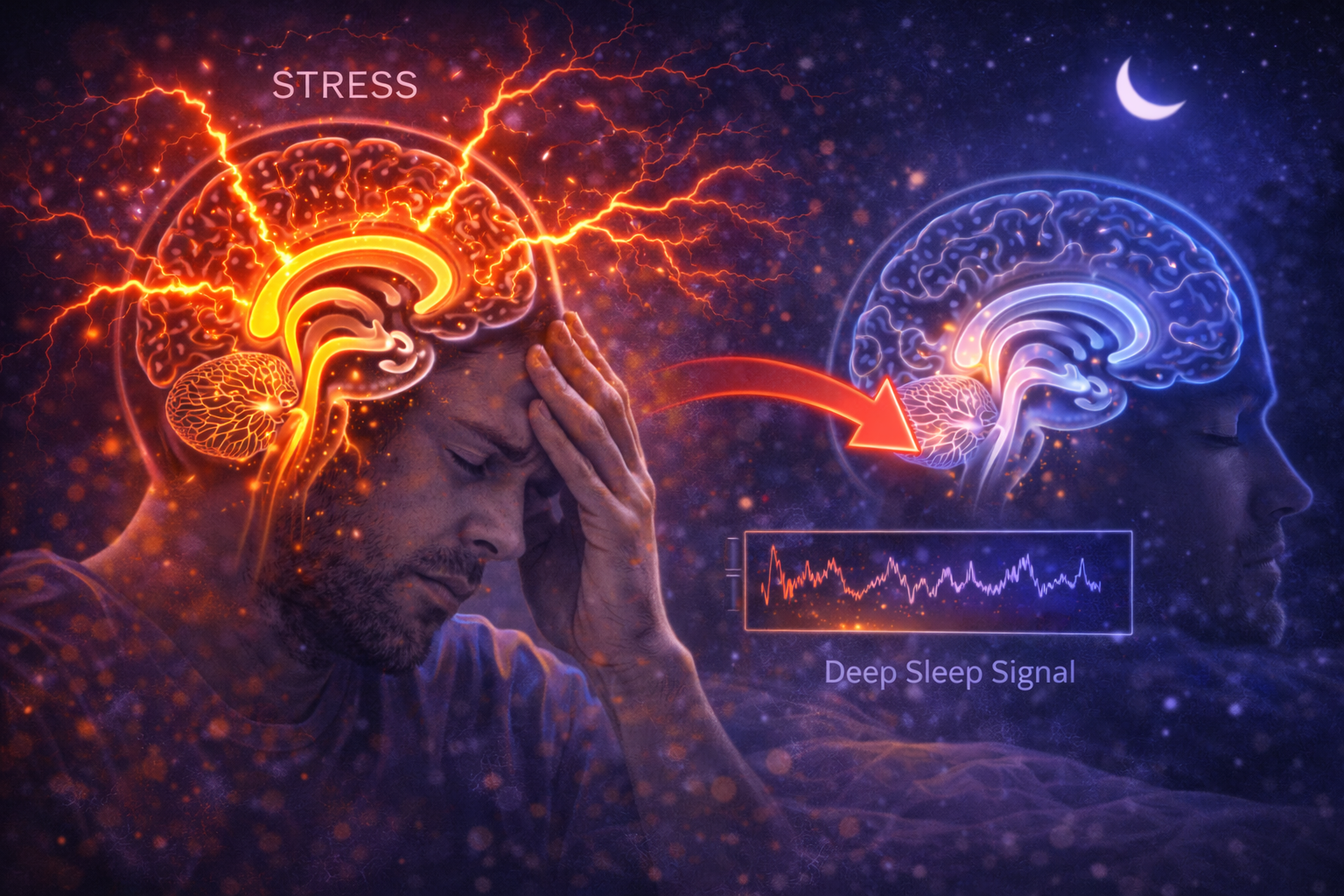
How chronic stress interferes with the brain’s ability to enter restorative sleep
Many people under stress notice the same pattern: sleep becomes lighter, more fragmented, and less refreshing. Even when they spend enough hours in bed, they wake up feeling unrested, tense, or mentally drained.
This is not a coincidence. Stress directly interferes with the brain processes that generate deep sleep. The problem is not simply worry or racing thoughts — it is a biological shift that changes how the brain regulates sleep depth and recovery.
What Deep Sleep Actually Does
Deep sleep, also known as slow-wave sleep, is the most restorative stage of sleep.
During deep sleep, brain activity slows, metabolic waste is cleared more efficiently, and neural repair processes are prioritized. This stage supports physical recovery, cognitive resilience, and emotional stability.
When deep sleep is reduced, sleep may still occur, but recovery is incomplete.
How Stress Changes Brain Chemistry
Stress activates systems designed for short-term survival.
Hormones such as cortisol and adrenaline increase alertness and prepare the body for action. While useful in acute situations, chronic activation keeps the brain in a state of readiness that conflicts with the conditions required for deep sleep.
When stress signals remain elevated into the night, the brain struggles to downshift into slow-wave activity.
Why Stress Prevents the Brain From Slowing Down
Deep sleep requires a reduction in neural firing and mental activity.
Stress increases cortical activation, emotional processing, and threat monitoring. Even when the body is physically tired, the brain remains partially alert.
This heightened arousal makes it difficult to enter and sustain deep sleep, leading to lighter sleep stages and more frequent awakenings.
The Role of the Autonomic Nervous System
Stress shifts the balance of the autonomic nervous system.
The sympathetic branch, associated with alertness and action, becomes dominant. Deep sleep depends on parasympathetic activity, which supports relaxation and recovery.
When sympathetic activation persists, the physiological environment needed for deep sleep is weakened.
Why Sleep Duration Doesn’t Compensate for Lost Depth
Many stressed individuals try to sleep longer to compensate.
However, extended sleep does not necessarily restore deep sleep if stress remains high. The brain may cycle through lighter stages repeatedly without spending sufficient time in slow-wave sleep.
As a result, long nights can still feel unrefreshing.
Stress, Fragmentation, and Micro-Awakenings
Stress increases sleep fragmentation.
Micro-awakenings become more frequent, even if they are not consciously remembered. Each interruption disrupts the continuity required for deep sleep to stabilize.
Over time, this fragmentation significantly reduces total deep sleep across the night.
The Feedback Loop Between Stress and Poor Sleep
Reduced deep sleep increases vulnerability to stress.
Without sufficient deep sleep, emotional regulation weakens, stress tolerance declines, and cognitive resilience drops. This makes daily stressors feel more intense, which further disrupts sleep depth.
The result is a self-reinforcing cycle of stress and poor recovery.
Why the Brain Prioritizes Vigilance Over Recovery
From an evolutionary perspective, stress signals danger.
When the brain perceives threat — even psychological threat — it prioritizes vigilance over recovery. Deep sleep becomes biologically risky when danger is perceived.
Modern stress triggers this ancient response, even when no physical danger exists.
Restoring Conditions for Deep Sleep
Improving deep sleep under stress is not about forcing relaxation.
It involves reducing physiological arousal over time and restoring predictability to daily rhythms. Consistent sleep timing, reduced evening stimulation, and gradual stress regulation help the brain relearn when it is safe to enter deep sleep.
Recovery emerges when the brain no longer expects constant threat.
The Core Idea to Remember
Deep sleep declines with stress because stress keeps the brain in a state of alertness.
When survival systems dominate, recovery systems are suppressed. Sleep still occurs, but its most restorative stage is reduced.
Protecting deep sleep means reducing chronic stress signals — not just trying harder to sleep. When the brain feels safe enough to slow down, deep sleep returns naturally.