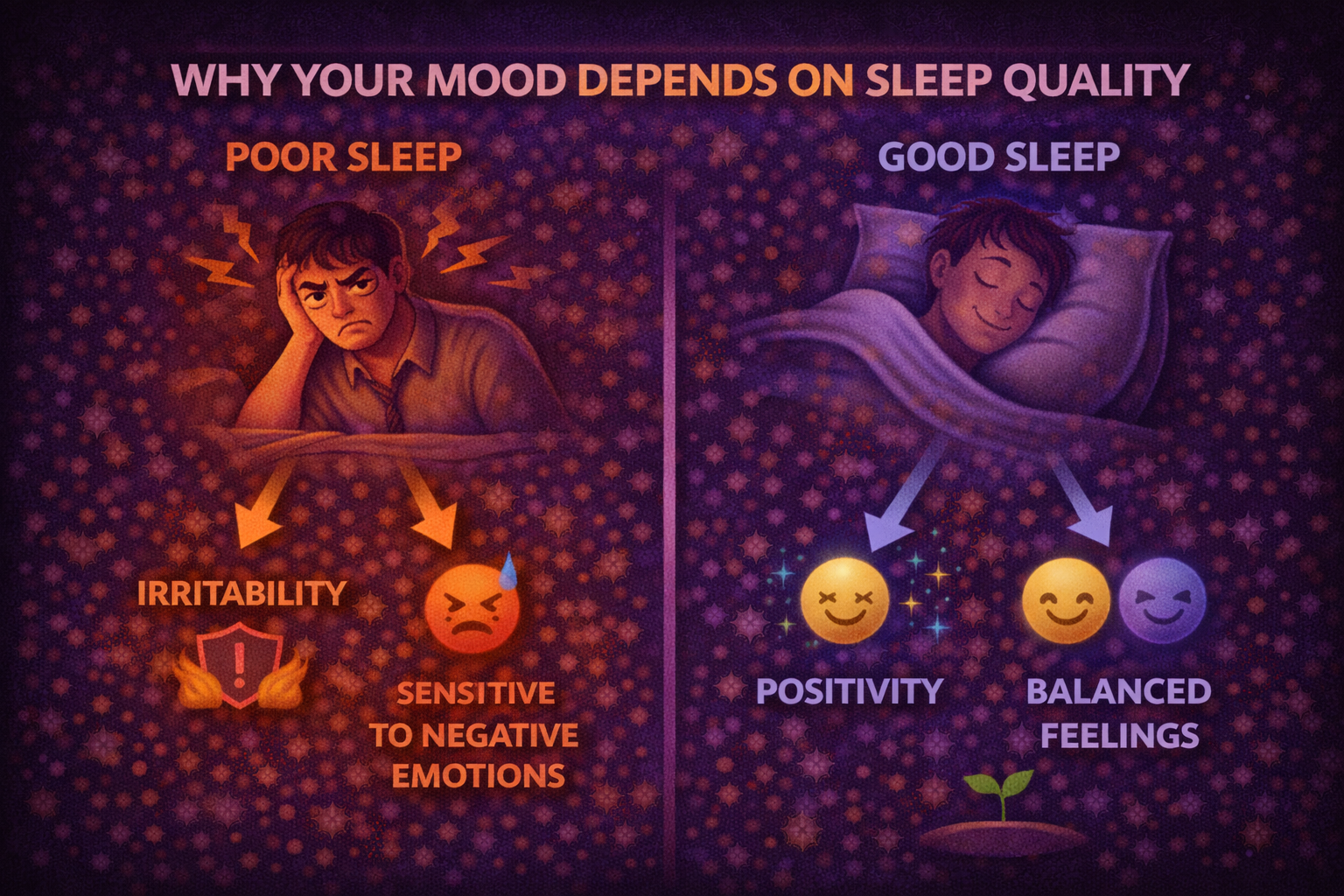
How sleep quality shapes emotional stability, resilience, and daily mood
Mood often feels like a reaction to circumstances. A good day lifts it, a stressful event lowers it. When mood worsens, people usually search for psychological or situational explanations.
But mood is not only shaped by what happens during the day. It is strongly influenced by how the brain recovers at night. Sleep quality — not just sleep duration — plays a central role in determining emotional tone, stress tolerance, and mood stability from one day to the next.
Mood Is Regulated by Brain State
Mood reflects how the brain processes emotional input.
A well-regulated brain evaluates situations proportionally, recovers quickly from stress, and maintains emotional balance. A poorly regulated brain reacts more strongly and recovers more slowly.
Sleep quality is one of the main factors determining which of these states dominates.
Why Sleep Quality Matters More Than Hours Slept
Sleeping longer does not guarantee emotional stability.
If sleep is fragmented, mistimed, or lacking restorative stages, the brain does not fully reset emotional systems. Mood may decline even after a long night in bed.
High-quality sleep allows emotional regulation to complete its overnight cycle.
How Sleep Recalibrates Emotional Thresholds
During sleep, emotional sensitivity is recalibrated.
Stress-related signaling decreases, emotional thresholds reset, and the brain restores balance between emotional reactivity and control. This allows emotions to arise without becoming overwhelming.
Poor sleep leaves this recalibration incomplete, increasing emotional volatility.
The Role of Deep Sleep in Mood Stability
Deep sleep supports baseline emotional stability.
It restores core neural networks involved in emotional regulation and reduces background neural noise. This creates a stable emotional baseline the next day.
When deep sleep is reduced, mood becomes more fragile and reactive.
REM Sleep and Emotional Processing
REM sleep plays a critical role in emotional integration.
During REM, emotional experiences are processed in a low-stress chemical environment. This allows emotional memories to be integrated without maintaining high emotional charge.
Disrupted REM sleep leaves emotional experiences unprocessed, increasing emotional sensitivity and mood instability.
Why Poor Sleep Increases Irritability
Irritability is one of the most common signs of poor sleep.
Sleep loss lowers tolerance for frustration and reduces impulse control. Minor inconveniences trigger disproportionate emotional reactions.
This irritability is not a character flaw — it reflects reduced emotional regulation capacity.
Sleep Quality and Emotional Recovery Speed
Mood depends not only on reaction, but on recovery.
After stress or negative emotion, a well-rested brain returns to baseline quickly. Poor sleep slows this recovery, allowing negative mood to persist longer.
Sleep quality determines how fast emotional balance is restored.
Negative Mood Bias After Poor Sleep
Poor sleep creates a negative mood bias.
The brain prioritizes negative information, memories, and interpretations. Positive experiences feel muted, while negative ones dominate attention.
This bias shapes overall mood even when external circumstances are neutral.
Cumulative Effects on Mood Over Time
Repeated nights of poor sleep compound mood instability.
Emotional regulation weakens, stress tolerance declines, and low mood becomes more persistent. Over time, this pattern increases vulnerability to anxiety and depressive symptoms.
Mood changes often precede conscious awareness of sleep problems.
Why Effort Can’t Stabilize Mood Without Sleep
Trying to “stay positive” does not restore mood regulation.
Effort requires neural resources that are replenished during sleep. Without recovery, emotional control remains impaired regardless of intention.
Sleep supports mood regulation at a biological level.
Why Mood Improves After High-Quality Sleep
After good sleep, mood often improves without explanation.
Emotions feel lighter, stress feels manageable, and perspective returns. This reflects restored regulation rather than changes in life circumstances.
Sleep allows the brain to process emotions before the day begins.
The Core Idea to Remember
Mood depends on sleep quality because sleep regulates emotional balance.
Through deep sleep and REM sleep, the brain restores emotional thresholds, processes experiences, and reduces negative bias. Poor sleep disrupts this process, amplifying mood instability.
Stable mood is not forced — it is supported overnight by high-quality sleep.